
Why Your Recovery Days Are Sabotaging Your Gains
Active recovery means low-intensity movement that increases blood flow to damaged muscles, speeding up repair without adding new damage. Discover the difference between active recovery and light training to optimize your gains and reduce post-workout soreness.
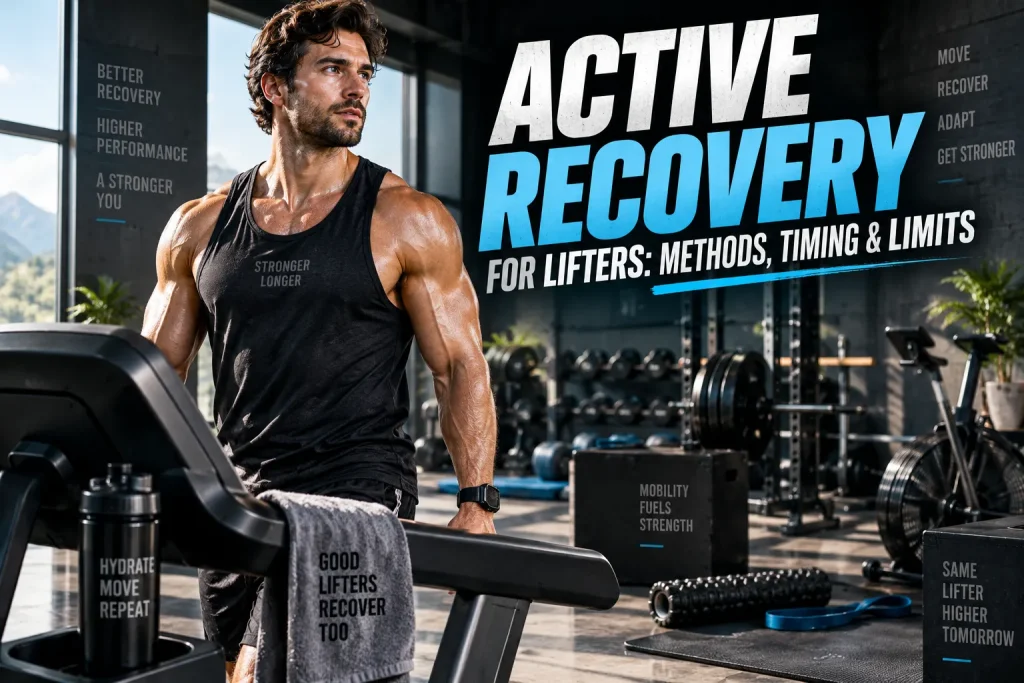
Your legs feel heavy two days after squats. Walking hurts less than sitting still. Movement clears the fog faster than another day on the couch. Active Recovery for Lifters: Methods, Timing & Limits turns soreness into faster gains.
Active Recovery for Lifters: Methods, Timing & Limits
Hard training creates the stimulus for muscle growth, but the work you do between demanding sessions helps determine how well you can repeat that performance. For natural lifters especially, recovery matters because training frequency, volume, sleep, nutrition, and fatigue all compete for a limited recovery budget.
Active recovery for lifters means deliberately performing low-intensity physical activity between or immediately after harder training sessions. Walking, easy cycling, gentle swimming, mobility work, and very light resistance exercise can all qualify.
The goal is not to sneak another workout into your rest day. It is to move enough to reduce stiffness, maintain mobility, and potentially improve how recovered you feel—without creating meaningful additional fatigue.
That distinction matters because more activity is not always better recovery.
A systematic review examining active-recovery interventions in competitive athletes found that active recovery is widely used, but improvements in subsequent athletic performance are not consistently demonstrated. Scientific review of active recovery interventions Meanwhile, a large meta-analysis of 99 studies found that active recovery was among several strategies capable of reducing delayed-onset muscle soreness (DOMS), although other approaches—particularly massage—also performed well. Meta-analysis of post-exercise recovery techniques
For lifters, that makes active recovery a useful tool rather than a magic recovery method.
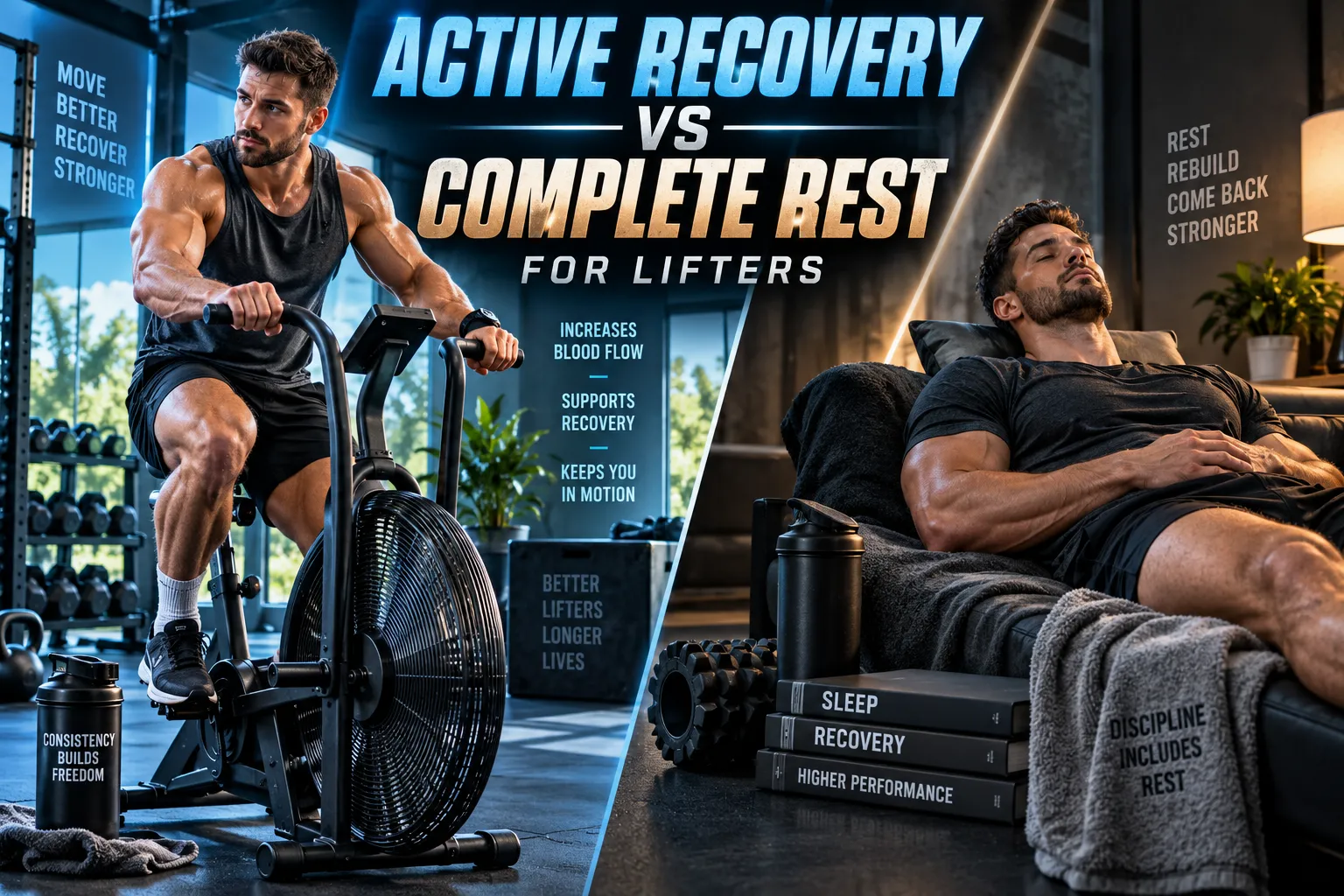
When deciding whether light movement or complete rest is better for your current fatigue level, Active Recovery vs Complete Rest for Lifters explains how soreness, systemic fatigue, performance and recovery status can help determine which approach makes more sense.
What Is Active Recovery After Weight Training?
Active recovery uses easy movement during a period that would otherwise involve complete rest.
Examples include:
- walking for 20–30 minutes;
- easy stationary cycling;
- relaxed swimming;
- low-intensity mobility work;
- gentle bodyweight movements;
- extremely light resistance training;
- easy recreational activity.
The intensity should remain low enough that you finish feeling approximately the same—or better—than when you started.
This separates active recovery from conditioning.
If your “recovery ride” leaves your quadriceps burning, your recovery run becomes intervals, or your rest-day circuit turns into 15 hard sets, you have created another training stimulus.
NaturalWeightlifting.com’s guide to cardio that supports fat loss without interfering with recovery explores this distinction in greater depth, including how low-intensity cardio can fit around resistance training.
How Does Active Recovery Work?
The benefits are more nuanced than the old idea that light exercise simply “flushes toxins” or lactic acid out of sore muscles.
Lactate produced during hard exercise is cleared relatively quickly and is not what causes soreness one or two days later. DOMS is particularly associated with unfamiliar or eccentric exercise and the subsequent physiological response to that training stress. Research on delayed-onset muscle soreness
Active recovery instead appears useful primarily because easy movement keeps you moving, temporarily reduces feelings of stiffness or soreness, and may improve subjective recovery without imposing a major additional workload.
One study examining light concentric exercise following damaging eccentric exercise found a temporary analgesic effect on DOMS but no acceleration of the underlying recovery from muscle damage. Study of light exercise and DOMS recovery
That is an important limitation.
Feeling less sore does not necessarily mean the muscle has completely recovered.
This is why active recovery should never become permission to ignore declining strength, joint pain, persistent fatigue, or unusually poor performance.
Residual soreness does not automatically mean a muscle needs complete rest; Can You Train a Muscle While It Is Still Sore? explains how soreness severity, strength, range of motion, and warm-up performance can help determine whether you should train again or prioritize recovery.
Best Active Recovery Methods for Lifters
1. Walking
Walking is arguably the simplest active recovery exercise for bodybuilding and strength training.
It requires virtually no technical preparation, produces relatively little muscular damage, and its intensity is easy to regulate.
A practical starting point is 20–30 minutes at a conversational pace. You should be able to speak normally without struggling for breath.
Walking is particularly useful the day after demanding lower-body training because it allows the hips, knees, and ankles to move through repeated low-force cycles without subjecting the legs to another heavy resistance workout.
You do not need to turn it into power walking.
The objective is recovery, not setting a calorie-burn record.
2. Easy Cycling
A stationary bike provides another effective option because you can tightly control resistance and duration.
Try approximately 10–25 minutes of easy cycling, particularly following leg training.
Keep resistance low. Your quadriceps should not develop a significant pump, burning sensation, or progressive fatigue.
A useful rule is simple:
If the recovery session requires recovery, it was too hard.
3. Light Swimming
Swimming can work well for lifters who already have efficient swimming technique.
Water reduces weight-bearing stress and allows movement through a large range of motion. However, poor swimmers can turn an intended recovery session into surprisingly demanding cardiovascular training.
Keep the effort relaxed rather than treating lap times as performance targets.
4. Mobility Work
Gentle mobility work can be valuable when your primary issue is stiffness or restricted movement rather than generalized fatigue.
That does not mean aggressive stretching is automatically a superior recovery method.
Research on DOMS treatments has historically found inconsistent evidence that stretching meaningfully accelerates soreness recovery. Scientific review of DOMS treatment strategies
Think of mobility as a way to maintain comfortable movement rather than a method of forcing damaged or highly sore muscles into extreme ranges.
5. Very Light Resistance Exercise
Experienced lifters can sometimes use the movements they normally train—but with drastically reduced loads.
For example, after a demanding chest workout, a later recovery session might involve a few very easy band movements or unloaded shoulder movements.
The crucial word is easy.
Avoid failure, heavy eccentric loading, high volume, and exercises that create additional soreness.
When Should Lifters Do Active Recovery?
There are three useful windows.
Immediately After Training
Five to 15 minutes of easy walking or cycling can provide a gradual transition from hard training to rest.
There is little reason to turn this period into additional conditioning unless conditioning is actually part of your program.
The Day After Hard Training
For many lifters, this is the most practical active-recovery window.
DOMS commonly develops after unfamiliar or demanding exercise and can become more noticeable after the workout rather than immediately during it. Research on the mechanisms of DOMS
A short walk, easy cycling session, or gentle mobility routine can make a sore lifter feel considerably more mobile.
When post-workout soreness itself becomes the main recovery problem, How Can I Get Rid of Muscle Soreness? examines practical approaches including movement, foam rolling, massage, nutrition, hydration and sleep.
Between Two Demanding Training Days
Active recovery also fits naturally into a weekly bodybuilding schedule.
For example:
Monday: Upper body
Tuesday: Lower body
Wednesday: 20–30 minute walk + mobility
Thursday: Upper body
Friday: Lower body
Saturday: Optional easy activity
Sunday: Rest
Wednesday is not another workout. It is deliberately positioned to avoid adding substantial fatigue before Thursday’s training.
How Hard Should Active Recovery Be?
Intensity is where lifters most commonly get active recovery wrong.
The objective is low fatigue.
You generally want an effort that feels easy enough to sustain comfortably. During aerobic recovery work, conversational intensity is a useful practical guide.
Your session should not involve:
- training to failure;
- hard intervals;
- heavy lifting;
- demanding eccentric exercises;
- long endurance sessions;
- high-volume circuits;
- competitive sports performed intensely.
This becomes especially important when you are already experiencing accumulated training fatigue.
If you’re uncertain whether your body needs training or recovery, Should You Lift or Rest Today? How HRV Tracks Your Fatigue explains how heart-rate variability can be considered alongside sleep, soreness, resting heart rate, mood, and performance rather than relying on soreness alone.
Active Recovery vs Complete Rest
For a more detailed breakdown of how workout volume, intensity, training age, muscle-group recovery, and performance determine whether you need 24, 48, or 72 hours before training again, see How Long Should You Rest Between Workouts?
Active recovery is not automatically superior to complete rest.
Sometimes the best recovery activity is doing almost nothing.
Complete rest becomes increasingly appropriate when you have systemic fatigue rather than ordinary muscle stiffness.
For a broader explanation of why recovery days support muscular adaptation—and how turning them into additional workouts can interfere with recovery—read Why Rest Days Build More Muscle Than Gym Days.
Consider prioritizing rest when you experience persistent reductions in performance, unusually poor sleep, lack of motivation, widespread fatigue, illness symptoms, or pain that appears more consistent with an injury than DOMS.
There is also a major difference between local muscular soreness and broader fatigue.
NaturalWeightlifting.com article on central nervous system fatigue and natural training plateaus examines why accumulated fatigue may require reductions in training stress rather than adding still more activity.
Likewise, The Localized Recovery Bottleneck provides additional context for situations where one muscle group or structure appears to recover more slowly than the rest of the body.
The Limits of Active Recovery
One of the biggest mistakes lifters make is expecting recovery techniques to compensate for poor programming.
Active recovery cannot fix:
Excessive training volume. If you repeatedly exceed the workload you can recover from, walking for 20 minutes will not solve the underlying programming problem.
Insufficient sleep. Sleep remains a fundamental part of recovery. NaturalWeightlifting.com guide to how sleep deprivation affects muscle protein synthesis explains why sleep deserves far more attention than most recovery “hacks.”
Poor nutrition. Muscular recovery requires adequate energy and amino acids. The International Society of Sports Nutrition notes that meeting total daily protein requirements and distributing adequate high-quality protein across the day supports muscle protein synthesis and training adaptations. ISSN position stand on protein and exercise
An actual injury. Sharp, localized, worsening, or joint-related pain should not simply be treated as soreness requiring more movement.
Chronic accumulated fatigue. If performance has declined for several sessions and your entire body feels run down, adding more activity can become counterproductive.
Nutrition and Supplements for Recovery
Active recovery works best when the fundamentals are already covered: sufficient calories, adequate protein, carbohydrates appropriate for training demands, hydration, micronutrient-rich foods, and quality sleep.
The ISSN’s nutrient-timing position stand emphasizes total daily protein intake and notes that roughly 20–40 grams of high-quality protein per feeding, distributed every three to four hours, can effectively support muscle protein synthesis. ISSN position stand on nutrient timing
Carbohydrate intake becomes particularly important when athletes need to restore glycogen rapidly between demanding sessions.
Creatine monohydrate also has extensive research behind its use for resistance-training performance and adaptation. The ISSN’s creatine position stand describes creatine as one of the most extensively studied nutritional ergogenic aids, with maintenance strategies commonly involving several grams per day once muscle stores are elevated. ISSN position stand on creatine supplementation
A more recent ISSN position stand on dietary antioxidants also highlights the importance of avoiding the assumption that eliminating all exercise-induced oxidative stress is desirable. Some oxidative stress participates in training adaptation, while excessive stress can become problematic. The review identifies creatine, omega-3 fatty acids, tart cherry, and several other compounds as having varying levels of evidence relevant to recovery or performance. ISSN position stand on dietary antioxidants
Lifters interested in nutritional support alongside a sound diet and training program can also explore supplements designed to support training and recovery. Supplements should complement—not replace—adequate food, sleep, hydration, and intelligent programming.
A Simple Active Recovery Protocol for Lifters
For most healthy lifters experiencing ordinary post-training soreness, active recovery does not need to be complicated.
On a recovery day, perform approximately 20–30 minutes of easy walking or cycling, followed by 5–10 minutes of comfortable mobility if desired.
Keep the entire session easy enough that you could have done considerably more.
Then eat normally, meet your protein and calorie requirements, hydrate, and prioritize sleep.
If the next training session arrives and performance is normal, your recovery strategy is probably doing its job.
If strength repeatedly declines, soreness persists, joints hurt, motivation crashes, or fatigue continues accumulating, the answer is probably not a more sophisticated recovery routine. It is time to examine training volume, intensity, frequency, nutrition, and sleep.
Frequently Asked Questions
Is active recovery better than complete rest for lifters?
Not universally. Active recovery can reduce feelings of soreness and stiffness and may improve short-term subjective recovery, but complete rest can be preferable when fatigue is high. Research supports some benefits of active recovery for DOMS, while evidence for consistently improving subsequent athletic performance is less definitive. Scientific meta-analysis of recovery techniques
What is the best active recovery workout after lifting?
For most lifters, 20–30 minutes of easy walking is difficult to beat. Easy cycling, swimming, and gentle mobility are also reasonable options. Choose an activity that creates minimal additional muscular damage.
Can active recovery help DOMS?
Yes, it can temporarily reduce soreness and make movement feel easier. However, reduced soreness does not necessarily mean the underlying muscle has recovered faster. Light concentric exercise, for example, has demonstrated a temporary analgesic effect without improving markers of recovery from eccentric exercise. Research on light exercise and DOMS
Can I do active recovery on every rest day?
Potentially, provided the activity remains genuinely easy and you are recovering normally. You do not need active recovery every day, however. Complete rest remains useful and should not be viewed as wasted time.
How long should an active recovery session last?
Around 15–30 minutes is a practical starting range for most lifters. Longer sessions can be appropriate when the activity is extremely easy, such as casual walking, but there is no reason to chase duration simply because more feels productive.
Should I use active recovery when extremely sore?
Gentle movement may temporarily reduce discomfort, but severe soreness is a reason to be conservative. Avoid heavily loading the affected muscles until normal movement and performance return. Exercise can temporarily relieve DOMS pain without necessarily accelerating tissue recovery. Study examining exercise and DOMS recovery
Final Takeaway
Active recovery for lifters works best when it stays active enough to promote comfortable movement but easy enough not to become another workout.
Walking, light cycling, gentle swimming, mobility work, and very light resistance exercise can all have a place between demanding lifting sessions. They may help reduce perceived soreness and stiffness, but active recovery has clear limits.
It cannot compensate for excessive training, inadequate calories, insufficient protein, chronic sleep deprivation, or an injury.
Treat active recovery as one piece of a larger recovery system. Train hard enough to create adaptation, recover well enough to repeat high-quality training, and resist the temptation to turn every rest day into another opportunity to accumulate fatigue.
For natural lifters, the objective is not to perform the most work possible. It is to perform the most productive training you can recover from consistently.