

Why Lifters Stop Taking Citrulline Malate Too Soon
Citrulline Malate converts to arginine in your body, raising nitric oxide and increasing blood flow to working muscles more effectively than taking arginine directly. Taking it an hour before training enhances athletic performance, boosts reps, and relieves muscle soreness.
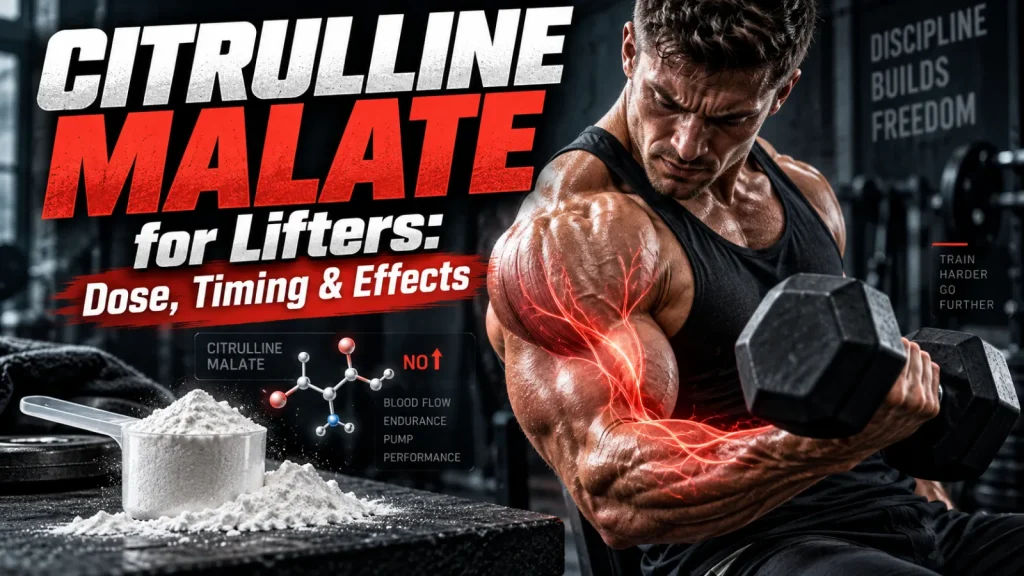
Citrulline Malate for Lifters: Dose, Timing & Effects is showing up in more gym bags than creatine. Pre-workouts with this amino acid sell at double the price of basic formulas. The key benefit isn’t just the pump. Take it an hour before training to get more reps.
Citrulline Malate for Lifters: Dose, Timing & Effects
Citrulline malate has become one of the most recognizable ingredients in pre-workout supplements, especially among bodybuilders and strength athletes looking for a better muscle pump, improved training endurance, and potentially more productive high-volume workouts.
But does citrulline malate actually work for lifters, how much should you take, and when should you take it before training?
Not sure which form belongs in your pre-workout? See Citrulline Malate vs L-Citrulline for Lifters for a direct comparison of their formulations, research, dosing differences, and potential resistance-training benefits.
The evidence is more nuanced than supplement marketing often suggests.
Research indicates that citrulline malate may provide a small improvement in resistance-training endurance under certain conditions, particularly during demanding workouts involving repeated sets. It does not appear to directly increase maximal strength, and not every study finds a performance benefit.
For natural lifters, that makes citrulline malate an optional performance supplement rather than a foundational muscle-building supplement.
This guide explains the best citrulline malate dose for lifting, when to take it, how it works, what the research actually shows, and how it compares with supplements such as creatine.
What Is Citrulline Malate?
Citrulline malate combines two compounds:
L-citrulline — a nonessential amino acid involved in the urea cycle and nitric oxide pathway.
Malate — a salt of malic acid involved in cellular energy metabolism.
Citrulline is the component receiving most of the attention for blood-flow-related effects.
After ingestion, citrulline can be converted by the kidneys into arginine. Arginine is subsequently used to produce nitric oxide.
Nitric oxide helps regulate blood-vessel dilation, potentially improving blood flow to working muscle.
This is one reason citrulline has become associated with the famous pre-workout “pump.”
However, increased blood flow does not automatically mean increased muscle growth.
Citrulline malate should therefore be viewed primarily as a potential acute exercise-performance aid, not as something that independently builds muscle.
Lifters comparing different evidence-based supplements should also read our guide to the top natural bodybuilding supplements to understand where citrulline fits within a complete supplementation strategy.
How Citrulline Malate Works for Lifters
Citrulline’s primary proposed performance pathway starts with nitric oxide.
The simplified sequence looks like this:
Citrulline → arginine → nitric oxide → vasodilation
Higher nitric oxide availability may increase blood flow through working muscles.
During resistance training, this potentially assists the delivery of oxygen and nutrients while supporting the removal of metabolic by-products.
That doesn’t mean citrulline suddenly turns an average workout into an extraordinary one.
The potential benefit appears much smaller.
Where citrulline becomes interesting is during repeated high-effort sets, when fatigue begins accumulating.
A systematic review and meta-analysis examining citrulline supplementation and resistance-training repetition performance reported that acute supplementation may produce a small improvement in repetition performance during strength training.
The overall effect was statistically significant but small.
That distinction matters.
Citrulline malate may help you perform slightly more work under certain circumstances, but it isn’t equivalent to suddenly becoming dramatically stronger.
Citrulline Malate Benefits for Bodybuilding
The potential advantages of citrulline malate become most relevant when workouts contain considerable training volume.
More Repetitions During Hard Sets
The most practically interesting effect for hypertrophy-oriented lifters is the possibility of completing additional repetitions.
If you normally perform several demanding sets of:
- squats
- leg presses
- Romanian deadlifts
- bench presses
- rows
- pulldowns
- machine presses
- isolation exercises
fatigue progressively reduces performance.
Citrulline malate may help preserve performance slightly better as the workout progresses.
That does not mean everyone will experience the same effect. Individual studies have produced conflicting results, which is why the overall evidence should be interpreted conservatively.
For a natural bodybuilder, even a small improvement in performance can be useful when it allows productive repetitions to be maintained during later working sets.
Citrulline Malate and Muscular Endurance
Citrulline malate appears more promising for muscular endurance than maximal strength.
That makes physiological and practical sense.
Consider the difference between performing one maximal squat and performing four hard sets of 8–12 repetitions.
The second situation creates substantially more accumulated fatigue.
If citrulline improves exercise performance, its effects are more likely to become noticeable as repeated work accumulates.
The meta-analysis examining citrulline supplementation and repetition performance during strength training concluded that acute supplementation produced a small but potentially useful improvement in repetitions performed.
For hypertrophy-focused lifters, even a modest effect can potentially matter because productive training volume accumulated over months contributes to progression.
But supplements should never become an excuse for unnecessary junk volume.
Does Citrulline Malate Increase Strength?
This is where expectations need to be adjusted.
Citrulline malate is not a reliable maximal-strength supplement.
A systematic review and meta-analysis examining citrulline malate supplementation and muscle strength found no significant overall improvement in muscular strength.
Therefore, don’t expect your squat, bench press, or deadlift one-repetition maximum to suddenly increase simply because you took citrulline before training.
Compare that with creatine.
Creatine has a substantially larger body of evidence supporting strength and high-intensity exercise performance.
If your supplement budget is limited, creatine would generally deserve priority.
Our detailed Creatine for Bodybuilding: Benefits, Dose and Timing Guide explains how creatine works and why its supplementation strategy differs considerably from citrulline.
Best Citrulline Malate Dose for Lifters
For resistance training, the most commonly researched practical range is:
6–8 grams of citrulline malate before exercise.
Eight grams has become particularly common in resistance-training research.
A useful starting protocol is therefore:
6–8 g citrulline malate approximately 40–60 minutes before lifting.
More isn’t automatically better.
Research has investigated larger doses, but the existing evidence does not establish a simple relationship in which continually increasing the dose produces continually greater resistance-training performance.
For most lifters, 6–8 grams remains a reasonable evidence-based starting range.
Importantly, the actual amount of L-citrulline contained within a serving depends on the formulation.
Citrulline Malate Ratio Matters
Here’s an often-overlooked problem with citrulline malate supplements:
Not every gram of citrulline malate represents one gram of citrulline.
Products can contain different citrulline-to-malate ratios.
You may see formulations such as:
2:1 citrulline-to-malate
or other ratios.
This makes comparing products and research more complicated.
Two products providing “8 grams of citrulline malate” could potentially deliver different amounts of actual citrulline depending on formulation and manufacturing accuracy.
This is one reason interpreting citrulline research requires more care than simply comparing the number of grams used in different studies.
For consumers, the practical lesson is simple:
Read the supplement label rather than assuming every citrulline malate powder is identical.
Look for transparent labeling that tells you exactly what you are getting rather than relying on a proprietary blend.
When Should You Take Citrulline Malate Before Lifting?
Citrulline malate is generally treated as an acute pre-workout supplement.
A practical target is:
Take citrulline malate about 40–60 minutes before your workout.
Many resistance-training studies have used supplementation within approximately this window.
Unlike creatine, citrulline doesn’t depend primarily on gradually saturating muscle stores over several weeks.
That makes workout timing considerably more relevant.
If your workout begins at 6:00 p.m., taking citrulline somewhere around 5:00–5:20 p.m. is a reasonable approach.
You do not need to obsess over hitting an exact minute. Consistency and an appropriate pre-training window matter more than trying to time supplementation with stopwatch precision.
Should You Take Citrulline Malate Every Day?
Probably not if your only objective is acute workout performance.
Most lifters can reserve it for training days.
This distinguishes citrulline from creatine.
Creatine is typically taken consistently because the objective is maintaining elevated muscular creatine stores.
Citrulline is commonly taken before exercise because the intended effect is acute.
Research into chronic L-citrulline and citrulline-malate supplementation continues to develop. However, the practical resistance-training evidence is more commonly associated with acute pre-exercise supplementation.
That makes training-day supplementation the simpler approach for most natural lifters.
Citrulline Malate for Muscle Pump
The muscle pump is one reason citrulline is so popular in bodybuilding.
During resistance exercise, increased blood flow and fluid accumulation cause trained muscles to temporarily expand.
Because citrulline participates in the nitric oxide pathway, it has a plausible mechanism for supporting this response.
But don’t confuse a better pump with permanent hypertrophy.
A pump can make your muscles:
- appear fuller,
- feel tighter,
- become temporarily more vascular,
- and provide useful feedback that the target muscle is working.
Those effects are temporary.
Long-term muscle growth still depends primarily on progressive resistance training, adequate protein, sufficient energy availability, sleep, and recovery.
A supplement that gives you an impressive arm pump isn’t automatically creating additional arm tissue.
Citrulline Malate and Muscle Soreness
Citrulline may also influence perceived soreness and exertion, although this area is less certain.
A systematic review and meta-analysis examining citrulline supplementation, perceived exertion, and muscle soreness reported evidence suggesting citrulline supplementation may reduce ratings of perceived exertion and post-exercise muscle soreness under some conditions.
These findings are interesting but shouldn’t turn citrulline into your primary recovery strategy.
Sleep, calories, protein intake, intelligent programming, and fatigue management matter much more.
Supplements should complement those fundamentals rather than attempt to compensate for inadequate recovery.
Citrulline Malate vs L-Citrulline
Consumers often assume these products are interchangeable.
They aren’t exactly the same.
L-citrulline provides citrulline alone.
Citrulline malate combines citrulline with malate.
The proposed rationale behind adding malate involves its participation in energy metabolism, but it remains uncertain how much malate independently contributes to exercise-performance effects.
That means consumers shouldn’t automatically assume that the word “malate” makes a product superior.
The important questions are:
How much actual citrulline are you getting?
Is the formulation clearly disclosed?
Does the product provide an evidence-informed amount?
Is the manufacturer reputable?
Ingredient transparency matters more than flashy marketing language.
Citrulline Malate vs Creatine
These supplements shouldn’t really be viewed as competitors because they work differently.
Creatine primarily supports rapid energy availability during intense muscular work through the phosphocreatine system.
Citrulline primarily influences arginine and nitric oxide availability and may support blood flow and fatigue resistance.
Creatine is usually taken daily.
Citrulline is typically taken before workouts.
Creatine has stronger overall evidence for increasing strength and supporting lean-mass gains when combined with resistance training.
Citrulline’s effects appear smaller and are primarily relevant to acute training performance.
That makes a reasonable supplement hierarchy:
Training + nutrition → creatine → optional performance supplements such as citrulline.
Can You Combine Citrulline Malate With Creatine?
Yes.
There is no need to choose one or the other simply because both appear in pre-workout products.
Their mechanisms differ enough that they can fit into the same supplementation strategy.
A lifter could take:
Creatine: daily according to their regular supplementation routine.
Citrulline malate: approximately 40–60 minutes before training.
Lifters building a broader supplement plan can also read EAA vs BCAA: Which Actually Triggers Protein Synthesis? to better understand how amino-acid supplements differ from performance-oriented ingredients such as citrulline.
For a broader overview, see The 5 Top Natural Bodybuilding Supplements in 2026 for additional context on prioritizing supplements within a natural bodybuilding program.
If you’re comparing commercially available performance and recovery products rather than purchasing individual ingredients, you can also explore supplement options for training, performance, and recovery. Always examine the ingredient panel, serving size, and actual ingredient doses instead of assuming that every pre-workout or multi-ingredient formula contains research-aligned amounts.
Does Citrulline Malate Build Muscle?
Not directly.
This is an important distinction for anyone searching “does citrulline malate increase muscle growth?”
Citrulline doesn’t supply the primary building material for new muscle protein, nor does it replace progressive overload.
Its possible contribution to hypertrophy is indirect.
Imagine citrulline allows you to complete:
10 reps instead of 9,
9 instead of 8,
or maintain slightly better performance across your later sets.
Repeated across enough productive training sessions, a small improvement in training capacity could theoretically support progression.
But that doesn’t prove citrulline independently produces more hypertrophy.
The supplement should therefore be viewed as something that may improve the quality or quantity of certain workouts, rather than a muscle-growth shortcut.
Who Is Most Likely to Benefit?
Citrulline malate makes the most sense for lifters performing relatively demanding, moderate-to-high-volume sessions.
A bodybuilder performing multiple hard sets of squats, leg presses, extensions, and hamstring exercises has more opportunity to potentially benefit from improved repetition performance than someone performing only a few low-repetition sets.
It may therefore be particularly relevant for:
- natural bodybuilders,
- hypertrophy-focused lifters,
- moderate-to-high-volume resistance training,
- demanding leg sessions,
- supersets,
- moderate-to-high repetition workouts,
- workouts involving repeated challenging sets.
Someone primarily training maximal singles may have much less reason to prioritize it.
The question shouldn’t simply be, “Does citrulline work?”
A better question is:
“Does citrulline provide a meaningful benefit for the type of training I actually perform?”
Does Citrulline Malate Have Side Effects?
Citrulline is generally well tolerated at commonly studied amounts, but that does not mean everyone responds identically.
The main practical issue some users experience is gastrointestinal discomfort.
If you’ve never used citrulline malate before, beginning toward the lower end of the practical dosage range may help you assess tolerance.
Avoid assuming that taking considerably more than the researched range will produce superior results.
People taking medications, managing cardiovascular or kidney conditions, pregnant or breastfeeding individuals, or anyone with a relevant medical condition should discuss supplementation with an appropriate healthcare professional.
Remember that “natural” does not automatically mean appropriate for everyone.
What Does the Overall Research Say?
The scientific picture is best described as promising but inconsistent.
Earlier individual studies sometimes reported noticeable improvements.
Other randomized trials found little or no benefit.
When researchers combine studies, the estimated effects become more modest.
The systematic review and meta-analysis of citrulline supplementation and resistance-training repetition performance found a small overall improvement in repetition performance.
In contrast, the systematic review and meta-analysis examining citrulline malate and muscle strength did not find a significant improvement in muscular strength.
More recently, a systematic review and three-level meta-analysis of randomized controlled trials examining citrulline and exercise performance reported a small overall effect while emphasizing important uncertainty and variability within the evidence.
Taken together, these findings support a measured conclusion:
Citrulline malate may improve certain aspects of resistance-training performance, particularly muscular endurance, but the effects are generally small and are not guaranteed for every lifter.
That is a much more defensible conclusion than either claiming citrulline is useless or portraying it as an essential muscle-building supplement.
Practical Citrulline Malate Protocol for Lifters
For a healthy lifter interested in experimenting with citrulline malate, a straightforward approach is:
Dose: approximately 6–8 grams of citrulline malate.
Timing: approximately 40–60 minutes before lifting.
Frequency: primarily on training days.
Best application: moderate-to-high-volume resistance workouts where muscular endurance matters.
Expectations: potentially slightly more training capacity and a better pump—not dramatic strength or muscle gains.
Check the label carefully to determine the product’s citrulline-to-malate ratio and avoid proprietary blends that make it impossible to determine how much of the active ingredients you’re actually consuming.
Most importantly, test the supplement against your own performance.
Track repetitions, loads, workout volume, rest periods, and perceived effort for several comparable sessions.
If your performance doesn’t change meaningfully, there is little reason to keep paying for it.
Frequently Asked Questions
How much citrulline malate should I take before lifting?
Approximately 6–8 grams taken 40–60 minutes before resistance training is a practical evidence-informed range commonly used in resistance-training research. Individual tolerance and product composition should also be considered.
Is 8 grams of citrulline malate enough?
Eight grams is one of the most commonly studied amounts and is a sensible starting point. Taking more does not automatically produce greater performance benefits.
How long before lifting should I take citrulline malate?
Aim for approximately 40–60 minutes before your workout. This closely matches the timing used in many resistance-training studies.
Does citrulline malate make you stronger?
Not reliably. Research examining maximal muscle strength does not show a consistent significant improvement. Citrulline appears more promising for repetition performance and muscular endurance than maximal strength.
Does citrulline malate give you a better pump?
Potentially. Citrulline increases arginine availability and participates in nitric oxide production, providing a plausible mechanism for increased blood flow. However, pump effects vary among individuals and shouldn’t be confused with permanent muscle growth.
Should I take citrulline malate on rest days?
It usually isn’t necessary when you’re using citrulline specifically as an acute pre-workout aid. Most practical resistance-training protocols focus on taking it before training.
Can I take citrulline malate with creatine?
Yes. Creatine and citrulline operate through different mechanisms and can be incorporated into the same supplementation strategy. Creatine is generally used daily, whereas citrulline is commonly consumed before workouts.
Is citrulline malate better than L-citrulline?
Not necessarily. Citrulline malate contains citrulline plus malate, whereas L-citrulline provides citrulline alone. Product composition and the amount of actual citrulline matter when comparing the two.
Is citrulline malate worth taking for natural bodybuilding?
Potentially—but think of it as an optional extra rather than a necessity. Lifters should prioritize progressive training, adequate calories and protein, sleep, recovery, and well-supported fundamentals such as creatine before spending heavily on secondary supplements.
Final Verdict: Is Citrulline Malate Worth It for Lifters?
Citrulline malate is one of the more plausible pre-workout ingredients for lifters, but its reputation sometimes exceeds what the research can confidently support.
The best available evidence suggests that roughly 6–8 grams taken approximately 40–60 minutes before resistance training may provide a small improvement in repetition performance and muscular endurance.
That could be useful during demanding hypertrophy workouts.
What citrulline malate probably won’t do is dramatically increase your one-rep max, directly build muscle, or compensate for poor programming and nutrition.
Think of the supplement hierarchy this way:
Training creates the stimulus. Nutrition provides the building materials. Recovery allows adaptation. Proven foundational supplements can support the process. Citrulline may provide a small additional performance edge.
For natural lifters who already have those fundamentals covered, that small edge may be worthwhile.
For everyone else, fix the fundamentals first.