
Training Sore Muscles Might Be Hurting Your Gains
Delayed onset muscle soreness (DOMS) peaks 36-48 hours after exercise and doesn’t necessarily indicate muscle damage or poor recovery. Understanding the difference between soreness and actual muscle damage helps you make smarter decisions about training while sore.

Can You Train a Muscle While It Is Still Sore? That question crosses every gym regular’s mind at some point. You hit legs on Monday and wake up Wednesday barely able to walk. But your training plan says it’s time for another leg day. The answer depends on what kind of soreness you’re dealing with.
Can You Train a Muscle While It Is Still Sore?
Muscle soreness after a hard workout can create a frustrating question for lifters: can you train a muscle while it is still sore, or should you wait until the soreness disappears completely?
The short answer is yes, you can sometimes train a sore muscle, provided the soreness is mild, your normal range of motion is intact, and your strength and technique are not meaningfully impaired. Delayed-onset muscle soreness (DOMS) does not automatically mean that a muscle is incapable of productive training.
However, severe soreness is different. If a muscle is extremely tender, movement is restricted, or your normal training loads suddenly feel unusually heavy, another demanding workout for that muscle may reduce training quality rather than improve your results.
The important distinction is therefore not simply sore versus not sore. Natural lifters should consider the severity of soreness, recovery of muscle function, exercise performance, and quality of movement before deciding whether to train the muscle again.
Rest duration is only one part of recovery between demanding sessions; Active Recovery for Lifters: Methods, Timing & Limits explains when low-intensity movement can complement complete rest without creating unnecessary additional fatigue.
What Does Muscle Soreness Actually Mean?
Delayed-onset muscle soreness usually develops after unfamiliar or unusually demanding exercise, particularly when the workout contains a substantial eccentric component.
Eccentric contractions occur when a muscle produces force while lengthening. Lowering a dumbbell during a curl, descending into a squat, and controlling the lowering portion of a Romanian deadlift are common examples.
DOMS often becomes noticeable several hours after training and can become more pronounced over the following day or two.
Importantly, soreness should not be interpreted as a direct measurement of muscle growth.
You can have an excellent hypertrophy workout without becoming particularly sore. Conversely, an unfamiliar exercise can make you extremely sore without necessarily providing a superior muscle-building stimulus.
Soreness is therefore better viewed as one piece of recovery information, not as a hypertrophy score.
Can You Work Out a Muscle That Is Still Sore?
Yes—if the soreness is mild and muscle function has largely recovered.
Imagine that you trained your chest two days ago. Your pecs still feel slightly tender when you stretch them, but you have full range of motion, normal coordination, and your warm-up sets feel strong.
There is not necessarily a compelling reason to postpone the workout simply because you can detect some soreness.
Now consider a different situation. Your chest is extremely sore, extending your arms is uncomfortable, your shoulders compensate during pressing movements, and weights that normally feel easy suddenly feel heavy.
That is a much stronger argument for additional recovery.
A practical way to think about soreness is:
| Soreness Level | Training Decision |
|---|---|
| None | Train normally |
| Mild | Usually safe to train |
| Moderate | Assess warm-up performance |
| Severe | Recovery or very light activity is preferable |
| Sharp/localized pain | Do not treat it as normal DOMS |
The key is determining whether soreness is merely noticeable or whether it is interfering with muscular performance.
What Does Science Say About Training Sore Muscles?
One particularly useful scientific resource is the Repeated Bout Effect of Multiarticular Exercises on Muscle Damage Markers and Physical Performances: A Systematic Review and Meta-Analyses.
This 2023 systematic review and meta-analysis included 20 studies examining repeated bouts of multi-joint exercise. Researchers found that DOMS and creatine kinase responses were significantly greater after the first exercise bout than after the subsequent bout. Strength and vertical-jump performance were also better preserved following the repeated exposure.
This phenomenon is known as the repeated-bout effect.
Once your muscles have experienced a particular training stress, they tend to become more resistant to exercise-induced muscle damage when exposed to a similar stimulus again.
That helps explain why a new exercise can leave you sore for several days when you first introduce it, yet produce considerably less soreness after several weeks of consistent training.
Research has even demonstrated protective effects lasting weeks after an initial exercise exposure.
For hypertrophy training, the implication is important: some residual soreness does not automatically mean another training stimulus will damage your recovery.
Soreness and Recovery Are Not the Same Thing
One of the biggest mistakes lifters make is assuming that soreness provides a precise measurement of recovery.
It doesn’t.
You could still feel mild soreness while being capable of producing normal force. Alternatively, soreness may seem modest while muscular performance remains suppressed.
This is why performance during your warm-up is often more useful than soreness alone.
Before training a sore muscle, evaluate:
- range of motion;
- strength during warm-up sets;
- movement quality;
- joint comfort;
- coordination;
- perceived effort at familiar loads.
Suppose you normally squat 225 pounds comfortably during an early working set. If your legs are mildly sore but your warm-ups move normally and technique feels stable, continuing with the planned session may be reasonable.
If 135 pounds suddenly feels unusually difficult and your squat depth or mechanics deteriorate, recovery probably hasn’t progressed far enough for another hard session.
When Should You Avoid Training a Sore Muscle?
Training through mild DOMS is different from forcing yourself through severe muscle damage or possible injury.
A demanding hypertrophy session is probably a poor choice when soreness substantially changes how you move.
Severe exercise-induced muscle damage can temporarily reduce force production and training quality. A systematic review examining exercise-induced muscle damage notes that damaging resistance exercise can produce soreness, swelling and reductions in muscle function that may persist for several days.
Watch particularly carefully for sharp pain, joint pain, unusual swelling, significant weakness, bruising, or pain that becomes worse during exercise.
Those symptoms should not simply be dismissed as normal DOMS.
Muscle soreness usually feels like diffuse tenderness or stiffness throughout the trained muscle. Injury-related discomfort is more likely to feel sharp, localized, unstable, or mechanically aggravated.
Use Your Warm-Up as a Recovery Test
Your warm-up provides an excellent opportunity to determine whether a sore muscle is ready for productive training.
Instead of deciding entirely based on how you feel when getting out of bed, begin with a few minutes of easy movement followed by progressively heavier warm-up sets.
Pay attention to what happens.
If stiffness decreases, range of motion normalizes, and your usual weights begin moving normally, mild soreness may have little practical importance.
If soreness intensifies, movement remains restricted, or strength is noticeably reduced, modify the session.
You could train another muscle group, reduce the workload, choose a less demanding exercise, or perform light recovery activity instead.
This approach allows your actual readiness to influence training, rather than following an arbitrary rule that a muscle must be completely soreness-free before it can be trained again.
Should You Reduce Training Volume When Sore?
Sometimes.
If soreness is mild and performance is completely normal, your usual training volume may be appropriate.
With moderate soreness, reducing volume can be a useful compromise.
For example, instead of performing 12 hard sets for the muscle, you might perform six to eight high-quality sets and reassess your recovery afterward.
The objective of hypertrophy training isn’t to accumulate the maximum possible fatigue. It is to repeatedly expose the muscle to a sufficient growth stimulus while maintaining enough recovery capacity to continue progressing.
If today’s extra sets reduce the quality of your next two workouts, they may not represent productive volume.
Should You Train to Failure When You Are Sore?
Training to failure deserves additional caution when a muscle has not completely recovered.
Failure training can be useful within a properly designed hypertrophy program, but it also produces substantial acute fatigue.
If you’re already experiencing moderate soreness, repeatedly taking exercises to absolute failure may create unnecessary recovery demands.
Instead, consider keeping one to three repetitions in reserve on demanding compound movements.
This allows you to continue stimulating the muscle without turning an already questionable recovery situation into an unnecessarily exhausting workout.
Isolation exercises can sometimes be pushed harder because they generally create less systemic fatigue, but technique and muscle function should still guide the decision.
Training Frequency Matters
Your normal training frequency also affects how you should interpret soreness.
Someone training each muscle once weekly may rarely encounter the question because six or seven days separate direct training sessions.
A lifter training each muscle twice or three times weekly is much more likely to experience residual soreness.
Higher-frequency hypertrophy training therefore requires sensible management of weekly volume and fatigue.
For example, instead of performing 16 sets of chest training during one brutal Monday workout, a lifter could distribute those sets across multiple sessions.
That can make each individual workout less damaging while still providing sufficient weekly training volume.
The goal should not be to make each workout so destructive that the muscle requires nearly a week to feel normal again.
Severe Soreness May Signal a Programming Problem
Occasional severe DOMS is normal, particularly after introducing unfamiliar exercises, returning after a layoff, or substantially increasing training volume.
Constant severe soreness is different.
If every leg workout leaves you struggling to walk for four days, your programming may be unnecessarily damaging.
Possible causes include excessive training volume, too many exercises performed to failure, abrupt increases in workload, unfamiliar lengthened-position exercises, or poor recovery between workouts.
You may actually progress faster by reducing the amount of damage produced per session.
Remember the repeated-bout effect as well. As you repeatedly perform similar resistance exercises, the muscle generally becomes better adapted to the stress and subsequent bouts produce less damage and soreness. Research involving resistance exercise has repeatedly demonstrated reduced DOMS and faster recovery following subsequent exposures.
Can Light Exercise Help a Sore Muscle?
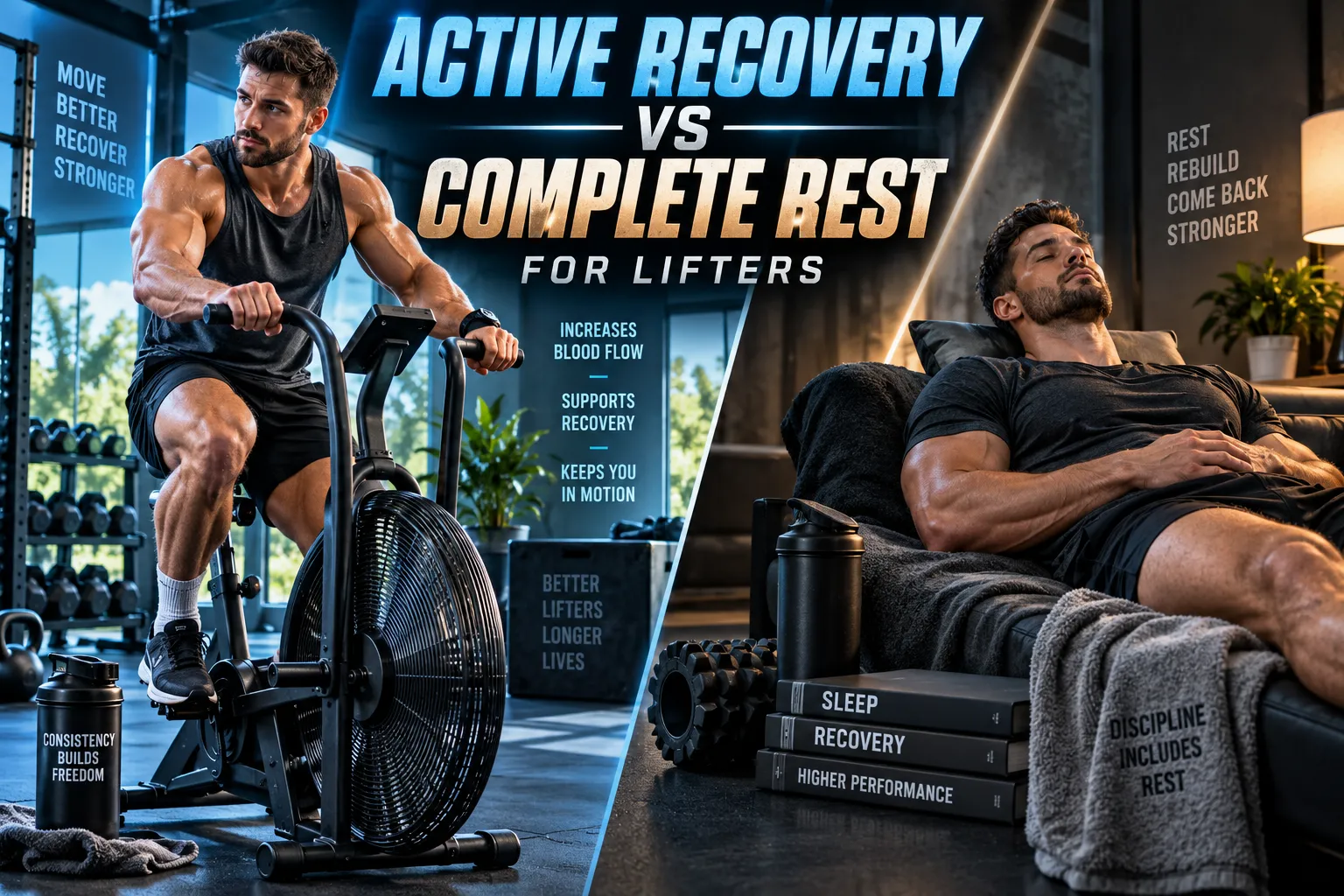
Light activity can be useful when you’re sore, particularly when the alternative is complete inactivity.
Walking, easy cycling, mobility work, low-intensity resistance exercise, or other gentle movement may increase circulation and make stiff muscles temporarily feel better.
But there is an important distinction between active recovery and another full training session.
Recovery activity should be easy enough that it doesn’t create substantial additional fatigue.
Turning an intended recovery session into five sets of squats, lunges, leg presses and Romanian deadlifts defeats the purpose.
Think movement rather than overload.
If your quads are extremely sore after a demanding leg session, an easy walk or gentle cycling session may make more sense than another hard quadriceps workout.
If your muscles are too sore for another demanding workout, use the methods in Active Recovery for Lifters: Methods, Timing & Limits to choose low-fatigue activities that support recovery without adding unnecessary training stress.
Nutrition and Supplements for Muscle Recovery
Training decisions are only one part of recovery. Adequate calories, protein, carbohydrates, hydration, micronutrients, and sleep all contribute to your ability to recover between resistance-training sessions.
Protein is especially important because resistance training increases the body’s need for amino acids to support muscle remodeling and adaptation.
Interestingly, protein supplementation should not be viewed as a guaranteed cure for soreness. A systematic review and meta-analysis found that peri-exercise protein supplementation may help preserve some measures of maximal strength following resistance exercise and may reduce certain markers of muscle damage, but it did not consistently reduce perceived muscle soreness.
That distinction is valuable.
The objective of nutrition isn’t necessarily to eliminate every sensation of DOMS. It is to provide your body with the resources needed to recover and adapt.
Lifters who want to complement a well-designed diet can also explore Natural Supplements for Lifters as part of a broader recovery and performance strategy.
Supplements should complement—not replace—adequate protein, total calories, hydration, sleep, and intelligent programming.
Don’t Chase Soreness for Muscle Growth
Many lifters subconsciously use soreness as evidence that a workout “worked.”
That can encourage increasingly damaging workouts.
More exercises.
More sets.
More eccentric overload.
More failure training.
But maximizing soreness is not the objective of hypertrophy training.
Your goal is to generate a sufficient stimulus for muscle growth and then recover quickly enough to deliver another high-quality stimulus.
If you can progressively increase repetitions, load, training quality, or productive weekly volume without constantly becoming extremely sore, that’s generally a positive development.
In fact, becoming less sore from the same workout can simply mean your body has adapted to the training stress.
What If You Are Still Sore After 48 Hours?
Forty-eight hours is not a magical recovery threshold.
Some muscles and workouts recover faster than others.
If you’re mildly sore after 48 hours but strength, mobility, and technique are normal, another workout may be perfectly reasonable.
If you’re severely sore after 48 hours and performance is clearly compromised, waiting another day or modifying the session may produce better training.
The same principle applies at 72 hours.
Don’t use the clock alone.
Use soreness + performance + movement quality.
Those three factors provide much better information than simply counting the hours since your previous workout.
How to Train When You Are Slightly Sore
When soreness is present but mild, start conservatively.
Perform your normal warm-up and evaluate how the muscle responds. If movement improves and strength feels normal, gradually progress toward your working loads.
You don’t necessarily need to reduce the weight simply because you can feel the muscle.
However, avoid treating the workout as a test of toughness.
If performance deteriorates as the session progresses, reduce volume or stop direct work for that muscle.
One slightly shorter workout will have virtually no meaningful negative impact on long-term hypertrophy.
Repeatedly forcing poor-quality workouts while inadequately recovered is a much bigger programming problem.
The Bottom Line: Can You Train a Muscle While It Is Still Sore?
Yes. A muscle does not necessarily need to be completely soreness-free before you train it again.
Mild DOMS combined with normal strength, range of motion, coordination, and technique usually doesn’t automatically require skipping a workout.
Moderate soreness requires more judgment. Use your warm-up as a readiness assessment and modify volume or intensity when performance is noticeably reduced.
Severe soreness accompanied by restricted movement, substantial weakness, or altered technique is a strong reason to prioritize recovery rather than another hard session.
Most importantly, don’t confuse soreness with growth.
Successful natural bodybuilding depends on repeatedly producing high-quality hypertrophy stimuli that you can recover from, not proving how much discomfort you can tolerate between workouts.