

Your HRV Score Just Revealed Why You're Constantly Tired
HRV measures the variation between heartbeats to reveal your body’s recovery status and stress levels. Use this non-invasive metric to determine whether you’re ready for heavy lifting or need rest for optimal performance.
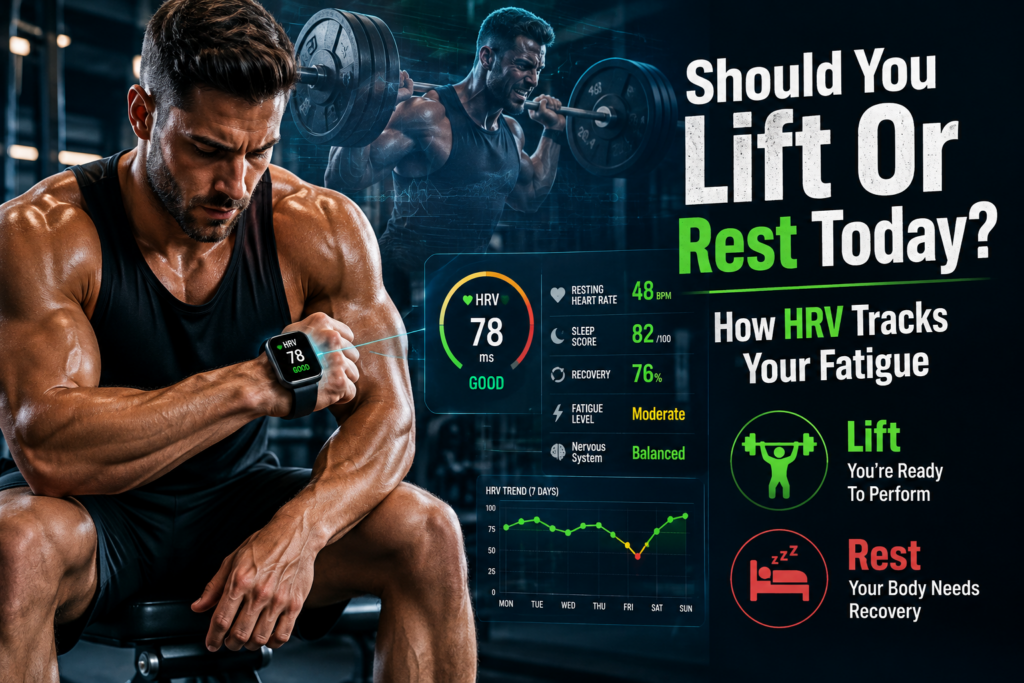
You drag yourself to the gym after a bad night’s sleep. Your muscles ache from yesterday. Should you lift heavy or rest? This is where understanding Should You Lift Or Rest Today How HRV Tracks Your Fatigue changes everything.
What HRV Really Measures When Should You Lift Or Rest Today How HRV Tracks Your Fatigue
HRV reflects the variation in time between each heartbeat. Your heart doesn’t beat like a clock. The gap between beats changes constantly. Higher HRV generally indicates a well-rested body ready to perform, while lower HRV can signal stress, fatigue, or illness. When you’re stressed, those gaps become more uniform. When you’re recovered, they vary more.
HRV can accurately measure autonomic nervous system (ANS) function in a non-invasive manner, making it a practical tool for monitoring your recovery state. This beat-to-beat variation is controlled by your autonomic nervous system, which regulates involuntary functions like heart rate, breathing, digestion, and blood pressure regulation. The ANS operates constantly without conscious effort, split between two opposing branches: the sympathetic nervous system (responsible for activation and stress response) and the parasympathetic nervous system (responsible for recovery and relaxation). By measuring HRV, you’re essentially getting real-time insight into which branch is currently dominating your physiology, giving you a window into your nervous system’s current state and recovery capacity.
Generally speaking, the more relaxed and unloaded the body is, the more variable the time between heartbeats. A recovered body shows more chaos in heartbeat timing. A fatigued body shows a rigid pattern. Your watch picks this up in milliseconds.
The Science Behind Should You Lift Or Rest Today How HRV Tracks Your Fatigue
The parasympathetic nervous system controls your “rest and digest” responses and is associated with recovery. Think of it as your brake pedal. Parasympathetic activation conserves energy, constricts pupils, aids digestion, and slows the heart rate. This system tells your body to repair and rebuild.
The sympathetic system does the opposite. It’s your gas pedal for action and stress. While both systems are always active, one typically dominates depending on the situation. Your HRV shows which one is winning.
HR is lowest and HRV is highest during rest and recovery when the parasympathetic or vagal activation is highest. This is why morning readings matter so much. You measure before stress hits. When measured at rest, high HRV indicates a predominance of parasympathetic activity, suggesting a relaxed and recovered state.
Low HRV reflects greater sympathetic activation or reduced vagal tone, often associated with stress or fatigue. Your body is still in fight mode from yesterday’s workout.
See Greater Details at…
Active Recovery for Lifters: Methods, Timing & Limits
How Training Affects Should You Lift Or Rest Today How HRV Tracks Your Fatigue Readings
After intense HIIT sessions, HRV is often suppressed for 24–72 hours, indicating the need for adequate recovery. Heavy lifting does the same thing. Your nervous system stays activated long after you leave the gym. This isn’t damage. It’s normal stress response.
The results show a HRV imbalance, increase of sympathetic and decrease of vagal activities respectively, along the event that correlated with rate of perceived exertion. Harder sessions create bigger drops. The correlation is real and measurable.
The greatest change in HRV balance was observed the days after the greatest relative physical load. You don’t feel the worst right after training. The next day reveals the real impact. Mean heart rate and HRV values returned to their baseline values one week after completion of the event. Recovery takes time even for elite athletes.
Training is, after all, about stress and recovery and a hard session, especially on top of accumulated fatigue, will lower your HRV. This drop isn’t a red flag. It’s proof your workout worked.
Setting Your Baseline for Should You Lift Or Rest Today How HRV Tracks Your Fatigue Decisions
Your morning HRV score means nothing on its own. The real signal is in your 7-day trend and baseline shifts. Comparing yourself to population averages is useless. Your trend relative to your own baseline is the only comparison that matters.
Same time each morning after waking, before caffeine, seated or supine, 60–90s. Measure HRV each morning, record resting HR, sleep hours or quality, soreness, and mood. Consistency makes the data useful. Random timing creates garbage data.
The single most important concept in HRV-guided training is the rolling average. Rather than reacting to a single morning reading, you compare today’s reading against your own recent trend, typically a 7-day rolling average of morning RMSSD. This filters out noise.
A 10% drop from your 7-day average suggests your body needs recovery, regardless of the number. If your baseline sits at 60 milliseconds, a reading of 54 means pull back today.
Making the Call When Should You Lift Or Rest Today How HRV Tracks Your Fatigue Shows Low
One low HRV reading is normal and expected. A full week of consistently low readings is a different story. Don’t panic over a single day. Look for patterns across 7 to 14 days to catch fatigue building up before it affects your performance or health.
Green: within baseline plus or minus SWC, train as planned. Yellow: 1–2 days below average by more than SWC or resting HR up 5–7 bpm, reduce intensity or volume 30–50%. Yellow doesn’t mean skip. It means adjust.
Red: 2 or more consecutive days more than SWC drop or strong fatigue or poor sleep or illness signs, active recovery or rest. Two consecutive bad readings demand action. Your body is telling you something clear.
Not necessarily. Single-day HRV drops showed no correlation with performance issues in 73% of cases studied. Consider whether the low reading is isolated or part of a multi-day pattern, and whether it matches how you subjectively feel. The number needs context from your body.
The Secret Daily Habit That Builds Muscle, Restores Energy, and Ignites Drive
The Devices That Track Should You Lift Or Rest Today How HRV Tracks Your Fatigue Best
Chest strap monitors using ECG technology remain the gold standard for HRV accuracy, with the Polar H10 achieving plus or minus 1ms precision. Nothing beats a chest strap for morning readings. The data is clean and research-validated.
Smart rings emerge as the sweet spot between accuracy and wearability. By measuring from the finger, rings achieve better PPG accuracy than wrist devices. The Oura Ring Gen 4 can match chest strap accuracy for overnight HRV measurements. You wear it all night without thinking about it.
HRV4Training is the first validated app able to measure your Heart Rate and Heart Rate Variability reliably, without requiring any sensor. Your phone camera works if you follow the protocol correctly. Smartphone apps using camera-based PPG or external sensors offer entry-level HRV tracking. While convenient for occasional measurements, phone cameras lack the consistency needed for reliable trending. Use them for learning, not long-term tracking.
When High HRV Still Means Should You Lift Or Rest Today How HRV Tracks Your Fatigue Says Rest
Parasympathetic overdrive, when your nervous system swings too far toward the “rest” side, can manifest as elevated HRV. This sometimes happens during overreaching, when the body essentially forces a shutdown response. You might see HRV numbers 15-20% above your baseline while simultaneously feeling flat and unmotivated. The number looks great. Your body feels terrible.
The Journal of Sports Sciences study noted that athletes who experienced HRV spikes more than two standard deviations above their baseline reported subjective fatigue ratings that were 40% higher than normal. This is rare but real. Your nervous system essentially crashes in recovery mode.
If your HRV shoots up unexpectedly and you feel great, that’s genuine recovery. If it shoots up and you feel sluggish, trust your body over the number. Data informs. Your body decides.
Overtraining Signs Beyond Should You Lift Or Rest Today How HRV Tracks Your Fatigue Numbers
Persistently low HRV, elevated resting heart rate, fatigue, and poor sleep may signal overtraining or inadequate recovery. These symptoms cluster together. One sign is noise. Four signs mean stop.
Declining trends correspond to decreases in physical fitness and may indicate accumulated fatigue, nonfunctional overreaching, or overtraining. Watch your weekly average trend, not daily fluctuations. Shifts in weekly mean HRV can signal whether the training program is effective or if adjustments are needed, such as modifying the training load or encouraging an extended recovery period.
Fatigue is multi-system, not just muscular. In reality, it reflects central, hormonal, immune, and psychological stress, with HRV acting as a global integrator of these systems. Sore muscles are just one piece. Mental fog and mood changes matter just as much.
Changes in HRV that are interpreted to be undesirable may be caused by non-training related factors, which can be communicated via ASRM. The appropriate intervention for a fatigued athlete may be to address life-stressors or sleep quality issues rather than only adjusting training load. Fix your sleep before blaming your program.
Training Adjustments When Should You Lift Or Rest Today How HRV Tracks Your Fatigue Shows Yellow
Studies have shown that HRV-based training, in which an athlete performs higher-intensity exercise when HRV increases and lower-intensity exercise or rest when HRV decreases, results in larger fitness gains than training according to a fixed plan. Flexible beats rigid for long-term progress.
When your HRV sits above your baseline, your body is primed to absorb harder work. These are the days to schedule intense sessions, heavy lifts, interval training, or anything else that demands a lot. The physiological stress will be better absorbed and produce stronger adaptations. Green days are for pushing.
A reading below baseline does not mean you should cancel the session. Yellow means modify. Drop volume by 30%. Keep the main lift but cut accessories. Turn intervals into steady cardio. That might mean choosing an endurance ride instead of threshold intervals after several rough mornings in a row.
The workout still happens. The stress load changes. This keeps momentum without digging a deeper hole.
Frequently Asked Questions
What is the best time to measure HRV for training decisions?
Measure immediately after waking, before caffeine or food. Stay seated or lie down for 60 to 90 seconds. Use the same position and time daily for consistent baseline data.
How long does it take to establish a reliable HRV baseline?
Seven days minimum provides a working baseline. Fourteen to thirty days gives better accuracy. Sixty days of data produces the most reliable training guidance according to research.
Can stress from work lower HRV the same as hard training?
Yes. Mental stress, poor sleep, and physical training all suppress HRV. Your nervous system doesn’t distinguish sources. Total stress load determines your recovery state and readings.
Should you train if HRV is low but you feel good?
One isolated low reading with good subjective feeling usually means train with caution. Two or three consecutive low days override how you feel. Trust the pattern over single data points.
Does age affect what HRV numbers mean for training readiness?
Age changes absolute values but not the principle. Older athletes have lower average HRV. Your personal trend and percentage changes from baseline matter more than the raw number itself.
Measure your HRV tomorrow morning and start building your seven-day baseline today.