

Why Your Recovery Stalled at the Local Level
The-Localized-Recovery-Bottleneck explains why some muscles refuse to grow despite consistent training—the issue lies in blood flow, not your workout plan. Certain muscle groups like calves and rear deltoids sit far from your heart, receiving fewer recovery nutrients through narrow blood vessels, creating a natural growth ceiling.
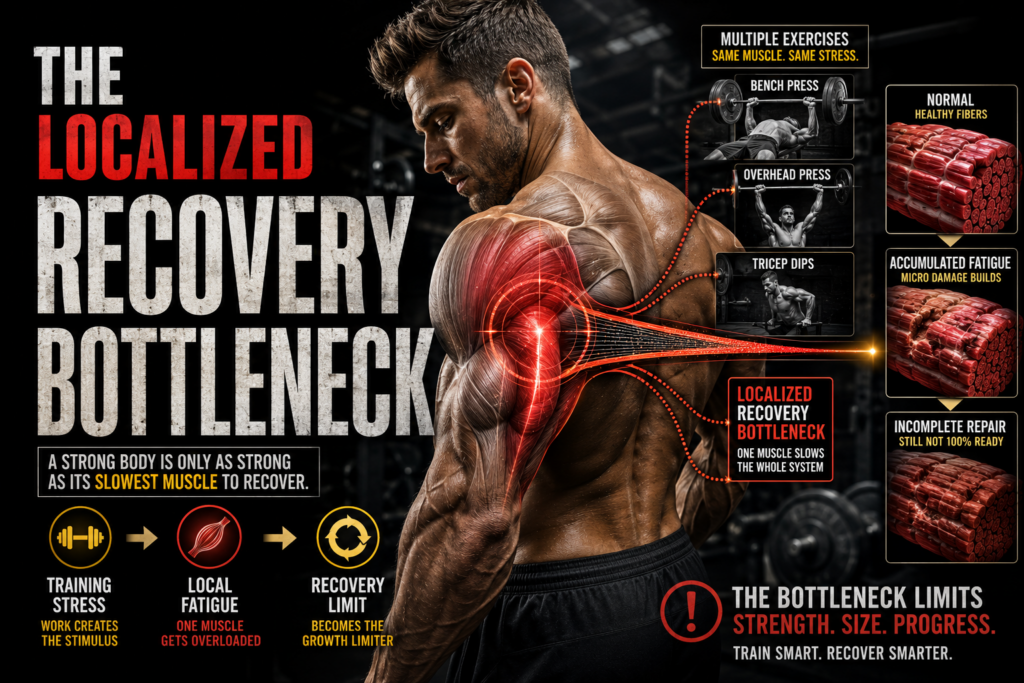
You train hard but one muscle group refuses to grow. The-Localized-Recovery-Bottleneck explains why only your shoulders stay weak. Other muscles respond but this spot stays stuck. The problem isn’t your workout plan but how blood reaches that area.
Why The Localized Recovery Bottleneck Targets Specific Muscle Groups
Your body doesn’t send nutrients evenly to every muscle. Some areas get rich blood flow naturally. Others sit at the end of smaller blood vessels. These spots receive fewer recovery materials after training.
Calves are the classic example. They sit far from your heart. The blood vessels feeding them are narrow. You can train calves daily and see no growth.
Rear deltoids face similar issues. The muscle sits behind the shoulder joint. Blood must travel through tight spaces to reach it. Most people do fifty sets monthly but rear delts stay flat.
The forearms present another frustrating case. Dense connective tissue wraps around the muscles. This tissue restricts blood vessel expansion. Pumps feel weak even after intense grip work.
Lower lats show the same pattern. The muscle attaches low on your spine. Vessels must navigate around your ribcage to feed it. Upper lats grow easily while lower lats lag behind.
How Poor Circulation Creates The Localized Recovery Bottleneck
Training damages muscle fibers on purpose. Your body repairs them during rest. Repair needs amino acids, oxygen, and minerals. Blood carries all three.
When blood flow is weak, amino acids arrive slowly. The damaged fibers wait longer for raw materials. Repair takes extra days instead of hours. You train again before the muscle fully heals.
This creates a downward spiral. Incomplete recovery means weaker performance next session. Weaker performance means less stimulus for growth. The muscle falls further behind your stronger areas.
Inflammation adds another layer of trouble. Damaged tissue swells after hard training. Swelling compresses the small blood vessels in that area. Less blood can squeeze through. The muscle needs more circulation but receives even less.
Waste products pile up too. Muscles produce lactate and other byproducts during work. Blood normally flushes these away quickly. Poor circulation leaves them sitting in the tissue. They interfere with the next workout.
Joint Health and The Localized Recovery Bottleneck Connection
Joints near weak muscle groups often hurt first. The connection isn’t random. Weak muscles force joints to handle extra stress. That stress damages cartilage over time.
Take knee pain as an example. Many people blame squats. The real problem is often weak vastus medialis muscles. This inner quad muscle doesn’t get enough blood. It stays small and weak.
The stronger outer quad pulls the kneecap sideways. The kneecap grinds against the joint incorrectly. Cartilage wears down. Pain starts after a few months.
Supporting joint structures with targeted nutrition makes a difference here. Products designed for connective tissue health address both the muscle imbalance and joint stress. A supplement like Locerin supports the underlying tissue repair that prevents these cascading problems.
Shoulder impingement follows similar mechanics. Weak rotator cuff muscles can’t stabilize the joint. The humeral head drifts forward during presses. It pinches tendons against bone. Inflammation sets in.
The rotator cuff sits in a tight anatomical space. Blood vessels must thread between bones to reach it. This makes it vulnerable to circulation problems. Weak blood flow means slow recovery and chronic weakness.
Training Adjustments That Address The Localized Recovery Bottleneck
Changing exercise selection helps some cases. Choose movements that create strong muscle contractions. Strong contractions squeeze blood vessels like a pump. This forces fresh blood into the area.
High-repetition training works better than heavy low-rep work. Twenty reps create more total contraction time. Blood gets pumped through the muscle repeatedly. The tissue fills with nutrients.
Partial range movements can help stubborn areas. Lock out the top half of a calf raise. Hold it for three seconds. The sustained contraction traps blood inside the muscle. Pressure forces plasma into the tissue.
Rest periods need adjustment too. Shorter breaks keep blood in the area. Sixty seconds works better than three minutes. The muscle stays engorged between sets.
Post-workout positioning matters more than people think. Elevate a lagging body part after training. This helps blood drain out properly. Fresh blood can then flow in during recovery.
Nutritional Strategies for The Localized Recovery Bottleneck
Your diet affects blood vessel function directly. Nitric oxide controls how wide vessels can open. More nitric oxide means better blood flow. Certain foods boost production significantly.
Beetroot contains high levels of nitrates. Your body converts these to nitric oxide. Studies show beetroot juice improves circulation within hours. Drink it before training lagging muscle groups.
Citrus fruits provide hesperidin and other flavonoids. These compounds strengthen blood vessel walls. Stronger vessels resist compression from swollen tissue. They stay open when inflammation rises.
Omega-3 fats from fish reduce blood thickness. Thinner blood flows through narrow vessels more easily. This helps areas at the end of small capillaries. Salmon provides the highest concentrations.
Targeted supplementation offers another approach. Vasodilatory compounds like arginine, citrulline, and ginger extract improve microcirculation throughout the body. These ingredients enhance nitric oxide availability and promote capillary expansion. Using evidence-based formulas that combine nitrate donors, flavonoid antioxidants, and blood-thinning nutrients addresses circulation at the capillary level where localized bottlenecks occur.
Hydration status changes blood volume directly. Dehydration makes blood thicker and slower. Drink half your body weight in ounces daily. Add extra water on training days.
Temperature and Blood Flow in The Localized Recovery Bottleneck
Heat expands blood vessels immediately. Cold causes them to constrict. You can use both strategically. Apply heat before training a weak area.
A hot towel on your calves for ten minutes helps. Vessels dilate before you start training. More blood reaches the muscle during work. The pump feels stronger from the first set.
Contrast therapy works well after training. Alternate hot and cold exposure. Hot for three minutes, cold for one minute. Repeat five times. This creates a pumping action in the vessels.
Cold plunges have become popular lately. They do reduce inflammation effectively. But they also limit blood flow during the critical post-workout window. Save ice baths for rest days.
Sleeping in a warm room aids overnight recovery. Your body sends more blood to the skin when warm. This indirectly increases flow to underlying muscles. Keep your bedroom at 68 degrees or higher.
Systemic Support Beyond The Localized Recovery Bottleneck
Cardiovascular fitness affects recovery everywhere. Poor cardio means a weak circulatory system overall. Even well-positioned muscles won’t get optimal blood flow. You need a strong heart pump.
Add twenty minutes of walking after lifting. This keeps your heart rate elevated. Blood continues circulating to trained muscles. Nutrients arrive faster than if you just sit down.
Sleep quality determines how efficiently repair happens. Growth hormone peaks during deep sleep. This hormone signals blood vessels to deliver more nutrients. Poor sleep cuts growth hormone by half.
Stress hormones like cortisol narrow blood vessels. Chronic stress means chronically reduced circulation. Manage stress through breathing exercises or meditation. Five minutes daily makes measurable differences.
Comprehensive nutrition support addresses multiple recovery factors simultaneously. Rather than targeting just one element, quality supplements provide building blocks for tissue repair, circulation, and inflammation control. Products like Locerin deliver combined support that helps overcome stubborn growth plateaus.
Identifying Your Personal The-Localized-Recovery-Bottleneck
Look for muscle groups that never get sore. Soreness indicates damage and repair activity. No soreness often means poor circulation. The muscle isn’t receiving enough stimulus.
Check for asymmetry between sides. Your right calf might grow while your left stays small. This points to a localized circulation issue. Systemic problems would affect both sides equally.
Monitor pump quality during training. A good pump means blood is filling the muscle. A weak pump despite hard work suggests vessel restrictions. The blood can’t get in.
Track strength gains over twelve weeks. Muscles with good recovery gain strength steadily. Stalled strength despite consistent training reveals a bottleneck. The muscle can’t repair fast enough.
Notice which areas feel cold to touch. Poor circulation means less warm blood reaches the tissue. Cold skin over a muscle group confirms limited flow. Your body is telling you where the problem sits.
Häufig gestellte Fragen
Can I fix The-Localized-Recovery-Bottleneck with just more training volume?
More volume without better circulation makes things worse. The muscle accumulates more damage than it can repair. You need to improve blood flow first. Then add volume gradually.
How long does it take to improve circulation to a stubborn muscle?
You’ll notice better pumps within two weeks of targeted work. Visible muscle growth takes six to eight weeks. Consistent effort with heat, nutrition, and proper exercises produces results.
Does massage help with The-Localized-Recovery-Bottleneck?
Massage pushes blood through tissue mechanically. This helps in the short term. But it doesn’t fix underlying vessel weakness. Combine massage with other strategies for lasting improvement.
Can supplements really improve localized blood flow?
Yes, certain ingredients dilate blood vessels throughout your body. This includes smaller vessels feeding stubborn muscles. Effects appear within hours of taking quality formulas.
Should I train a bottleneck muscle more or less frequently?
Train it more often but with lower volume per session. Three short sessions beat one long brutal workout. Frequent stimulation improves circulation over time. Recovery happens faster with better blood flow.
Start tracking which muscle groups lag behind and apply targeted circulation strategies this week.