

Why Your Rep Range Is Costing You Muscle Growth
The Muscle Specific Rep Range Matrix tailors your training approach based on each muscle’s unique fiber composition, maximizing growth potential. Fast-twitch and slow-twitch fibers respond differently to rep ranges, so using identical sets and reps for all muscles leaves significant gains on the table.
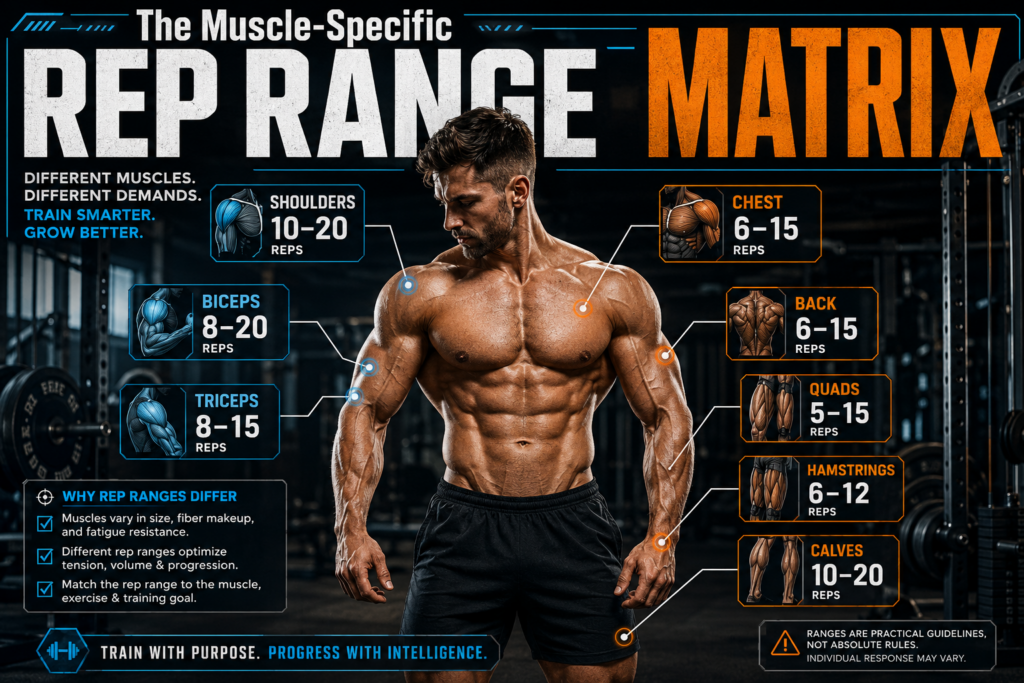
You walk into the gym with a plan to grow your chest, following The Muscle Specific Rep Range Matrix to guide your training approach. You do four sets of twelve reps on bench press, then give your legs the same treatment with four sets of twelve squats, but some muscles respond better to different rep schemes than others.
Why The Muscle Specific Rep Range Matrix Changes Everything
Your body doesn’t treat all muscles equally. Fast-twitch muscle fibers dominate in some areas while slow-twitch fibers rule in others. This split determines how each muscle responds to different rep ranges. Chest muscles contain about 60% fast-twitch fibers on average. Your soleus muscle in the lower leg sits at 85% slow-twitch fibers. Training both with identical sets and reps leaves gains on the table.
The Muscle Specific Rep Range Matrix matches training volume to fiber type composition. High fast-twitch muscles grow faster with lower reps and heavier loads. High slow-twitch muscles need more reps and sustained tension. This isn’t theory. Research on muscle biopsies shows fiber type differences across the body reach 40 percentage points between muscles.
Most programs ignore this reality. They prescribe eight to twelve reps for everything. Your quads might thrive on twenty reps per set. Your rear delts could need six reps with maximum load. The matrix gives you a framework to stop guessing.
How Fast-Twitch and Slow-Twitch Fibers Shape The Muscle Specific Rep Range Matrix
Fast-twitch fibers generate explosive force but tire quickly. They grow in response to heavy mechanical tension. Slow-twitch fibers produce less force but resist fatigue for longer periods. They respond better to metabolic stress and time under tension. Your training must match the dominant fiber type in each muscle group.
Take your calves as an example. Soleus muscles contain mostly slow-twitch fibers because they work all day to keep you upright. Sets of six reps won’t create enough stimulus. You need fifteen to twenty-five reps to exhaust these endurance-oriented fibers. The gastrocnemius muscle sits on top of the soleus with more fast-twitch content. It responds to both moderate and higher rep ranges.
Upper back muscles like the traps and rhomboids lean toward slow-twitch dominance. They stabilize your shoulder blades during every upper body movement throughout the day. Sets of fifteen to twenty reps with controlled tempo produce better growth. Compare this to your triceps lateral head. It contains more fast-twitch fibers and responds well to heavy six to eight rep sets.
The difference matters more than most people realize. A study comparing low reps to high reps on different muscles found that fiber type predicted growth response. Muscles with higher fast-twitch content grew more from heavy sets of six reps. Muscles with more slow-twitch fibers showed better results from sets of fifteen to twenty reps.
The Muscle Specific Rep Range Matrix for Upper Body Training
Your chest muscles perform best in the eight to twelve rep range. The pectoralis major contains roughly balanced fiber types with a slight fast-twitch bias. Heavy sets of five reps work but don’t provide enough total volume. Sets above fifteen reps create fatigue without sufficient mechanical tension. Eight to twelve reps hits the sweet spot for most chest exercises.
Shoulders present a more complex picture. Front delts have moderate fast-twitch content and respond to six to twelve reps. Side delts contain slightly more slow-twitch fibers. They grow better from ten to fifteen reps with strict form. Rear delts lean heavily toward slow-twitch dominance because they work constantly to maintain posture. Fifteen to twenty reps produces superior results for rear delt isolation work.
Biceps growth responds well to eight to twelve reps on compound movements like chin-ups. Isolation curls work better in the twelve to fifteen rep range. The biceps contains mixed fiber types but accumulates metabolic stress effectively during higher rep sets. Your forearms need even higher reps. Forearm muscles work all day gripping objects. Sets of fifteen to twenty-five reps match their endurance nature. Those looking to support their training with proper nutrition often see better results across all rep ranges.
Lower Body Applications of The Muscle Specific Rep Range Matrix
Quadriceps muscles contain significant fast-twitch fiber content in most people, yet they also respond exceptionally well to high rep training due to their large cross-sectional area and capacity for metabolic stress accumulation. The quad muscles can handle substantial training volume and benefit from varied rep schemes. Heavy compound movements like back squats and front squats in the five to eight rep range build maximal strength and myofibrillar hypertrophy. Machine-based exercises such as leg presses, hack squats, and V-squats in the fifteen to twenty rep range create tremendous growth stimulus through increased time under tension and metabolic byproduct accumulation, particularly effective for inducing sarcoplasmic hypertrophy.
The best approach uses both ends of the spectrum. Start your leg session with heavy compound movements for six to eight reps. Finish with isolation exercises or machine work for fifteen to twenty-five reps. This combination hits both fiber types and creates maximum adaptation.
Hamstrings differ from quads in fiber composition. Most people have more fast-twitch content in their hamstrings. Romanian deadlifts and leg curls work well in the eight to twelve rep range. Going heavier into the five to eight rep zone produces good results. Very high reps above twenty create fatigue without enough mechanical load.
Glutes respond to multiple rep ranges depending on the exercise. Hip thrusts build strength and size with six to ten reps using heavy loads. Glute kickbacks and abduction movements work better with twelve to twenty reps. The glute muscles contain mixed fiber types and benefit from varied training stimuli.
The Muscle Specific Rep Range Matrix for Stubborn Muscle Groups
Calves frustrate more people than any other muscle group. The problem stems from treating them like other muscles. Your calves walk you around all day performing thousands of reps. They adapt to endurance work. Training them with eight to twelve reps provides no novel stimulus.
Effective calf training demands fifteen to thirty reps per set. Use a slow tempo with a pause at the bottom stretch position. Heavy weight matters less than total time under tension. Three sets of twenty-five reps beats five sets of eight every time for calf development.
Abs present another misunderstood muscle group. Rectus abdominis contains roughly equal fast and slow-twitch fibers. But abs stabilize your spine during every movement you perform. They possess high endurance capacity. Weighted abs exercises in the eight to twelve rep range build thickness. But sets of fifteen to twenty-five reps on various movements create better definition and development.
Forearms often lag because people train them like biceps. Wrist curls for eight reps don’t match the fiber type profile. Your grip muscles work constantly throughout the day. They need high reps to respond. Farmer carries for distance work better than timed sets. Wrist curls should hit twenty to thirty reps. This matches the endurance nature of forearm muscles.
Programming The Muscle Specific Rep Range Matrix Into Your Training Split
Don’t abandon your current program completely. Start by adjusting rep ranges for muscles that aren’t growing. If your chest grows but your rear delts lag, shift rear delt work from ten reps to eighteen reps. Track the change for four weeks.
A push day could include bench press for eight reps, incline dumbbell press for ten reps, and side raises for fifteen reps. Rear delt flyes finish with twenty reps per set. Each movement matches the target muscle’s fiber type profile. This creates better stimulus than using ten reps for everything.
Leg days benefit from starting heavy and finishing with volume. Back squats for six reps build strength. Leg press for twenty reps creates metabolic stress. Leg extensions for fifteen reps exhaust the quads. Calf raises close the session with twenty-five reps. Each exercise serves a specific purpose based on fiber type response. Many athletes who optimize their supplement intake find this approach accelerates their progress.
Pull days should vary rep ranges between vertical and horizontal pulling. Deadlifts work in the five to six rep range for maximum strength. Barbell rows hit eight to ten reps. Face pulls and rear delt work extend to fifteen to twenty reps. This spectrum covers all bases.
Common Mistakes When Applying The Muscle Specific Rep Range Matrix
The biggest error is changing everything at once. You lose the ability to track what works. Pick two lagging muscle groups and adjust their rep ranges first. Keep everything else constant for four weeks. Measure the results before making more changes.
Another mistake involves abandoning progressive overload. Higher reps don’t mean light weights that never increase. If you do calf raises for twenty-five reps, you must add weight over time. Track your loads and aim to add reps or weight each week. The matrix guides rep ranges but doesn’t replace progression principles.
Some people swing too far in one direction. Finding out that rear delts need higher reps doesn’t mean fifty reps per set helps. Fifteen to twenty reps provides enough stimulus. Beyond that point you’re just doing cardio. Stay within the recommended ranges for each muscle type.
Ignoring exercise selection causes problems too. Compound movements generally work better with moderate to low reps even for slow-twitch muscles. Save very high reps for isolation exercises. Squatting for thirty reps tests your conditioning more than your quads. Leg extensions for thirty reps actually target the muscle effectively.
Tracking Progress With The Muscle Specific Rep Range Matrix
Write down your working weights and reps for each exercise. Note when you increase either variable. Take photos every four weeks from the same angles in identical lighting. Measurements tell part of the story but photos reveal what’s actually changing.
Pay attention to muscle pump and soreness patterns. When you nail the right rep range for a muscle, the pump feels different. The muscle fills with blood and stays tight for hours. Soreness hits the target muscle specifically rather than spreading to surrounding areas. These signals confirm you’ve found the right stimulus.
Don’t expect changes overnight. Muscle growth happens slowly even with perfect training. The matrix improves your results over months, not weeks. Give each adjustment at least four weeks before deciding if it works. Eight weeks provides even better data. Individuals who combine smart training with quality supplementation typically see results within this timeframe.
Compare your progress on different muscles within the same timeframe. If your chest grew but your calves didn’t, the calf rep range might need adjustment. If everything grows at similar rates, your current approach works. The matrix helps you identify and fix weak points systematically.
Frequently Asked Questions
What is The Muscle Specific Rep Range Matrix?
It’s a training framework that matches rep ranges to each muscle’s fiber type composition. Fast-twitch dominant muscles get lower reps while slow-twitch muscles receive higher reps. This approach maximizes growth by providing the right stimulus for each muscle group.
How do I know which fiber type dominates in each muscle?
Research on muscle biopsies provides average fiber type percentages for different muscles. Calves and forearms lean heavily toward slow-twitch fibers. Hamstrings and parts of the shoulders contain more fast-twitch fibers. Chest and quads sit in the middle with mixed composition.
Can I still build muscle using the same reps for everything?
Yes, you can build muscle with standard rep ranges across all exercises. But matching reps to fiber types produces faster results, especially for lagging muscles. The matrix eliminates a common reason why some body parts don’t respond to training.
Should beginners use The Muscle Specific Rep Range Matrix?
Beginners grow well from almost any training approach because the stimulus is novel. Basic programs with consistent rep ranges work fine initially. Apply the matrix after six months of training when progress slows on specific muscles.
How often should I change rep ranges for each muscle?
Don’t change rep ranges frequently once you find what works for each muscle. The matrix provides a template based on fiber types, not a rotation strategy. Stick with effective rep ranges and focus on progressive overload instead of constant variation.
Start applying The Muscle Specific Rep Range Matrix to your two most stubborn muscle groups this week and track the changes for the next month.