
Why BMI Fails Lifters (And What Doctors Won't Tell You)
BMI treats muscle and fat equally, making it unreliable for strength athletes who build lean mass. FFMI provides a more accurate metric for lifters to track true body composition and progress.

FFMI vs BMI for Lifters: Which Metric Matters More?
If you lift weights seriously, the number on the scale tells only part of the story. Two people can stand at the same height and weigh exactly the same amount while having dramatically different physiques. One might carry considerably more muscle, while the other carries more body fat.
That is where the debate over FFMI vs BMI for lifters becomes important.
Body mass index (BMI) is one of the most widely used measurements for classifying body weight relative to height. It is simple, inexpensive, and useful for examining large populations. But for muscular lifters, BMI has an obvious limitation: it cannot distinguish muscle from fat.
Fat-free mass index (FFMI) approaches the question differently. Instead of considering total body weight, FFMI evaluates fat-free mass relative to height. For natural bodybuilders, strength trainees, and anyone trying to build muscle while controlling body fat, that distinction can make FFMI much more informative.
So, which metric matters more for lifters?
For evaluating muscularity and muscle-building progress, FFMI is generally the more relevant measurement. BMI still has value as a broad health-screening metric, but it should not be interpreted as a direct measurement of body composition—especially in muscular people.
What Is BMI?
BMI, or body mass index, compares your total body weight with your height.
The formula is:
BMI = body weight (kg) ÷ height² (m)
For example, consider a lifter who weighs 90 kilograms and is 1.80 meters tall:
90 ÷ (1.80 × 1.80) = 27.8 BMI
Under commonly used adult BMI classifications, that falls into the overweight category.
But there is a problem.
BMI has no idea what makes up those 90 kilograms.
They could include a relatively large amount of body fat—or an unusually large amount of muscle.
That distinction matters enormously to lifters.
A muscular natural bodybuilder at 10–12% body fat may have the same BMI as a sedentary person carrying substantially more body fat. BMI sees two people of equal height and weight as essentially identical.
Their body compositions may be completely different.
Why BMI Can Be Misleading for Lifters
BMI was never designed to measure muscle mass directly.
That makes it useful for certain population-level applications but considerably less precise when the goal is evaluating an individual muscular athlete.
Research illustrates the problem.
In College Athletes With an Elevated Body Mass Index Often Have a High Upper Arm Muscle Area, but Not Elevated Triceps and Subscapular Skinfolds, researchers studied 213 NCAA Division III athletes.
Thirty-eight athletes had BMIs of 25 or higher, placing them in the overweight-or-obese range by BMI. Yet only four of those athletes had elevated body fat based on the skinfold criterion used in the study, while 27 had high upper-arm muscle area.
In other words, BMI frequently identified muscular athletes as overweight even though elevated muscle mass—not excessive body fat—was contributing substantially to their body weight.
That is exactly why lifters should be careful when interpreting BMI.
A High BMI Does Not Automatically Mean High Body Fat
Imagine two 5-foot-11-inch men who both weigh 190 pounds.
One is sedentary and carries 25% body fat.
The other has trained naturally for eight years and carries 12% body fat.
Their BMI is virtually identical.
Their physiques are not.
The trained lifter has much more fat-free mass and considerably less fat mass. Yet BMI cannot detect the difference because its calculation uses only height and total body weight.
For someone primarily interested in obesity screening at a population level, BMI can still provide useful information.
For someone asking, “How muscular am I for my height?”, BMI is the wrong tool.
That is where FFMI becomes much more useful.
What Is FFMI?
FFMI stands for fat-free mass index.
The basic formula is:
FFMI = fat-free mass (kg) ÷ height² (m)
Fat-free mass includes everything in your body that is not fat, including muscle, bone, organs, water, and other lean tissues.
To calculate fat-free mass, you first need an estimate of body-fat percentage.
A simplified calculation is:
Fat-Free Mass = Body Weight × (1 − Body-Fat Percentage)
Suppose our 90-kilogram, 1.80-meter lifter is 15% body fat.
His estimated fat-free mass would be:
90 × 0.85 = 76.5 kg
His FFMI would then be:
76.5 ÷ 1.80² = 23.6
For the complete calculation, interpretation ranges, height normalization and limitations of the metric, see FFMI Calculator: Formula, Scores & Natural Limits.
Now we have information BMI could not provide.
Instead of simply telling us that the lifter is heavy for his height, FFMI tells us how much fat-free mass he carries relative to his height.
For a complete explanation of the calculations, interpretation ranges, normalization and the limitations of using FFMI to estimate natural muscular development, see the FFMI Calculator: Formula, Scores & Natural Limits guide.
FFMI vs BMI: The Critical Difference
BMI and FFMI look superficially similar because both divide mass by height squared.
What goes into the calculation is what separates them.
BMI uses total body weight.
FFMI uses fat-free mass.
That single difference dramatically changes their usefulness for lifters.
If you gain 10 pounds while maintaining approximately the same body-fat percentage, much of that gain may represent fat-free mass. Both your BMI and FFMI could increase.
However, FFMI provides a much better indication that your body composition has changed in the direction a hypertrophy-focused lifter actually cares about.
Conversely, if someone gains substantial fat, BMI will rise regardless of whether meaningful muscular development occurred.
FFMI attempts to separate those two outcomes.
Why FFMI Is More Relevant for Natural Lifters
For natural lifters, one of the central questions is not simply how much you weigh but how much muscular size you carry relative to your frame and height.
This is why FFMI became popular in bodybuilding discussions.
The landmark paper Fat-Free Mass Index in Users and Nonusers of Anabolic-Androgenic Steroids examined FFMI in 157 male athletes, including 74 reported nonusers and 83 users of anabolic-androgenic steroids.
The researchers calculated FFMI and also proposed a height-normalized version. In their sample, normalized FFMI among the reported nonusers extended to approximately 25, while many steroid users exceeded 25 and some exceeded 30.
This study is the origin of much of the discussion surrounding the famous “FFMI 25 natural limit.”
But that number should not be treated as a biological law.
The study itself described its conclusions as preliminary. FFMI is influenced by body-composition measurement accuracy, height normalization, individual variation and the characteristics of the population being examined. Self-reported drug-use status is another important consideration when interpreting research of this kind.
Therefore, an FFMI of 25 should not be treated as a magical line proving whether someone is natural or enhanced.
The better use of FFMI is as a muscularity and progress metric, especially when followed consistently over time.
FFMI vs BMI Example for a Muscular Lifter
Consider a 1.78-meter lifter weighing 88 kilograms at an estimated 12% body fat.
His BMI is:
88 ÷ 1.78² = approximately 27.8
BMI therefore classifies him as overweight.
Now calculate his fat-free mass:
88 × 0.88 = 77.44 kg
His FFMI is:
77.44 ÷ 1.78² = approximately 24.4
Those two measurements tell very different stories.
BMI says that he carries a relatively high amount of total mass for his height.
FFMI reveals that much of that size is fat-free mass.
For a lifter evaluating muscular development, the second piece of information is considerably more useful.
Does That Mean Lifters Should Ignore BMI?
No.
The limitations of BMI do not make it worthless.
BMI is simple, standardized, widely researched and useful for population-level health screening. If a person’s BMI rises because body fat is steadily increasing rather than because muscularity is increasing, that trend may still be worth paying attention to.
The mistake is treating BMI as something it is not.
BMI is not a direct body-fat measurement.
It is also not a muscle-mass measurement.
For a muscular athlete, therefore, BMI should be interpreted alongside measurements such as body-fat percentage, waist circumference, fat-free mass and training history.
A BMI of 28 means something very different in a lean, muscular bodybuilder than in a sedentary person with a high waist circumference and substantially higher body-fat percentage.
Context matters.
FFMI Has Limitations Too
FFMI solves one major problem with BMI, but it introduces another: you need an estimate of body composition.
And body-fat measurements contain error.
DEXA, bioelectrical impedance, skinfold measurements and other methods can produce different estimates. Hydration status, food intake, testing conditions, equipment and technician skill can also affect certain methods.
That means your calculated FFMI is only as reliable as the fat-free-mass estimate going into the equation.
Suppose your actual body-fat percentage is 15%, but your device estimates 11%.
The calculation will assign too much of your body weight to fat-free mass, artificially increasing your FFMI.
This is particularly important when people debate tiny differences such as an FFMI of 24.8 versus 25.2.
Those decimals may imply a level of precision that the underlying body-composition measurement cannot support.
For tracking purposes, consistent measurement conditions and long-term trends are more valuable than obsessing over tiny FFMI fluctuations.
FFMI vs Body-Fat Percentage
FFMI and body-fat percentage answer different questions.
Body-fat percentage tells you approximately what proportion of your total body mass is fat.
FFMI tells you approximately how much fat-free mass you carry relative to your height.
A lifter can therefore improve one without dramatically changing the other.
For example, during a successful cutting phase, you might lose mostly fat while preserving nearly all your lean mass. Your body-fat percentage would fall substantially while FFMI remained relatively stable.
During a productive lean-gaining phase, your FFMI might gradually increase as you accumulate muscle.
Used together, the two measurements provide much more information than BMI alone.
FFMI Is Especially Useful for Tracking Long-Term Muscle Gain
Experienced natural lifters know that muscle growth becomes increasingly slow as training age increases.
Scale weight alone can therefore become deceptive.
Suppose you gain eight pounds over six months.
Was it muscle?
Fat?
Water?
Glycogen?
Some combination of all four?
Scale weight cannot answer that question, and neither can BMI.
Tracking body weight, estimated body-fat percentage and FFMI together provides a better picture.
If body weight rises gradually while body fat remains relatively controlled and estimated FFMI trends upward over longer periods, that is consistent with an increase in fat-free mass.
Similarly, if your weight increases rapidly while FFMI barely changes and body-fat percentage climbs, much of the added weight probably isn’t the muscular progress you wanted.
Can FFMI Tell Whether Someone Uses Steroids?
Not reliably.
This is one of the biggest misconceptions surrounding FFMI.
The original Kouri study made FFMI popular partly because of differences observed between reported steroid users and nonusers. But a statistical pattern within a study population does not create a perfect diagnostic test for individuals.
A high FFMI does not prove anabolic-steroid use.
Likewise, an FFMI below 25 does not prove someone is drug-free.
Genetics, height, skeletal structure, body-composition measurement error, training experience and other variables influence the score.
FFMI should therefore be used as a descriptive measurement—not a drug test.
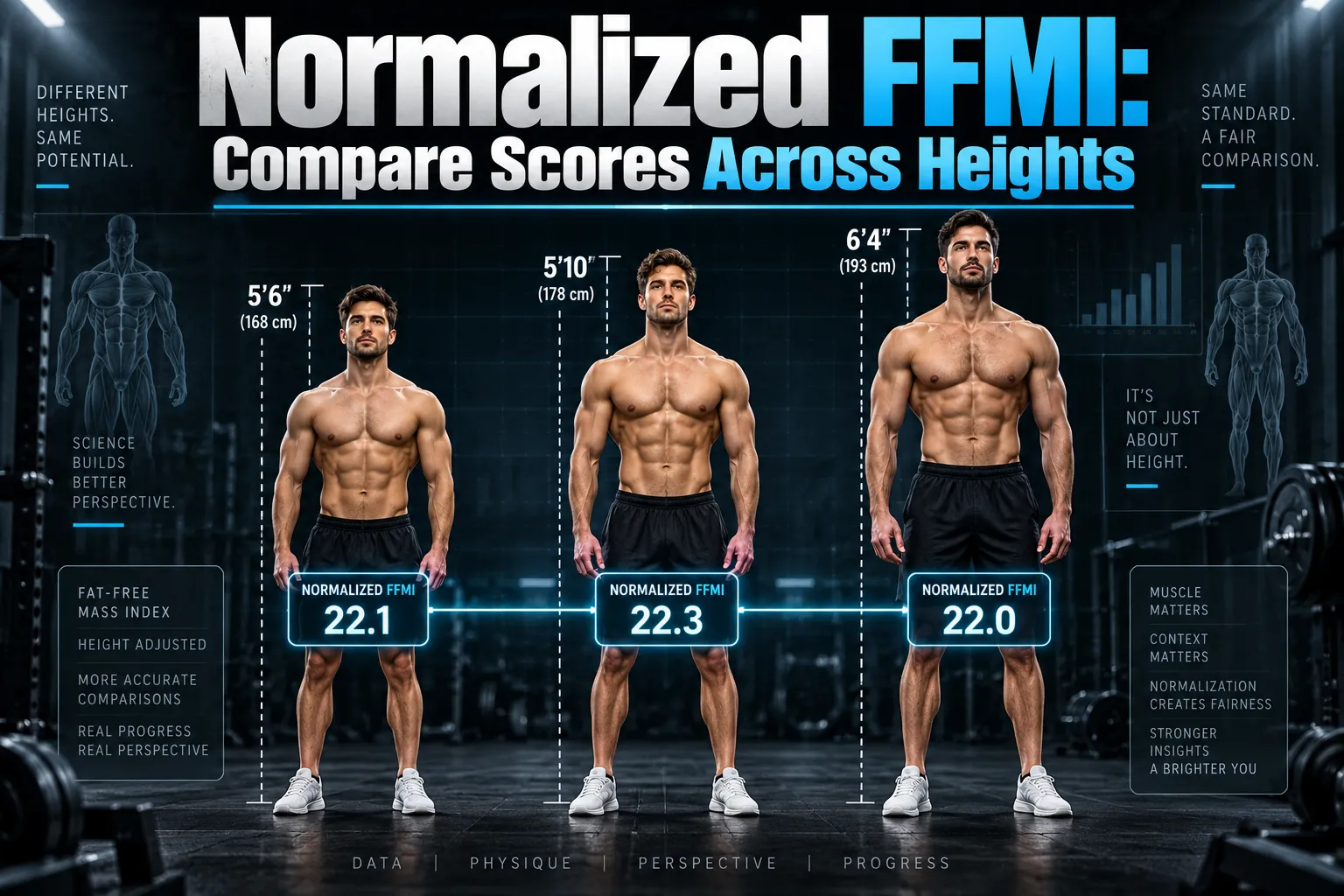
Should You Use Normalized FFMI?
Standard FFMI already adjusts fat-free mass for height by dividing it by height squared. However, researchers have also proposed an additional height normalization intended to make comparisons between people of different heights more meaningful.
This can be particularly useful when comparing physiques across substantially different heights.
For tracking your own progress, however, your height is essentially constant once you are an adult.
That means consistency may matter more than repeatedly switching between formulas.
Choose a method, measure body composition under reasonably consistent conditions, and monitor the trend.
Which Metric Should Lifters Track?
For someone focused on hypertrophy or natural bodybuilding, a useful hierarchy is:
- Body weight — tells you whether overall mass is increasing or decreasing.
- Body-fat estimate — provides context for changes in body weight.
- FFMI — helps quantify fat-free mass relative to height.
- Waist circumference — provides another practical indicator of changes in abdominal size and fat accumulation.
- Gym performance and measurements — help determine whether changes in body composition correspond with productive training progress.
BMI can remain in the background as a broad screening measurement, but it usually should not be the primary physique metric for a muscular lifter.
FFMI vs BMI for Bulking
The difference becomes particularly useful during a gaining phase.
Imagine your BMI increases from 25.5 to 27 over a year.
Was the bulk successful?
BMI cannot tell you.
Now imagine that during the same period your waist increased only modestly, your lifts improved substantially, and your consistently measured FFMI increased.
That provides much stronger evidence that at least part of the weight gain represented productive fat-free mass.
FFMI is therefore better aligned with the actual goal of hypertrophy training: building more lean tissue rather than simply becoming heavier.
FFMI vs BMI During a Cutting Phase
The same principle applies when losing fat.
BMI may fall during a cut simply because body weight falls.
But a successful bodybuilding cut aims to reduce fat while retaining as much muscle as possible.
If body weight and body-fat percentage decline while FFMI remains relatively stable, that can be a useful sign that fat-free mass is being preserved reasonably well.
If estimated FFMI drops sharply, the result deserves closer investigation—although changes in hydration and glycogen can temporarily influence estimates of lean mass.
Again, trends are more informative than isolated readings.
The Bottom Line: FFMI or BMI for Lifters?
For the average member of the general population, BMI remains a convenient screening tool.
For muscular lifters, it has major limitations.
BMI answers:
“How heavy are you relative to your height?”
FFMI answers a question much closer to what bodybuilders and hypertrophy-focused lifters actually want to know:
“How much fat-free mass do you carry relative to your height?”
That makes FFMI the more meaningful physique metric for most serious lifters.
But neither number should be viewed in isolation.
The strongest assessment combines FFMI with body-fat estimates, waist circumference, body weight, progress photos, muscular measurements and gym performance. Most importantly, follow trends over months and years rather than becoming fixated on a single calculation.
BMI can tell you that you’re heavy for your height.
FFMI can help explain why.
And for a natural lifter trying to determine whether years of progressive training are producing more muscularity rather than simply more body weight, that distinction makes FFMI far more useful.