
Why Your Muscles Grow When Your Mind Isn't Connected
Mind-Muscle Connection for Hypertrophy bridges the gap between simply moving weight and actually growing muscle by focusing on what happens inside the muscle fibers during each rep. This technique involves consciously feeling your target muscle contract and work throughout the movement, transforming your lifting from mindless repetitions into purposeful muscle-building sessions.
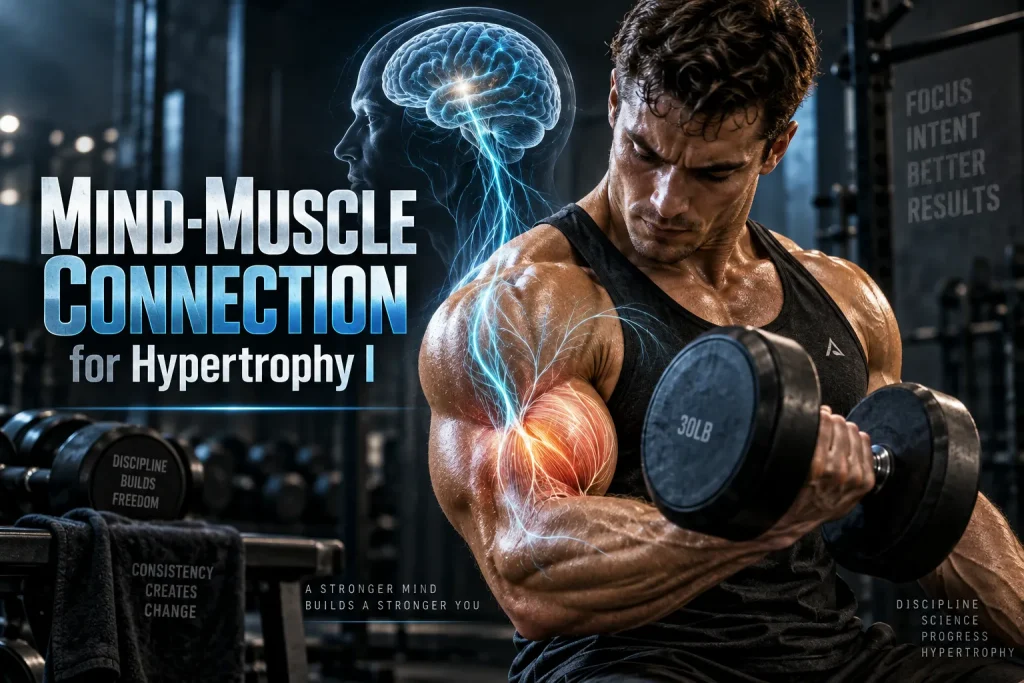
You squeeze the dumbbells harder but your biceps still feel nothing. The weight moves but the muscle stays cold and uninvolved. Mind-Muscle Connection for Hypertrophy bridges this gap between lifting and growing.
Mind-Muscle Connection for Hypertrophy
The mind-muscle connection is one of bodybuilding’s oldest training concepts. Lifters are routinely told to stop simply moving the weight and instead feel the muscle working. For decades, this advice was based largely on bodybuilding experience rather than controlled research.
But does consciously focusing on a muscle actually make it grow more?
There is some scientific evidence that mind-muscle connection can improve hypertrophy under certain conditions, particularly when an internal attentional focus helps a lifter direct more effort toward the intended muscle. However, the effect is not universal, and concentrating harder on every muscle during every exercise is unlikely to be the best approach.
For natural lifters, the real value of mind-muscle connection is learning when an internal focus may improve the hypertrophy stimulus and when focusing on performance is more useful.
What Is the Mind-Muscle Connection?
The mind-muscle connection describes consciously directing your attention toward the muscle you want to train while performing an exercise.
Researchers generally call this an internal attentional focus.
During a biceps curl, for example, an internal focus might involve thinking about contracting and shortening the biceps as you lift the weight.
An external attentional focus directs attention toward the outcome or environment instead. During that same curl, you might focus on moving the dumbbell upward or completing the repetition efficiently.
That difference sounds minor, but attentional focus can alter how a movement is performed and how muscles are recruited.
This creates an interesting hypertrophy question:
If consciously focusing on a muscle increases its involvement during an exercise, could repeatedly training that way eventually increase muscle growth?
Can the Mind-Muscle Connection Increase Muscle Growth?
One of the most pertinent studies addressing this question was conducted by Brad Schoenfeld and colleagues.
Thirty untrained college-aged men were assigned to either an internal-focus or external-focus resistance-training group for eight weeks. Both groups trained three times per week and performed four sets of 8–12 repetitions.
The internal-focus participants were instructed to concentrate on contracting the target muscle. The external-focus participants concentrated on the outcome of the movement.
After eight weeks, elbow-flexor muscle thickness increased 12.4% in the internal-focus group compared with 6.9% in the external-focus group.
Interestingly, the same advantage was not observed in the quadriceps.
This makes the study particularly useful because it demonstrates both the potential benefit and the limitations of mind-muscle connection.
Read the scientific report: Differential Effects of Attentional Focus Strategies During Long-Term Resistance Training.
The results suggest that deliberately focusing on a target muscle can enhance hypertrophy in some circumstances, but they do not prove that internal focus universally produces superior muscle growth.
That distinction is critical.
Why Might Mind-Muscle Connection Help Hypertrophy?
A muscle grows primarily in response to an adequate resistance-training stimulus accumulated over time.
If an exercise involves several muscles, changing how you perform it can potentially change how the workload is distributed between them.
Imagine a pulldown.
The movement involves the latissimus dorsi, elbow flexors, and several other muscles. Two people could perform what looks like essentially the same pulldown while distributing muscular effort somewhat differently.
One lifter may simply think about getting the handle down.
Another may deliberately think about driving the upper arm toward the torso while contracting the lats.
The second strategy does not magically transform the exercise. However, an internal focus may help some lifters direct muscular effort toward the tissue they actually want to develop.
This may be particularly relevant during bodybuilding exercises where target-muscle development matters more than moving the greatest possible load.
Muscle Activation Is Not the Same as Muscle Growth
This is where the mind-muscle connection is frequently oversold.
Studies have often examined attentional focus using electromyography, or EMG. Research generally indicates that consciously focusing on a muscle can increase its measured activation under some conditions.
But increased EMG activity during a workout does not automatically prove greater long-term hypertrophy.
Muscle growth is a chronic adaptation occurring over weeks, months, and years. Acute muscle activation is only one piece of a much larger picture.
Training volume, exercise selection, range of motion, progressive overload, effort, fatigue management, nutrition, recovery, and consistency all influence the eventual result.
Therefore, a better pump, stronger sensation, or higher EMG reading should not automatically be interpreted as evidence that an exercise will produce more growth.
The direct hypertrophy research is much more important—and currently much more limited.
Internal vs External Focus for Hypertrophy
This creates an apparent contradiction.
Internal focus may sometimes help lifters emphasize a target muscle, while external focus frequently improves physical performance.
A meta-analysis examining attentional focus and muscular strength found an acute strength advantage from using an external rather than internal focus. Long-term overall strength gains were not significantly different, although an external focus showed an advantage for lower-body strength in subgroup analysis.
This suggests that the best attentional strategy may depend on your immediate objective.
If your goal is maximizing performance on a heavy compound lift, concentrating on executing the movement may be preferable.
If your objective is making a specific muscle the limiting factor during a controlled hypertrophy exercise, an internal focus may become more useful.
Bodybuilding therefore does not require choosing one strategy permanently.
Use the focus that best matches the exercise and objective.
Mind-Muscle Connection May Work Better With Moderate Loads
Trying to establish an intense mind-muscle connection during a maximal squat or near-maximal deadlift is very different from doing it during a controlled cable curl.
As load increases, successfully completing the movement requires greater attention to whole-body execution.
The ability to focus on a target muscle is partly influenced by the exercise itself, because movements requiring substantial balance and stabilization can divide attention and effort. To understand this programming factor in greater depth, read Exercise Stability for Hypertrophy: Does It Matter?
During heavy compound training, deliberately thinking about one individual muscle may interfere with efficient movement or force production.
Moderate-load hypertrophy exercises provide more opportunity to concentrate on a particular muscle while maintaining good technique.
Think of exercises such as:
- cable curls
- triceps extensions
- lateral raises
- pec flyes
- leg extensions
- hamstring curls
- machine rows
- pulldowns
These exercises generally make it easier to consciously contract the intended muscle without sacrificing the basic movement.
That makes the mind-muscle connection potentially more useful for controlled bodybuilding work than maximal strength work.
Compound Exercises Require a Different Approach
A common mistake is attempting to feel every compound exercise exclusively in one muscle.
Consider the bench press.
The pectorals, anterior deltoids, and triceps all contribute to the movement. Trying to eliminate the triceps or shoulders is neither necessary nor realistic.
Similarly, squats involve multiple muscles working together. Attempting to consciously isolate the quadriceps during every heavy squat repetition could distract from maintaining an efficient movement pattern.
This does not mean mind-muscle connection has no place in compound exercises.
You can still use internal cues when they improve execution. But during technically demanding lifts, the primary objective should usually be performing stable, repeatable repetitions with the intended technique.
You do not need to turn a compound exercise into an isolation exercise through concentration.
Why You Don’t Need to “Feel” a Muscle for It to Grow
Another bodybuilding myth is that an exercise is ineffective unless you strongly feel the target muscle.
That is not true.
A muscle can produce substantial force and receive a hypertrophic stimulus without creating an intense subjective sensation.
Consider progressive resistance training. If you perform an exercise with sound technique, adequate range of motion, sufficient effort, and progressive loading, the targeted musculature can grow even if every repetition does not produce an enormous mind-muscle sensation.
This is particularly important for beginners.
New lifters often struggle to feel muscles because they have limited experience performing the exercises. That does not mean their workouts are worthless.
Mind-muscle connection should therefore be viewed as a potential optimization tool rather than a prerequisite for hypertrophy.
The Mind-Muscle Connection and Exercise Selection
If you consistently cannot feel a target muscle, first examine the exercise itself.
Suppose your goal is lat hypertrophy, but every rowing variation seems limited by your lower back or grip.
Simply thinking harder about your lats may not solve the underlying problem.
A chest-supported row or appropriately selected machine might reduce unrelated demands and make it easier to train the target musculature.
Likewise, if a pressing exercise consistently causes discomfort or primarily feels limited by another muscle group, changing the exercise may be more productive than repeatedly attempting to improve the mind-muscle connection.
Mental focus cannot rescue poor exercise selection.
The exercise still needs to fit your structure, goals, and ability to progressively train it.
When Mind-Muscle Connection Is Most Useful
Mind-muscle connection is probably most valuable when the movement is already technically stable and your goal is maximizing the contribution of a specific muscle.
Isolation exercises are obvious candidates.
During a biceps curl, concentrating on elbow flexion and contracting the biceps may help prevent the movement from becoming a whole-body exercise.
During a lateral raise, focusing on controlled shoulder abduction can discourage excessive momentum.
During a pec fly, thinking about bringing the upper arms toward one another may help maintain attention on the chest rather than simply moving the handles.
The common characteristic is precision.
Internal focus becomes useful when it improves the execution of an exercise rather than distracting from it.
When You Should Not Force the Mind-Muscle Connection
More concentration is not always better.
Do not force an internal focus if it causes your performance to deteriorate significantly.
If concentrating intensely on your chest causes you to lose several repetitions on a press, the tradeoff may not be worthwhile.
Similarly, do not intentionally slow repetitions to an extreme simply because doing so increases the sensation in the muscle.
Hypertrophy training still requires meaningful resistance and sufficient effort.
You also should not continually reduce the load just to produce a better pump.
A strong muscle sensation can be useful feedback, but it should exist alongside progressive training rather than replace it.
Mind-Muscle Connection vs Progressive Overload
If forced to choose between becoming progressively stronger within a productive hypertrophy rep range and achieving an intense muscle sensation without measurable progression, progression deserves priority.
The mind-muscle connection should support progressive overload, not compete with it.
Suppose you perform dumbbell curls with excellent control and can clearly feel your biceps working.
Over several months, you progress from 20-pound dumbbells to 30-pound dumbbells while maintaining similar technique and repetition ranges.
That represents meaningful training progress.
But repeatedly using 20 pounds forever because it creates an exceptional biceps pump is not necessarily superior hypertrophy training.
Muscle growth requires continued stimulus.
Use internal focus to improve where that stimulus goes, then progressively develop your performance while preserving the desired execution.
How to Improve Your Mind-Muscle Connection
Developing better muscular awareness does not require complicated techniques.
Start by selecting an exercise that provides a stable setup and clear target-muscle function.
Use a manageable load that allows controlled repetitions.
During the eccentric portion, maintain control rather than simply allowing the resistance to fall.
During the concentric phase, think about performing the target muscle’s primary action rather than merely moving the weight from point A to point B.
For example, during a curl, think about shortening the biceps through elbow flexion rather than throwing the dumbbell upward.
During a pulldown, concentrate on moving your upper arm toward your torso rather than simply pulling the bar down with your hands.
With practice, this becomes more natural.
The objective is not meditation during every repetition. It is developing enough awareness to recognize whether the exercise is being performed as intended.
Can Advanced Lifters Benefit More?
Potentially.
Experienced bodybuilders generally have better movement skill and muscular awareness than beginners. They may therefore be able to alter technique or attentional focus without compromising exercise execution.
Beginners have more fundamental priorities.
Learning basic technique, controlling the resistance, developing consistent range of motion, training hard enough, and progressively adding repetitions or resistance will generally matter more than mastering subtle internal-focus techniques.
As training experience increases, smaller refinements become more valuable.
That is where mind-muscle connection can become another useful tool in an advanced hypertrophy program.
Is Mind-Muscle Connection Necessary for Muscle Growth?
No.
You can build substantial muscle without deliberately thinking about individual muscles throughout every workout.
Progressive resistance training remains the foundation.
But the evidence also means mind-muscle connection should not simply be dismissed as bodybuilding folklore.
At least one controlled long-term study found substantially greater elbow-flexor hypertrophy when subjects deliberately focused on contracting the target muscle, although the effect did not carry over to quadriceps growth.
The correct conclusion therefore lies between two extremes.
Mind-muscle connection is neither essential nor useless.
It is a situational training strategy.
Frequently Asked Questions
Does mind-muscle connection actually build muscle?
There is limited direct evidence suggesting that an internal attentional focus can increase hypertrophy in some muscles. However, considerably more research is needed before concluding that it improves growth across all muscles and exercises.
Should I focus on the muscle during every set?
No. Internal focus may be most useful during controlled hypertrophy and isolation exercises. Heavy compound exercises may benefit more from concentrating on overall movement execution.
Is feeling the muscle necessary for hypertrophy?
No. A strong muscle sensation is not required for growth. Effective resistance training can stimulate hypertrophy even without an intense pump or conscious muscle sensation.
Is mind-muscle connection better than progressive overload?
No. Mind-muscle connection should complement progressive overload. It should help you direct an effective stimulus toward the intended muscle without preventing long-term progression.
Does mind-muscle connection work better for isolation exercises?
It may be easier and more practical during isolation exercises because fewer muscles and movement demands compete for attention.
Does a better pump mean better muscle growth?
Not necessarily. A pump indicates increased blood and fluid within trained muscle tissue, but it cannot reliably tell you how much long-term hypertrophy an exercise will produce.
The Bottom Line
The mind-muscle connection for hypertrophy has more scientific support than many lifters assume, but less evidence than bodybuilding folklore sometimes suggests.
Direct research has shown that an internal focus can potentially enhance muscle growth in certain circumstances, particularly in the elbow flexors. At the same time, external focus can improve strength and muscular endurance performance, and the hypertrophy advantage of internal focus has not been consistently demonstrated across different muscle groups.
The practical solution is to use attentional focus strategically.
For heavy compound exercises, prioritize stable technique, force production, and repeatable execution. For controlled hypertrophy and isolation exercises, experiment with deliberately focusing on the target muscle when doing so improves its involvement without dramatically reducing performance.
Most importantly, do not allow the mind-muscle connection to replace the fundamentals.
Progressive overload, productive exercise selection, sufficient training volume, appropriate effort, recovery, and consistency remain the foundation of muscle growth.
Think of mind-muscle connection as the final adjustment—not the engine driving the entire program.
When consciously focusing on a muscle helps you place a better training stimulus where you want it, use it.
When it interferes with performance, don’t force it.
That balance turns the mind-muscle connection from bodybuilding mythology into a practical hypertrophy tool.