
Shaky Lifts Still Build Muscle? What Science Found
Training on unstable surfaces significantly reduces the force, power, and weight you can lift, which directly limits mechanical tension needed for muscle growth. Research shows that stable surfaces allow for greater peak force and rate of force development, making them superior for building muscle mass.
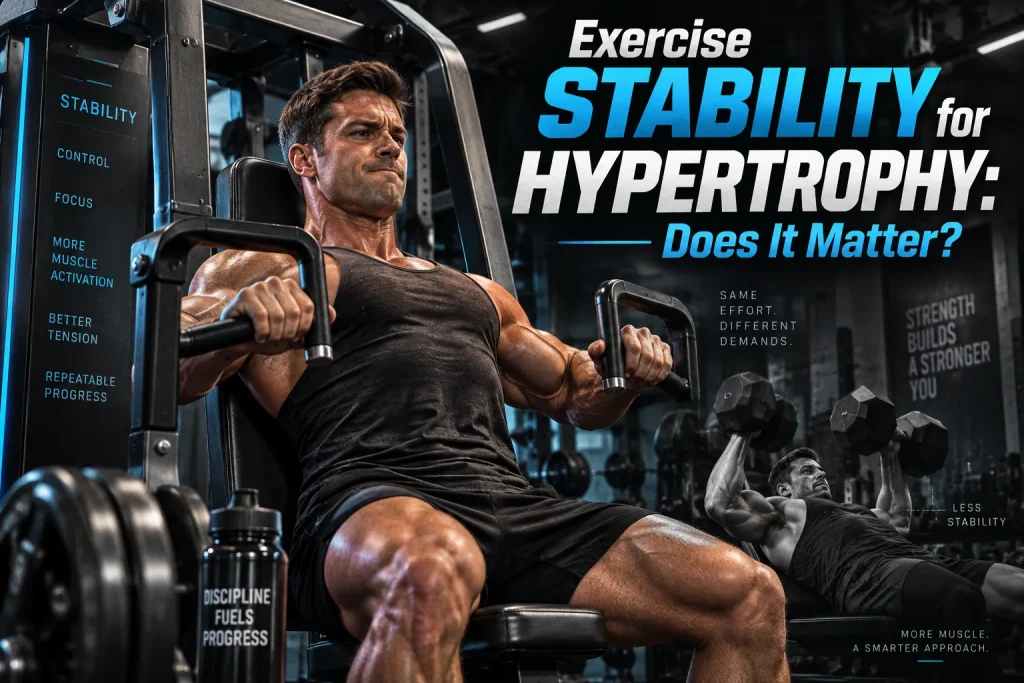
Exercise Stability for Hypertrophy: Does It Matter? Most gyms now have Swiss balls and unstable platforms stacked in every corner. Trainers put clients on wobbly surfaces to “activate more muscles.” This actually hurts muscle growth, not helps it.
Exercise Stability for Hypertrophy: Does It Matter?
Exercise stability has become an increasingly important topic in hypertrophy training. Walk into almost any gym and you will see exercises ranging from highly stable machine presses and chest-supported rows to barbell squats, dumbbell presses, cable movements, and exercises requiring substantial balance and coordination.
But does exercise stability actually matter for muscle growth?
The short answer is yes—but probably not in the way many lifters think.
A more stable exercise can make it easier to direct force toward the muscles you want to train, maintain consistent technique, approach muscular failure safely, and progressively overload the movement. However, this does not mean machines automatically build more muscle than free weights. Research comparing machine-based and free-weight resistance training generally finds similar hypertrophy when both are performed effectively.
To understand the broader role of balance, external support, target-muscle recruitment, and exercise selection beyond near-failure training, Exercise Stability for Hypertrophy: Does It Matter? explains how stability can influence hypertrophy across an entire training program.
For natural lifters, the practical question is therefore not, “Are stable exercises better?” Instead, ask:
Does this exercise provide enough stability for the target muscle to become the primary limiting factor while still allowing effective loading, progression, and comfortable movement?
That distinction can dramatically improve exercise selection.
What Is Exercise Stability?
Exercise stability describes how much balance, coordination, and stabilization are required to perform a resistance exercise successfully.
Consider the difference between a standing dumbbell shoulder press and a machine shoulder press.
During the standing dumbbell press, your legs, trunk, shoulders, and numerous smaller stabilizing muscles must work together to maintain your position and control two independent weights.
A well-designed shoulder press machine provides external support and guides much of the movement path. You still produce force, but you devote less effort to preventing unwanted movement.
Neither approach is inherently superior.
They simply create different stability demands.
Exercise stability exists on a spectrum rather than in two categories.
A barbell back squat may be more stable than a Bulgarian split squat but less externally stable than a hack squat. A dumbbell bench press generally requires more stabilization than a barbell bench press, while many chest press machines provide even greater external stability.
Understanding that spectrum is useful because hypertrophy training has different requirements from balance training or maximizing skill in a particular free-weight lift.
Equipment choice can substantially change stability demands, range of motion, and how easily you can push a target muscle close to failure. For a complete comparison of these differences, see Free Weights vs Machines for Muscle Growth
Why Stability Could Matter for Muscle Growth
Muscle hypertrophy ultimately requires the target musculature to experience sufficient mechanical loading repeatedly over time.
That means an exercise needs to allow you to produce meaningful muscular force through a useful range of motion while accumulating enough challenging training.
Stability can influence this process indirectly.
Imagine performing a set in which your quadriceps could theoretically produce several more repetitions, but your balance deteriorates first. The set ends because you cannot maintain position rather than because the quadriceps are sufficiently fatigued.
From a hypertrophy perspective, that can be inefficient.
Now compare that with a hack squat in which your torso and movement path are supported. Because balance is less likely to terminate the set, you may be able to continue until the knee extensors become much closer to their muscular limit.
This is one reason stable exercises can be extremely useful for bodybuilding.
The important distinction is that stability itself is not the hypertrophic stimulus.
Instead, stability may create conditions that make it easier to expose the target muscle to an effective stimulus.
Greater exercise stability may also make it easier to deliberately focus on the target muscle instead of dividing attention between force production, balance, and controlling the movement. Learn how that internal focus may influence training in Mind-Muscle Connection for Hypertrophy.
What Does the Research Say?
One of the strongest pieces of evidence comes from a systematic review and meta-analysis examining free-weight and machine-based resistance training.
The Effect of Free-Weight vs. Machine-Based Strength Training on Maximal Strength, Hypertrophy and Jump Performance systematic review and meta-analysis included 13 studies and 1,016 participants. Five of the included studies provided hypertrophy outcomes.
The researchers found no significant difference in muscle hypertrophy between free-weight and machine-based resistance training.
This finding is particularly relevant because free-weight exercises generally impose greater stabilization requirements, whereas resistance machines generally provide greater external stability.
The evidence therefore does not support the simplistic claim that machines automatically produce more muscle because they are more stable—or that free weights produce more muscle because they recruit more stabilizing musculature.
Instead, both can build muscle effectively.
The meta-analysis also found an important difference when strength was considered: improvements tended to follow the specific training modality. People training with free weights became particularly good at free-weight strength tests, while machine training favored performance on machine-based tests.
That is the principle of specificity in action.
For hypertrophy, however, muscle growth was comparable between modalities.
Stability vs. Instability: An Important Distinction
There is also a difference between an exercise requiring normal stabilization and deliberately making an exercise unstable.
A barbell squat requires stabilization.
Squatting while standing on an unstable surface introduces deliberate instability.
Those are not the same thing.
Some instability is unavoidable and can be useful. Extreme instability, however, can reduce your ability to apply force.
For hypertrophy training, creating instability merely to make an exercise “harder” is usually unnecessary. Making an exercise more difficult does not automatically make it more effective for muscle growth.
If balancing becomes the limiting factor, you may actually reduce the loading potential of the muscles you are trying to develop.
That is why BOSU-ball squats, unstable-surface presses, and similar variations generally have limited value as primary hypertrophy exercises.
They may have applications for balance, rehabilitation, proprioception, or sport-specific preparation, but those are different goals.
More Stability Does Not Automatically Mean More Hypertrophy
This point deserves emphasis.
If stability were the dominant factor controlling hypertrophy, machines should consistently outperform free weights for muscle growth.
They do not.
A randomized controlled trial provides a useful example.
In Free-Weight and Machine-Based Training Are Equally Effective on Strength and Hypertrophy: Challenging a Traditional Myth, researchers assigned 38 resistance-trained men to eight weeks of either free-weight or machine-based resistance training.
The programs included comparable versions of squats, bench presses, rows, and shoulder presses, with training variables controlled between groups.
Both groups significantly increased muscle size.
Importantly, the researchers found no significant differences between the free-weight and machine groups in hypertrophy of the muscles measured.
That reinforces an important principle:
Exercise stability matters, but it is only one component of effective exercise selection.
A highly stable exercise can still be poor for a particular lifter because of uncomfortable joint positioning, an unsuitable resistance profile, limited range of motion, or difficulty progressing.
Likewise, a free-weight movement requiring substantial stabilization can still be an excellent hypertrophy exercise if the lifter can execute it consistently and load the target musculature effectively.
The Real Advantage of Stable Exercises
The greatest hypertrophy advantage of stability may be reducing irrelevant limitations.
Suppose your goal is growing your back.
During an unsupported bent-over row, several things may limit your set:
- lower-back fatigue,
- hamstring fatigue,
- maintaining your torso angle,
- grip,
- cardiovascular demand,
- or the target back muscles themselves.
Now perform a chest-supported row.
Supporting the torso removes some of those competing demands. Your lower back no longer needs to maintain the same isometric position, and you may find it easier to focus your effort on shoulder extension and scapular movement.
That does not guarantee greater back growth.
But it can improve the exercise’s stimulus-to-fatigue relationship for some lifters.
The same principle applies throughout hypertrophy programming.
A seated leg curl removes most balance requirements.
A preacher curl stabilizes the upper arm.
A cable lateral raise provides a predictable resistance path.
A machine chest press supports the torso.
A hack squat provides more external stability than many free-weight squat variations.
These features can make exercises easier to repeat consistently and progressively overload.
Stability and Training Close to Failure
Exercise stability may become especially useful as a set approaches muscular failure.
Early repetitions often look similar regardless of stability because fatigue is relatively low. During the final challenging repetitions, however, maintaining balance and positioning becomes harder.
A stable exercise reduces the number of variables you need to control.
This can make it easier to determine whether the target muscle actually reached the intended effort level.
Consider leg training.
Taking a set of machine leg extensions close to failure is straightforward. Your body is supported and the exercise has a simple movement path.
Taking walking lunges to true muscular failure is more complicated. Balance, breathing, coordination, cardiovascular fatigue, grip, and general discomfort may influence when the set stops.
Lunges can absolutely build muscle.
But the reason for choosing them should not simply be that they are more difficult.
For hypertrophy, difficulty and stimulus are not synonymous.
Stable Exercises and Progressive Overload
Progressive overload is another reason stability deserves attention.
A good hypertrophy exercise should allow performance to be tracked reliably.
If you performed 10 repetitions with a certain load last week and 12 repetitions this week using comparable technique, that progression provides useful information.
But when exercise execution varies substantially from session to session, performance becomes harder to interpret.
Greater stability can improve repeatability.
This is particularly valuable for natural lifters because muscle growth occurs slowly. Small improvements accumulated over months matter.
You want exercises that allow you to compare performance meaningfully across time.
If your stance, balance, torso position, or movement path changes dramatically from set to set, it becomes difficult to determine whether you are genuinely becoming stronger in the target movement.
Stable exercises can reduce this noise.
When Free Weights May Be the Better Choice
None of this means you should replace every free-weight exercise with a machine.
Free weights offer major advantages.
They are versatile, widely available, highly adjustable, and can train large amounts of muscle simultaneously. They also develop coordination and strength in the specific movements being performed.
Barbell squats, Romanian deadlifts, dumbbell presses, overhead presses, rows, and other free-weight exercises can all be excellent hypertrophy movements.
If a free-weight exercise feels natural, provides a strong target-muscle stimulus, allows progressive overload, and does not create excessive fatigue elsewhere, there may be no reason to replace it.
Remember what the research shows: greater machine stability has not demonstrated a universal hypertrophy advantage over free weights.
The goal is not maximum stability.
The goal is sufficient stability.
When Machines May Be the Better Choice
Machines become particularly attractive when additional stability improves the quality of your hard sets.
For example, machines can be useful when:
- balance limits a free-weight variation,
- another muscle consistently fatigues before the target muscle,
- you want to safely train very close to failure,
- accumulated systemic fatigue is high,
- you need a movement that is easy to standardize,
- or you want additional volume without adding unnecessary stabilization demands.
This makes machines especially useful later in a workout.
A lifter might begin lower-body training with squats or Romanian deadlifts and then use a hack squat, leg extension, or leg curl to accumulate additional targeted volume.
For the upper body, a session could combine free-weight pressing with cable flyes, machine presses, chest-supported rows, and lateral-raise machines.
This hybrid approach avoids treating machines and free weights as opposing philosophies.
Stability Is Muscle-Specific
Another overlooked point is that stability should be evaluated relative to the muscle you are trying to train.
An exercise can be stable overall yet fail to provide the desired target-muscle stimulus.
Conversely, an exercise may require substantial whole-body stabilization while still loading the target muscle extremely well.
Ask yourself:
What is actually causing me to stop the set?
If you are performing a quadriceps exercise and consistently stop because you lose balance, stability may be limiting hypertrophy efficiency.
If you are performing a chest-supported row and stop because your back musculature can no longer produce enough force with good technique, the exercise is probably accomplishing its intended purpose.
This concept is more useful than categorizing exercises simply as “stable” or “unstable.”
How Much Stability Do You Need for Hypertrophy?
You need enough stability that you can train the intended muscle hard without unnecessary limitations.
You do not need every exercise to be maximally stabilized.
A practical hypertrophy exercise should allow you to:
- Maintain repeatable technique.
- Produce high muscular effort.
- Load the target muscle effectively.
- Approach failure without balance becoming the main limitation.
- Progress repetitions or resistance over time.
- Use a productive range of motion.
- Train without unacceptable joint discomfort.
- Recover sufficiently for subsequent training.
If an exercise satisfies those criteria, its exact position on the stability spectrum becomes less important.
Should Beginners Prioritize Stable Exercises?
Beginners can benefit from both stable and less-stable exercises.
Machines can simplify training because fewer technical variables need to be learned simultaneously. That can help beginners understand muscular effort and establish consistent movement patterns.
Free weights, however, develop exercise-specific coordination and can provide efficient full-body training.
A beginner therefore does not need to choose one exclusively.
A program might combine a machine chest press with dumbbell curls, a leg press with Romanian deadlifts, and a chest-supported row with cable lateral raises.
As technique improves, exercise selection can become increasingly individualized.
Should Advanced Lifters Use More Stable Exercises?
Advanced hypertrophy-focused lifters may sometimes gain more practical value from stable exercises because their goal becomes increasingly specific.
An experienced bodybuilder may not need every exercise to challenge balance or coordination. The objective may simply be to place a particular muscle under high tension while managing fatigue.
Advanced lifters also tend to use more total training volume and heavier absolute loads.
Under those conditions, externally stable movements can make targeted training easier to recover from and repeat.
That still does not mean advanced lifters should abandon free weights.
Instead, they can choose stability strategically.
Stability is only one part of choosing an effective hypertrophy movement; range of motion, target-muscle loading, progression potential, comfort, and fatigue cost also matter. Use How to Choose Exercises for Muscle Growth to bring these factors together when building your exercise selection.
Exercise Stability vs. Exercise Quality
Stability should ultimately be viewed as one characteristic of exercise quality, not the deciding characteristic.
When choosing exercises for hypertrophy, consider the complete picture:
- target-muscle loading,
- stability,
- range of motion,
- resistance profile,
- comfort,
- progression potential,
- fatigue,
- setup requirements,
- and individual anatomy.
No single characteristic automatically determines whether an exercise is good.
A movement that looks biomechanically perfect on paper is not useful if you cannot perform it comfortably or progressively.
Likewise, a supposedly “less optimal” exercise may produce excellent results if it allows months or years of consistent progression.
A Practical Stability Test for Exercise Selection
You can evaluate almost any hypertrophy exercise with four questions.
First: What ends the set?
Ideally, the target musculature should be a major reason you cannot continue.
Second: Can I repeat the movement consistently?
Your technique does not need to be mechanically identical on every repetition, but large variations make progression harder to evaluate.
Third: Can I safely approach the desired effort level?
Exercises that become dangerous or highly unpredictable near failure may be better performed with slightly more repetitions in reserve or replaced with a more stable variation.
Fourth: Can I progressively overload it?
If the exercise allows you to gradually increase repetitions, resistance, or training quality, it has long-term hypertrophy potential.
If greater stability improves these four characteristics, increasing stability is probably worthwhile.
Frequently Asked Questions
Are machines better than free weights for hypertrophy?
Not inherently. Current research indicates that both machine-based and free-weight resistance training can produce similar muscle hypertrophy. The better choice depends on the exercise, target muscle, individual anatomy, training goals, and ability to progressively overload the movement.
Does more stability mean more muscle growth?
No. Greater stability may make it easier to target a muscle and train close to failure, but stability itself does not guarantee greater hypertrophy.
Are unstable exercises bad for building muscle?
Not necessarily, but deliberately unstable exercises are usually unnecessary when hypertrophy is the primary objective. If instability substantially reduces force production or causes balance to terminate the set, a more stable alternative may be more efficient.
Are free weights less effective because they require stabilizers?
No. Free weights can produce substantial hypertrophy. The additional stabilization demand only becomes a potential problem when it prevents the target muscle from receiving sufficient loading or consistently limits the set.
Should natural bodybuilders use machines?
Absolutely. Machines can provide stable, repeatable, highly targetable resistance and are especially useful for accumulating hard training volume. They can be combined with free weights rather than replacing them entirely.
What is the best level of exercise stability for hypertrophy?
The best level is generally enough stability to let the target musculature work hard without balance or unrelated fatigue unnecessarily limiting performance. Maximum stability is not required.
Final Takeaway: Does Exercise Stability Matter for Hypertrophy?
Exercise stability matters for hypertrophy, but it should not become another rigid rule.
Research comparing free weights and machines shows that both can produce similar muscle growth. The evidence does not justify claiming that highly stable machine exercises are universally superior for hypertrophy, nor does it support the idea that free weights automatically build more muscle because they recruit additional stabilizers.
Instead, stability matters because it can influence how effectively you perform the exercise.
More external stability can reduce balance requirements, improve repeatability, help isolate the intended movement, make training close to failure more manageable, and facilitate progressive overload.
But once an exercise is sufficiently stable to accomplish those objectives, adding even more stability does not automatically increase muscle growth.
For natural lifters, the most useful principle is simple:
Choose exercises that are stable enough for the target muscle—not your balance, coordination, or unrelated fatigue—to be a major limiting factor.
Then judge the exercise by what ultimately matters: whether you can train it hard, perform it consistently, progressively overload it, recover from it, and use it to accumulate productive training over months and years.
That is where exercise stability becomes valuable—not as the goal of hypertrophy training, but as a tool for making the hypertrophy stimulus more reliable.