
Why Machines Hold Back the Muscle Growth You Want
Research reveals that free weights and machines produce comparable muscle growth when training volume is equal, challenging the common gym debate. What matters most is the tension and mechanical load on your muscles, not the equipment you choose.
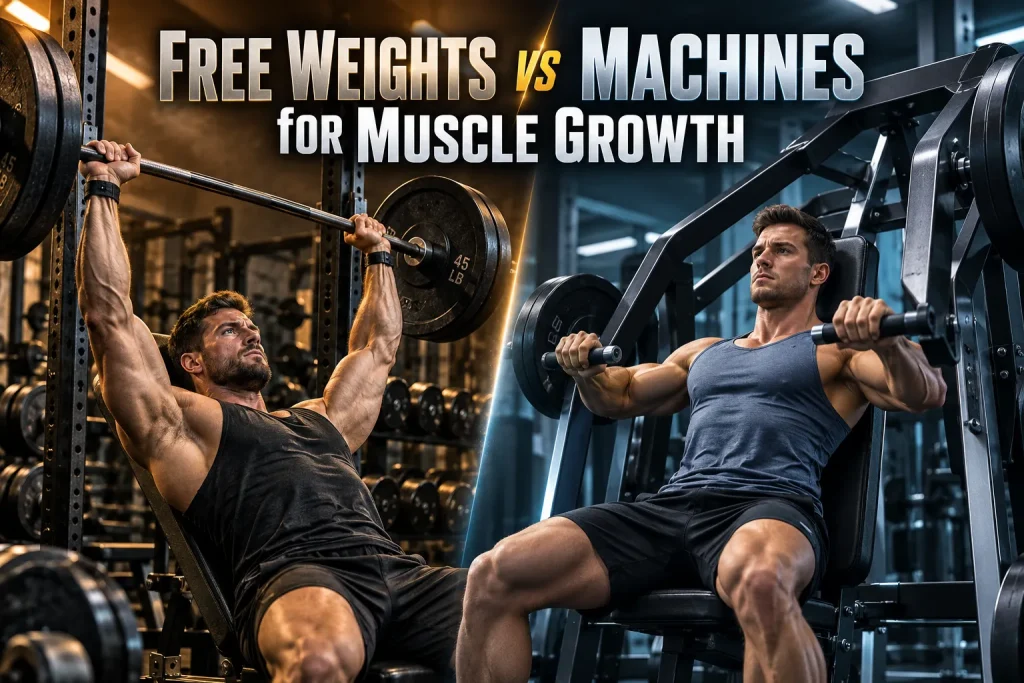
Free Weights vs Machines for Muscle Growth creates one of the gym’s biggest debates. You hear strong opinions on both sides. Most trainers lean toward free weights as the superior choice. The research tells a different story than you might expect.
Free Weights vs Machines for Muscle Growth
Walk into almost any gym and you will see two distinct approaches to building muscle. On one side are lifters performing barbell squats, dumbbell presses, rows, and other free-weight exercises. On the other are people using chest presses, leg presses, hack squats, cable stations, and selectorized machines.
This raises one of the most common questions in hypertrophy training: Are free weights or machines better for muscle growth?
The evidence provides a surprisingly straightforward answer. Neither method appears inherently superior for hypertrophy. When resistance training is performed with sufficient effort, appropriate volume, progressive overload, and exercises that effectively challenge the target muscles, both free weights and machines can build substantial muscle.
The more useful question, therefore, is not simply which type of equipment builds more muscle. It is which exercise allows you to train a particular muscle most effectively, progressively, comfortably, and consistently.
Understanding that distinction can make exercise selection much easier.
One of the most important differences between these training methods is how much stability the exercise provides, which can affect force production, fatigue, and how effectively you load the intended muscle. For a deeper look at this factor, read Exercise Stability for Hypertrophy: Does It Matter?
Free Weights vs Machines: What Does the Research Show?
The strongest evidence comes from research directly comparing the two training modalities.
A 2023 systematic review and meta-analysis examined 13 studies involving 1,016 participants and compared free-weight and machine-based resistance training. Five of the included studies assessed hypertrophy.
The researchers found no significant difference in muscle hypertrophy between free-weight and machine training.
Read the scientific report: Effect of Free-Weight vs. Machine-Based Strength Training on Maximal Strength, Hypertrophy and Jump Performance – A Systematic Review and Meta-Analysis.
Interestingly, strength gains were much more specific to the equipment being used. People who trained with free weights generally became better at free-weight strength tests, while machine training tended to produce greater improvements when strength was tested on machines.
That distinction is important.
Strength is highly exercise-specific, while hypertrophy appears considerably less dependent on whether the resistance comes from a barbell, dumbbell, or machine.
An earlier systematic review and meta-analysis reached essentially the same conclusion. It found no meaningful difference in hypertrophy between machine and free-weight exercises, while strength improvements were influenced by the type of exercise used during training.
For bodybuilding, that means equipment should generally be viewed as a tool for delivering muscular tension, rather than the primary determinant of whether growth occurs.
Why Free Weights Can Be Excellent for Muscle Growth
Free weights remain extremely valuable for hypertrophy training.
Barbells and dumbbells allow lifters to perform foundational exercises such as squats, Romanian deadlifts, bench presses, overhead presses, rows, curls, and lateral raises.
One major advantage is flexibility.
A dumbbell, for example, does not lock your joints into one predetermined path. You can often modify grip width, elbow position, stance, range of motion, or movement trajectory to accommodate your anatomy.
Free weights are also excellent for exercises involving multiple muscle groups.
A barbell squat simultaneously challenges the quadriceps, glutes, adductors, trunk musculature, and other supporting muscles. A bench press heavily trains the pectorals while also involving the anterior deltoids and triceps.
This makes compound free-weight exercises particularly useful when you want to train several muscles efficiently.
Free weights also develop skill and stabilization requirements that machines often reduce. Controlling a heavy dumbbell press or squat requires you to stabilize the resistance while producing force.
That can be valuable, particularly when strength and athletic competence are secondary goals.
However, greater stabilization does not automatically mean greater hypertrophy.
If stabilization becomes the limiting factor before the target muscle receives sufficient stimulus, the increased instability can actually become a disadvantage for bodybuilding.
Why Machines Can Be Excellent for Hypertrophy
Machines sometimes get dismissed as inferior because they require less stabilization.
For hypertrophy, that reasoning is questionable.
Muscle growth does not require an exercise to be difficult to balance. What matters is whether the target muscle experiences sufficient mechanical loading across repeated hard sets and whether that stimulus can be progressively increased over time.
Machines provide an external source of stability, which can allow you to concentrate more heavily on producing force with the muscles you actually want to train.
Consider a chest-supported machine row.
Because your torso is supported, you do not need to devote as much effort to maintaining body position. That potentially allows the upper-back musculature to become the primary limiting factor.
The same logic applies to exercises such as:
- hack squats
- leg presses
- leg extensions
- hamstring curls
- machine chest presses
- machine rows
- cable exercises
When hypertrophy is the primary objective, reducing unnecessary stability demands can sometimes make an exercise more effective, not less effective.
A Direct Training Study Provides Strong Evidence
One particularly relevant study compared machine and free-weight training in resistance-trained men over eight weeks.
The participants performed equivalent programs using either free-weight or machine versions of exercises including squats, bench presses, rows, and shoulder presses.
Both groups increased muscle size.
More importantly, researchers found no significant differences between groups in the increases in cross-sectional area of the muscles examined.
Read the study: Free-Weight and Machine-Based Training Are Equally Effective on Strength and Hypertrophy: Challenging a Traditional Myth.
The study also demonstrated the specificity of strength adaptations. Participants tended to improve more on the equipment they practiced, yet hypertrophy remained similar between groups.
Another randomized eight-week study involving 46 participants likewise found that biceps and quadriceps muscle thickness increased without significant differences between free-weight and machine groups.
Collectively, this evidence makes it difficult to justify the claim that free weights are universally superior for building muscle.
Stability Changes the Exercise
One of the biggest practical differences between free weights and machines is stability.
A free-weight movement generally requires the lifter to control more degrees of freedom. Machines typically constrain some portion of the movement.
But stability should not be treated as automatically good or bad.
Imagine performing a dumbbell chest press. Your chest, triceps, and shoulders produce force while your body simultaneously controls the dumbbells.
Now compare that with a well-designed machine chest press.
The machine handles much of the stabilization, potentially allowing you to devote more effort to pressing through the target musculature.
For someone training primarily for hypertrophy, that can be advantageous.
Conversely, a machine that does not accommodate your structure may feel awkward or uncomfortable. In that case, the freedom provided by dumbbells could make them the superior option.
The best exercise is therefore highly contextual.
Which Is Better for Progressive Overload?
Both.
Progressive overload simply means increasing the training stimulus as your body adapts.
Free weights make progression easy to quantify because you can add weight to a barbell or select heavier dumbbells.
Machines provide the same advantage through weight stacks, plates, or resistance settings.
Neither equipment category owns progressive overload.
More importantly, hypertrophy does not require continually adding large amounts of weight. Progress can also come through additional repetitions, more productive sets, improved range of motion, better execution, or greater control at a given load.
A large systematic review and network meta-analysis involving 119 studies and 3,364 participants in its hypertrophy network found that many different resistance-training prescriptions can produce muscle growth, with multiple-set programs ranking particularly well.
The broader lesson is that consistent, progressive resistance training matters considerably more than loyalty to one equipment category.
Free Weights vs Machines for Beginners
Beginners can successfully use both.
Machines may make some movements easier to learn because fewer variables must be controlled simultaneously. A beginner can sit in a chest press, adjust the seat, and begin learning how hard muscular effort feels without first mastering barbell technique.
But free weights should not automatically be avoided.
Basic dumbbell and barbell movements can teach valuable movement skills and provide tremendous long-term training flexibility.
A sensible beginner program might therefore combine relatively simple free-weight movements with stable machines.
For example, a beginner could perform a dumbbell bench press followed by a machine chest press, or a squat variation followed by leg extensions.
There is no requirement to choose one camp.
Free Weights vs Machines for Advanced Lifters
The argument for combining both modalities becomes even stronger as lifters gain experience.
Advanced lifters often require more training volume and more precise exercise selection to continue progressing.
Performing every exercise with highly demanding free-weight movements may create unnecessary fatigue.
Consider quadriceps training.
Heavy barbell squats can provide an excellent stimulus, but repeating several demanding squat variations throughout the week may become exhausting.
An experienced bodybuilder could instead combine squats with a hack squat, leg press, and leg extension.
The goal is not to determine which exercise is philosophically superior.
The goal is to accumulate productive training for the quadriceps while controlling fatigue.
Machines can be particularly useful later in a workout because external stability may allow the target muscle to continue being trained hard even when overall fatigue has increased.
Machines May Make Some Sets Easier to Push Hard
Training close enough to muscular failure can be useful for ensuring that sets provide a meaningful hypertrophic stimulus.
Machines can make this psychologically and practically easier on certain exercises.
Taking a machine chest press close to failure generally requires less concern about getting trapped under the resistance than taking a barbell bench press to the same level of fatigue.
Similarly, pushing a hack squat or leg extension hard may be simpler than attempting repeated near-failure sets of free-weight squats.
That does not mean every machine set should reach absolute failure.
Rather, machine stability and safety mechanisms can sometimes make high-effort training more practical.
Exercise Quality Matters More Than Equipment Category
Instead of asking whether an exercise uses free weights or machines, evaluate what the exercise actually does.
For hypertrophy, useful questions include:
Does the exercise effectively load the target muscle?
Can you perform it through a productive range of motion?
Can you progressively overload it?
Does the target muscle become the limiting factor?
Can you repeat the movement consistently?
Does it cause joint pain or unnecessary discomfort?
Does it produce excessive systemic fatigue relative to the muscular stimulus?
Those questions tell you considerably more about an exercise’s hypertrophy potential than simply categorizing it as a machine or free-weight movement.
Should You Use Both Free Weights and Machines?
For most natural lifters, yes.
A combination provides enormous exercise-selection flexibility.
Free weights can provide efficient compound movements and allow natural adjustment of movement paths. Machines can provide stability, isolation, controlled execution, and an effective way to accumulate additional hypertrophy-focused volume.
A chest workout, for example, might combine a barbell or dumbbell press with a stable machine press and cable movement.
A quadriceps workout might combine a squat variation with a hack squat and leg extension.
Back training might combine free-weight pulling with chest-supported machine rows and cable exercises.
There is no evidence-based requirement that a bodybuilding program must be predominantly one modality.
Common Free Weights vs Machines Myths
One common claim is that free weights build more muscle because they activate more stabilizers.
More stabilization does not necessarily mean more growth in the muscles you are trying to develop. If stabilizing the movement limits target-muscle force production, extra instability may offer little hypertrophy advantage.
Another claim is that machines do not build functional strength.
Strength adaptations are specific. Training on machines makes you stronger at machine movements, while free-weight training improves free-weight skills more effectively. But both forms of resistance training can increase muscular strength and size.
A third myth is that serious bodybuilders should graduate from machines to free weights.
Machines are not beginner equipment. They are resistance-training tools that can remain valuable throughout an entire lifting career.
Free Weights vs Machines: Which Builds More Muscle?
Based on the current evidence, free weights and machines appear similarly effective for muscle hypertrophy when training variables are reasonably comparable.
That does not mean every machine is equal to every free-weight exercise.
Individual exercises have different resistance characteristics, ranges of motion, stability demands, comfort levels, and fatigue costs.
A poorly chosen machine does not become effective simply because machines can build muscle. Likewise, a technically impressive barbell movement is not automatically the best hypertrophy exercise for every lifter.
The best bodybuilding programs choose exercises individually rather than ideologically.
Use free weights when they provide an effective, comfortable, progressively overloadable stimulus.
Use machines when their additional stability or resistance characteristics allow you to train the target muscle more effectively.
And use both when combining them produces a better overall program.
Frequently Asked Questions
Are machines as good as free weights for building muscle?
Current comparative research suggests that machines and free weights can produce similar hypertrophy. Exercise quality, training volume, effort, progression, and consistency are likely more important than the equipment category itself.
Do free weights activate more muscles?
Free-weight exercises often require greater stabilization, but greater stabilizer involvement does not automatically translate into greater hypertrophy of the primary target muscle.
Are machines better for isolation exercises?
Machines can be excellent for isolating muscles because they reduce stability requirements and constrain movement. However, dumbbells and cables can also provide highly effective isolation exercises.
Can you build a muscular physique using only machines?
Yes. A well-designed machine-based program can provide sufficient resistance and progressive overload to build substantial muscle. However, combining machines with free weights usually provides a broader selection of useful exercises.
Are free weights better for strength?
It depends on how strength is measured. Research demonstrates strong specificity: free-weight training tends to improve performance on free-weight tests more effectively, while machine training improves machine-specific strength.
Should beginners start with machines or free weights?
Both can work. Machines may simplify some movements, while free weights teach useful lifting skills. A program incorporating both is often practical.
Should natural bodybuilders use more machines?
Natural bodybuilders should select exercises based on stimulus, recoverability, progression, comfort, and individual biomechanics rather than assuming one equipment type is universally superior.
The Bottom Line
The free weights vs machines for muscle growth debate creates a false choice.
Scientific evidence does not show a meaningful overall hypertrophy advantage for either modality. Both can build muscle extremely well when they allow hard, progressive, repeatable resistance training.
Free weights offer versatility, movement freedom, compound exercise options, and greater stabilization demands. Machines provide external stability, controlled movement paths, convenient isolation, and potentially easier high-effort training.
For hypertrophy, the smartest approach is therefore not free weights versus machines.
It is free weights and machines—selected according to what each exercise contributes to your program.
Choose movements that effectively challenge the intended muscles, allow consistent progression, fit your anatomy, manage fatigue, and can be performed productively for months or years.
Ultimately, your muscles do not care whether resistance comes from a barbell, dumbbell, cable, or weight stack.
They respond to the training stimulus you create.