
The One Exercise Variable Most People Get Wrong for Growth
Exercise selection is crucial for muscle growth, and choosing the right movements can save years of wasted effort in the gym. Compound exercises create mechanical tension through heavier loading, while isolation exercises target specific muscles—both are effective for building hypertrophy.

How to Choose Exercises for Muscle Growth starts with what you see in the gym. Beginners pick random machines and hope. Experienced lifters know exercise selection controls which muscles grow. The right choices save years of wasted effort.
How to Choose Exercises for Muscle Growth
Choosing exercises for muscle growth sounds simple until you walk into a well-equipped gym. Should you squat or leg press? Bench press or machine press? Barbell row or chest-supported row? Do you need isolation exercises? Should you constantly rotate movements to hit muscles from different angles?
The best hypertrophy exercise is not necessarily the exercise that lets you lift the most weight, creates the biggest pump, or leaves you the sorest the next morning.
For muscle growth, a good exercise needs to accomplish something more specific: provide a strong, repeatable stimulus to the target muscle while allowing progressive training without creating unnecessary fatigue, discomfort, or instability.
That means exercise selection should be based on biomechanics, target-muscle involvement, range of motion, stability, progression, fatigue, and your individual structure—not simply whether an exercise is considered a traditional bodybuilding movement.
Here’s how to choose exercises for muscle growth systematically.
What Makes an Exercise Good for Muscle Growth?
A hypertrophy exercise should allow the target muscle to produce meaningful force while you maintain consistent technique.
Several characteristics deserve attention:
- strong loading of the intended muscle
- an appropriate and repeatable range of motion
- sufficient stability
- practical progression over time
- manageable joint stress
- acceptable fatigue relative to the stimulus
- a movement that fits your individual anatomy
No single characteristic determines whether an exercise is effective.
A squat might be outstanding for one lifter’s quadriceps but limited by another lifter’s lower back, balance, or hip mechanics. A machine that feels restrictive to one person might perfectly match another person’s structure.
Exercise selection therefore requires looking at what happens when you perform the movement, rather than simply ranking exercises by name.
Scientific Evidence on Exercise Selection and Hypertrophy
One of the most relevant scientific reviews examined whether systematically varying resistance exercises produces greater hypertrophy and strength.
Researchers reviewed eight studies involving 241 young men and concluded that exercise variation can influence muscular adaptations. Importantly, the evidence suggested that systematic exercise variation may enhance regional hypertrophy, whereas excessive or random exercise rotation can potentially compromise muscular adaptations.
Read the scientific report: Does Varying Resistance Exercises Promote Superior Muscle Hypertrophy and Strength Gains? A Systematic Review.
The researchers specifically emphasized using anatomical and biomechanical principles when selecting exercises rather than adding variation simply for variety’s sake.
This gives natural lifters an important rule:
Use enough exercise variety to provide complementary stimuli, but not so much that you cannot progressively master and overload your exercises.
You do not need a different workout every week.
Start With the Target Muscle
Before choosing an exercise, identify exactly what you are trying to develop.
“Back training” is vague.
Are you emphasizing the latissimus dorsi? Upper back? Trapezius? Rear deltoids?
Likewise, “leg training” could mean prioritizing the quadriceps, hamstrings, glutes, or calves.
Once you identify the target, evaluate exercises according to how well they train that tissue.
For example, a squat is a multi-joint exercise capable of developing substantial lower-body muscle, but it does not eliminate the potential value of knee-extension or knee-flexion exercises.
Similarly, pressing movements train several upper-body muscles simultaneously, while isolation movements can provide more targeted work.
The question isn’t whether compound or isolation exercises are “better.”
It’s whether each exercise contributes something useful to the program.
Choose Exercises That Fit Your Anatomy
People have different limb lengths, joint structures, mobility, and proportions.
Those differences can change how an exercise feels and where the greatest demands occur.
A lifter with long femurs may experience a squat differently from someone with shorter femurs. Shoulder structure and arm length can influence pressing comfort. Hip anatomy can affect stance preferences and lower-body exercise selection.
You therefore should not assume that an exercise must be included simply because it is popular.
Pain is especially important.
Muscular effort and discomfort from hard training are not the same thing as persistent joint pain.
If a particular exercise repeatedly irritates your shoulders, elbows, knees, hips, or lower back despite appropriate technique and loading, another exercise that trains the same target muscle may be the smarter hypertrophy choice.
Muscles cannot benefit from an exercise you continually have to stop performing.
Stability Matters for Hypertrophy Exercises
A highly unstable exercise is not automatically better because more muscles are involved.
For hypertrophy, excessive instability can become a limitation.
Imagine trying to train your chest with an exercise in which maintaining balance becomes harder than producing force with your pectorals.
Your body may be working hard, but the target muscle may not receive the best possible stimulus.
Stable exercises can allow you to concentrate more heavily on force production by the intended muscles.
This is one reason machine presses, chest-supported rows, hack squats, cable movements, and other externally stabilized exercises can be valuable for bodybuilding.
Free-weight exercises can also provide excellent stability when properly selected.
The objective is not to eliminate every stabilizing demand. It is to ensure that stability isn’t unnecessarily preventing the target muscle from being trained hard.
A muscle-building exercise should be stable enough that balance or unnecessary movement does not become the primary limitation before the target muscle is sufficiently challenged. For the complete explanation of how this affects hypertrophy, read Exercise Stability for Hypertrophy: Does It Matter?
Look for a Productive Range of Motion
Range of motion is another important exercise-selection factor.
A 2020 systematic review found evidence favoring full-range resistance training over partial-range training for lower-body hypertrophy, although the research available at the time was limited. More recent research has made the picture more nuanced, particularly regarding training muscles at longer lengths.
For practical exercise selection, you generally want a movement that allows the target muscle to work through a substantial, comfortable range.
“Full range of motion” should not mean forcing your joints into positions that your structure does not tolerate.
Instead, use the largest productive range you can control while keeping the intended muscle meaningfully involved.
Range of motion should serve the muscle rather than becoming an arbitrary depth contest.
Consider the Lengthened Position
Exercise selection increasingly involves considering where a muscle experiences meaningful loading throughout its range of motion.
Evidence examining training at different muscle lengths suggests that longer-muscle-length training can influence hypertrophy, with effects potentially varying across different regions of a muscle.
This does not mean every exercise must create the largest imaginable stretch.
It means your program should not consist entirely of exercises that challenge muscles in virtually identical positions.
For example, choosing complementary exercises may allow you to expose a muscle to different mechanical demands while maintaining a manageable number of movements.
That is more rational than randomly collecting five exercises because they supposedly “shock” the muscle.
Can You Progress the Exercise?
An exercise can feel fantastic but still be difficult to use for long-term hypertrophy if progression is nearly impossible to measure.
Good exercises generally allow you to track performance.
Suppose you perform a machine row for three sets of 8–12 repetitions. Over time, you may progress from:
100 pounds × 10 reps
to
100 pounds × 12 reps
and eventually
110 pounds × 9 reps.
That provides objective evidence that your training capacity on the movement is improving.
Progress does not have to mean adding weight every workout.
You can progress through additional repetitions, greater loads, improved technique, increased productive volume, or better execution at the same load.
But an exercise should allow some form of repeatable progression.
Consider Stimulus-to-Fatigue Ratio
Some exercises are tremendously demanding.
That doesn’t automatically make them tremendously effective for hypertrophy.
Imagine two exercises that provide a similar quadriceps stimulus. One leaves your quadriceps heavily trained with relatively manageable systemic fatigue. The other exhausts your lower back, cardiovascular system, grip, and entire body before your quadriceps receive sufficient work.
Depending on your goals, the first exercise may offer a better stimulus-to-fatigue tradeoff.
This becomes increasingly important as weekly training volume rises.
Fatigue has a cost.
You need to recover from each exercise before you can productively train again.
This doesn’t mean avoiding demanding compound exercises. Squats, presses, rows, Romanian deadlifts, and similar movements can be extremely productive.
It means that difficulty itself should never be confused with hypertrophy quality.
Compound vs Isolation Exercises for Muscle Growth
Compound exercises train multiple joints and muscle groups simultaneously.
Examples include:
- squats
- presses
- rows
- pulldowns
- Romanian deadlifts
They are efficient and can provide a large amount of muscular work with relatively few exercises.
Isolation exercises emphasize movement around fewer joints and can target muscles more specifically.
Examples include:
- biceps curls
- triceps extensions
- lateral raises
- leg extensions
- hamstring curls
A systematic review and meta-analysis comparing single- and multi-joint exercises found broadly similar whole-muscle hypertrophy, while noting that single-joint exercises may have value for preferentially developing particular muscular regions.
For bodybuilding, this supports combining the two rather than treating them as rivals.
Use compound movements for efficient multi-muscle training and isolation exercises when they fill a specific developmental gap.
Don’t Choose Exercises Based Only on the Pump
A powerful pump feels satisfying, but it isn’t a reliable exercise-ranking system.
An exercise can produce an enormous burning sensation without necessarily being your best option for progressive hypertrophy.
Likewise, soreness should not determine whether an exercise stays in your program.
Novel movements often create significant soreness precisely because they are unfamiliar. Continually changing exercises to chase soreness may actually make progression harder.
Instead, judge exercises primarily by performance, target-muscle involvement, comfort, recoverability, and long-term progression.
Pump and soreness can provide information, but neither should become the goal.
Don’t Change Exercises Too Frequently
Muscle confusion is unnecessary.
Your muscles do not become bored with an exercise.
Keeping movements in your program for a reasonable period allows you to improve technique, establish performance baselines, and determine whether you are actually progressing.
This is exactly where the systematic review on exercise variation becomes useful: systematic variation may provide benefits, while excessive random variation may interfere with adaptation.
Rather than changing exercises every workout, build a relatively stable exercise menu.
Replace a movement when there is a reason—for example:
progress has persistently stalled, the exercise causes discomfort, another movement better matches your objective, or your program enters a new training phase.
Variation should solve a problem.
How Many Exercises Do You Need Per Muscle?
More exercises do not automatically mean more complete muscle development.
If four movements provide almost identical mechanical demands, adding all four may simply create redundant volume.
Instead, look for complementary exercises.
A muscle group might benefit from a compound movement plus an isolation exercise, or from movements that provide different joint actions or resistance demands.
The exact number depends on the muscle, training frequency, volume, experience, and individual response.
Remember that the objective is not collecting exercises.
It is accumulating enough high-quality hypertrophy training to produce growth.
Build Your Exercise Selection Checklist
When considering a new movement, ask yourself:
Does it effectively train the muscle I want to grow?
Can I perform it through a useful and comfortable range of motion?
Is the movement stable enough for hard training?
Can I progressively overload it?
Does it fit my anatomy without persistent joint discomfort?
Is the fatigue reasonable relative to the muscular stimulus?
Does it add something my other exercises don’t already provide?
Can I perform it consistently enough to measure progress?
An exercise that scores well across these questions deserves serious consideration.
An exercise that fails several of them probably doesn’t belong in your program simply because someone called it “optimal.”
Frequently Asked Questions
What are the best exercises for muscle growth?
There is no universal list. The best exercises effectively load the target muscle, provide an appropriate range of motion, allow progression, offer sufficient stability, fit your anatomy, and produce manageable fatigue.
Should I use compound or isolation exercises?
Most hypertrophy programs benefit from both. Compound exercises efficiently train multiple muscles, while isolation exercises can provide targeted additional work.
How often should I change exercises?
Avoid changing exercises simply for novelty. Keep effective movements long enough to develop skill and measure progression, then change them when there is a specific reason.
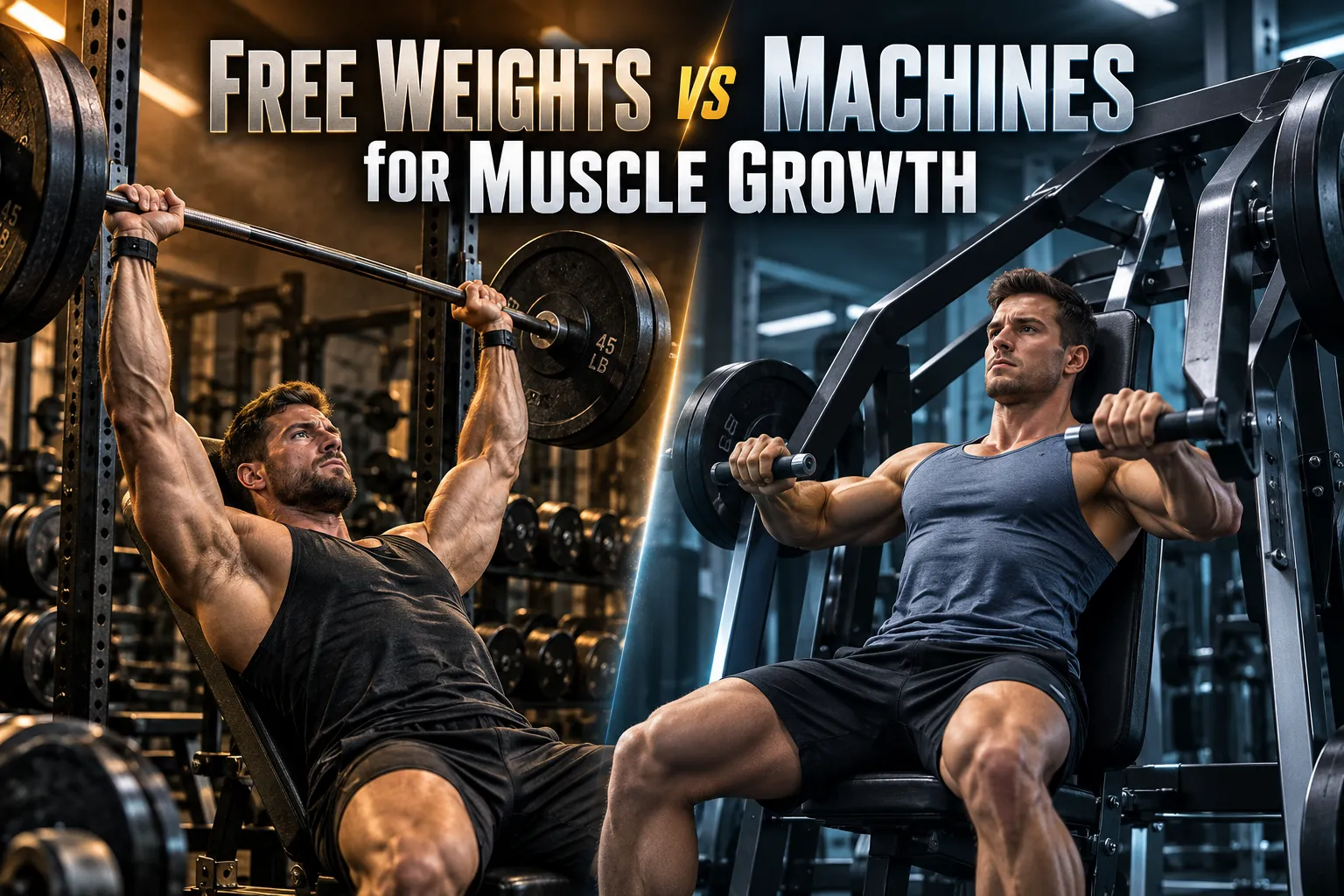
Do I need free weights to maximize muscle growth?
No. Free weights and machines can both be valuable hypertrophy tools. The individual exercise matters more than assigning superiority to an entire equipment category.
Is the exercise that lets me lift the most weight always best?
No. Absolute load does not determine hypertrophy effectiveness. Different exercises have different leverage, stability, range-of-motion, and resistance characteristics.
Should an exercise make the target muscle sore?
Not necessarily. Soreness is not required for muscle growth and should not be used as the primary measure of exercise quality.
The Bottom Line
Learning how to choose exercises for muscle growth is less about discovering a perfect list and more about understanding what makes an exercise productive.
Start with the muscle you want to develop. Choose exercises that effectively challenge it through a useful range of motion, provide enough stability to train hard, allow measurable progression, fit your anatomy, and don’t generate disproportionate fatigue or joint discomfort.
Then resist the temptation to constantly change them.
Research suggests that intelligently planned exercise variation may help develop different muscular regions, while excessive random variation can work against progress.
Build a small portfolio of productive exercises. Learn them. Progress them. Monitor how your body responds.
Use variety when it adds a genuinely different stimulus—not because your muscles supposedly need to be confused.
The best exercise isn’t automatically the newest, hardest, most complicated, or most popular movement.
It is the exercise that lets you repeatedly deliver a high-quality stimulus to the muscle you want to grow—and continue progressing over time.