
Lifting Straps Might Be Weakening Your Hands
Grip strength often fails before your back muscles during heavy deadlifts, creating a training bottleneck that limits muscle growth. Lifting straps can solve this problem, but understanding the tradeoffs helps you build long-term strength and prevent imbalances.
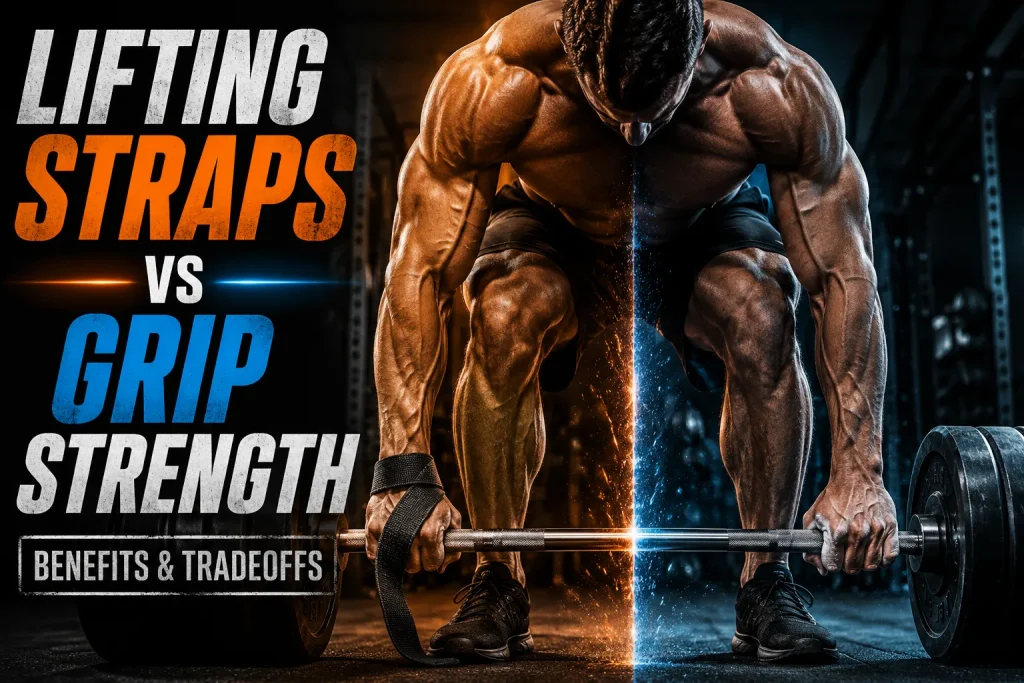
Your grip gives out before your back does on deadlifts. This happens to every lifter at some point. Lifting Straps vs Grip Strength: Benefits & Tradeoffs becomes your most pressing decision. The answer shapes how your whole body develops over time.
Lifting Straps vs Grip Strength: Benefits & Tradeoffs
Lifting straps versus grip strength is not an either-or debate. Straps are a training tool, while grip strength is a physical ability. The real question is whether your grip should limit a particular exercise, set, or training goal and should be considered.
If you are performing heavy deadlifts, Romanian deadlifts, shrugs, or rows to develop your back and posterior chain, an early grip failure may prevent the target muscles from receiving enough productive work. However, using straps on every pulling exercise can remove opportunities to develop the support grip needed for strength sports, everyday lifting, and unassisted barbell performance.
The best approach is usually selective use: perform enough pulling without straps to challenge your hands and forearms, then use straps when grip fatigue would interfere with the primary purpose of the exercise.
For a broader explanation of how straps can support back development, see the pillar guide on lifting straps for muscle growth, back training, grip, and gains. This supporting article focuses specifically on the tradeoff between maximizing pulling performance and preserving natural grip development.
Lifting Straps vs Grip Strength: The Quick Answer
Lifting straps are most useful when your hands fail before the muscles you intend to train. Training without straps is more important when grip strength is part of the exercise goal.
Use straps when:
- Your grip limits back, hamstring, or trapezius training.
- Your hands begin slipping before the target muscles approach failure.
- Repeated pulling sets cause grip fatigue to reduce later performance.
- You are using high repetitions, long sets, or demanding hinge variations.
- Callus discomfort or hand fatigue distracts you from controlled execution.
Train without straps when:
- You are specifically trying to improve support grip strength.
- You compete in an activity that requires unassisted gripping.
- Your warm-up or early work sets are comfortably within your grip capacity.
- You can complete the planned set without the bar slipping.
- The exercise itself is being used as grip training.
This distinction allows lifters to develop their grip without forcing it to become the limiting factor in every back or posterior-chain workout.
Why Grip Failure Changes a Pulling Exercise
Your grip acts as the connection between your body and the weight. When that connection weakens, your attention often shifts away from the intended movement.
During a heavy row, for example, you may still have the back strength to perform several controlled repetitions. If your fingers begin opening, however, you may rush the eccentric phase, shorten the range of motion, or terminate the set. The set ends because of the hands rather than because the back has reached the planned level of fatigue.
That distinction matters when deciding whether to use lifting straps for back workouts. A set stopped by grip failure is not necessarily a poor set, but it may be less specific to your back-development goal.
This is especially relevant after several pulling exercises. Grip fatigue accumulates across deadlifts, pull-ups, pulldowns, rows, shrugs, and loaded carries. Even if your hands are strong enough for the first exercise, they may become the performance bottleneck later in the session.
Do Lifting Straps Make Your Grip Weaker?
Using lifting straps does not automatically weaken your grip. Weakening is more likely to occur when straps replace nearly all meaningful exposure to unsupported gripping thus make your decision on usage accordingly.
Grip strength follows the same basic principle as other physical abilities: it needs a sufficient training stimulus. If every warm-up, work set, carry, row, and deadlift is strapped, the hands receive fewer opportunities to adapt to heavy loads.
The solution is not necessarily to abandon straps. Instead, preserve deliberate grip exposure elsewhere in the program.
A lifter might complete deadlift warm-ups and the first work set without assistance, then use straps for higher-volume back-off sets. Another option is to perform rows with straps but retain unassisted pull-ups, farmer’s carries, or timed barbell holds.
In these examples, straps protect the quality of target-muscle training without eliminating grip work.
It is also important to distinguish measured handgrip strength from barbell support grip. A hand dynamometer typically measures a crushing action, whereas holding a loaded bar depends heavily on maintaining finger closure for time. These abilities overlap, but they are not identical. Therefore, a higher dynamometer score does not guarantee that a lifter can hold every heavy deadlift, and heavy barbell holds are not a complete test of every type of hand strength.
What Research Says About Lifting Straps and Performance
The available lifting-strap research is useful but relatively limited, with many studies examining short-term performance rather than years of muscle or grip development.
In a study involving resistance-trained women, participants performed three sets of deadlifts at 80% of their one-repetition maximum. The 2023 study published in the Journal of Strength and Conditioning Research found that straps allowed participants to complete more repetitions while preserving more grip strength. Mean and peak barbell velocity were not negatively affected.
A separate deadlift study on lifting straps found that straps helped maintain movement velocity, grip strength, and perceived grip security during repeated deadlift work. These findings suggest that straps can reduce the extent to which tired hands degrade performance across demanding sets.
Research has not shown the same effect in every movement. A study examining straps during the lat pulldown did not find clear improvements in maximum strength, repetitions, or muscle activation. That difference is important: a tool that helps during a heavy deadlift may offer less benefit during a machine or cable exercise where grip is not the primary limitation.
The practical conclusion is that lifting straps should be applied according to the lifter, load, exercise, and source of failure—not according to a universal rule.
The Three Grip Abilities Lifters Should Consider
When people discuss improving grip strength without giving up straps, they often treat “grip” as a single quality. In training, at least three abilities deserve attention.
Support Grip
Support grip is the ability to keep the fingers closed around a bar, handle, or implement. It is highly relevant to deadlifts, Romanian deadlifts, heavy rows, pull-ups, and farmer’s carries.
This is the type of grip most directly bypassed by lifting straps. If stronger unassisted deadlifts are a priority, support grip needs regular direct exposure.
Crush Grip
Crush grip involves closing the hand forcefully, as when squeezing a gripper. It can strengthen the finger flexors, but it does not perfectly reproduce holding a heavy bar for 20 or 30 seconds.
Grippers can supplement a grip program, but they should not be assumed to replace loaded holds or carries.
Pinch Grip
Pinch grip involves holding an object between the fingers and thumb. Plate pinches are a common example. This quality has value for general hand strength but is less specific to keeping a barbell from rolling out of the hands.
Understanding these categories helps explain why a lifter can be good at one grip drill and still struggle during another.
How to Use Lifting Straps Without Losing Grip Strength
A combined approach works better than making every pulling set either completely strapped or completely strapless.
Keep Warm-Up Sets Strapless
Warm-up sets provide low-fatigue practice with unsupported gripping. As the weight rises, your hands experience progressively greater loading without necessarily interfering with the hardest work.
If the bar remains secure, there is little reason to use straps automatically during light warm-ups.
Use a Grip Threshold
Instead of choosing straps based solely on the exercise, establish a performance threshold. Use them when your grip begins to alter technique, shorten the set, or pull your attention away from the target muscles.
This creates a simple rule: remain strapless while grip is adequate, then add straps when grip becomes the bottleneck.
Separate Grip Work From Back Work
Trying to make every back exercise double as grip training can compromise both goals. Grip fatigue from early exercises may reduce later rowing or hinging performance, while back fatigue may prevent you from applying enough load to a dedicated grip movement.
Placing a small amount of direct grip training near the end of the workout makes fatigue easier to manage.
Track Strapless Performance
Record at least one repeatable measure of unassisted grip capacity. Useful options include:
- The heaviest double-overhand deadlift you can hold securely.
- The duration of a loaded barbell hold.
- The load and distance used for farmer’s carries.
- The number of controlled strapless pull-ups completed.
- The heaviest dumbbells held for a predetermined time.
Tracking reveals whether selective strap use is maintaining, improving, or gradually reducing your grip capacity.
A Practical Hybrid Training Method
The following method can balance lifting straps and natural grip development without turning every workout into a forearm session.
Heavy Deadlift Day
Perform warm-ups without straps. Complete the heaviest sets strapless if competition rules or unassisted deadlift strength matters to you. Use straps for optional volume sets when your posterior chain needs more work but your hands are already fatigued.
Back Hypertrophy Day
Use straps on exercises where grip repeatedly limits the intended muscles, such as high-repetition Romanian deadlifts, heavy dumbbell rows, or demanding shrug variations. Keep one suitable movement strapless, provided doing so does not disrupt technique.
Direct Grip Work
Add one or two grip exercises after your main training. For example, perform two or three sets of timed barbell holds or farmer’s carries. Start conservatively because grip work can create more forearm and hand fatigue than expected.
Progress by increasing the load, hold duration, distance, or total quality work—not all four simultaneously.
When You Should Delay Using Straps
Beginners should usually spend time learning how to hold and control manageable weights before relying heavily on straps. Early training provides an opportunity for the hands, forearms, connective tissues, and pulling technique to adapt together.
That does not mean beginners are forbidden from using straps. If a new lifter’s hands consistently prevent safe, controlled execution on a suitable exercise, straps may still be helpful. However, they should not conceal loads that the lifter cannot otherwise control.
You may also want to limit strap use temporarily when rebuilding grip after a layoff. Strapless sets with appropriate weights can restore tolerance gradually before straps are reintroduced for more demanding volume.
When Straps Are the Better Choice
Straps become particularly useful when the cost of grip fatigue exceeds its benefit.
Consider using lifting straps for Romanian deadlifts if your hamstrings and glutes can continue working but your hands force you to stop. The same logic applies to high-volume rows or shrugs performed after deadlifts. Your grip may already have received a substantial stimulus, while your back still needs additional work.
Straps may also help prevent one demanding pulling exercise from reducing the quality of everything that follows. Preserving grip strength across a deadlift session was one of the benefits observed in the available research, although individual responses and exercise demands will vary.
The goal is not to make every repetition easier. It is to ensure that fatigue occurs in the muscles the exercise is intended to challenge.
Common Lifting-Strap Mistakes
Using Straps Before Grip Is Challenged
Putting straps on for every light pulling set removes easy opportunities to practice unsupported gripping. Save them for loads, repetition ranges, or fatigue levels where they provide a meaningful benefit.
Refusing Straps for Ego Reasons
Allowing the hands to ruin a back-focused set is not automatically more functional or disciplined. If the purpose of the set is to challenge the lats, traps, spinal erectors, glutes, or hamstrings, grip failure may simply be mistimed fatigue.
Assuming Straps Replace Grip Training
Straps reduce the demand of holding the weight, but they do not develop every aspect of hand strength. If grip performance matters, train it intentionally.
Ignoring Sport-Specific Rules
Powerlifters must perform competition deadlifts without straps. Olympic weightlifters may use straps in selected training situations, but releasing a strapped bar during certain lifts requires specific technical awareness. Recreational bodybuilders do not face the same competitive constraints and can base the decision primarily on training quality.
Lifting Straps vs Grip Strength: Final Verdict
Lifting straps and grip strength can coexist in a well-designed program.
Training without straps builds the specific ability to control heavy weights with your hands. Training with straps can prevent grip fatigue from limiting back, trapezius, hamstring, and posterior-chain work. Neither method is universally superior because each serves a different purpose.
For most natural lifters, the best strategy is to keep warm-ups and selected work sets strapless, use straps when the hands become the wrong limiting factor, and include measurable grip work if unassisted holding strength is important.
Treat straps as a way to allocate fatigue, not as proof of strength or weakness. Your exercise goal should determine whether grip is trained, tested, or temporarily assisted.
Frequently Asked Questions
Should I use lifting straps if I want stronger forearms?
You can use straps and still build stronger forearms, but you need sufficient strapless pulling or direct grip training. Keep some warm-ups and manageable work sets unassisted, then add loaded holds, carries, or another grip-specific exercise when needed.
Do lifting straps stop grip strength development?
Not automatically. Grip development may slow if straps eliminate nearly all unsupported gripping. Selective strap use combined with direct grip work can preserve the training stimulus for your hands.
Are lifting straps better than mixed grip for deadlifts?
They serve different purposes. A mixed grip can secure the bar without straps and is relevant to powerlifting, but it creates an asymmetrical hand position. Straps provide assistance while allowing both hands to remain in the same orientation. Your sport, training goal, comfort, and technique should guide the choice.
When should I start using lifting straps during a workout?
Start using them when grip fatigue begins to reduce repetitions, compromise technique, shorten range of motion, or distract from the target muscle. There is no single weight or repetition number that applies to every lifter.
Should natural bodybuilders use straps for back training?
Natural bodybuilders can benefit from straps when grip failure restricts productive back work. They should still retain some strapless training if maintaining or improving grip strength is part of their overall goal.
Can straps improve deadlift repetitions?
They can in some situations. Research in resistance-trained women found that straps increased the number of repetitions completed during repeated sets at 80% of one-repetition maximum while reducing the loss of grip strength. Results may differ according to experience, load, exercise, and individual grip capacity.