
Why Your Grip Stops Your Muscle Gains Cold
Your grip strength is limiting your back development, causing you to miss crucial muscle-building repetitions during heavy lifts. Lifting straps solve this problem by allowing your back muscles to reach complete failure while your hands stay secure on the bar.
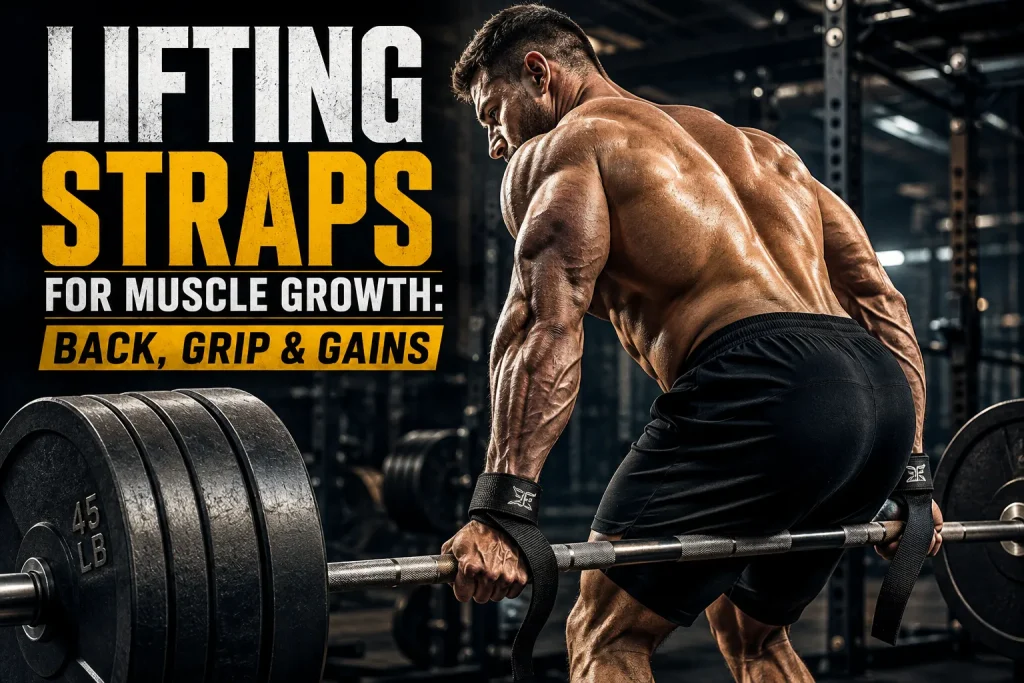
Your forearms burn out before your back gets a real workout. Grip fails at rep eight when your lats could handle twelve more. Lifting Straps for Muscle Growth: Back, Grip & Gains solves this exact problem instantly.
Lifting Straps for Muscle Growth: Back, Grip & Gains
Lifting straps can be valuable for muscle growth when your grip gives out before the muscles you are trying to train. By securing your hands to a barbell, dumbbell, or cable attachment, straps reduce the amount of gripping force needed to hold the weight. This may help you maintain performance during demanding pulling exercises such as deadlifts, Romanian deadlifts, barbell rows, shrugs, and pulldowns.
However, lifting straps do not directly build muscle. They work by removing a potential weak link—your grip—so your back, traps, glutes, or hamstrings can receive a more complete training stimulus. Their usefulness therefore depends on the exercise, your grip strength, the weight being lifted, and the goal of the set.
This guide explains how lifting straps affect muscle growth, back training, grip strength, exercise performance, and long-term gains. You will also learn when to use lifting straps, when to train without them, which exercises benefit most, and how natural lifters can combine straps with dedicated grip work.
What Are Lifting Straps?
Lifting straps are strips of cotton, nylon, leather, or reinforced fabric that wrap around your wrists and the handle of a weight. Once tightened, they help connect your hands to the bar.
Instead of relying entirely on your fingers and forearm muscles to prevent the bar from slipping, part of the load is supported through the strap and wrist. You still hold the bar, but maintaining your grip requires less effort.
The most common types of lifting straps include:
- Lasso straps: Traditional straps with an adjustable loop around the wrist and a long tail that wraps around the bar.
- Figure-eight straps: Closed-loop straps that secure the wrist directly to the bar. They provide exceptional security for heavy deadlifts and strongman-style training.
- Olympic lifting straps: Shorter straps designed to release quickly during movements such as snatches and clean pulls.
- Hook straps: Wrist supports with built-in hooks that hold the bar. These require less setup but provide a different feel from conventional straps.
For bodybuilding and hypertrophy training, ordinary cotton or nylon lasso straps are usually sufficient. They are inexpensive, adjustable, and suitable for most back and posterior-chain exercises.
Do Lifting Straps Help Build Muscle?
Lifting straps may help build muscle indirectly by allowing the target muscles to continue working after grip strength becomes limiting.
Imagine performing a set of heavy Romanian deadlifts. Your hamstrings and glutes may be capable of completing three more technically sound repetitions, but the bar begins slipping from your fingers. If you end the set because of your grip, the hamstrings never experience the full intended stimulus.
Using straps could allow you to complete those remaining repetitions while maintaining control of the bar. Over weeks and months, preserving productive repetitions and training volume may contribute to better muscle growth.
Training volume is one important component of hypertrophy. A systematic review examining resistance-training volume found that multiple-set programs and sufficient weekly volume generally support muscle development, although the amount an individual can recover from remains important (Baz-Valle et al., 2022).
Straps can help protect that volume when grip fatigue would otherwise reduce:
- The number of repetitions completed
- The weight you can control
- Bar speed during later sets
- Range of motion
- Stability and exercise technique
- Focus on the target muscles
Nevertheless, straps are not inherently anabolic. If your grip is already strong enough for the exercise, adding straps may not produce more repetitions, greater muscle activation, or better growth.
How Lifting Straps Support Back Muscle Growth
The back contains several large muscles capable of handling substantial resistance, including the latissimus dorsi, trapezius, rhomboids, spinal erectors, and rear deltoids. Your fingers and forearm flexors are much smaller.
During heavy rows, deadlifts, and pulldowns, the gripping muscles may fatigue before the larger back muscles reach a meaningful level of fatigue. This creates a strength imbalance within the exercise: your hands become the limiting factor even though your back could keep working.
Lifting straps for back workouts can help in three main ways.
1. Straps may prevent premature grip failure
When the bar starts slipping, many lifters shorten their range of motion, rush repetitions, or stop the set. Straps provide a more secure connection to the weight, potentially allowing the set to be limited by the back rather than the hands.
This is particularly useful during high-repetition rows, heavy shrugs, and Romanian deadlifts, where the bar must be held continuously.
2. Straps may improve focus on the target muscle
Some lifters find that straps make it easier to think of their hands as hooks. Instead of squeezing the bar as hard as possible, they can concentrate on driving the elbows back or down.
This does not guarantee greater muscle activation, but it may improve execution for lifters who struggle to feel their lats or upper back working.
Your main cues should still focus on movement:
- Pull your elbows toward your hips during pulldowns.
- Drive your elbows behind your torso during rows.
- Keep the bar close during deadlifts and Romanian deadlifts.
- Elevate the shoulder blades through a controlled range during shrugs.
Straps support good technique; they do not replace it.
3. Straps may preserve performance across multiple sets
Grip fatigue accumulates during a workout. Even if your hands survive the first exercise, several hard sets of deadlifts can reduce your performance on subsequent rows, pulldowns, or shrugs.
Research on deadlifting supports this potential benefit. In a controlled study, using lifting straps during deadlifts improved mean and peak lifting velocity under certain loading conditions, reduced grip fatigue, and increased perceived grip security. Participants also recovered grip strength faster after strapped deadlifts (Jukic et al., 2021).
For bodybuilding, preserving grip during an early exercise may help you perform the rest of your back workout more effectively.
What Does the Research Say About Lifting Straps?
Research on lifting straps remains limited, and results vary by exercise.
The previously mentioned deadlift study found benefits in lifting velocity, grip-fatigue management, perceived security, and perceived power. These findings suggest that straps may be most valuable during exercises involving very heavy absolute loads.
However, a study involving resistance-trained men found that straps did not improve lat-pulldown one-repetition maximum, repetitions to failure, total repetitions, or latissimus dorsi muscle activation. Participants performed three sets at 70% of one-repetition maximum, and results were similar with and without straps (Valério et al., 2021).
A 2024 study of the prone bench pull also found that lifting straps did not meaningfully change maximum repetitions-to-failure and velocity relationships. The researchers concluded that the effects of straps appear to depend on the exercise and its grip demands (Miras-Moreno et al., 2024).
The evidence therefore does not support the claim that straps automatically increase back activation or performance in every pulling movement. Their effects appear strongest when grip is genuinely the weak link.
This leads to a practical rule:
Use lifting straps when losing your grip would end or degrade a productive set before the target muscles are sufficiently challenged.
Best Exercises to Use Lifting Straps for Muscle Growth
Straps are best reserved for pulling exercises in which the hands must support heavy loads or maintain a prolonged grip.
Romanian deadlifts
Romanian deadlifts are among the best exercises to use with lifting straps for hamstring and glute growth. The target muscles often tolerate more weight and repetitions than an unsupported double-overhand grip can hold.
Straps allow you to concentrate on pushing the hips back, keeping the bar close, and controlling the eccentric phase. They may also prevent grip limitations from turning a hamstring exercise into a forearm endurance test.
Conventional and sumo deadlifts
Straps can be useful during bodybuilding-focused deadlifts, high-repetition deadlift sets, rack pulls, and overload work. They reduce the need for a mixed grip and may make heavy sets feel more secure.
Competitive powerlifters must remember that straps are not permitted in standard powerlifting competition. If competition performance is the goal, perform enough strapless deadlifting to develop the exact grip required on the platform.
Barbell and dumbbell rows
Heavy rows frequently expose grip limitations, especially after deadlifts or other pulling exercises. Straps may help maintain a consistent range of motion and prevent the hands from opening during later repetitions.
They can be particularly beneficial for:
- Bent-over barbell rows
- Chest-supported rows
- One-arm dumbbell rows
- T-bar rows
- Seal rows
- Meadows rows
For muscle growth, use the amount of weight you can control through the intended range. Straps should not become an excuse to turn every row into a short-range hip extension.
Lat pulldowns and cable rows
Straps can help some people during high-volume pulldowns and seated cable rows, but the research suggests they will not benefit everyone. If your grip is not limiting the set, straps may add little beyond comfort.
Try both conditions using the same weight, technique, tempo, and rest period. If straps reliably improve target-muscle control or prevent premature grip fatigue, use them for selected working sets.
Shrugs
The upper trapezius can handle extremely heavy loads, making grip a common limiting factor during barbell and dumbbell shrugs. Straps help keep the bar secure so you can focus on controlled scapular elevation.
Avoid rapidly rolling the shoulders. Elevate them upward through a comfortable range, pause briefly, and lower the weight under control.
Weighted pull-ups
Straps may help during high-repetition or heavily weighted pull-ups when grip fails before the lats and upper back. However, they can make releasing the bar more difficult. Secure setup and access to a safe platform are important.
Lifting Straps vs. Grip Strength
A common concern is that lifting straps will weaken your grip. Straps do reduce the gripping demand of the exercises on which they are used, but they do not automatically cause grip strength to decline.
The real issue is training specificity. Your body adapts to the demands you repeatedly place on it. If every pulling exercise is performed with straps and no direct grip work is included, your back strength may eventually progress faster than your unsupported grip.
Conversely, refusing to use straps on every set can allow grip fatigue to restrict the training of much larger muscle groups.
The most effective approach is not choosing between lifting straps and grip strength. It is training both according to their purposes.
A balanced straps-and-grip strategy
You can perform lighter pulling sets without straps and add straps only when grip becomes limiting. For example:
- Complete warm-up sets without straps.
- Perform early working sets strapless when practical.
- Add straps for the heaviest or highest-repetition sets.
- Include dedicated grip training once or twice per week.
Effective grip-strength exercises include:
- Farmer’s carries
- Barbell holds
- Dead hangs
- Plate pinches
- Towel pull-ups
- Wrist curls and extensions
- Thick-handle holds
- Captains-of-crush-style grippers
This approach allows you to develop your forearms and grip without sacrificing back, hamstring, or trapezius training.
When Should You Start Using Lifting Straps?
Beginners usually do not need straps immediately because the weights used during early training are relatively manageable. Learning how to grip a bar and developing basic hand strength are valuable parts of becoming a competent lifter.
However, beginners are not prohibited from using straps. A new lifter with small hands, a previous hand injury, or an unusually demanding pulling program may benefit from them under appropriate supervision.
Consider introducing straps when:
- The bar repeatedly slips before the target muscles fatigue.
- Your grip shortens your Romanian deadlift or rowing sets.
- Forearm fatigue compromises several exercises in one workout.
- You use a mixed grip only because a double-overhand grip fails.
- Grip discomfort distracts you from proper movement mechanics.
- High-repetition pulling sets are limited by hand endurance.
- You are training your back but mostly feel your hands and forearms.
Do not introduce straps simply because an exercise feels hard. Difficulty is part of productive training, and straps cannot correct poor technique or inappropriate loading.
How to Use Lifting Straps Correctly
For standard lasso straps, thread the loose end through the loop to create a circle. Place your hands through the circles so the loose tails run across the palms in the direction of the thumbs.
To attach the straps:
- Place your hands on the bar.
- Wrap each loose end under and around the bar.
- Rotate the bar slightly toward you to tighten the material.
- Close your hands around the bar.
- Confirm that both sides feel secure before lifting.
The straps should feel supportive but should not painfully cut into the wrists. You generally need only one to three wraps around the bar. Excess material can create a bulky, uneven grip.
Practice with light weights before using straps for heavy deadlifts. You should be able to tighten and release them deliberately.
Lifting-Strap Mistakes That Can Limit Your Gains
Using straps on every exercise
Wearing straps for light warm-ups, curls, and every pulling set unnecessarily reduces opportunities to train your natural grip. Use them selectively.
Adding more weight than you can control
Straps may allow you to hold a heavier bar, but holding the weight is not the same as controlling it. If technique deteriorates, the additional load may reduce the intended muscular stimulus.
Ignoring wrist position
Keep the wrist reasonably neutral. Excessive bending can create discomfort and weaken your connection to the bar.
Wrapping the straps in the wrong direction
The strap should tighten as you close your hand and rotate the bar into position. If it immediately unwinds, reverse the wrapping direction.
Treating straps as a cure for elbow or wrist pain
Straps sometimes reduce forearm fatigue, but persistent pain requires proper assessment. Do not use equipment to conceal an injury or continue movements that cause worsening symptoms.
Assuming more repetitions always mean more growth
Extra repetitions are useful only when they remain technically sound and keep meaningful tension on the intended muscles. Straps should extend a productive set, not create a series of uncontrolled partial repetitions.
How Close to Failure Should Strapped Sets Be?
Because straps may prevent grip failure, they can allow the target muscles to work closer to their actual limits. That does not mean every strapped set must reach absolute muscular failure.
A systematic review and meta-analysis found no clear evidence that momentary muscular failure is consistently superior to non-failure training for hypertrophy (Refalo et al., 2023). Another meta-analysis similarly concluded that training to failure is not required to increase muscle size or strength (Grgic et al., 2022).
For most compound pulling exercises, finishing sets with approximately one to three repetitions in reserve is a practical starting point. Isolation exercises and stable machine movements can occasionally be taken closer to failure with less concern about whole-body fatigue.
Straps are especially useful when they allow the intended muscle—not your grip—to determine what one to three repetitions in reserve actually means.
Sample Back Workout Using Lifting Straps
Here is one way a natural lifter could use straps without neglecting grip development:
| Exercise | Sets and reps | Strap strategy |
|---|---|---|
| Romanian deadlift | 3 × 6–10 | Warm-ups strapless; working sets strapped |
| Pull-ups | 3 × 6–10 | First sets strapless; straps only if needed |
| Chest-supported row | 3 × 8–12 | Use straps on demanding working sets |
| Lat pulldown | 2–3 × 10–15 | Optional, based on grip fatigue |
| Cable rear-delt row | 2–3 × 12–20 | Usually strapless |
| Farmer’s carry | 2–3 carries | No straps; direct grip training |
The correct plan depends on your exercise selection, training experience, recovery, and individual weaknesses. Straps should solve a specific performance problem rather than appear automatically in every workout.
Are Lifting Straps Worth It for Natural Lifters?
Lifting straps are worth considering for natural lifters because hypertrophy depends on consistently delivering an appropriate training stimulus and recovering from it. If grip fatigue repeatedly reduces the quality of your back or posterior-chain training, straps provide a simple way to remove that bottleneck.
They are inexpensive, portable, and easy to use once practiced. More importantly, they allow you to separate two different goals:
- Training your back, traps, glutes, or hamstrings for growth
- Training your hands and forearms for grip strength
You do not need to force one exercise to accomplish both goals simultaneously.
The greatest benefit will likely occur in experienced lifters who use heavy loads, perform substantial pulling volume, or have back and lower-body strength that exceeds their grip capacity. Lifters whose grip is already sufficient may notice little difference.
Frequently Asked Questions
Do lifting straps increase muscle growth?
Lifting straps do not directly trigger muscle growth. They may support hypertrophy by preventing grip fatigue from ending sets before the target muscles receive enough tension and productive volume.
Are lifting straps good for back workouts?
Yes, particularly for heavy rows, shrugs, Romanian deadlifts, and other exercises where grip fails before the back. They may be less useful during lighter pulldowns if grip is not limiting performance.
Will lifting straps weaken my grip?
Straps will not automatically weaken your grip, but exclusive reliance on them can reduce the amount of direct grip training you receive. Perform selected sets without straps and include dedicated grip exercises.
Should beginners use lifting straps?
Beginners should normally develop basic grip strength and lifting technique first. Straps can still be used when a genuine grip limitation prevents proper training, but they should not compensate for poor form or excessive loading.
Should I use straps for deadlifts?
Use straps for bodybuilding sets, high-repetition deadlifts, Romanian deadlifts, or overload training when grip is limiting. Competitive powerlifters should also practice the grip they will use in competition because straps are not permitted on the platform.
Are lifting straps better than an alternating grip?
Straps allow you to maintain a symmetrical double-overhand hand position while supporting heavy loads. A mixed grip is convenient and competition-specific for powerlifting, but it places the arms in different rotational positions. Both options can be useful depending on the goal.
Can lifting straps help grow the lats?
They may help if grip fatigue limits your rows, pull-ups, or pulldowns. However, research has not shown that straps automatically increase latissimus dorsi activation or pulldown performance. Exercise technique, effort, progression, and total training remain more important.
When should I put straps on during a workout?
Use straps when you predict that grip will become the limiting factor. Many lifters perform warm-ups and early working sets without them, then add straps for their heaviest sets or after grip fatigue begins accumulating.
How tight should lifting straps be?
They should be tight enough to secure the bar without causing pain, numbness, or excessive wrist pressure. Practice adjusting them with light weights before using them during demanding sets.
Final Verdict: Use Straps Strategically for More Productive Gains
Lifting straps can support muscle growth by allowing your larger pulling muscles to work without being prematurely limited by your hands and forearms. Their greatest value appears during heavy or grip-intensive exercises such as deadlifts, Romanian deadlifts, rows, and shrugs.
The scientific evidence is not strong enough to say that lifting straps increase muscle activation, strength, or repetitions in every exercise. Some studies show meaningful deadlift-performance and grip-fatigue benefits, while others find no advantage during pulldowns or prone bench pulls.
That does not make straps ineffective. It means they should be used according to the problem they solve.
If your grip is secure and your target muscles determine when the set ends, straps may be unnecessary. If the bar slips while your back, traps, glutes, or hamstrings still have productive repetitions available, straps may improve the quality of your training.
For the best long-term results, use lifting straps selectively, continue training your natural grip, maintain proper technique, and progress your exercises gradually. Straps are not a shortcut to muscle growth—but when grip is the weak link, they can help ensure your hardest pulling sets produce gains where you actually want them.