
Why One Exercise Outperforms All Others
The squat is scientifically proven to be the king of all exercises, dominating other movements in building total body strength. This compound movement works all leg muscles through a full range of motion while forcing honest strength without compensation.
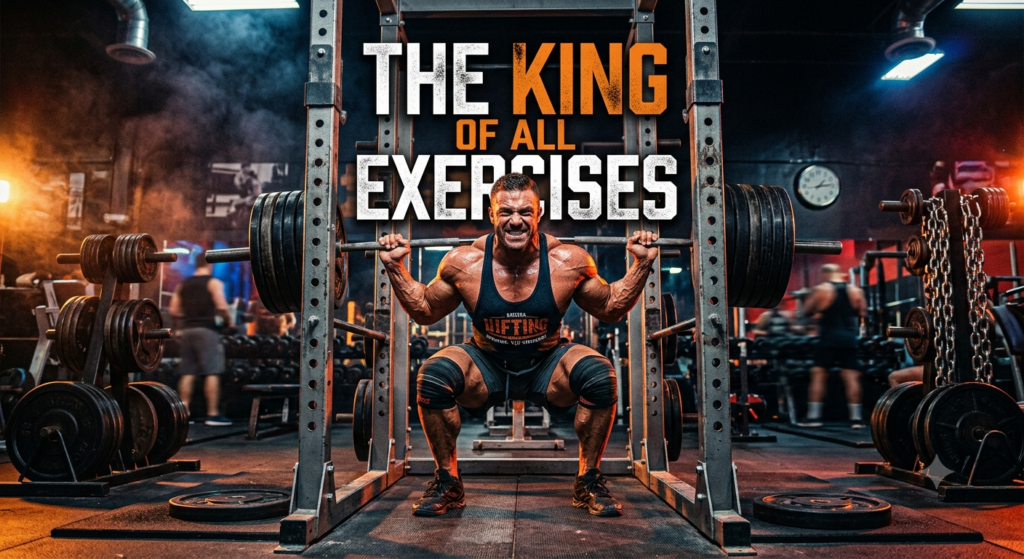
What is the king of all exercises? Walk into any serious gym on the planet. You’ll hear this debate within ten minutes. The squat earns that royal title more than any other movement.
What is the king of all exercises and why does it matter
The squat is the king of all exercises. This isn’t marketing talk. A study comparing back squats to deadlifts and thrusters found that the back squat dominated the contest. The researchers measured total body strength. The squat won across the board.
The movement works all leg muscles through a fuller range of motion. Your quads fire. Hamstrings engage. Glutes activate. The core braces throughout.
The beauty of the squat is that it doesn’t let you get away with much and you can’t muscle through it. This forces honest strength. Deadlifts allow compensation through poor form. Squats punish sloppy technique immediately.
The back squat’s heavier working loads required more overall muscle recruitment, developing central nervous system pathways that carried over to all exercises. This means squatting makes every other lift stronger. The reverse doesn’t work as well.
The muscle recruitment answer to what is the king of all exercises
Squats activate the glutes, hips, quads, hamstrings, and calves. No other single movement hits this many lower body groups. You’re still contracting your back and shoulders during the lift. The upper body works harder than most people realize.
When you perform the barbell squat, you’re recruiting multiple muscle groups at the same time from head to toe. This coordination separates compound lifts from isolation work. Your body learns to move as one unit.
Squats stimulate so many larger lower body muscle groups that they help the upper body grow as well. This phenomenon happens through hormonal response. Heavy squats trigger growth hormone release. That affects your entire body.
The deadlift gets praised for working more total muscles. True on paper. The deadlift recruits more muscles of the posterior chain because it’s a pulling movement. But the squat’s vertical load creates unique demands. The back squat has greater range of motion, moving the barbell further each rep with similarly heavy loads.
Programming strategies when the squat is the king of all exercises
If an athlete has only time for one strength exercise, back squats should be the choice because they have the greatest carryover to total body strength. This settles the efficiency debate. You get maximum return on invested time.
Most strength athletes follow workout splits based around the squat and deadlift, squatting more for a stronger squat. Specificity rules. You can’t skip the movement you want to improve.
The back squat can be programmed at moderate loads for high repetitions without the same nervous system fatigue that heavy deadlifts cause. This allows more frequent training. You recover faster between squat sessions than deadlift days.
Structure matters here. Because squats and deadlifts are physically taxing on muscles and nervous systems, perform both on separate days. Same-day programming crushes recovery. Your second lift always suffers.
Start with bodyweight variations. Assisted squats should be the base layer for anyone learning to master the movement, focusing mostly on form and depth. Then progress to goblet squats. Goblet squats load the lifter anteriorly without worrying about front rack position. Only then advance to barbell work.
Understanding what is the king of all exercises through variations
The squat is widely acknowledged as the king of leg exercises, and other muscle groups are also involved. Different variations shift emphasis. High bar squats target quads more intensely. High bar back squats place emphasis on quadriceps and glutes with less reliance on hamstrings.
Low bar positioning changes everything. Low bar squats place the barbell on the posterior deltoid, resulting in different body parts being used. Your torso leans forward more. This recruits posterior chain muscles differently.
Sumo squats work the adductors more than any other squat variation and can be better for certain anatomies while goblet squats are great for beginners and advanced lifters. Front squats create an upright torso. Bulgarian split squats address imbalances.
The pistol squat is the most advanced variation, requiring high degrees of balance and mobility. This single-leg beast exposes weaknesses. Most people can’t perform even one rep initially.
Jump squats add explosive power. A study on jump squat training done three times weekly over eight weeks concluded it improved sprint time and explosive strength simultaneously. Athletes need this transfer.
Yes, definitely do the king of all Exercises but
The mobility component of what is the king of all exercises
Being able to squat to the ground properly requires adequate range of motion in the hips, ankles, and knees—critical mobility components for full-depth squatting. This movement assessment reveals overall mobility quality and movement patterns. Poor squat depth signals specific mobility restrictions like tight hip flexors, limited ankle dorsiflexion, or knee extension limitations that need addressing through targeted mobility work like foam rolling, dynamic stretching, and corrective exercises.
Squatting promotes flexibility and mobility in the hips, knees, and ankles, helping improve athletic performance and prevent injuries. The squat itself becomes the corrective exercise. Time under tension stretches tight tissues.
Most people get tight in their low back or have bad knees as they age, losing range of motion and usually ending up injured. Regular squatting prevents this decline. Movement quality deteriorates without loading.
Squats improve flexibility, and regularly doing them can help slow down the process of tendons and ligaments becoming less elastic. This keeps you young. Sedentary living accelerates stiffness.
Depth matters more than weight. The most critical aspect of squatting is achieving proper depth where the hip crease is at least parallel to the knee, otherwise it becomes mere knee bends. Half squats waste time.
Common errors that undermine what is the king of all exercises
Not squatting low enough is the single biggest squatting problem, and half squats seriously impact leg development while leaving you open to injury. Ego lifting causes this. People load weight they can’t handle properly.
Knees caving inwards is one of the most common squatting mistakes, typically happening when pushing up out of the squat. This puts knees and surrounding ligaments under more stress as they take the brunt of your weight. The fix involves external rotation cues.
Not keeping the upper back stiff is a common mistake that results in the entire spine losing stiffness and missed lifts. Pull your shoulder blades together and down to activate upper back muscles and create a stable platform.
Hips shooting back first creates a good morning squat fault caused by relative weakness in the quadriceps, making the body compensate by relying too much on the posterior chain. This reveals muscle imbalances that need addressing.
Incorrect stance prevents achieving proper squat depth, and toes should be angled about thirty degrees outward to allow knees to track out over toes. Stance width varies by anatomy. Experiment to find yours.
Real-world benefits beyond what is the king of all exercises claims
The muscles worked during squats help power daily tasks such as walking and climbing stairs, and adding squats to workouts can help boost exercise performance and decrease injury risk. This transfers immediately to life outside the gym.
You squat all the time in everyday life when sitting down or getting in and out of the car, and squats can strengthen knees and make them more resilient to physical demands. The movement pattern is fundamental to human function.
A one hundred fifty-five pound person can burn approximately two hundred twenty-three calories doing thirty minutes of vigorous squats. The calorie burn rivals cardio. Large muscle recruitment demands energy.
Squats may help boost bone mineral density for stronger bones, adding strength to your skeleton mainly in the spine and lower body. Studies show squats are one of the few exercises that can increase bone mineral density in people who already have osteoporosis.
Research indicates the squat is among the top three prescribed exercises for sports training and rehabilitation, improving sprint speed and vertical jump height. Coaches understand its value. Performance improvements show up measurably.
Frequently Asked Questions
How often should I squat each week?
Train squats two to three times weekly with rest days between sessions. Your muscles need recovery time. Advanced lifters can squat more frequently with proper programming and lighter variation days.
Can I squat if I have knee pain?
Squats often reduce knee pain when performed correctly with appropriate depth. Poor form causes problems. Consult a physical therapist to assess your movement patterns before adding heavy weight.
Should I squat below parallel?
Yes, squat until your hip crease drops below your knee level. This engages your glutes fully. Stopping high turns squats into quad-only knee bends with less benefit.
What weight should beginners use when squatting?
Start with bodyweight only until you master proper form and depth. Then add a light barbell. Progress slowly by adding five to ten pounds weekly as technique allows.
Do squats make your legs bigger?
Squats build leg muscle when combined with enough food and protein. Results take months of consistent training. You won’t accidentally get huge legs from moderate squatting twice weekly.
Pick a squat variation today and perform three sets of eight controlled reps with perfect depth.