
The Weight You Pick First Determines Your Progress
Choosing the right starting weight prevents injury and builds proper form from day one. Use the one-rep test to find weights that let you complete 10 reps with perfect control and smooth movement.
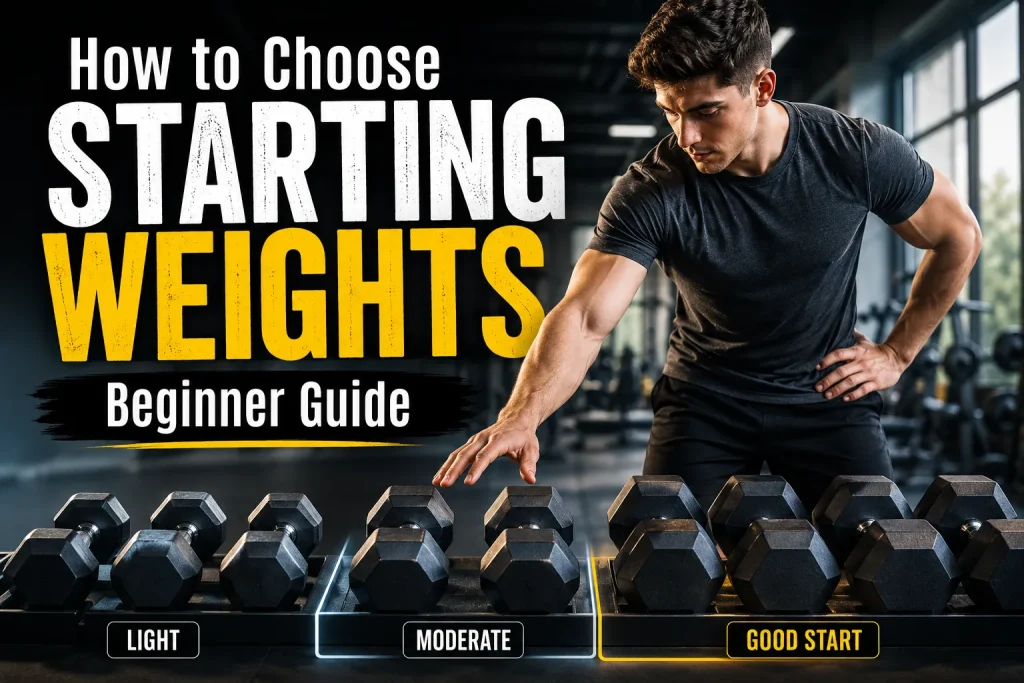
How to Choose Starting Weights: Beginner Guide
Choosing your starting weights is one of the first challenges you face when you begin bodybuilding. Go too light and you may finish every set feeling as though you barely trained. Go too heavy and your technique can deteriorate before the target muscles receive the training you intended.
Fortunately, beginners do not need to know their exact one-repetition maximum or perform complicated strength tests to choose an effective starting weight.
A better approach is to select a manageable load, perform a controlled set within a target repetition range, evaluate how many good repetitions you probably had left, and adjust the weight accordingly.
This beginner guide explains how to choose starting weights for bodybuilding exercises, recognize when a weight is too heavy or too light, and gradually increase your loads as you become stronger.
If you are building your first complete training routine rather than simply choosing your initial loads, read Bodybuilding for Beginners: Your First 12 Weeks Explained for the broader beginner roadmap.
What Is a Good Starting Weight for a Beginner?
A good starting weight is not a specific number of pounds or kilograms.
It is a load that allows you to perform the planned exercise through a controlled range of motion while completing your target repetitions without significant technique breakdown.
That distinction matters because two beginners of the same age and body weight can have dramatically different starting strength.
Previous sports participation, occupation, body proportions, exercise familiarity and individual strength can all influence how much weight someone can initially handle.
Instead of asking:
“How much weight should a beginner lift?”
Ask:
“What weight allows me to perform this exercise correctly within my target repetition range?”
That question produces a much more useful answer.
The American College of Sports Medicine has historically recommended approximately an 8–12 repetition maximum range for novice resistance training, while emphasizing that training recommendations should reflect an individual’s goals and physical capacity.
For bodybuilding beginners, however, you do not have to determine your literal 8RM, 10RM or 12RM before you start training.
You can find an appropriate working weight through progressive trial sets.
Start Lighter Than You Think You Need
Your first bodybuilding session is not a strength test.
When performing an unfamiliar exercise, begin conservatively enough that you can learn how the movement feels before deciding how much weight you can safely control.
Suppose your workout calls for dumbbell bench presses.
Rather than selecting the heaviest dumbbells you think you can press for 10 repetitions, choose a pair that looks comfortably manageable. Perform several controlled repetitions and evaluate the difficulty.
If the dumbbells are obviously too light, increase them for the next set.
This might require several attempts during your first workout. That is completely normal.
You are establishing a baseline.
After recording the weight you eventually settle on, your next workout becomes much easier to plan.
Use a Target Rep Range to Find Your Starting Weight
One of the simplest ways to choose starting weights for bodybuilding is to work backward from your prescribed repetition range.
Imagine an exercise that calls for 8–12 repetitions.
Select a conservative weight and perform the exercise with good technique.
Three general outcomes are possible:
You cannot reach 8 clean repetitions: the weight is probably too heavy.
You reach 8–12 repetitions with controlled technique and some effort: the weight is likely appropriate.
You easily exceed 12 repetitions: the weight may be too light for the intended range.
The key word is clean.
A repetition should not count merely because the weight moved from point A to point B. If reaching the target requires dramatically shortening the range of motion, bouncing the weight, swinging your torso or changing the exercise mechanics, the load may be exceeding your current ability.
This rep-range method gives beginners an immediate feedback system without requiring maximal testing.
Learn to Think in Repetitions in Reserve
Once you understand basic technique, another useful concept is repetitions in reserve, commonly abbreviated as RIR.
RIR estimates how many additional technically acceptable repetitions you could have completed before reaching muscular failure.
For example:
If you stop after 10 repetitions but believe you could have completed three more, you finished with approximately 3 RIR.
If you probably had one more repetition available, you stopped around 1 RIR.
If another repetition was impossible, you effectively reached 0 RIR.
RIR is useful because the same absolute weight does not represent the same difficulty for everyone.
However, beginners should treat RIR as an estimate rather than a precision instrument. Research discussing methods for measuring proximity to failure notes that self-reported RIR is individualized but inherently subjective, while percentage-based loading also has limitations because people can perform different numbers of repetitions at the same percentage of their 1RM.
That means you do not need to obsess over whether a set was exactly 2 RIR versus 3 RIR.
Use the scale to answer a simpler question:
Was this weight clearly too easy, appropriately challenging or too heavy to control?
Your estimates should become more useful as you accumulate training experience.
Don’t Test Your One-Rep Max to Find Starting Weights
A new bodybuilder usually does not need a true one-repetition maximum test to determine starting loads.
A 1RM test identifies approximately the heaviest load you can successfully lift once under specified conditions. While useful in strength testing and percentage-based programming, it adds unnecessary complexity when your immediate objective is simply finding manageable working weights.
Consider a beginner performing a machine chest press.
If the goal is to perform controlled sets within a moderate repetition range, knowing whether your theoretical 1RM is 145 or 155 pounds does not materially change your first workout.
You can simply select a lighter load, perform the set and adjust.
This also allows you to learn the exercise without turning the first session into a maximal-effort event.
How to Tell When Your Starting Weight Is Too Heavy
Beginners sometimes assume that struggling means a workout is productive.
Difficulty itself is not the problem. The question is whether the resistance is so high that it prevents you from performing the exercise as intended.
Common signs that your starting weight may be excessive include:
- failing below the bottom of your planned rep range;
- repeatedly shortening your range of motion;
- losing control of the lowering phase;
- substantially altering your body position to finish repetitions;
- turning an isolation exercise into a whole-body movement;
- being unable to reproduce your basic technique from rep to rep.
For example, imagine performing dumbbell curls.
If the first several repetitions are controlled but subsequent repetitions require pronounced hip drive and torso swinging just to raise the dumbbells, you are no longer evaluating the same movement under the same conditions.
Reduce the load and reassess.
The objective is not to make every exercise look effortless. It is to make the load challenging without allowing the weight to dictate your technique.
How to Tell When a Weight Is Too Light
The opposite problem is choosing such a conservative load that the target repetition range provides little challenge.
Suppose your goal is 8–12 repetitions.
You perform 12 reps and immediately recognize that another eight or ten repetitions would have been easy.
That is useful information.
Increase the resistance slightly on your next attempt.
A weight can therefore be perfectly appropriate as an assessment weight even if it turns out to be too light as your eventual working weight.
Nothing has gone wrong. The lighter set helped you establish your baseline.
Use Smaller Weight Jumps Whenever Possible
Once a weight feels too easy, avoid automatically making a huge jump.
Imagine that you perform dumbbell lateral raises with 10-pound dumbbells and find them relatively easy.
Jumping directly to 20-pound dumbbells doubles the resistance.
That is an enormous increase.
Moving from 10 to 12 pounds, if available, represents a much more manageable progression.
The appropriate size of an increase also varies between exercises. Adding five pounds to a heavy leg exercise represents a much smaller percentage change than adding five pounds to a light isolation movement.
The ACSM progression model provides a useful general principle: when someone can exceed the desired repetitions with the current workload, resistance can be progressively increased, with historical recommendations describing increases of roughly 2–10% depending on the circumstances.
Beginners do not need to calculate percentages before every set. The practical lesson is simply:
Increase loads in the smallest useful increments instead of making unnecessarily large jumps.
Starting Weights Will Differ Between Exercises
Do not expect your starting weight to remain consistent across movements.
You might use substantially more resistance on a leg press than on a leg extension, and more weight on a chest press than on a lateral raise.
This does not mean the lighter exercise is less valuable.
Exercises involve different muscle groups, leverage, equipment designs and stabilization requirements.
Even two machines supposedly training the same muscles can feel completely different.
For that reason, avoid comparing machine stack numbers between gyms.
“100 pounds” on one machine does not necessarily create the same resistance experience as 100 pounds on another machine.
Record the machine and setting you actually use rather than treating the number as a universal measurement of strength.
Free Weights and Machines Require Separate Starting Loads
Do not automatically transfer a weight from one exercise variation to another.
If you can bench press a particular barbell load, that does not tell you precisely which dumbbells you should use for dumbbell bench presses.
Likewise, a machine shoulder press does not directly establish your appropriate dumbbell shoulder-press weight.
Whenever you introduce a new exercise, treat it as a new loading problem.
Start conservatively, establish technique and gradually find the appropriate resistance.
This principle becomes especially important when changing gyms or equipment.
Your First Working Weight Is Not Permanent
One reason beginners become overly concerned about choosing the perfect starting weight is that they assume the decision has long-term consequences.
It doesn’t.
Your first weight is simply your first data point.
Suppose you begin a cable row at 60 pounds and discover that it is too easy.
Next session, you try 70.
After several workouts, perhaps 80 pounds becomes the appropriate working resistance.
You did not “waste” the earlier workouts. You systematically calibrated the exercise.
That process is especially useful during your first few weeks because your ability to perform an exercise can improve rapidly as the movement becomes more familiar.
Keep a Training Log From Your First Workout
A simple workout log eliminates much of the guesswork surrounding beginner starting weights.
Record:
Exercise — Weight — Repetitions
For example:
Dumbbell Bench Press — 25 lb each — 12 reps
Lat Pulldown — 70 lb — 10 reps
Leg Extension — 50 lb — 12 reps
Dumbbell Curl — 15 lb each — 11 reps
You can optionally add an RIR estimate or a brief note such as “too easy,” “good weight” or “reduce next time.”
When you return to the exercise, you now have evidence for selecting your load.
Over several weeks, your training log becomes a personalized loading guide.
This is far more useful than copying another beginner’s weights from the internet.
Use a Simple Beginner Weight-Selection System
You can reduce the entire process to a repeatable method:
- Choose your target repetition range.
- Select a deliberately conservative starting load.
- Perform controlled repetitions using your intended technique.
- Stop and evaluate the difficulty.
- If you cannot reach the minimum reps cleanly, reduce the weight.
- If you comfortably exceed the top of the range, increase it slightly.
- If you land within the range with good control and an appropriate effort, keep the weight.
- Record the result for your next workout.
This creates a feedback loop:
Choose → Perform → Evaluate → Adjust → Record → Repeat
You do not need perfect numbers on day one.
You need a reliable process for discovering them.
How to Progress After Finding Your Starting Weight
Once you establish an appropriate weight, resist the temptation to add resistance simply because another workout has arrived.
Instead, earn the increase through performance.
Suppose your target is 8–12 repetitions and you begin with 50 pounds.
Your progression might look something like this:
Workout 1: 9 reps
Workout 2: 10 reps
Workout 3: 11 reps
Workout 4: 12 reps
Once you can consistently reach the top of your intended range with your target technique and level of effort, increase the weight slightly.
Your repetitions may initially drop again.
That is expected.
You then build upward within the range before increasing resistance again.
This is a straightforward form of progressive overload that beginners can implement without complicated calculations.
Don’t Compare Your Starting Weights With Other Lifters
The number written on the dumbbell matters far less than whether the resistance is appropriate for you.
Another beginner may squat more than you but curl less.
Someone with several years of sports experience may enter the gym considerably stronger despite never following a bodybuilding program.
Body size, limb lengths, training history and movement familiarity can all influence exercise performance.
Your useful comparison is therefore not:
How much does the person beside me lift?
It is:
Am I gradually improving compared with my own previous performance?
That question keeps your attention on measurable progress.
Starting Weights Are Only One Part of Beginner Bodybuilding
Choosing the right load solves one important beginner problem, but it does not create an entire bodybuilding program.
Exercise selection, workout organization, recovery and progression all need to fit together.
For the complete framework, continue with Bodybuilding for Beginners: Your First 12 Weeks Explained. That pillar guide explains how the larger beginner training process fits together, while this article serves as the focused reference for choosing your initial training loads.
Frequently Asked Questions
How much weight should a beginner start lifting?
There is no universal starting weight. Choose a resistance that lets you complete your intended repetition range using controlled technique. Begin conservatively and increase the weight until the set provides an appropriate challenge.
Should beginners start with light weights?
Beginners should generally start lighter when learning an unfamiliar exercise and increase resistance after demonstrating control. Starting conservatively makes it easier to evaluate technique and determine an appropriate working weight.
How do I know if my weights are too light?
If you can comfortably exceed the top of your intended repetition range and believe you could perform many additional repetitions, the resistance may be too light. Increase it by a small amount and reassess.
How do I know if my weights are too heavy?
A weight may be too heavy if you cannot reach your minimum target repetitions without substantial technique changes, shortened range of motion or loss of control.
Should beginners train to failure to find the correct weight?
You do not need to take every set to absolute muscular failure simply to establish a starting weight. Using your repetition range together with an estimate of repetitions remaining provides a practical way to adjust resistance.
When should a beginner increase weight?
Consider increasing resistance after you can consistently reach or exceed the top of your target repetition range with controlled technique. Increase the resistance gradually rather than making unnecessarily large jumps.
Final Takeaway
Choosing starting weights for bodybuilding does not require guessing, copying stronger lifters or testing your maximum strength.
Begin with a conservative load. Perform controlled repetitions. Compare your performance with your target rep range. Evaluate how difficult the set felt. Then adjust the resistance and record what happened.
Your first starting weight does not need to be perfect.
It only needs to give you enough information to make the next choice better.
As your technique improves and your training log grows, selecting appropriate weights becomes increasingly automatic. What initially feels like guesswork develops into a simple process of measuring performance and progressively adjusting resistance.
And once you have established those starting loads, use Bodybuilding for Beginners: Your First 12 Weeks Explained to put those weights into the context of your complete first bodybuilding program.