

Most Lifters Waste Their Warm-Up Sets for Hypertrophy
Skipping proper warm-up sets costs you muscle growth and leaves gains on the table. Master the right reps, weight, and sets to prime your muscles and nervous system for maximum hypertrophy results.
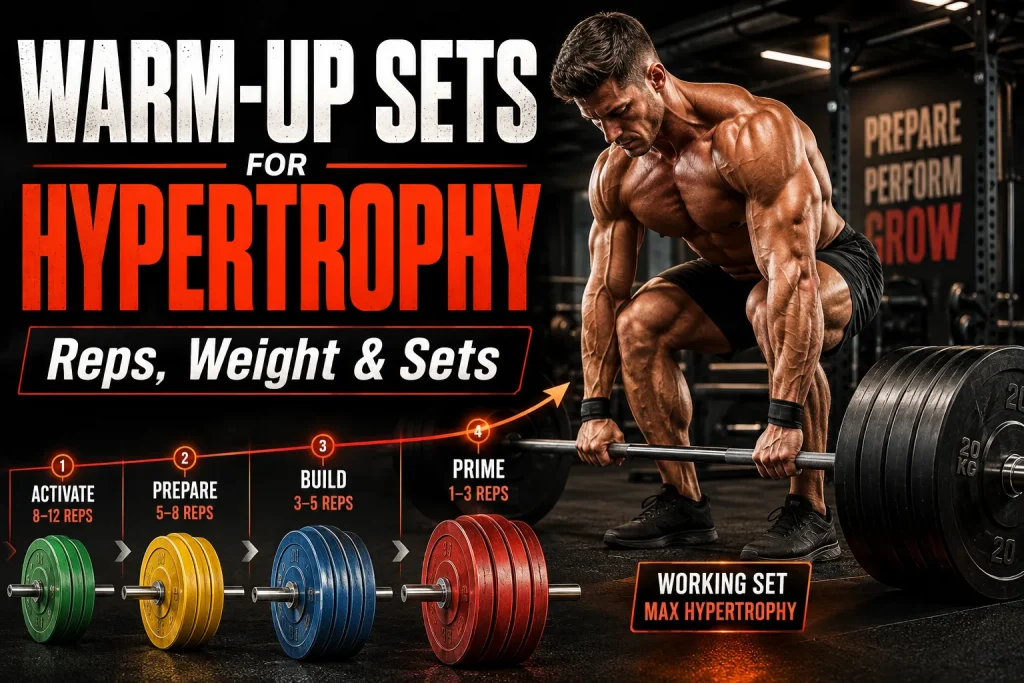
You step into the gym ready to chase muscle growth, but without the right approach to warm-up sets for hypertrophy—reps, weight, and sets—your first heavy set feels stiff and weak. The right warm-up routine primes your muscles and joints for maximum gains, ensuring your working sets deliver the hypertrophy results you’ve planned.
Warm-Up Sets for Hypertrophy: Reps, Weight & Sets
Warm-up sets for hypertrophy should prepare your muscles, joints, technique, and nervous system without creating meaningful fatigue. For most exercises, use 1–4 progressive warm-up sets, beginning with 8–12 easy reps at roughly 30–50% of your working weight and finishing with 1–5 reps at approximately 70–90% of your working weight. Keep every warm-up set well away from muscular failure—generally five or more reps in reserve (RIR)—and count only challenging working sets toward your weekly hypertrophy volume.
That is the short answer. The exact number of warm-up sets depends on the exercise, the load, where the movement appears in your workout, your training experience, and how your body feels that day. A heavy barbell squat performed first may require four or five gradual sets. A cable curl performed after several pulling exercises may need only one light rehearsal set—or none at all.
The goal is not to complete a fixed warm-up ritual. It is to arrive at your first working set physically ready, technically sharp, and no more fatigued than necessary.
What Is a Warm-Up Set?
A warm-up set is a preparatory set performed before the challenging sets intended to stimulate muscle growth. It uses the same exercise, or a very similar movement, but with fewer repetitions, less weight, and substantially less effort than a working set.
Warm-up sets serve several purposes:
- Rehearse the movement pattern and improve exercise technique
- Gradually expose your joints and connective tissues to the planned load
- Increase local blood flow and muscle temperature
- Test your range of motion, comfort, and pain-free execution
- Help you judge whether the planned working weight is appropriate
- Prepare you psychologically for a heavy or demanding set
A general warm-up and a specific warm-up are not the same. A general warm-up might involve five minutes of brisk walking, cycling, or dynamic movement. A specific warm-up uses the exercise you are about to train, such as progressively heavier squat sets before the day’s working squats.
For hypertrophy training, the specific warm-up is usually the more important component because it prepares the exact muscles, joints, and movement pattern you will use.
Do Warm-Up Sets Count Toward Hypertrophy Volume?
In most cases, warm-up sets should not count as hypertrophy sets.
Muscle-building volume is most usefully tracked as the number of sufficiently challenging sets performed for a muscle group. A set of 10 squats with an empty bar may provide movement practice and improve circulation, but it usually does not create enough mechanical tension or effort to count as a productive quadriceps set for a trained lifter.
For a complete explanation of how effort, repetitions in reserve and set difficulty determine whether preparatory work contributes to weekly volume, read Do Warm-Up Sets Count Toward Hypertrophy Volume?.
Research indicates that hypertrophy can occur across a broad spectrum of loads when sets are performed with sufficiently high effort. However, the lighter the resistance, the closer a set generally must be taken to failure to recruit and fatigue the full pool of available motor units.
The updated American College of Sports Medicine position stand on resistance training emphasizes that muscle growth is possible across different loading schemes, while sufficient weekly volume remains an important programming variable.
A normal warm-up set deliberately avoids high effort. That is precisely why it does not belong in your hard-set total.
There is one exception: a set intended as a warm-up may accidentally become difficult. If you perform 15 repetitions with a weight you could lift only 17 times, that set is approximately two reps from failure and may provide a hypertrophy stimulus. At that point, however, it is functionally a working set—not an intelligently designed warm-up set. It may also reduce your performance in the sets that follow.
For consistent tracking, classify sets according to their actual effort:
- Warm-up set: Technique and readiness work, usually five or more RIR
- Working set: Programmed hypertrophy work, commonly about zero to four RIR
- Feeder or acclimation set: A very low-fatigue bridge to a heavy working load
This distinction prevents inflated training logs. Recording six “sets” when only three were challenging makes it difficult to assess whether your real weekly training volume is progressing.
How Many Warm-Up Sets Do You Need for Hypertrophy?
Most lifters need two to four warm-up sets for the first heavy compound exercise of a workout. Later exercises usually require zero to two.
Use the following framework as a starting point:
| Exercise situation | Suggested warm-up sets |
|---|---|
| First heavy compound lift of the session | 3–5 |
| First moderate-load machine or dumbbell exercise | 2–3 |
| Second compound lift using already-warm muscles | 1–3 |
| Isolation exercise after related compound work | 0–2 |
| Very light, high-repetition isolation movement | 0–1 |
These are readiness ranges, not hypertrophy volume targets.
When to Use More Warm-Up Sets
Add more gradual sets when:
- The working weight is heavy relative to your one-repetition maximum
- The exercise requires considerable skill or stability
- It is the first movement of the session
- You are training in a cold environment
- You feel stiff, cautious, or poorly coordinated
- You have a history of discomfort that improves with gradual loading
- You are performing low-repetition working sets
When to Use Fewer Warm-Up Sets
Use fewer when:
- The target muscles were trained by the previous exercise
- The movement is stable and technically simple
- The working weight is relatively light
- You are using moderate or high repetitions
- Additional warm-up work noticeably reduces your working-set performance
Warm-ups should be autoregulated. If everything feels smooth and your rep speed is normal, you do not earn extra muscle growth by adding ceremonial sets. If a joint feels stiff or the movement feels unfamiliar, one additional low-fatigue set may be worthwhile.
Best Warm-Up Reps and Weight for Hypertrophy
An effective hypertrophy warm-up usually moves from more repetitions with a light weight to fewer repetitions with a heavier weight. As the load rises, the repetition count falls. This exposes you to the working weight without accumulating unnecessary fatigue.
A Percentage-Based Warm-Up
The percentages below refer to your planned working weight, not your one-repetition maximum:
- First set: 30–50% of your working weight for 8–12 reps
- Second set: 50–65% for 5–8 reps
- Third set: 65–80% for 3–5 reps
- Optional final set: 80–90% for 1–3 reps
- Rest briefly, then begin your first working set
Suppose your first working set on the bench press is 200 pounds for eight repetitions. A practical warm-up progression could look like this:
- Empty 45-pound bar × 10–15 reps
- 95 pounds × 8 reps
- 135 pounds × 5 reps
- 170 pounds × 2–3 reps
- 200 pounds × 8 reps as the first working set
The early sets provide practice. The final warm-up set provides exposure to a heavier load. None of them should involve grinding, significant slowing, or a pump so intense that it interferes with your working sets.
A Simpler Method Without Calculating Percentages
You do not need a calculator in the gym. Use this sequence:
- Easy rehearsal set: 8–12 smooth reps
- Middle set: 4–6 smooth reps
- Near-working-weight set: 1–3 crisp reps
- Working sets: Begin once the movement feels comfortable and stable
The weight jumps can be larger for strong compound lifts and smaller for dumbbell, cable, and isolation exercises.
How Hard Should Warm-Up Sets Be?
Keep warm-up sets far from failure. A useful target is at least five RIR, with the lightest sets often 10 or more repetitions away from failure. You should finish each warm-up set feeling more prepared, not more tired.
Stop a warm-up set when you have achieved its preparatory purpose. Performing 20 repetitions merely because the load feels light can create local fatigue, metabolite accumulation, and an unnecessary pump. Those effects are not automatically harmful, but they can reduce the quality of your first hard set.
This matters because the hypertrophy stimulus comes primarily from your working sets. A broad review of hypertrophy programming identifies appropriate effort, load, and volume as central training variables. You can read the review in Loading Recommendations for Muscle Strength, Hypertrophy, and Local Endurance.
Think “crisp repetitions,” not “effective repetitions.” Avoid failure, forced reps, slow grinders, drop sets, and extended eccentrics during your warm-up.
What Does the Research Say About Warm-Up Sets?
Warm-up research does not establish one perfect protocol for every hypertrophy workout. Studies differ in their exercise selection, participants, warm-up loads, and performance tests. Still, several findings provide useful guidance.
A 2020 study comparing specific warm-up protocols for the squat and bench press found that warm-up design can influence subsequent resistance-training performance. The broader lesson is that specificity and load matter; simply accumulating numerous light repetitions is not necessarily the best preparation.
A 2024 study indexed in PubMed reported that a high-load, low-volume warm-up—performed at 80% of the initial training load—improved repetition performance compared with lower-load approaches. This supports including a small number of repetitions reasonably close to the working weight, especially before a demanding first exercise.
However, the evidence is not completely uniform. In a 2014 randomized crossover study, specific, aerobic, combined, and no-warm-up conditions did not significantly change the total repetitions completed across several exercises performed at 80% of one-repetition maximum.
That study involved only 15 young men and cannot settle the question for every lifter or exercise, but it demonstrates that a longer warm-up does not automatically improve hypertrophy-session performance.
A broader systematic review of warm-ups and physical performance found performance improvements in most of the criteria examined, although the included activities were not limited to bodybuilding workouts.
Taken together, the evidence favors a specific, progressive, low-fatigue warm-up. It does not justify turning the warm-up into a second workout, nor does it prove that every isolation exercise requires multiple preparatory sets.
Warm-Up Sets for Different Hypertrophy Exercises
Barbell Squats and Deadlifts
These lifts often need the most preparation because they use large loads and require coordination across multiple joints.
Start with an empty bar or a very light load, then make progressive weight increases while reducing your repetitions. A strong lifter may use four to six warm-up sets, but most of those sets should contain only one to five repetitions.
Deadlifts can become fatiguing quickly. Avoid performing several high-repetition deadlift warm-up sets. Once your hips, back, grip, and technique feel ready, use low-repetition weight increases.
Bench Press and Overhead Press
Use two to four gradual sets before heavy pressing. The empty bar is useful for rehearsing your bar path and checking shoulder comfort.
Keep the final warm-up set brief—often one to three repetitions at roughly 80–90% of your planned working-set weight.
If you bench press first and perform an incline dumbbell press next, one lighter dumbbell set may be enough for the second exercise because your chest, shoulders, and triceps are already warm.
Rows, Pulldowns, and Pull-Ups
One to three warm-up sets are generally sufficient. Use the first set to establish controlled shoulder-blade movement and a stable torso position.
Before weighted pull-ups, perform a few body-weight or assisted repetitions without approaching muscular failure.
Machine Exercises
Machines require less stabilization than free-weight exercises, but they can still place substantial loads on your muscles and joints.
Perform one to three progressive sets on your first machine compound exercise. Later machine movements using the same muscles may require only one brief set to adjust your seat position, range of motion, and hand or foot placement.
Isolation Exercises
Curls, triceps extensions, lateral raises, leg extensions, and similar exercises rarely need an elaborate warm-up after related compound training.
One easy set of 8–12 repetitions is usually enough. If the isolation exercise is first in your session, the joint position is unfamiliar, or the movement commonly causes discomfort, add a second gradual warm-up set.
Supporting your joints and connective tissue becomes more important as training volume increases. Many serious lifters use targeted joint support formulas to maintain training consistency over time.
How Long Should You Rest After Warm-Up Sets?
Rest long enough to prevent fatigue from carrying into your working set, but not so long that you lose your physical and psychological readiness.
A practical approach is:
- 30–60 seconds after very light warm-up sets
- 60–120 seconds after moderate warm-up sets
- Two to three minutes after the final heavy warm-up before a demanding compound working set
Stronger lifters using heavier absolute loads may need longer. Isolation exercises usually require less rest.
Judge your readiness by your breathing, concentration, and local muscular fatigue instead of following the clock rigidly.
If your final warm-up set feels harder than expected, extend your rest period and reconsider the planned working weight. Your warm-up is also a diagnostic tool.
Common Warm-Up Mistakes That Reduce Muscle Growth
1. Taking Warm-Up Sets Close to Failure
This is the biggest warm-up mistake. A preparatory set that creates significant fatigue may reduce your repetitions, load, or technique quality during your working sets.
2. Performing the Same Reps at Every Weight
Doing 10 reps with the empty bar, 10 reps at 50%, 10 reps at 70%, and 10 reps at 85% creates progressively more fatigue as the weight rises.
Taper the repetition count downward as you add weight.
3. Making Weight Jumps That Are Too Large
Moving directly from an empty bar to a heavy working weight may leave your technique and load tolerance unprepared. Add at least one intermediate step before heavy compound lifts.
4. Warming Up Every Exercise From Scratch
Your muscles do not become completely cold when you move from a bench press to a chest-press machine.
Use exercise-specific rehearsal where needed, but recognize the warm-up effect carried over from earlier movements.
5. Counting Warm-Up Sets as Weekly Volume
Counting easy warm-up sets makes your program appear more demanding than it really is. This can lead to false conclusions about your optimal number of weekly sets.
Track sufficiently challenging working sets separately from warm-up and acclimation sets.
6. Using Static Stretching as the Entire Warm-Up
Static stretching is not inherently harmful, but long, intense holds immediately before forceful lifting may be less useful than dynamic movement and exercise-specific warm-up sets.
If flexibility work is needed to reach a safe position, use the minimum effective amount and then rehearse the loaded exercise.
7. Ignoring Pain Signals
A warm-up is not intended to numb or overpower pain. Stop if you experience sharp, escalating, or unusual discomfort.
Adjust the exercise, range of motion, or load. Seek guidance from a qualified healthcare professional when appropriate.
Sample Hypertrophy Warm-Up Routines
Heavy First Compound: Squat for 6–8 Reps
- Empty bar × 10 reps
- 40% of working weight × 6 reps
- 60% × 4 reps
- 75% × 2–3 reps
- 85–90% × 1 rep
- Working weight × 6–8 reps
Moderate Compound: Dumbbell Press for 10–12 Reps
- Light dumbbells × 10 reps
- Approximately 60% of working weight × 5–6 reps
- Approximately 80% × 2–3 reps, if needed
- Working weight × 10–12 reps
Isolation Exercise After Compound Work: Cable Curl
- Approximately 50–60% of working weight × 8–10 reps
- Working weight × programmed repetitions
Machine Exercise Later in the Workout: Leg Extension After Squats
- Light load × 8–10 reps while setting the seat and testing knee comfort
- Working weight × programmed repetitions
These warm-up templates are starting points. Add a set when the movement still feels unprepared. Remove one when you are clearly ready and additional repetitions would only create fatigue.
Frequently Asked Questions
How Many Warm-Up Sets Should I Do Before Hypertrophy Training?
Use approximately two to four warm-up sets before your first major compound exercise and zero to two sets before later exercises.
Heavy, technical lifts generally require more preparation than stable machines and isolation exercises.
What Percentage Should Warm-Up Sets Be?
Start at approximately 30–50% of your working weight and progressively increase toward 70–90%.
Reduce your repetition count as the weight increases. These percentages are practical guides rather than strict requirements.
Should Warm-Up Sets Use High Reps or Low Reps?
Use moderate repetitions with the lightest load and low repetitions with heavier warm-up loads.
A useful pattern is 8–12 reps, followed by 4–6 reps, and then 1–3 reps before beginning your working sets.
Do Warm-Up Sets Build Muscle?
Typical warm-up sets contribute little direct hypertrophy because they remain far from muscular failure.
A warm-up set can stimulate growth if it becomes sufficiently challenging, but it will also generate fatigue. At that point, it is better classified as a working set.
Do I Need to Warm Up for Every Exercise?
No. You should be prepared for every exercise, but that does not require several warm-up sets each time.
Later exercises for muscles that have already been trained may need only a quick technique and setup set.
Can Too Many Warm-Up Sets Hurt Hypertrophy?
Yes. Excessive repetitions or sets performed too close to failure can reduce the quality of your productive working sets.
The ideal warm-up uses the least amount of volume needed to feel prepared.
Should Beginners Perform More Warm-Up Sets?
Beginners may benefit from additional light practice repetitions, but their absolute working weights are normally lower. They usually do not need numerous heavy ramp-up sets.
Exercise technique should remain the priority.
Is Cardio Required Before Lifting for Hypertrophy?
No. A brief general warm-up can be useful when you are cold or have been inactive, but exercise-specific warm-up sets are normally more relevant.
Avoid long or strenuous cardio that fatigues the muscles you plan to train.
The Bottom Line
The best warm-up sets for hypertrophy improve your readiness without consuming the energy required for muscle-building work.
For your first compound lift, use approximately two to four progressive warm-up sets. Begin with 8–12 easy repetitions, increase the weight as you decrease the reps, and finish with one to three crisp repetitions near—but still below—your working weight.
Keep warm-up sets at least five repetitions away from failure, do not automatically count them toward your weekly hypertrophy volume, and reduce your warm-up requirements for later exercises involving muscles that are already prepared.
Your warm-up is successful when your first working set feels familiar, stable, and powerful. It should sharpen your workout—not become the workout.