

Why Your Pump Might Be Sabotaging Muscle Growth
Discover the science behind the tension versus pump debate in muscle building. Understanding cellular mechanisms reveals both training methods trigger growth through different but complementary signals.
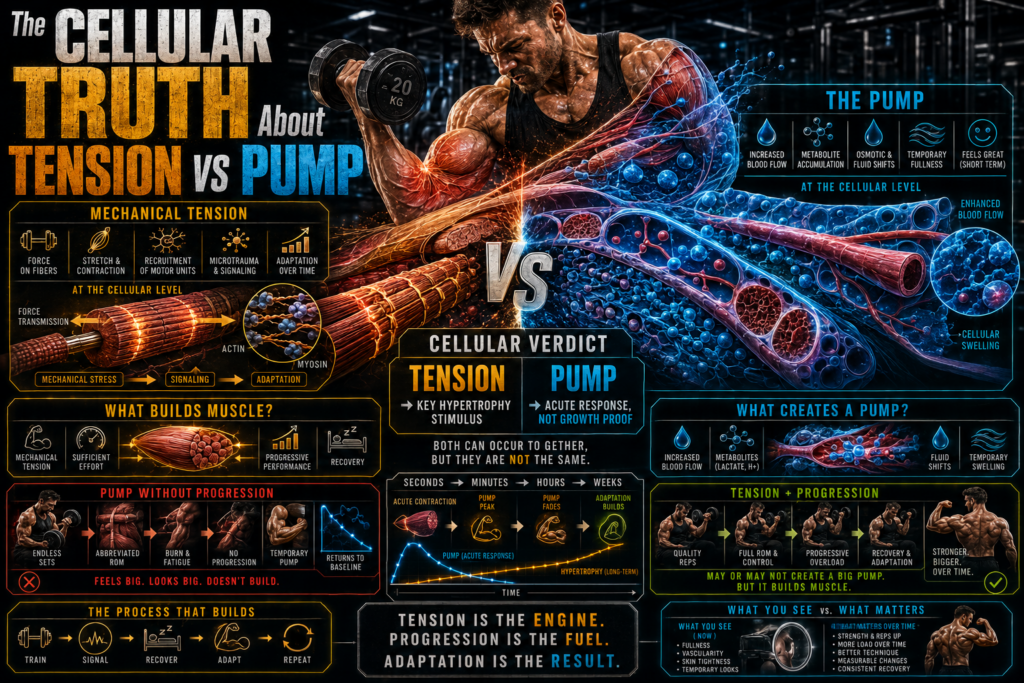
The Cellular Truth About Tension vs Pump divides gym culture into two warring camps. Walk into any training facility and you’ll hear the debate. Lifters swear by one method while dismissing the other completely. Understanding what happens inside muscle cells reveals both sides miss half the picture.
The Cellular Truth About Tension vs Pump: What Actually Happens Under Your Skin
Your muscles don’t care about your training philosophy. They respond to specific signals at the cellular level. Mechanical tension occurs when muscle fibers stretch and contract under load. This creates microtears in the tissue that trigger growth responses. Heavy loads with fewer reps maximize this signal. Your body interprets the damage as a threat worth adapting to.
Metabolic stress works through a different pathway entirely. Higher rep ranges trap blood in the muscle tissue. Waste products accumulate because blood can’t escape fast enough. Lactate, hydrogen ions, and other metabolites build up inside cells. This chemical environment activates growth pathways completely separate from mechanical damage. The pump you feel is real swelling from fluid accumulation.
Both mechanisms turn on muscle protein synthesis through distinct routes. Tension activates the mTOR pathway most directly. This molecular switch tells cells to build new proteins. Metabolic stress increases cell swelling which triggers different growth signals. Neither method is superior because they complement each other perfectly.
Why Heavy Lifters Look Different Than High-Rep Athletes
Powerlifters and bodybuilders train the same muscles with opposite approaches. One group chases maximum weight for low reps. The other pursues the pump with moderate weight for high volume. Their physiques reflect these choices in measurable ways. Heavy training builds denser muscle with less fluid retention.
Myofibrillar hypertrophy describes muscle growth from adding contractile proteins. This happens primarily from mechanical tension. The actual force-producing parts of muscle cells multiply. Strength increases faster than size with this adaptation. Your muscles become harder and more compact under the skin.
Sarcoplasmic hypertrophy means expanding the fluid portion of muscle cells. Metabolic training increases glycogen storage inside muscles. More water gets stored alongside that glycogen. Blood vessel networks expand to support the increased metabolic demand. Size increases faster than strength with this type of growth. The muscle looks fuller but feels softer to the touch.
Most advanced lifters need both adaptations for complete development. Pure strength training leaves size on the table. Pure pump work limits neural adaptations that drive performance. Smart programming cycles between these emphases throughout the year.
The Cellular Truth About Tension vs Pump During Your Recovery Window
Growth doesn’t happen in the gym during your workout. The training session only provides the signal your body reads. Actual protein synthesis occurs during the hours and days after. Different training stimuli create different recovery demands on your system. Heavy tension work damages structures that take longer to repair.
Muscle protein synthesis stays elevated for 24 to 48 hours after training. Tension-based workouts create a higher initial spike in this response. The signal is stronger but may not last as long. Metabolic workouts create a smaller initial response that extends further in time. Your body keeps building new tissue at a lower rate for longer.
Recovery nutrition needs to match the stimulus you provided. Tension work requires adequate protein to rebuild damaged fibers. Metabolic training demands carbohydrates to refill depleted glycogen stores. Skimp on either nutrient and you limit the adaptation you worked for. Quality supplements can bridge gaps in whole food intake when your schedule makes perfect nutrition difficult.
What Science Says About Tension Versus Pump for Maximum Growth
Research studies consistently show both methods build muscle effectively. A 2016 meta-analysis compared different loading schemes across dozens of studies. Total volume mattered more than load selection in most cases. Thirty total reps built similar muscle whether done as three sets of ten or ten sets of three. This surprised researchers who expected heavy loads to dominate.
The caveat is that lighter loads must be taken close to failure. Stopping sets with reps in reserve wastes the metabolic stimulus. You need to reach that burning, pump sensation for the signal to register. Heavy loads provide growth stimulus even with more reps left in the tank. Effort level changes the equation significantly.
Individual response varies based on genetics and training history. Some people are responders to high tension work. Others grow better from metabolic stress and volume accumulation. You discover your response pattern through systematic experimentation. Track your progress with both approaches over dedicated training blocks.
Recent studies suggest rotating between emphases produces superior long-term results. Your body adapts to repeated stimuli by becoming more efficient. Efficiency means less disruption to homeostasis over time. Changing the stimulus pattern keeps your system in an adaptive state. This explains why periodization works better than repeating identical workouts forever.
How The Cellular Truth About Tension vs Pump Changes With Training Age
Beginners respond well to almost any consistent training stimulus. Everything works when you’re new because your baseline is low. Pure tension builds muscle. Pure pump builds muscle. Random workouts still trigger growth in the first year. This honeymoon period doesn’t last forever though.
Intermediate lifters need more specific programming to continue progressing. Your body has adapted to general stress at this stage. You must target specific adaptation pathways more deliberately. This is when understanding tension versus pump becomes practically important. Programming needs to emphasize one quality while maintaining the other.
Advanced athletes require sophisticated manipulation of both variables. Competition bodybuilders use tension phases to build new tissue. They switch to pump work to maximize fullness before shows. Strength athletes maintain some metabolic work to preserve muscle mass. The ratio shifts but both stimuli stay present in well-designed programs.
Age affects how your body responds to each training type. Older lifters often tolerate metabolic stress better than heavy mechanical tension. Joint stress increases with heavier loads as connective tissue ages. Higher rep training with moderate weight protects joints while still building muscle. This approach reduces cumulative joint wear while maintaining muscle protein synthesis through metabolic pathways. Tendons and ligaments adapt slower than muscle tissue, making longevity a key consideration for mature athletes. Deload weeks become increasingly important to manage accumulated fatigue and inflammation. Adequate sleep, nutrition timing, and active recovery between sessions support the extended repair windows older lifters require after both tension and pump-based work.
Programming The Cellular Truth About Tension vs Pump Into Your Weekly Split
The best training programs include both stimuli in the same week. Day one might emphasize heavy compound movements for mechanical tension. Day three could focus on higher volume work for metabolic stress. This approach hits both pathways without creating excessive fatigue. Your muscles receive complementary signals that drive complete adaptation.
You can also vary the emphasis within a single workout. Start with heavy compound lifts when you’re fresh. Your nervous system handles maximum loads better before fatigue accumulates. Finish with higher rep isolation work to chase the pump. This sequence maximizes both stimuli in one training session.
Exercise selection matters as much as rep ranges. Compound movements like squats and deadlifts create massive mechanical tension. Isolation exercises work better for metabolic stress and targeted pumps. Cables and machines allow you to push sets to failure safely. Free weights demand more stability which limits how hard you can push metabolically.
Rest periods change the training stimulus even with identical exercises. Short rest between sets amplifies metabolic stress by preventing full recovery. Blood stays trapped in the muscle between efforts. Longer rest periods allow more complete recovery for maximum tension on each set. A simple timer adjustment shifts which pathway you’re emphasizing.
The Cellular Truth About Tension vs Pump for Stubborn Body Parts
Some muscle groups respond better to specific training approaches. Calves and forearms often need higher volume and metabolic stress. These muscles contain more slow-twitch fibers genetically. They’re built for endurance activity rather than maximum force production. Endless heavy sets rarely make them grow as well as high-rep pump work.
Back muscles typically respond well to heavy tension work. They’re designed to handle large loads during pulling movements. Deadlifts and heavy rows stimulate impressive growth in most people. Adding some high-rep work helps but shouldn’t form the foundation. The architecture of these muscles favors tension-based development.
Arms seem to need both approaches in equal measure. Biceps and triceps grow from heavy compound pressing and pulling. They also respond remarkably well to isolation work with moderate weight. The pump you get from arm training correlates strongly with growth. Blood flow restriction training works exceptionally well for arm development.
Experimentation reveals what your specific weak points need. If a muscle hasn’t grown from your current approach, try the opposite. Lagging shoulders might need more heavy pressing instead of endless lateral raises. Stubborn quads could respond better to heavy squats than high-rep leg extensions. Proper recovery support helps you test different approaches without overtraining the target muscle.
Measuring Progress Beyond What The Scale Shows You
Tension-based training increases strength faster than it adds muscle size. Track your working weights on key lifts every session. Progression here indicates successful mechanical adaptation. If your squat increases by twenty kilograms, you built stronger muscle tissue. The scale might not move much but your physique will change.
Pump-focused training shows up differently in measurements. Take circumference measurements of arms, chest, and legs weekly. These numbers increase from sarcoplasmic hypertrophy even without strength gains. Visual fullness in the mirror also improves noticeably. Photos capture these changes better than the bathroom scale does.
Performance in the gym tells you which stimulus your body needs. Strength stalling despite adding muscle size suggests more tension work. Size plateaus despite strength gains indicate you need more metabolic volume. Your body reveals these imbalances through training performance patterns.
Frequently Asked Questions
Can you build muscle with only tension-based training?
Yes, mechanical tension alone triggers muscle growth through protein synthesis. You’ll build dense, strong muscle with this approach exclusively. Size gains come slower compared to including metabolic work as well. Strength increases will outpace visible size changes over time.
How many reps create the best pump for growth?
Sets of twelve to twenty reps with short rest generate maximum metabolic stress. The burning sensation indicates lactate accumulation and cell swelling. You must take these sets within two reps of failure. Stopping too early wastes the metabolic stimulus you’re chasing.
Does training to failure matter more for tension or pump work?
Failure is more critical for pump-focused training to work effectively. Lighter loads need maximum effort to trigger growth signals. Heavy tension work stimulates growth even with reps left in reserve. Training within two reps of failure works for heavy sets.
Which training style burns more calories during the workout?
Metabolic pump work burns significantly more calories during the session itself. Your heart rate stays elevated and energy expenditure increases. Heavy tension training burns fewer calories during the actual workout. It may increase metabolism more in the hours after training though.
Should beginners focus on tension or pump when starting out?
New lifters should emphasize learning proper form with moderate weight first. This naturally includes both mechanical tension and some metabolic stress. Master the fundamental movement patterns before worrying about specialized approaches. Consistency matters far more than training philosophy for beginners.
Start your next training block with one primary emphasis and track the results for six weeks.