
Scientists Just Ranked Bodybuilding Exercises—Your Routine Is Probably Wrong
New EMG research reveals surprising winners in bodybuilding exercises, showing that machines outperform free weights for certain muscle groups and many popular exercises rank lower than expected. Learn how to match the right movements to your weak points based on scientific muscle activation data.
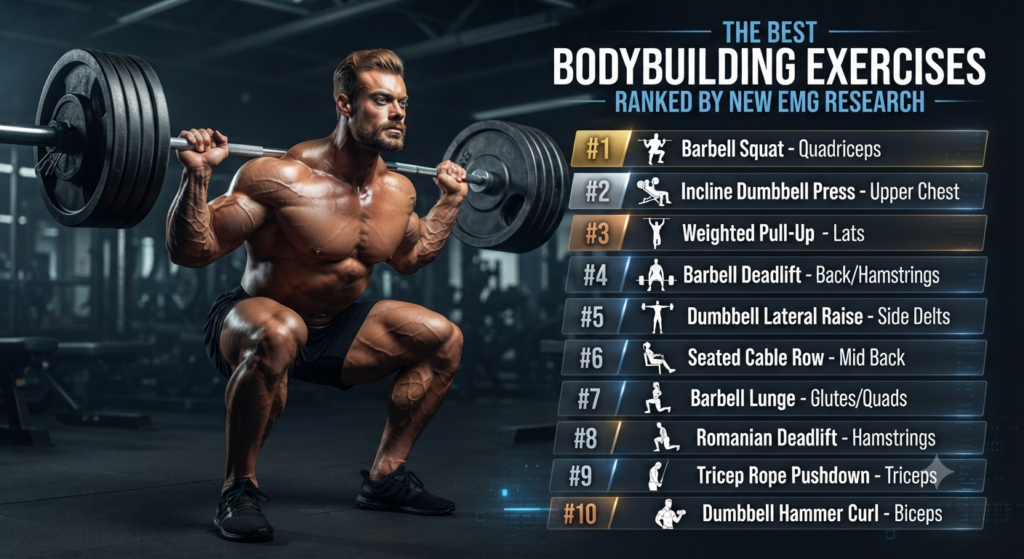
The Best Bodybuilding Exercises Ranked by New EMG Research shows surprising winners you’ve probably ignored. Machines beat free weights for some muscle groups. Exercises you’ve done for years rank near the bottom. What matters most is matching the right movement to your weak points.
How Electromyography Studies Measure Muscle Activation in The Best Bodybuilding Exercises Ranked by New EMG Research
EMG measures the electrical activity produced by skeletal muscles. Researchers place electrodes on your body during different exercises. The machine records how hard each muscle fires during the movement. Higher numbers mean more muscle fibers get recruited.
Percentages relate to mean voluntary contraction. This measures average muscle activity across the entire rep. A muscle working at 90 percent fires more intensely than one at 60 percent. The data reveals which exercises create the strongest signal to your target muscles.
But EMG only tells part of the story. Mechanical tension is more important for driving adaptation than muscle activation alone. You can get high EMG readings from light cable exercises. Heavy compound movements create more growth despite sometimes lower electrical readings.
The research catches what your muscles actually do versus what you think they’re doing. You might feel your chest burning during flies. The EMG shows your front delts doing most of the work. This gap between perception and reality is why rankings matter.
Chest Exercise Rankings from The Best Bodybuilding Exercises Ranked by New EMG Research
Based purely on muscle activation, the dumbbell bench press is where it’s at. Most people assume barbell bench wins. They’re wrong. Using dumbbells allows for a greater range of motion when compared to barbells.
You get more stretch at the bottom position. More fibers engage to control two independent weights. Your weak side can’t hide behind your strong side.
The decline bench press is the most effective exercise for the pectoralis major as a whole. The angle puts your chest in a mechanically stronger position. You can load heavier weight safely. The movement pattern matches how your pec fibers actually run.
The barbell bench press, the peck deck, and bent-forward cable crossovers could be used interchangeably to elicit the greatest muscle activation. All three produced similar EMG readings in controlled studies. Pick based on your joints and available equipment.
The incline bench press isolates the upper part of the chest muscle. Use it when your upper chest lags behind. Skip it when overall mass matters more than regional development.
Back Training Insights from The Best Bodybuilding Exercises Ranked by New EMG Research
The barbell deadlift consistently ranks as one of the most effective back exercises according to EMG studies. This compound movement targets the erector spinae, latissimus dorsi, and other muscles in the posterior chain. No other single exercise builds thickness like heavy pulls from the floor.
The one-arm dumbbell row is a top performer for isolating the latissimus dorsi and rhomboids. EMG research demonstrates that unilateral movements activate the muscles deeply and help improve muscular imbalances. Your core works harder to stabilize your torso during single-arm work.
Bent-over barbell rows 93, one-arm dumbbell rows 91, T-bar rows 89. These percentages show activation compared to maximum contraction. The differences look small. In practice, barbell rows let you load the most weight.
Pull-ups dominate for width development. Lat pulldowns and pullups 86 rate high but slightly below rowing movements. Your body position during vertical pulls creates a different stimulus than horizontal rows. You need both patterns for complete development.
Lower Body Movement Analysis in The Best Bodybuilding Exercises Ranked by New EMG Research
The barbell back squat reigns supreme when it comes to leg development. EMG studies show that squats produce the highest muscle activation across the quadriceps, hamstrings, and glutes compared to other leg exercises like leg presses or lunges.
A compound exercise like the squat or deadlift recruits between 80 and 90 percent of muscle fibers in the targeted groups, compared to only 40 to 60 percent for an equivalent isolation exercise. Leg extensions might feel like they’re torching your quads. They’re activating less than half what squats do.
The research shows compound movements create bigger hormonal responses too. Heavy squats generate a testosterone and growth hormone elevation significantly greater than that observed after leg extensions alone. This whole-body stress triggers more adaptation signals.
EMG activity during hip thrusts can exceed that during squats when focusing purely on glute activation. Your glutes work harder when they’re the prime mover. Squats spread the work across more muscles. Choose hip thrusts when glute development is the specific goal.
Build Muscle Faster While Skyrocketing Energy & Desire
Shoulder and Arm Exercise Rankings in The Best Bodybuilding Exercises Ranked by New EMG Research
The overhead barbell press ranks at the top for shoulder development. The barbell overhead press activates the anterior deltoids at 79 percent, lateral deltoids at 66 percent, and triceps at 61 percent. Lateral raises scored much lower despite being popular isolation work.
Decline skull crushers 92, tricep pushdowns 90. Skull crushers won the EMG battle for triceps. The declining angle keeps constant tension throughout the range. Your elbows stay in a more comfortable position than flat bench variations.
Cable pushdowns scored nearly as high with less joint stress. Skull crushers offer more mechanical tension, but use both exercises for best results. Heavy crushers build mass. High-rep pushdowns create metabolic stress and pump.
Preacher curls 90, standing barbell curls 86. The preacher bench prevents momentum and body English. Your biceps can’t cheat. Standing curls let you load more weight. The EMG difference is small enough that your joints should decide.
Core Exercise Performance in The Best Bodybuilding Exercises Ranked by New EMG Research
The plank is the most effective exercise for core activation, according to EMG studies. Static holds outperformed dynamic movements. Your abs work to prevent movement rather than create it. This matches how they function during heavy compound lifts.
The top 4 ab exercises are vertical leg raise, incline curl-up, bicycle crunch, and roll-out. Vertical leg raises force your lower abs to lift your entire leg weight. The stability ball crunch virtually tied with vertical leg raises for lower ab activation.
The roll-out ranked at or near the top for lower and upper abs. You can do this with a wheel, barbell, or Swiss ball. It works your deltoids, serratus, and back with your abdominals. The anti-extension pattern builds real core strength.
Significantly greater peak normalized EMG activity were observed in isolated core exercises compared to integrated core exercises. Direct ab work beats hoping lunges will build your midsection. Compound movements engage your core for stability. Isolation exercises force maximum contraction.
Why The Best Bodybuilding Exercises Ranked by New EMG Research Contradicts Common Gym Advice
Most training advice comes from anecdotal reports and bodybuilders with elite genetics and pharmaceutical assistance rather than controlled scientific research. EMG data provides objective, measurable evidence of what actually happens in normal human muscles during exercise, revealing muscle fiber recruitment patterns that subjective experience alone cannot capture. This disconnect between gym folklore and electromyography findings explains why popular programs often fail average people who lack genetic advantages or performance-enhancing drugs, making evidence-based exercise selection crucial for natural lifters seeking sustainable hypertrophy and strength gains.
Pre-exhaustion does not increase target muscle EMG activity during the multi-joint movement. You tire your muscles before the main lift. They work less hard, not more. Pre-exhaustion increased isolation EMG activation but produced equivalent final hypertrophy to compound-first ordering.
The supposed mind-muscle benefits don’t show up in long-term growth studies. You just lift less weight when pre-fatigued. Lower mechanical tension cancels any activation advantage.
EMG activities of the pectoralis major and triceps brachii muscles were significantly increased when the unstable device was added. Wobble boards and Swiss balls increase electrical activity. They also force you to use lighter weights. The trade-off rarely favors growth.
Unstable surfaces work for rehab and variety. They don’t build more muscle than stable, heavy loading. Higher EMG from stabilizer recruitment doesn’t equal bigger target muscles.
How to Apply The Best Bodybuilding Exercises Ranked by New EMG Research to Your Training
Start your session with compound lifts to overload the system, then follow with exercises that boast the highest EMG ratings. Heavy barbell work creates mechanical tension. Isolation exercises with proven activation finish the job.
If you only chase the highest EMG numbers, you’ll end up doing exclusively isolation work with light weights. This tanks your progress. Leg extensions show high quad activation. You can’t progressive overload them like squats.
Pick your compound movement based on what you can load safely. Front squats, back squats, and leg presses all work. The best one is whatever lets you add weight month after month. Technical breakdown kills progress faster than exercise selection.
EMG data helps beginners pick the best exercises and prioritize them to maximize growth in minimal time. For advanced trainers working on weak points within a muscle group, the data can be misleading. Lower-ranked exercises might hit the exact fibers you’re missing.
Track which exercises make you stronger over time. That matters more than any study. EMG tells you where to start testing. Your logbook shows what actually works for your body.
Frequently Asked Questions
What does EMG measure in bodybuilding exercise studies?
EMG measures electrical signals your muscles produce during contractions. Electrodes record how many muscle fibers fire during each exercise. Higher readings mean more intense muscle activation and fiber recruitment.
Do high EMG exercises always build more muscle than low EMG exercises?
No, mechanical tension matters more than activation alone for muscle growth. Heavy compound lifts often produce more growth despite lower EMG readings. Combine both high-load movements and high-activation exercises for best results.
Why do dumbbells beat barbells for chest activation in EMG research?
Dumbbells allow greater range of motion and deeper stretch at bottom position. Each arm works independently, preventing your strong side from compensating. More muscle fibers engage to stabilize two separate weights versus one bar.
Should beginners focus on the highest-ranked EMG exercises for every muscle?
Yes, beginners benefit most from exercises with proven high activation rates. Focus on compound movements that score well in EMG studies. Add isolation work only after you’ve built a strength foundation.
Can EMG research replace personal experience when choosing exercises for your program?
No, EMG data shows where to start your exercise selection process. Your individual response and injury history matter more than any study. Track which movements make you stronger and adjust based on results.
Start your next workout with one high-EMG compound lift and one proven isolation exercise for your weakest muscle group.