

Why Your Barbell Curls Aren't Building Bigger Arms
The Barbell Curl Blueprint for Big Arms reveals how grip width determines which bicep muscles grow most effectively. Discover shoulder-width, narrow, and wide grip strategies to build bigger, more defined arms.
You walk into the gym with a plan to grow your arms. Everyone grabs the barbell first for biceps work. The Barbell Curl Blueprint for Big Arms starts with knowing exactly how to execute each rep. Perfect form beats heavy weight every single time.
The Barbell Curl Blueprint for Big Arms: Grip Width Makes or Breaks Growth
Your hands control which part of your biceps gets the most work. A shoulder-width grip hits the entire bicep muscle evenly. This is where most people should start their curl training.
Narrow grips do something different. They shift tension to the outer head of the bicep. Your arms look wider from the front when this area grows.
Wide grips target the inner bicep head instead. This creates the peak you see when bodybuilders flex their arms. The difference shows up in about eight weeks of focused training.
You can rotate grip widths every four weeks. This ensures both heads of the bicep receive equal attention. No weak points develop when you plan your grip selection.
Most gym goers never change their hand position. They use the same grip for months and wonder why growth stalls. Your biceps need varied angles to keep adapting and growing.
1. By Equipment & Grip Alteration
-
Standard Barbell Curl: The classic, shoulder-width underhand grip that evenly targets both heads of the biceps.
-
Wide-Grip Barbell Curl: Placing hands wider than shoulder-width shifts more emphasis onto the short head (inner bicep) to help build arm thickness.
-
Close-Grip Barbell Curl: Bringing hands closer together emphasizes the long head (outer bicep), which helps build the bicep “peak”.
-
Reverse Grip Barbell Curl: Using an overhand (pronated) grip heavily targets the brachialis and forearms (brachioradialis) rather than just the biceps.
-
EZ-Bar Curl: Using an angled EZ-curl bar places the wrists in a neutral/semi-supinated position, reducing strain on the wrist and elbow joints while targeting the biceps effectively.
2. By Body Position & Equipment Setup
-
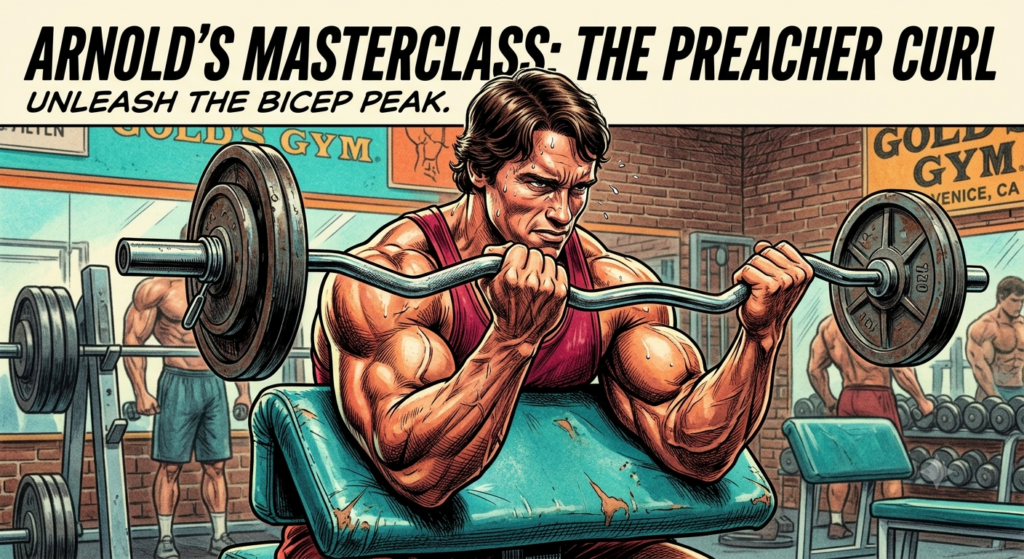
Barbell Preacher Curl: Performed on an inclined preacher bench, locking the elbows in place to isolate the biceps and eliminate momentum.
-
Barbell Drag Curl: Dragging the bar directly up the front of your torso while driving the elbows straight back, keeping constant tension on the long head.
-
Spider Curl (Prone Incline): Lying chest-down on an incline bench with arms hanging down; isolates the top half of the movement and peak contraction.
-
Cheat Curl: A powerlifting/bodybuilding variation where slight hip momentum is intentionally used to overload the eccentric (lowering) phase with heavier weight.
Standing Versus Seated: The Barbell Curl Blueprint for Big Arms Position Strategy
Standing curls let you handle more weight than any other variation. You can use a slight body lean to push through hard reps. This recruits more muscle fibers when fatigue sets in.
Some coaches call this cheating. They’re wrong if you control the movement deliberately. A ten-degree torso lean on your last two reps extends your set.
Seated curls remove all momentum from the exercise completely. Your biceps do one hundred percent of the work with zero help. This creates intense muscle tension that drives growth differently.
You sacrifice weight when you sit down to curl. Expect to drop the barbell load by fifteen to twenty pounds. The bicep pump you get compensates for the lighter resistance.
Alternate between standing and seated curls across different workouts. Monday uses standing for heavy sets of six reps. Thursday switches to seated for moderate sets of ten reps.
The Barbell Curl Blueprint for Big Arms Tempo Secrets Nobody Teaches
Most people curl the bar up in one second. They drop it back down in half a second or less. This tempo wastes half the growth potential of each rep.
The lowering phase builds more muscle than the lifting phase. Your biceps can handle more load eccentrically than concentrically. Slow negatives create significant damage that repairs into bigger arms.
Try a three-second descent on every single curl rep you perform. Count in your head to maintain consistent speed throughout the range. Your biceps will burn in ways you haven’t felt before.
The lifting phase needs one to two seconds of controlled speed. Exploding the weight up reduces time under tension unnecessarily. Smooth and steady beats fast and jerky for arm development.
A two-second lift with a three-second lower gives you five seconds per rep. Ten reps now takes fifty seconds of continuous bicep work. That’s when real hypertrophy begins to happen in your arms.
Straight Bar Versus EZ Bar: The Barbell Curl Blueprint for Big Arms Equipment Choice
The straight bar keeps your wrists in a fully supinated position. This maximizes bicep activation throughout every inch of the curl. Your forearms also get significant work from this hand position.
Wrist pain stops many people from using straight bars regularly. The locked supination creates joint stress that accumulates over time. Some lifters feel discomfort after just two sets of curls.
EZ bars angle your wrists into a more neutral position. This reduces strain on the wrist joint during heavy curling. Your biceps still receive excellent tension despite the grip change.
The angled grip of an EZ bar does shift some work to your brachialis. This is the muscle underneath your bicep that pushes it upward. Total arm size actually increases when you develop this area.
Use both bar types in your training split for best results. Straight bars work well for lighter, higher-rep sets of twelve. EZ bars handle your heavy sets of six reps more comfortably.
The Barbell Curl Blueprint for Big Arms: Range of Motion Errors That Limit Size
Partial reps appear in every gym during bicep training sessions. People load the bar heavy and curl it halfway up. They think this builds strength that transfers to full reps.
It doesn’t work that way for muscle growth purposes. Your biceps grow most when stretched fully at the bottom. Missing the bottom half of each rep eliminates crucial stimulus.
Full extension means your elbows straighten completely between every repetition. Your arms should hang straight down before each new curl. This starting position loads the bicep under maximum stretch.
The top of the curl needs attention too. Your forearms should touch your biceps at peak contraction. Stopping two inches short leaves gains on the table unnecessarily.
Film yourself doing barbell curls from the side angle. Watch how far you actually lower the weight down. Most people discover they cut their range short by three inches.
The Barbell Curl Blueprint for Big Arms Weekly Frequency and Volume Guidelines
Your biceps are small muscles compared to your back or legs. They recover faster than large muscle groups do after training. This allows you to curl more often than you might think.
Two sessions per week works well for most people chasing bigger arms. Space these workouts three to four days apart for adequate recovery. Monday and Thursday creates a good weekly split for curls.
Each session should include eight to twelve total sets for biceps. This counts all curl variations combined across the entire workout. Going beyond twelve sets rarely produces better results for natural lifters.
One workout can focus on heavy weight for lower reps. The second session uses lighter weight for higher rep ranges. This combination hits different muscle fibers and growth pathways effectively.
Three weekly curl sessions pushes into overtraining territory for many people. Your biceps might not recover fully between workouts at that frequency. Tendon issues often develop when you curl too frequently.
The Barbell Curl Blueprint for Big Arms Plateau-Breaking Techniques
Rest-pause sets extend a normal set past initial muscle failure. You complete your regular reps until you can’t curl anymore. Then you rest fifteen seconds and squeeze out three more reps.
This technique recruits muscle fibers that never activate during standard sets. Your body digs deeper into its reserves when you rest-pause. Two sets using this method equals four regular sets for growth.
Drop sets work differently but produce similar overload on your biceps. You curl to failure, then immediately reduce the weight by twenty-five percent. No rest happens between the weight changes at all.
You can drop the weight twice in one extended set. Start at one hundred pounds, drop to seventy-five, then finish at fifty. Your biceps will be completely exhausted after one brutal set.
Save these advanced techniques for the last exercise in your workout. Using them early drains your energy for subsequent movements. One plateau-breaker per workout session is plenty for most people.
Elbow Position and The Barbell Curl Blueprint for Big Arms
Your elbows should stay locked in one spot throughout each curl. They sit slightly in front of your torso at the starting position. This alignment keeps constant tension on your biceps during movement.
Moving your elbows forward during the curl is a common mistake. This shifts work from your biceps to your front deltoids. You’re doing a front raise instead of an isolation curl.
Pulling your elbows backward is equally problematic for bicep development. This turns the curl into a rowing motion for your back. Your lats start doing work your biceps should be doing.
Pin your upper arms against your sides during every repetition. Imagine someone holding your elbows in place while you curl. Only your forearms should move throughout the entire set.
Some people let their elbows flare outward to the sides. This reduces bicep activation and creates shoulder joint stress unnecessarily. Keep everything tight and controlled for maximum arm growth.
Frequently Asked Questions
How much weight should I use for barbell curls?
Start with a weight you can curl for eight reps with perfect form. Your last two reps should feel challenging but still controlled. Add five pounds to the bar when you reach twelve clean reps.
Can I do barbell curls every day for faster arm growth?
Daily barbell curls will overtrain your biceps and stop growth completely. Your muscles grow during rest periods between workouts. Stick to two or three sessions weekly for best results.
Why don’t my biceps get sore after barbell curls anymore?
Soreness decreases as your body adapts to the same exercise pattern. This doesn’t mean your biceps aren’t growing from the work. Change your tempo or grip width to create new stimulus.
Should I fully lock out my elbows at the bottom?
Yes, full elbow extension at the bottom maximizes your range of motion. This stretched position triggers more muscle growth than partial reps do. Keep slight tension without resting between reps.
How long until I see arm size gains from barbell curls?
Most people notice visible bicep growth after six to eight weeks of consistent training. Measure your arms every two weeks to track actual progress. Take progress photos monthly to see changes you might miss daily.
Pick up a barbell tomorrow and apply one new technique from The Barbell Curl Blueprint for Big Arms to your next workout.