

Why Muscle Builders Are Skipping the Mobility Drills Holding Them Back
Mobility drills for functional muscle growth outperform static stretching by increasing blood flow and teaching your nervous system to control movements under tension. Dynamic mobility preparation allows you to lift with proper form through a complete range of motion, accelerating muscle development faster than adding more sets.
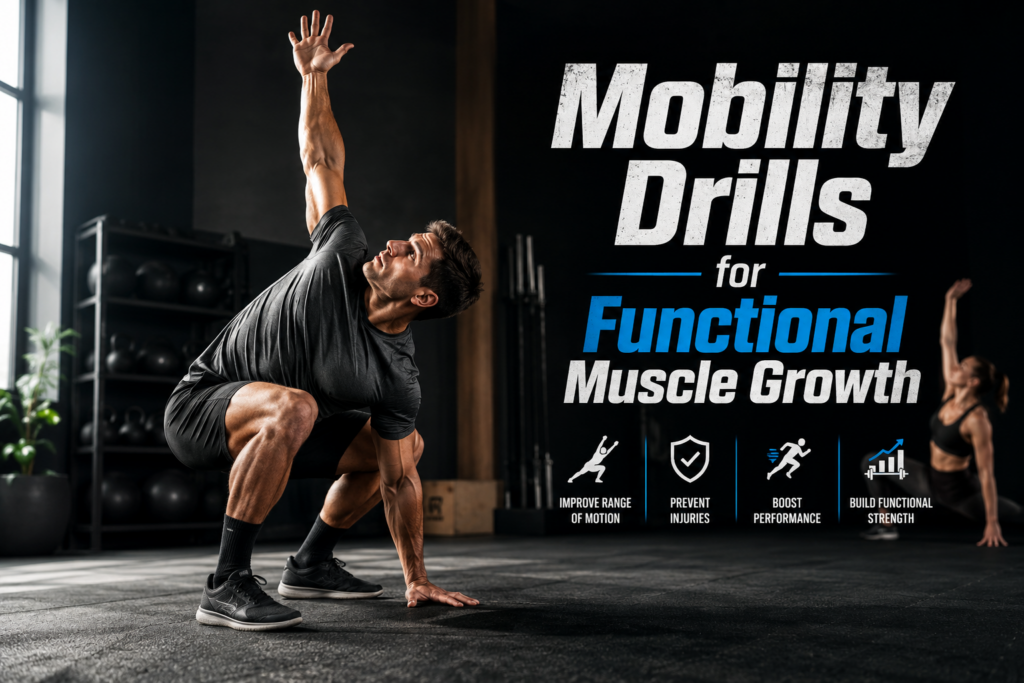
You walk into a gym and see two people lifting the same weight. One moves smoothly through a full range of motion. The other struggles halfway down and compensates with their lower back. Mobility Drills for Functional Muscle Growth close that gap faster than adding more sets.
Why Mobility Drills for Functional Muscle Growth Beat Static Stretching
Static stretching before a workout actually weakens your muscles temporarily. Research shows it reduces force production by up to 8 percent. You end up lifting less weight with worse form.
Dynamic mobility drills prepare your joints and muscles differently. They increase blood flow to the exact ranges you’ll use during exercise. Your nervous system learns to control movement patterns under tension.
A hip flexor stretch held for 30 seconds does nothing for your squat. A walking lunge with rotation teaches your hip to stabilize while moving. That transfers directly to every lower body exercise you do.
Static work has a place after training when muscles are warm. Before training, you need movement that mimics what’s coming next. The body doesn’t understand positions. It understands actions.
Joint Capsule Restrictions That Block Muscle Activation
Your shoulder joint has a capsule of connective tissue surrounding it. When this capsule tightens in one direction, your brain limits muscle activation. It’s a protective mechanism to prevent injury.
People with restricted shoulder internal rotation can’t fully engage their lats. They compensate by overusing their biceps during pulling movements. The biceps fatigue first and the back never gets properly trained.
The same pattern shows up in hips. Limited internal rotation at the hip joint prevents glute activation. Your body shifts the work to your quads and lower back instead.
You can add more volume to your training program. You can eat more protein and sleep nine hours. None of it matters if the joint capsule won’t let the muscle turn on.
Controlled articular rotations target these capsular restrictions directly. You move each joint through circles at its end range. Five rotations per direction before your workout changes what fires during it.
How Mobility Drills for Functional Muscle Growth Fix Movement Compensation
Your body will always find a way to complete a movement. If one muscle can’t do its job, another takes over. This compensation becomes your new default pattern within weeks.
Watch someone squat who lacks ankle mobility. Their heels lift off the ground early in the descent. Their knees cave inward and their torso pitches forward excessively.
Every rep reinforces this faulty pattern. The quads work overtime while glutes stay quiet. After six months, you’ve built muscle in the wrong places with the wrong ratios.
Ankle mobility drills performed daily reverse this. Wall ankle mobilizations push your knee past your toes while keeping your heel down. Three sets of 12 reps per side changes your squat depth in two weeks.
The compensation disappears when the restriction does. Your glutes can finally work at the bottom of the squat. You add 20 pounds to your working weight without trying harder.
Thoracic Spine Mobility for Upper Body Development
Your thoracic spine runs from the base of your neck to your lower ribs. Most people can’t extend this area more than a few degrees. They sit hunched forward for hours every day.
This limitation destroys overhead pressing mechanics. Your lower back hyperextends to compensate for a stiff mid back. Your shoulders roll forward and your elbows flare out.
Pressing in this position compresses the shoulder joint repeatedly. You develop pain in the front of your shoulder. Your chest grows but your shoulders lag behind from chronic irritation.
Thoracic extensions over a foam roller open this area in minutes. Lie with the roller perpendicular to your spine at bra strap level. Extend backward over it and hold for five breaths.
Move the roller up one vertebra and repeat. Cover six positions from your shoulder blades to your neck. Do this before every upper body session without fail.
Your overhead press improves immediately. Your elbows stack under the bar instead of drifting forward. Your shoulders stay healthier and your arms respond better to training.
Mobility Drills for Functional Muscle Growth During Active Recovery Days
Rest days don’t mean sitting still for 24 hours. Your joints stiffen when you don’t move them through their ranges of motion. Your nervous system forgets the neuromuscular patterns and motor control you trained yesterday. Synovial fluid in your joints—which provides lubrication and nutrient delivery—becomes less distributed during complete inactivity.
Active recovery sessions maintain the mobility you gained during training. They also speed up muscle recovery by increasing blood flow. Fifteen minutes of movement beats lying on the couch.
Focus on the joints you used most recently. If you trained legs yesterday, work through hip and ankle drills. If you did upper body, target shoulders and thoracic spine.
Cat cow movements improve spinal mobility in both directions. Start on hands and knees with a neutral back. Arch your spine and look up for cow position.
Round your spine and tuck your chin for cat position. Move slowly between the two for 10 full cycles. Your spine should feel looser and your lower back less tight.
World’s greatest stretch hits multiple areas at once. Step into a lunge and place both hands inside your front foot. Drop your back knee and push your hips forward.
Rotate your torso toward your front leg and reach your arm up. Hold for three breaths and switch sides. Do three rounds per side on off days.
Specific Drills That Improve Squat and Deadlift Range
Hip flexor tightness prevents you from reaching depth in squats. Your pelvis tilts forward and your lower back arches excessively. You cut the squat high to avoid the restriction.
Kneeling hip flexor mobilizations with a reach fix this. Kneel on one knee with your other foot forward. Push your hips forward until you feel a stretch.
Reach both arms overhead and lean slightly to the side. This position targets the hip flexor and the obliques simultaneously. Hold for 30 seconds per side before squatting.
Hamstring tension limits deadlift setup position. Your hips start too high and your back rounds immediately. The weight never moves in a straight line.
Active straight leg raises teach hamstring control through range. Lie on your back with one leg extended on the ground. Raise the other leg while keeping both knees straight.
Pull your toes toward your shin to increase the stretch. Lower slowly with control for five reps per side. Your hamstrings learn to lengthen while staying active.
Rotational Mobility Drills for Functional Muscle Growth and Athletic Performance
Most gym exercises happen in straight lines forward and backward. Real life involves rotation in every direction. Your body needs to control twisting motions under load.
Athletes who can’t rotate at their thoracic spine rotate at their lower back instead. This causes disc problems over time. It also leaks power during any rotational movement.
Quadruped thoracic rotations build segmental control. Start on hands and knees with one hand behind your head. Rotate your elbow down toward the opposite arm.
Then rotate your elbow up toward the ceiling as far as possible. Your hips stay square to the ground throughout the movement. Do 10 reps per side before training.
This drill separates upper body rotation from lower body stability. Your lifts become more stable and your injury risk drops. Your core works harder because it has better positioning.
Tracking Progress in Range of Motion
You measure weight lifted and reps completed in training. You should measure joint range the same way. What gets measured improves faster.
Take a video of your squat from the side. Note where your hip crease sits relative to your knee. Mark the depth you reach without compensation.
Repeat this test every two weeks. You’ll see measurable changes as mobility improves. Your squat depth increases by inches without losing neutral spine.
Test shoulder flexion by lying face down with arms extended overhead. Have someone measure the distance from your wrists to the floor. Lower numbers mean better mobility.
Track your ankle dorsiflexion with the wall test. Stand facing a wall with your toe five inches away. Push your knee forward to touch the wall without lifting your heel.
If you can’t touch, move closer. If you can, move farther away. The distance you achieve correlates directly to squat depth potential.
These measurements tell you if your mobility work is actually working. They also show which joints need more attention. Numbers remove guesswork from the process.
Frequently Asked Questions
How long should I spend on mobility drills before lifting?
Spend five to ten minutes on drills before training. Focus on the joints you’ll use that session. More time doesn’t improve results beyond this window.
Can I do mobility work on the same day as weight training?
Yes, mobility drills work best immediately before lifting weights. They prepare your joints for loaded ranges of motion. Separate sessions don’t transfer as well to your lifts.
Will mobility drills make me too flexible for strength training?
No, controlled mobility work doesn’t reduce strength. It increases the range where you can produce force. Hypermobility only becomes a problem when you lack muscular control.
How soon will I see results from daily mobility work?
You’ll notice changes in joint range within one to two weeks. Your lifting form improves in the same timeframe. Muscle growth follows once compensation patterns disappear.
Should beginners focus on mobility before building muscle?
Beginners should do both at the same time. Good movement patterns prevent years of training with poor mechanics. Five minutes daily prevents months of corrective work later.
Start tomorrow’s workout with three mobility drills for your weakest joint.