

The Volume Threshold Most Lifters Never Hit for Growth
MEV, MAV, and MRV are three critical volume thresholds that determine whether your training creates muscle growth or just fatigue. Understanding these landmarks helps you find the perfect training volume sweet spot for maximum gains without overtraining.
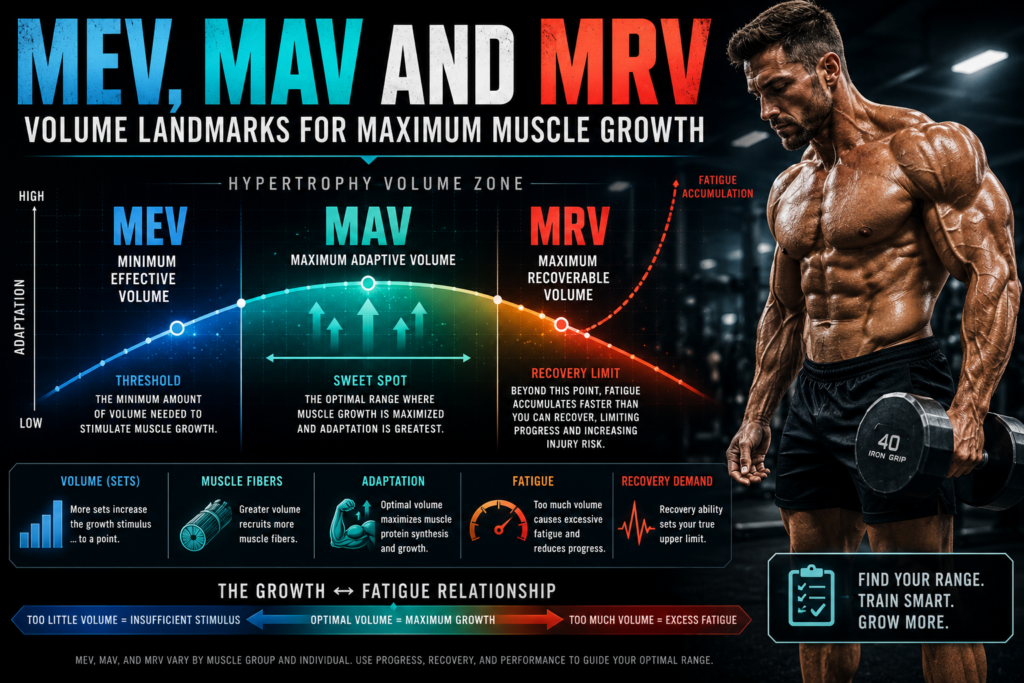
You train hard but your muscles stay the same size. You add more sets and suddenly you feel wrecked. MEV, MAV and MRV: Volume Landmarks for Maximum Muscle Growth explain why this happens. These three volume thresholds determine whether you grow or just get tired.
What MEV, MAV and MRV: Volume Landmarks for Maximum Muscle Growth Actually Mean
MEV stands for Minimum Effective Volume. This is the smallest amount of training that creates growth. Go below this and your muscles won’t change. Most people hit this threshold with two hard sets per muscle each week.
MAV means Maximum Adaptive Volume. This represents the sweet spot where you grow fastest. You push hard enough to trigger gains but not so hard you can’t recover. MAV sits between eight and eighteen sets per muscle per week for most people.
MRV is Maximum Recoverable Volume. This is your ceiling. Push past this point and you stop growing. Your body can’t repair the damage you create. Sleep gets worse and strength drops.
These aren’t random numbers someone made up. They came from years of tracking how lifters respond to different training loads. Dr. Mike Israetel developed this framework after coaching thousands of athletes.
Why Most Lifters Ignore MEV, MAV and MRV: Volume Landmarks for Maximum Muscle Growth
The fitness industry sells you the idea that more is always better. Influencers post their twenty-set chest workouts and you think that’s normal. It’s not. Those people often use drugs that change their recovery capacity completely.
Natural lifters have strict limits. You produce only so much testosterone and growth hormone. Your muscle cells can only synthesize so much new protein each day. Quality supplements help support this process, but they don’t remove the ceiling.
Another problem is ego. Admitting you need less volume feels like admitting weakness. You see someone doing more and assume they know something you don’t. Usually they’re just overtraining and not growing either.
Volume landmarks are far easier to individualize when you have several weeks of training data rather than relying on guesswork. Tracking sets, performance, RIR, recovery, and fatigue can help reveal when additional volume is productive and when it is simply creating more fatigue. Learn exactly what to record in Training Logs for Hypertrophy: What to Track & Why.
People also confuse soreness with effectiveness. Doing thirty sets makes you incredibly sore. That soreness feels productive. But soreness just means tissue damage. Growth requires damage plus full recovery. Skip recovery and you just stay damaged.
How to Find Your Personal MEV, MAV and MRV: Volume Landmarks for Maximum Muscle Growth
Start with MEV for each muscle group. Pick a number like two sets per week. Track your measurements and strength for three weeks. If nothing changes, add two more sets. Keep adding until you see progress.
Once you find MEV, push toward MAV. Add two sets every three weeks. Watch your recovery closely. Good recovery means you feel fresh before each workout. Your strength climbs steadily. Sleep stays solid.
You’ll know you hit MRV when things fall apart. Your strength stops improving or drops. You feel tired all day. Your joints ache constantly. Sleep quality crashes even though you’re exhausted.
Back off immediately when you spot these signs. Cut your volume by thirty percent for a week. This deload lets your body catch up. Then settle into a volume between MEV and MRV. That’s your MAV zone.
Different muscles have different thresholds. Your quads might handle sixteen sets weekly while your biceps max out at ten. Test each muscle group separately. Keep detailed notes.
Training Frequency Changes How MEV, MAV and MRV: Volume Landmarks for Maximum Muscle Growth Work
You can spread your weekly volume across different numbers of sessions. Doing ten sets for chest once per week hits different than five sets twice weekly. The total is the same but the growth differs.
Higher frequency usually works better up to a point. Muscle protein synthesis stays elevated for about forty-eight hours after training. Hitting each muscle every two or three days keeps that signal active.
This means your MEV per session drops when you train more often. Two sets per session across three sessions gives you six weekly sets. That beats six sets in one brutal session.
Frequency also affects MRV. Splitting volume across more days reduces the damage per session. You recover faster between workouts. This lets you handle more total weekly volume.
Most natural lifters grow best training each muscle two or three times weekly. Once per week works but requires perfect execution. Four or more times weekly usually causes scheduling problems and minor injuries.
Progression Systems Within MEV, MAV and MRV: Volume Landmarks for Maximum Muscle Growth
You can’t stay at the same volume forever. Your body adapts through repeated exposure to training stimulus, requiring progressive overload to continue triggering hypertrophy adaptations. But adding volume every week leads straight to overtraining and CNS fatigue, preventing supercompensation and muscle protein synthesis optimization. You need a smarter periodization system that manages training fatigue while allowing adequate recovery windows for neuromuscular and metabolic adaptation.
Try mesocycles lasting four to six weeks. Start each cycle near your MEV. Add sets each week until you approach MRV. Then take a deload week and start over.
Week one might include eight sets per muscle. Week two goes to ten sets. Week three hits twelve sets. Week four pushes to fourteen sets. Week five deloads back to six sets. Week six starts a new cycle at nine sets.
This wave pattern keeps you in the growth zone without burying you. The deload weeks feel easy but they’re when adaptation actually happens. Supporting your recovery during deloads with proper nutrition makes the next cycle more productive.
Some people prefer linear progression until they clearly hit MRV. They start conservative and add volume until performance tanks. Then they deload and begin again slightly higher than last cycle’s starting point.
Exercise Selection Impact on MEV, MAV and MRV: Volume Landmarks for Maximum Muscle Growth
Not all sets are equal. A set of heavy squats trashes your system more than a set of leg extensions. Compound movements require more recovery resources than isolation work.
This means you hit MRV faster with compounds. You might handle eighteen sets of lateral raises weekly but only twelve sets of overhead presses. Both target shoulders but the systemic fatigue differs wildly.
Smart programming mixes compounds and isolations strategically. Do compounds early in the week when you’re fresh. Add isolations later to push volume higher without wrecking recovery.
Exercise variation also matters. Doing all your chest volume with barbell bench press beats up your shoulders eventually. Mixing in dumbbell work, machines, and different angles distributes stress better.
You can typically handle more total volume with varied exercises. Your joints stay healthier and weak points get addressed. Just don’t change exercises so often you can’t track progress.
Nutrition Requirements for MEV, MAV and MRV: Volume Landmarks for Maximum Muscle Growth
Volume tolerance depends heavily on fuel. Trying to train at MAV while cutting calories is asking for trouble. Your recovery capacity drops when energy is limited.
During a calorie deficit, your MRV might drop by twenty to thirty percent. What you handled easily while gaining weight now pushes you into overtraining. You must reduce volume to match your recovery ability.
Protein needs scale with training volume too. The standard recommendation is about one gram per pound of body weight. Push toward MRV and you might need more. Protein repairs the damage your sets create.
Carbohydrates fuel your workouts and refill muscle glycogen. Low carb diets reduce your work capacity. You fatigue faster during sets. Your volume per session drops even if your weekly target stays the same.
Quality matters as much as quantity. Whole food sources combined with targeted supplementation provide better results than junk food at the same calorie level. Your body needs micronutrients to build tissue.
Deloading Strategy for MEV, MAV and MRV: Volume Landmarks for Maximum Muscle Growth
Deloads aren’t rest weeks where you do nothing. They’re active recovery periods where you train below MEV. This maintains skill and neural patterns without creating new fatigue.
A typical deload cuts volume by forty to fifty percent. If you normally do twelve sets per muscle, drop to six or seven. Keep the same exercises and frequency. Just do fewer hard sets.
Some people reduce intensity instead of volume. They keep set counts the same but stop each set further from failure. This works but volume reduction tends to work better for most lifters.
Time your deloads strategically. Schedule them every fourth or fifth week if you’re pushing volume hard. Take them when life stress is high even if training feels fine. Stress is cumulative.
You’ll feel restless during a deload. Your ego says you’re being lazy. Ignore that voice. The supercompensation you get from proper deloading adds more muscle than grinding would.
Frequently Asked Questions
What happens if I train below MEV every week?
Your muscles won’t grow at all. You’ll maintain current size and maybe gain some strength. But no new muscle tissue gets built. Training becomes pointless for hypertrophy goals.
Can beginners use MEV, MAV and MRV concepts right away?
Yes, but their numbers look different. Beginners have very low MEV, sometimes one set per muscle weekly. Their MRV is also lower because their recovery systems aren’t developed. They still need to find their personal ranges.
How long does it take to find my exact MAV?
Expect three to six months of systematic testing. You need to try different volumes for several weeks each. Keep detailed logs. Most people find their range within one training cycle.
Does MRV increase as I get more advanced?
Usually yes, but not always. Advanced lifters develop better recovery systems over years. But they also lift heavier weights that create more damage. Some advanced lifters actually need less volume than intermediates.
Should I use the same volume for bulking and cutting?
No, reduce volume during a cut. Your recovery drops when calories are low. Drop total sets by twenty to thirty percent. Focus on maintaining strength rather than adding volume.
Start tracking your weekly sets per muscle group today and find your personal volume sweet spot.