

Incline Walking Builds Muscle 3x Faster Than You Think
Incline treadmill walking transforms flat cardio by forcing your glutes and hamstrings to work harder, building lower body strength through a workout that mimics repeated partial squats. This single adjustment recruits your posterior chain more effectively while reducing knee impact stress compared to traditional flat walking.
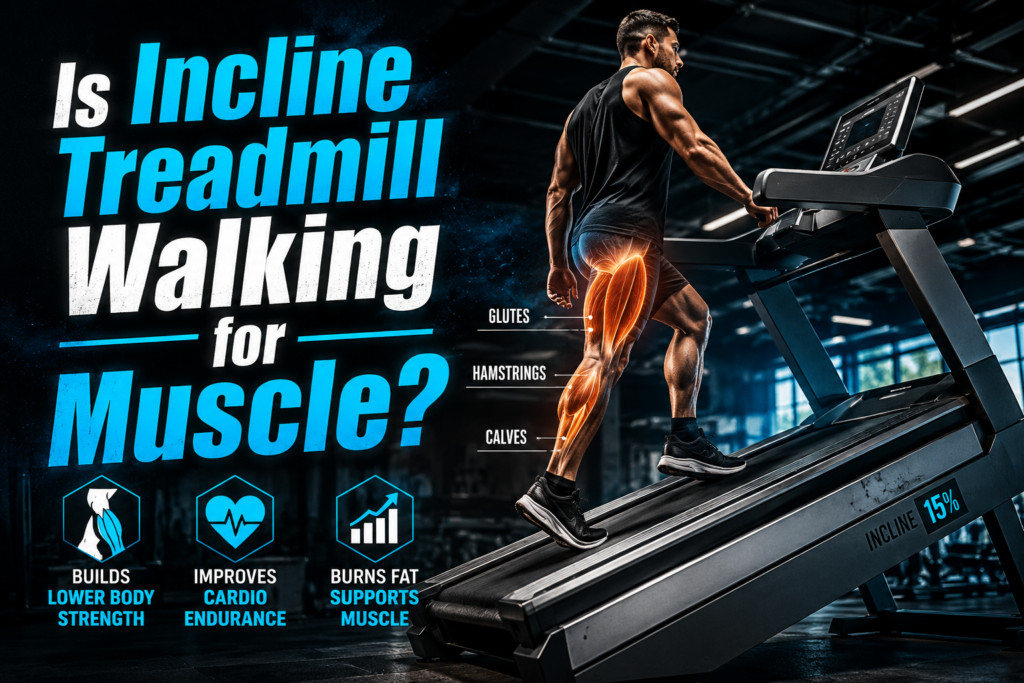
Most gym walkers spend thirty minutes going nowhere on a flat belt. Incline Treadmill Walking for Muscle changes that entirely with one simple adjustment. The slope forces your glutes and hamstrings to work harder than any flat surface. This single change builds lower body strength without adding impact stress.
How Incline Treadmill Walking for Muscle Activates Your Posterior Chain
Walking uphill shifts the workload from your knees to your hips. Your glutes fire with each step to push your body upward. Hamstrings lengthen and contract more completely than during flat walking. This recruitment pattern mimics a partial squat repeated hundreds of times.
The calves also engage differently on an incline. They must stabilize your ankle through a greater range of motion. This creates time under tension that flat walking never delivers. Your soleus muscle works overtime to control each heel strike.
A fifteen percent incline can double the muscular effort compared to zero. Your heart rate climbs but your joints absorb less pounding. The trade-off favors muscle building over joint wear. This makes incline work sustainable for daily sessions.
Setting Up Your Incline Treadmill Walking for Muscle Sessions
Start with a five to seven percent grade if you’re new. Walk at a pace that lets you maintain good posture. Leaning forward onto the console defeats the entire purpose. Keep your chest upright and core engaged throughout.
Speed matters less than incline for muscle activation. Three miles per hour on a twelve percent grade outperforms four miles per hour flat. Your glutes can’t tell the difference between a real hill and a motorized belt. They only respond to the angle and resistance.
Session length should range from twenty to forty minutes. Shorter bursts at steeper grades work well for advanced walkers. Beginners benefit from longer sessions at moderate inclines. Both approaches build muscle when done consistently.
Avoid holding the handrails during your walk. Gripping the rails reduces muscle engagement by thirty percent. Your arms should swing naturally at your sides. This also improves balance and burns more calories per minute.
Why Incline Treadmill Walking for Muscle Beats Flat Cardio
Flat treadmill work trains aerobic endurance and cardiovascular capacity but builds minimal muscle tissue. The repetitive movement pattern at constant resistance becomes too easy for your neuromuscular system to adapt, failing to create progressive overload. Your leg muscles stop responding to the stimulus after the first few weeks as your body reaches homeostasis. Progress stalls because the mechanical tension, metabolic stress, and muscle damage required for hypertrophy never increase, leaving you on a cardio treadmill rather than a muscle-building tool.
Incline walking forces constant adaptation in your muscle fibers. Each degree of elevation adds resistance your body must overcome. This progressive overload triggers growth in your glutes and hamstrings. The stimulus stays fresh even after months of training.
Joint stress decreases as muscular demand increases. Your knees experience less impact force per step on an incline. The controlled movement protects cartilage while challenging muscle tissue. This combination is rare in cardio equipment.
Calorie burn jumps significantly with every percentage point of incline. A five percent grade increases energy expenditure by twenty percent. Supporting your body’s recovery with targeted nutrition helps maximize these metabolic benefits. The extra work comes from muscle activation, not joint stress.
Incline Treadmill Walking for Muscle and Fat Loss Combined
Building muscle while losing fat sounds impossible to most people. Incline walking creates the exact conditions for both outcomes. The muscle stimulus preserves lean tissue during a calorie deficit. The elevated heart rate burns stored energy simultaneously.
Your body prioritizes muscle maintenance when that muscle gets used regularly. Daily incline sessions signal your system to keep leg strength. Fat becomes the preferred fuel source during these moderate-intensity efforts. The result is body recomposition instead of simple weight loss.
Morning sessions on an empty stomach can accelerate fat oxidation. Your body taps into stored triglycerides without dietary carbs available. Specialized formulations designed for metabolic support can enhance this process when used appropriately. The key is maintaining enough energy for consistent effort.
Post-walk nutrition timing affects muscle recovery and growth. Consuming protein within ninety minutes helps repair worked fibers. Your muscles stay insulin-sensitive after incline work. This means nutrients get partitioned toward muscle instead of fat storage.
Programming Incline Sessions for Maximum Muscle Development
Three to five sessions per week allows adequate recovery time. Your glutes and hamstrings need rest to repair and grow. Overtraining leads to diminishing returns and potential injury. Schedule at least one full rest day between intense sessions.
Vary your incline percentages throughout the week. Monday might be twelve percent for twenty-five minutes. Wednesday could be eight percent for forty minutes. Friday pushes to fifteen percent for twenty minutes. This variation prevents adaptation and boredom.
Track your total elevation gain each week. Climbing three thousand feet spread across multiple sessions builds endurance. Gradual increases in weekly elevation create measurable progress. Your legs respond to cumulative vertical distance over time.
Add resistance with a weighted vest once bodyweight feels easy. Two to four percent of your body weight works initially. The extra load forces deeper muscle fiber recruitment. Your cardiovascular system also adapts to moving increased mass uphill.
Common Mistakes That Limit Incline Treadmill Walking for Muscle Gains
Taking tiny steps reduces the stretch in your hamstrings. Shorter strides mean less range of motion per repetition. Your muscles never fully lengthen and contract. Extend your stride length to match the incline percentage.
Walking too fast sacrifices form for speed. Your body compensates by leaning forward excessively. This shifts work away from your glutes to your lower back. Slow down and feel each muscle working through the movement.
Skipping the warm-up invites muscle strains and poor performance. Five minutes at zero incline prepares your tissues. Blood flow increases and movement patterns activate. Jumping straight to fifteen percent shocks your system unnecessarily.
Watching videos on your phone destroys posture and engagement. Looking down rounds your shoulders and weakens your core. Your stride pattern changes to accommodate the head position. Maintaining focus on form and supporting recovery properly produces better results than distracted training.
Neglecting cool-down stretches leaves muscles tight and shortened. Your hip flexors especially need attention after incline work. Static stretching for five minutes prevents next-day stiffness. Flexible muscles recover faster and grow more efficiently.
Measuring Progress Beyond the Scale
Muscle growth shows up in measurements before the mirror. Measure your thighs weekly at the same spot. Glute circumference tells you more than total body weight. An inch gained in muscle-dense areas signals successful training.
Performance metrics reveal adaptation better than appearance changes. Can you hold thirteen percent for thirty minutes now? That’s progress worth celebrating. Increased incline tolerance means stronger muscle fibers. The numbers on the display matter more than clothing sizes.
Recovery speed indicates improved conditioning and muscle resilience. If soreness lasts only twenty-four hours instead of forty-eight, you’re adapting. Shorter recovery windows let you train more frequently. More frequent quality sessions compound into significant gains.
Energy levels throughout the day reflect metabolic improvements. Better mitochondrial density in your leg muscles affects whole-body function. You climb stairs easier and stand longer without fatigue. These practical benefits matter more than gym performance alone.
Frequently Asked Questions
How steep should the incline be for building muscle?
Begin with seven to ten percent for muscle building benefits. Advanced walkers can progress to twelve or fifteen percent safely. Steeper angles increase glute activation but require better form. Listen to your body and increase gradually over weeks.
Can incline walking replace leg day at the gym?
Incline walking complements but doesn’t fully replace weighted leg training. It builds muscular endurance and moderate strength gains. Heavy squats and deadlifts create different adaptations. Combine both methods for complete lower body development.
How long before seeing muscle growth from incline walking?
Most people notice improved muscle tone within four to six weeks. Measurable size increases take eight to twelve weeks of consistent training. Nutrition and recovery speed determine individual results. Daily sessions produce faster visible changes than sporadic efforts.
Should I walk on an incline every day?
Daily incline walking works if you vary intensity and duration. Alternate between moderate and challenging sessions throughout the week. Include at least one complete rest day weekly. Listen for signs of overtraining like persistent soreness.
Does incline walking build muscle in the upper body?
Incline walking primarily targets lower body muscle groups. Your core engages for stability but doesn’t grow significantly. Arms swing naturally but receive minimal resistance. Focus remains on glutes, hamstrings, and calves during this exercise.
Start your first incline session tomorrow with a ten percent grade for twenty minutes.