
The Exercise Order That's Secretly Limiting Your Gains
Exercise order significantly impacts your results, with compound movements performed first producing greater muscle growth over time. Your nervous system performs best when fresh, making the beginning of your workout the optimal time for complex, multi-muscle exercises like squats.
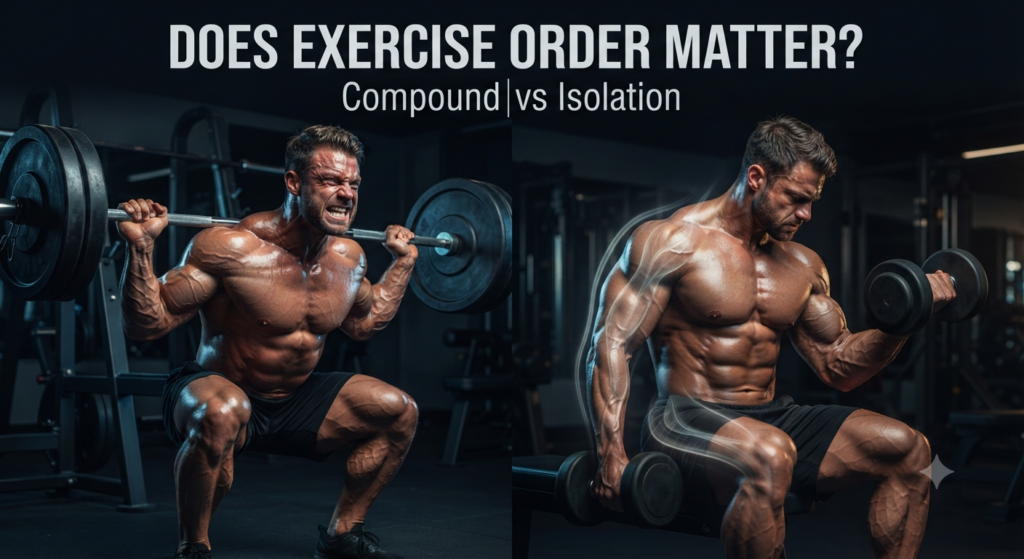
Does Exercise Order Matter? Compound vs Isolation comes up in every training discussion. You arrive at the gym with six exercises planned. Starting with squats drains you before leg curls. Muscles targeted by exercises performed first in a session show greater growth over time.
What Happens to Your Body When You Do Compound Movements First
Compound lifts recruit multiple muscle groups, demand more energy, and are more complex. Your nervous system works hardest when fresh. A squat asks your brain to coordinate quads, glutes, hamstrings, and core simultaneously. Miss that coordination and the bar drops.
Fatigue destroys this ability. Compound lifts should be placed in the beginning of workouts when fatigue is at its lowest, allowing individuals to perform more complex movements with better technique. Doing tricep extensions before bench press leaves your stabilizers weak. You’ll lift less weight. The chest gets undertrained.
Compound lifts impose systemic fatigue, forcing the body to recover and adapt more aggressively. Deadlifts tax everything from grip to lower back. That stress signals your body to grow stronger everywhere. Small movements don’t trigger the same response. Your biology rewards hard, coordinated work.
Does Exercise Order Matter? Compound vs Isolation for Lagging Muscles
Training weak points changes the rules. When trained men performed isolation exercises before compound exercises, the isolated muscle was trained more intensely at the cost of reduced performance on the compound movement. This tradeoff works if chest is your weakness but shoulders dominate your bench press.
The point of failure can be prematurely reached when the weakest muscle group within the chain is fatigued. Your triceps quit during pressing before your pecs feel anything. Pre-fatiguing the chest with flyes shifts the burden. The muscle you want to grow now fails first.
Research suggests that exercises be ordered based on the priority of importance, and when smaller muscle groups were trained before larger muscles, the subjects did less total volume. You trade overall strength for targeted stress. Accept lower numbers on compound lifts. The weak muscle finally gets worked properly.
The Pre-Exhaust Method and How It Affects Does Exercise Order Matter? Compound vs Isolation
Pre-exhaust pairs isolation with compound work back to back. An isolation exercise is performed first for a specific muscle group and taken to positive failure, then the lifter immediately transitions into a compound movement. Leg extensions into squats. Flyes into bench. No rest between exercises.
The whole point of doing the isolation exercise first is to fatigue the targeted body part so it won’t be capable of carrying as much workload during the compound exercise. Your chest starts the bench press already tired. Shoulders and triceps now help push the fatigued chest deeper into contraction.
Research shows mixed results. Pre-exhaustion increased isolation EMG activation during the subsequent compound but produced equivalent final hypertrophy to compound-first ordering, and the load reduction on the compound cancels out the theoretical benefit. You lift lighter weights. The extra activation doesn’t translate to more growth long term.
Current evidence does not support a benefit to the pre-exhaust method compared to traditional models regarding chronic improvements in strength, hypertrophy and body composition. It feels harder. That doesn’t mean it builds more muscle. Save pre-exhaust for short phases targeting stubborn areas.
Does Exercise Order Matter? Compound vs Isolation When Strength Is the Goal
Building maximum strength demands fresh energy on heavy lifts. Your one-rep max depends on neural drive. Firing rates drop when tired. Your low back muscles may fatigue before your legs do in a back squat. The weight falls before your target muscles reach failure.
Doing isolation work first guarantees weaker performance on the main lift. A 315-pound squat becomes 275 after leg extensions. You miss progressive overload. Strength gains stall. The math is simple: heavier weight builds more strength.
Total lifting time increased and velocity in the ascending movement decreased with increasing fatigue in bench pressing. Bar speed predicts power output. Slower reps mean less force production. Every isolation exercise before your compound lift steals bar speed.
Prioritize what matters most. Chasing a bigger squat? Squat first every session. Want bigger arms? Curls can go first. Don’t expect your squat to improve though. You can’t have both in one workout.
Why Some Muscles Never Grow on Compound Lifts Alone
Some muscle groups receive insufficient stimulus from compound lifts alone due to biomechanical limitations and muscle group hierarchy in movement patterns. Biceps, triceps, hamstrings, and quadriceps often function as secondary movers during compound exercises, limiting their time under tension and range of motion. Barbell rows don’t fully develop biceps because lats dominate the pulling pattern and biceps only assist. Conventional deadlifts don’t adequately target hamstrings through their full range of motion since the movement emphasizes hip extension through the posterior chain as a whole. Isolation exercises provide direct, single-joint stimulation that compounds cannot deliver, making targeted accessory work essential for balanced muscle development and addressing strength imbalances.
If a lifter wants to build bigger biceps, doing rows and chin-ups can help but might limit overall growth due to larger muscle groups taking over the compound movement. Your lats always dominate pulling. Biceps assist. They never work hard enough to grow maximally. Direct arm work fills the gap.
Rear delts, calves, and abs fall into this category too. Compound movements hit them lightly. They need isolation volume placed strategically. Put isolation work after compounds when building balanced size. Or train small muscles on separate days entirely.
Training Volume and Does Exercise Order Matter? Compound vs Isolation Decisions
Exercise order controls how much work you complete. When smaller muscle groups were trained before larger muscles, subjects did less total volume. Fatiguing triceps before bench press means fewer reps on the heavy lift. Total pounds lifted drops across the session.
Volume drives growth. Losing reps on your heaviest sets costs you gains. Five reps at 225 beats eight reps at 135. The intensity matters more than feeling tired. Place high-value exercises first to protect total workload.
This becomes critical during fat loss. Energy is low. Recovery is slower. Wasting strength on isolation movements leaves nothing for compounds. Your squat and press suffer. You lose muscle. Order protects what matters when calories are restricted.
When to Flip the Script on Exercise Order
Bodybuilding competition prep changes priorities. Symmetry beats strength. Pre-exhaustion has a valid niche in specialization training for lagging muscles but is not a superior general approach. Underdeveloped side delts? Raise them first every shoulder session for six weeks. Proportions improve.
Injury recovery demands different sequencing too. A tweaked lower back can’t handle heavy deadlifts. Romanian deadlifts go later in the workout after lighter hamstring curls. You train around pain. Compounds still happen but with reduced load.
High-rep finishers provide another exception. After heavy squats and leg press, leg extensions with 20 reps pump blood into fatigued quads. This isn’t about growth. It’s metabolic stress and joint nutrition. Placement at the end works perfectly.
Practical Programming: Applying Does Exercise Order Matter? Compound vs Isolation Rules
Build every workout around one or two compound movements. Squat, deadlift, press, or row goes first. Use 3 to 5 working sets. Push for progressive overload. Track the weight and reps rigorously. This is where real gains happen.
Add isolation exercises after your compounds finish. Pick 2 to 4 movements targeting muscles that need extra work. Use moderate weight for 8 to 15 reps. Don’t chase records here. Create a pump and accumulate volume safely.
Adjust order only when fixing specific problems. Weak biceps? One arm day per week can start with curls. Every other session follows compound-first rules. Short-term specialization works. Making it your default strategy doesn’t. Strength and size both depend on heavy, coordinated lifting done fresh.
Frequently Asked Questions
Should I always do compound exercises before isolation exercises?
Yes, for general strength and muscle building. Compound movements need fresh energy for best performance. Isolation work can go first only when targeting a specific weak muscle.
Can pre-exhaust training help me build muscle faster?
No, research shows it produces similar growth to traditional order. You’ll lift lighter weights on compounds. The reduced load cancels out any activation benefits over time.
Why does my chest never feel sore after bench press?
Your triceps or shoulders likely fail first. Try pre-fatiguing chest with flyes before pressing. This shifts failure to the target muscle for better stimulation.
How many isolation exercises should I add after compounds?
Two to four is plenty for most lifters. Focus on muscles that compounds miss. More isolation work doesn’t mean more growth if compounds aren’t heavy.
Does exercise order matter more for strength or size?
It matters more for strength. Maximum lifts need peak neural output when fresh. Muscle growth tolerates varied order better as long as volume stays high.
Start your next workout with your heaviest compound lift and watch your numbers climb within four weeks.