
Isometric Exercises Build Strength Without Moving a Muscle
Recent 2025 research on 621 adults demonstrates that isometric exercises produce significant strength gains, with a 0.35 effect size advantage over no exercise. Isometric training proves equally effective as dynamic training for building strength, offering a viable alternative to traditional exercise methods.
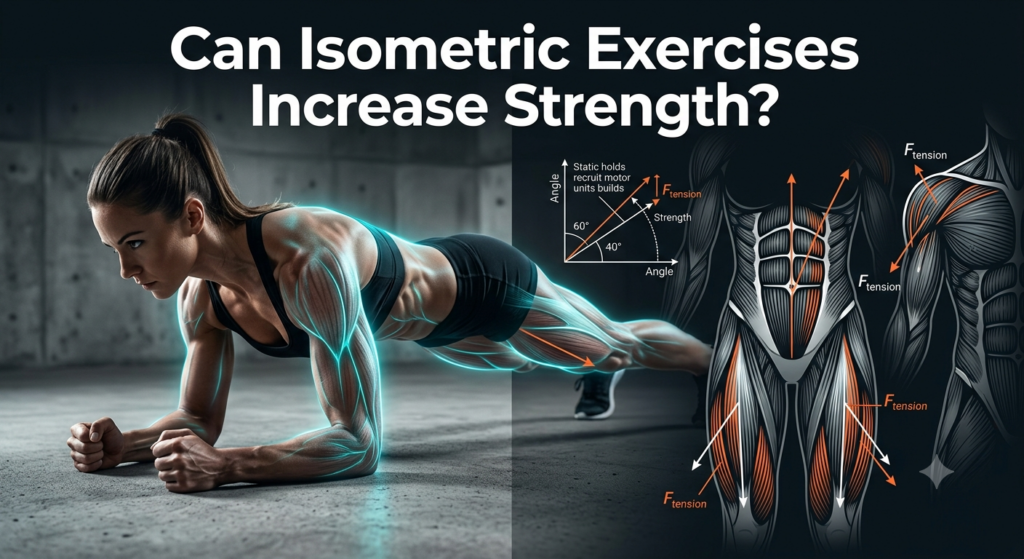
Can Isometric Exercises Increase Strength? You’ve likely held a plank and wondered if standing still actually works. Recent research shows isometric training produces significant strength gains compared to both no exercise and traditional dynamic training. The answer changes how you should think about strength work.
Can Isometric Exercises Increase Strength According to the Latest Research?
A 2025 study of 621 adults found isometric training improved strength more than dynamic training. The difference wasn’t small. The advantage was measured at 0.35 on the standardized effect scale. This comes from real testing with real people.
There was no significant difference between isometric and dynamic training for moving strength gains. Think about what this means. You can hold a position and still get stronger at movements. A six-week program led to gains of 2.9% in dynamic strength and 1.9% in maximum velocity.
The question shouldn’t be if they work. The question is how they work differently from regular lifting.
Why Can Isometric Exercises Increase Strength Without Movement?
Continuous tension recruits more muscle fibers than dynamic movements. Your nervous system has to fire muscles without any break. The muscle can’t rest at any point in the movement. Every second counts.
Just one set of isometric contraction for seven seconds at two thirds maximum capacity can increase strength 5% per week. This came from research at the Max Planck Institute. The intensity matters more than the duration.
Holding a position for 30 to 60 seconds forces muscles to stay engaged without rest. This strain challenges muscle tissue differently than lifting and lowering weight. The fatigue builds in a unique way.
How Can Isometric Exercises Increase Strength at Specific Angles?
Strength gains occur within 15 degrees on either side of the training angle. This angle specificity is real and proven. Studies provide robust evidence for joint angle-specific strength gains after isometric training.
Say you hold a squat at 90 degrees. You get strongest around that exact position. The research unanimously shows significant improvements in strength at the joint angle trained. Moving 30 degrees away shows less benefit.
A neural mechanism is responsible for the specificity of joint angle in isometric training. Your brain learns to recruit muscles at that exact position. This isn’t about muscle size. It’s about coordination and nerve firing patterns.
To get strong through a full range, you need multiple angles. To strengthen elbow flexors through full motion, sets should be performed at 20, 60, 100, and 140 degrees. Four positions cover most of the range.
Can Isometric Exercises Increase Strength and Build Muscle Size?
Sustained contractions increased strength by 24% and muscle volume by 8% after 12 weeks. The muscle growth happens but slower than the strength gains. Expect strength to jump faster than size.
Contractions at 70 to 75% of maximum maintained for 3 to 30 seconds per rep stimulate growth effectively. For muscle growth, aim for 80 to 150 seconds of total isometric tension per muscle group per workout. You can split this into multiple holds.
Quadriceps trained with isometrics grew by 2% while full range trained legs grew by 1%. Double the growth sounds impressive. But it’s just 1% actual difference. Six weeks is probably too short to see major size changes.
Higher numbers of contractions increase strength while holding contractions longer increases muscle mass. You pick your goal with your hold time. Short and intense builds strength. Long and moderate builds size.
When Can Isometric Exercises Increase Strength Better Than Dynamic Training?
Less time is required to recover after isometric training compared to heavy resistance training. You can train more frequently without burning out. During competition season, this matters.
Isometric strength training is a potentially safer and more accessible alternative than traditional resistance training. Older adults and injured people can push hard without joint stress. The risk drops when nothing moves.
Isometric training has positive effects on injury pain management and tendon properties. High-intensity isometric contractions above 70% maximum effort trigger tendon stiffness improvements that surpass other training methods. Stiffer tendons transfer force better.
After an injury, you can load the muscle without moving the joint. The exercises help maintain strength and promote recovery. This keeps muscle from wasting during rehab.
Top Natural Supplements Catalogue!
How Long Should You Hold to See If Isometric Exercises Can Increase Strength?
The muscle should remain under tension for 3 to 10 seconds. This applies to maximum effort contractions. Short holds work for strength building.
Try holding exercises for 20 to 60 seconds and gradually increasing time under tension as you get stronger. Start at the low end. Add five seconds each week. Track your times.
The pause between two isometric contractions should last 20 seconds or longer. Don’t rush between sets. Your nervous system needs rest even when muscles aren’t damaged.
For maximum strength gains, using around 65% of maximal isometric force for a single 6 second daily effort can improve muscle strength by 5% per week. One hard hold each day adds up over weeks.
Frequently Asked Questions
Can isometric exercises increase strength as effectively as weights?
Research shows isometric training significantly improved strength compared to dynamic resistance training. The gains are real and measurable. For static strength, isometrics may actually work better than lifting weights.
How often should I do isometric exercises to build strength?
For general fitness, 2 to 4 times per week is optimal. For rehab, daily shorter holds may be recommended. More frequency works when you keep the volume lower per session.
Will isometric training make me stronger at all joint angles?
Isometric training produces strength gains in a range of 15 degrees on either side of the training angle. You won’t get full range strength from one position. Train at multiple angles to cover the whole movement.
Can isometric exercises build muscle or just strength?
Sustained contractions increased quadriceps muscle volume by 8% after 12 weeks. Muscle growth happens but strength increases faster. Holding contractions longer increases muscle mass while higher numbers of contractions increase strength.
Are isometric exercises safe for people with injuries?
Isometric exercises may be helpful to someone who has an injury which could make movement painful. They have positive effects on injury pain management and changes in tendon properties. Always check with your doctor first.
Start with three positions per exercise and hold each for 10 seconds at 70% effort today.