
Everything You Know About Hypertrophy Is Wrong
Science reveals that training to failure isn’t essential for building muscle, contradicting what most lifters believe. Studies show stopping two reps short of failure produces nearly identical gains while reducing recovery time and nervous system fatigue.
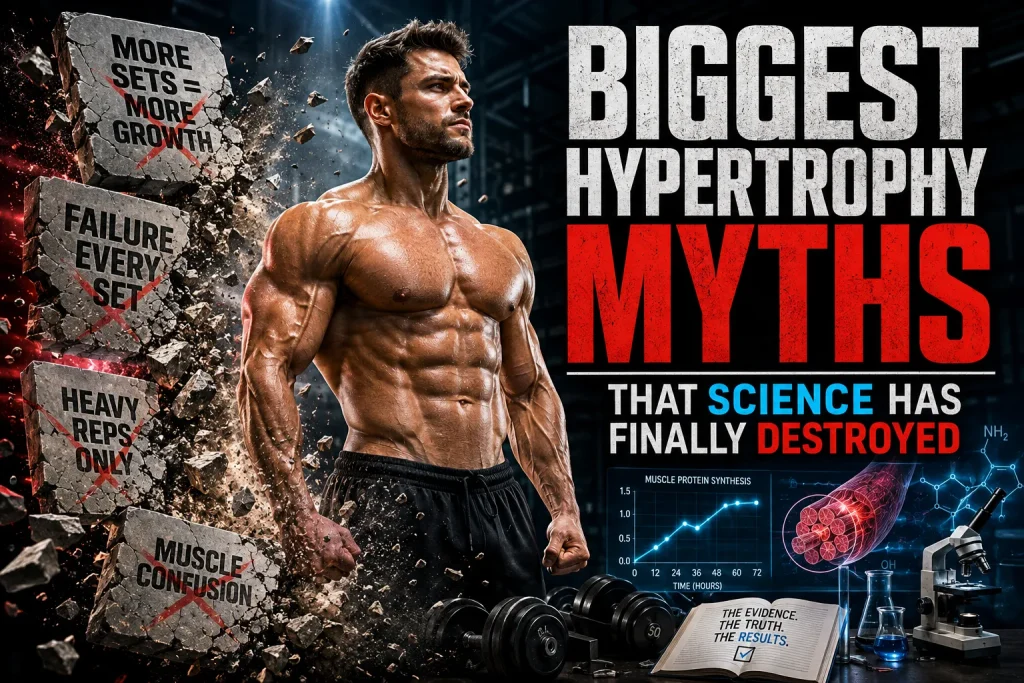
You’ve spent years doing bicep curls to failure every workout. Your buddy gained more arm size with half the volume. The biggest hypertrophy myths that science has finally destroyed explain why this happens. Understanding what actually drives muscle growth changes everything.
The Biggest Hypertrophy Myths That Science Has Finally Destroyed About Training to Failure
Most lifters think every set needs to end in complete failure. Science shows this approach actually slows progress for most people. Training to failure creates excessive fatigue that takes days to recover from. Your nervous system gets hammered harder than your muscles do.
Research from 2022 compared failure training to stopping two reps shy. Both groups gained nearly identical muscle mass over twelve weeks. The group avoiding failure recovered faster between sessions. They completed more total volume across the training week.
Failure has its place in specific situations. The last set of an isolation exercise works well. Compound movements like squats become dangerous when pushed to complete failure. Your form breaks down before your muscles actually give out.
Stopping one to three reps before failure builds muscle efficiently. You accumulate less systemic fatigue this way. More frequent training becomes possible when recovery demands stay manageable. Quality supplements like Bulk Extreme support faster recovery between these demanding sessions.
How Science Destroyed the Myth That You Need Extreme Soreness
Gym culture glorifies soreness as proof of a good workout. This belief has zero scientific support for muscle growth. Soreness indicates unfamiliar movement patterns or excessive eccentric damage. It does not correlate with hypertrophy at all.
Studies tracking muscle growth and soreness find no relationship. Beginners get extremely sore while making great gains initially. Advanced lifters rarely feel sore but continue building muscle. The same workout causes intense soreness the first time. It produces no soreness by the fourth session.
Muscle growth happens from progressive tension over time. Damage plays a small role compared to mechanical tension. Chasing soreness leads people to constantly change exercises randomly. This approach prevents progressive overload from actually occurring.
You can build muscle while barely feeling sore. Consistent exercise selection allows you to track strength increases. Adding weight or reps to familiar movements drives growth. Random workout variation just makes you sore without progress.
The Biggest Hypertrophy Myths That Science Has Destroyed About High Reps
Old gym wisdom claimed only 8 to 12 reps build muscle. Lower reps supposedly only increased strength without size. Higher reps were dismissed as pure endurance training. None of these divisions actually exist in reality.
Modern research proves muscle growth occurs across massive rep ranges. Sets of 5 reps build muscle when taken close to failure. Sets of 30 reps also work if you push hard enough. Total volume and proximity to failure matter most.
A 2021 meta-analysis examined rep ranges from 3 to 50. Hypertrophy rates stayed remarkably similar across this entire spectrum. The key factor was taking sets within a few reps of failure. Effort level determined results more than specific rep counts.
This flexibility opens up smarter training options. Heavy sets protect your joints better on some exercises. Lighter sets work better for movements that cause discomfort when loaded heavy. You can build muscle using whatever rep range your body tolerates best.
Why the Protein Timing Window Myth Finally Collapsed
The anabolic window myth terrorized lifters for decades. You supposedly had 30 minutes after training to consume protein. Missing this window meant wasting your entire workout. Supplement companies built fortunes on this fear.
Research demolished this myth completely in recent years. Total daily protein intake matters far more than timing. Your muscles stay receptive to protein for 24 hours after training. The window is actually a garage door.
One study had subjects consume protein immediately versus six hours post-workout. Both groups showed identical muscle protein synthesis rates. Another study found no difference between pre-workout and post-workout protein. Your body uses protein efficiently across the entire day.
Meal timing becomes relevant only in specific contexts. Athletes training multiple times daily need strategic timing. Regular lifters should focus on hitting daily protein targets. Spreading intake across three to five meals works perfectly fine.
The Biggest Hypertrophy Myths That Science Has Finally Destroyed About Rest Periods
Traditional bodybuilding demanded 60 to 90 second rest periods. Longer breaks supposedly reduced the hypertrophic stimulus. Shorter rests were thought to create superior metabolic stress. This entire framework was built on assumptions.
Science now shows rest period length barely affects muscle growth. A 2016 study compared one minute versus three minute rests. The three minute group actually gained slightly more muscle. They recovered enough strength to maintain performance across sets.
Metabolic stress feels intense but contributes minimally to hypertrophy. That burning sensation comes from lactate accumulation and metabolite buildup. These factors create temporary swelling without long term growth. Mechanical tension from heavy loads drives actual muscle building.
Rest as long as needed to perform quality sets. Complex movements like squats require longer recovery periods. Isolation exercises need less rest between sets. Your performance across all sets matters more than the clock.
How Research Exposed the Muscle Confusion Fallacy
Muscle confusion programs promise superior results through constant variation. You supposedly need to shock muscles with new exercises constantly. This approach prevents adaptation and plateaus according to promoters. The opposite is actually true.
Muscles do not get confused by exercise variation. They respond to progressive mechanical tension regardless of exercise selection. Constantly changing movements prevents you from tracking actual progress. You never know if you are getting stronger.
A 2018 study compared varied programs against consistent exercise selection. The consistent group gained significantly more strength and muscle. They could progressively overload the same movements each week. The variation group just spun their wheels.
Stick with core exercises for extended blocks of time. Track performance on key lifts while supporting recovery with proven formulas. Add five pounds or two reps when possible. This boring approach actually works better than exciting randomness.
The Biggest Hypertrophy Myths That Science Has Finally Destroyed About Age
Many people believe muscle building becomes impossible after 40. Testosterone declines supposedly prevent any meaningful hypertrophy. Older lifters are told to accept gradual muscle loss. This defeatist mindset ignores compelling evidence.
Studies show older adults build muscle at similar rates to younger people. A 2019 research review examined subjects aged 60 to 75. They gained muscle mass identical to college age trainees. The stimulus needed stays the same across decades.
Older lifters need slightly longer recovery between hard sessions. Protein requirements increase marginally with age. Joint health becomes more important for consistent training. These adjustments are minor compared to the similarity in results.
Training in your 50s and 60s absolutely builds significant muscle. Consistency matters more than your birth year. Progressive overload works at any age when applied correctly. Supporting your body with quality supplementation helps maintain the training frequency needed.
Why the Eccentric Emphasis Myth Deserves Retirement
Eccentric training became wildly popular in recent training trends. Slow negatives supposedly stimulate far greater muscle growth. Five second lowering phases appeared in countless programs. The science behind this practice is much weaker than claimed.
Eccentric contractions do produce slightly more muscle damage initially through lengthening under tension. However, this microtrauma does not translate to proportionally greater hypertrophy or muscle protein synthesis compared to concentric contractions. A 2020 meta-analysis examining time under tension, time to fatigue, and rep ranges found minimal differences between eccentric-focused and concentric-focused training protocols. Total volume completed and mechanical tension across all phases of the movement mattered far more than emphasizing a single contraction type or training method.
Excessive eccentric focus creates disproportionate soreness and fatigue. You sacrifice training frequency for minimal potential benefit. Most people cannot recover from pure eccentric sessions twice weekly. The fatigue accumulation exceeds the modest growth advantage.
Control the eccentric portion without obsessing over slow tempos. A natural two second lowering works perfectly well. Focus energy on progressive overload instead of contraction type. This approach builds muscle without crushing your recovery capacity.
Frequently Asked Questions
Do I need to feel the burn for muscle growth?
No, the burning sensation comes from metabolite buildup, not growth signals. Mechanical tension from progressive loads matters far more. You can build muscle without ever feeling a burn.
How often should I change my workout routine?
Keep core exercises consistent for at least eight to twelve weeks. Track performance improvements on these movements. Change programs only when progress genuinely stalls for several weeks.
Does training to failure work better for muscle growth?
Training near failure works as well with much less fatigue. Stopping one to three reps short produces similar hypertrophy. Reserve actual failure for occasional high effort sets only.
Can I build muscle with light weights?
Yes, light weights build muscle when taken close to failure. Sets of 20 to 30 reps work as well as heavier loads. Total volume and effort determine results more than weight used.
Is muscle building harder after age 40?
No, older adults build muscle at similar rates to younger people. Recovery may take slightly longer between hard sessions. Consistent progressive training works at any age when applied properly.
Start tracking your actual performance on core lifts instead of chasing feelings and outdated rules.