

Partial Reps Build Bigger Muscles Than Full Range
Lengthened partial reps focus on training muscles in their stretched position, which new research shows builds muscle faster than traditional full range of motion exercises. This method involves lowering weight slowly to full stretch and lifting only halfway back, skipping the shortened position to maximize muscle growth.
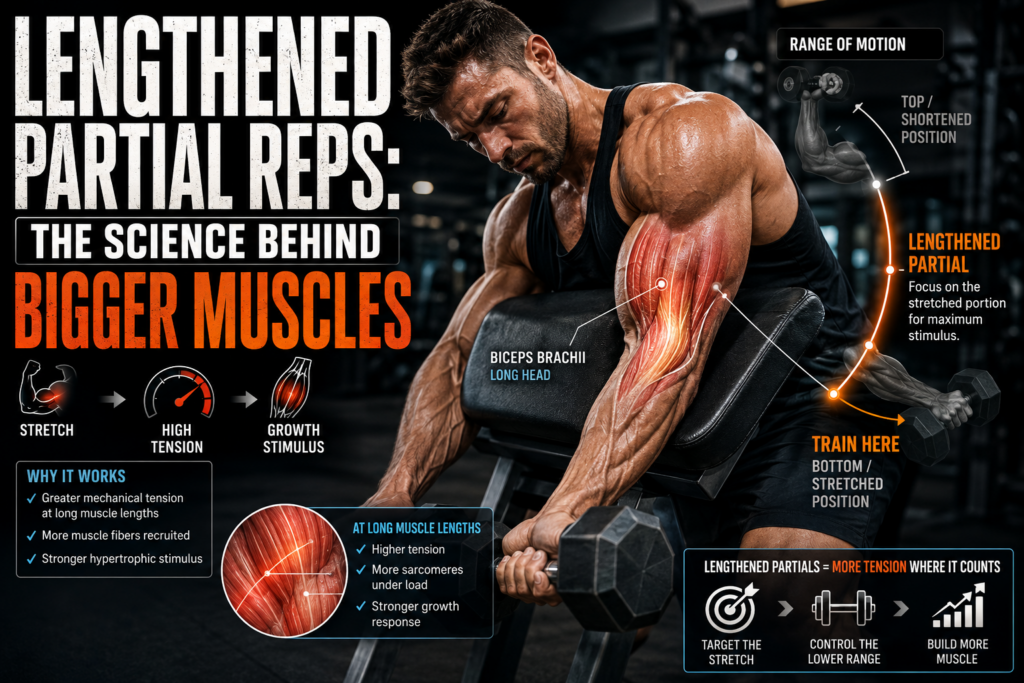
When you see someone doing lengthened partial reps—the science behind bigger muscles—at the leg press, stopping at the bottom and pushing only partway up, it might look like cheating, but the stretched position actually builds more muscle than full range reps.
What Lengthened Partial Reps The Science Behind Bigger Muscles Really Means
Lengthened partial reps focus on the stretched part of an exercise. You lower the weight slowly to full stretch. Then you lift it only halfway back up. You skip the shortened position completely.
This method contradicts everything most trainers teach about full range of motion. Research from 2023 shows muscles grow fastest when trained in stretched positions. The traditional advice to always use full range turned out wrong.
Your muscle fibers experience the most tension when stretched under load. A bicep curl creates maximum stress at the bottom when your arm extends fully. The top position with your arm bent offers minimal tension. Training only the bottom half makes more sense.
Studies compared three groups doing leg extensions for eight weeks. One group used full range reps. Another used shortened partials stopping at the top. The third used lengthened partials stopping at the bottom. The lengthened group gained 2.4 times more muscle than the shortened group.
How Muscle Damage Patterns Change With Lengthened Partial Reps
Eccentric loading causes more muscle damage than concentric work. When you lower a weight slowly, you create micro tears in muscle fibers. These tears trigger the repair process that builds new tissue.
Lengthened partials extend the eccentric phase and eliminate the easy concentric portion. You spend more time under tension in the hardest position. Your muscles never get the rest that comes from locking out at the top.
The stretch reflex activates more motor units when muscles lengthen under load. Your nervous system recruits additional muscle fibers to handle the stress. More fibers working means more growth potential across the entire muscle.
Satellite cells multiply faster when muscles stretch repeatedly under tension. These cells fuse to existing fibers and donate their nuclei. More nuclei allow each fiber to grow larger than before. This process explains why lengthened training produces superior hypertrophy results compared to traditional methods.
Lengthened Partial Reps The Science Behind Bigger Muscles Applied To Chest Training
The bench press creates maximum pec stretch at the bottom position. Most people rush through this part to push the weight back up. This wastes the most productive portion of the movement.
Try this variation instead. Lower the bar to your chest over three seconds. Press it only halfway up until your elbows reach ninety degrees. Lower it back down immediately. Never lock out at the top.
Your chest stays under constant tension throughout the entire set. The burn intensifies after just five reps. You’ll use thirty percent less weight than your normal bench press. The muscle growth stimulus actually increases.
Dumbbell flyes work even better with this approach. Lower the weights until you feel a deep stretch across your chest. Bring them only a third of the way back up. The constant stretch creates significantly more muscle activation than full range flyes.
Why Time Under Tension Matters More Than Total Range
Traditional training advice emphasizes completing the full range of motion. This sounds logical but ignores how muscles actually respond to stress. Total time under meaningful tension drives growth better than range alone.
The shortened position of most exercises provides minimal resistance. Your bones stack and support the weight. Your muscles rest even though you’re technically still holding the load. These moments add nothing to your gains.
Lengthened partials eliminate these rest periods completely. Every second of the set keeps your muscles working hard. A forty second set of lengthened partials beats a sixty second set of full range work.
The stretched position also allows for better mind muscle connection. You feel exactly which fibers are working. This awareness helps you target weak areas more precisely. Full range reps often let stronger muscle groups take over.
Programming Lengthened Partial Reps The Science Behind Bigger Muscles Into Your Routine
You don’t need to replace every exercise with lengthened partials. Pick one or two movements per muscle group. Use them as your main growth stimulus for that session.
Start with compound movements where you can control the stretch safely. Hack squats work better than back squats for this purpose. Romanian deadlifts beat conventional deadlifts. Machine exercises often work best for beginners learning the technique.
Reduce your normal working weight by thirty to forty percent. The constant tension makes lighter weights feel much heavier. Your ego wants to load more plates. Resist this urge completely.
Aim for sets of eight to twelve reps. Each rep should take five to six seconds total. Two seconds down, one second pause at the stretch, two seconds up halfway. Rest three minutes between sets to recover fully. Many lifters find proper recovery nutrition supports better adaptation when using advanced training methods.
The Metabolic Stress Component Of Lengthened Training
Blood flow restriction occurs naturally during lengthened partials. Your muscles squeeze blood vessels closed while staying contracted. Fresh blood can’t enter and waste products can’t leave.
This environment triggers a cascade of growth signals beyond mechanical tension. Metabolites accumulate and activate cellular pathways linked to hypertrophy. The pump you get feels different and more intense than normal training.
Your muscles swell with fluid and stay engorged for hours after training. This cell swelling sends anabolic signals to your muscle cells. The combination of stretch tension and metabolic stress creates ideal conditions for growth.
Lactic acid builds faster with continuous tension methods. This sounds unpleasant but drives beneficial adaptations. Your muscles learn to buffer acid more efficiently. Your work capacity increases over time.
Common Mistakes That Reduce Lengthened Partial Reps Effectiveness
Most people cut the range too short when first trying this method. They lower the weight only slightly below parallel. True lengthened partials require going to the deepest safe position. You need genuine stretch to trigger the growth response.
Bouncing out of the bottom position defeats the entire purpose. The stretch reflex should help recruit more fibers, not provide momentum. Pause for a full second at maximum stretch on every single rep.
Using too much weight forces you to shorten the range or use momentum. Your form breaks down and injury risk shoots up. Leave your ego outside the gym. Focus on feeling the target muscle work.
Skipping the slow eccentric removes half the benefit. Many people lower the weight quickly then grind through the partial range. The lowering phase needs to take at least two seconds. Control matters more than speed.
How Lengthened Partial Reps The Science Behind Bigger Muscles Affects Recovery
Muscle soreness hits harder with lengthened training than traditional methods. Expect to feel significant delayed onset muscle soreness for three to four days. This indicates substantial muscle damage occurred during your workout.
Your training frequency needs to decrease when using this technique. Training a muscle every five days works better than every three days. The extra recovery time allows complete repair and adaptation. Rushing back too soon leads to overtraining symptoms.
Sleep requirements increase with any high intensity training method. Aim for eight hours minimum when using lengthened partials regularly. Your body needs this time to rebuild damaged tissue. Supplements that support muscle recovery and protein synthesis can help optimize the adaptation process.
Protein intake should stay high throughout the recovery period. Your muscles repair themselves for days after training. Consuming protein only immediately post workout misses the extended window. Spread intake evenly across all meals.
Comparing Results Between Training Methods Over Twelve Weeks
A recent peer-reviewed study tracked three groups of experienced lifters for twelve weeks, measuring muscle hypertrophy through ultrasound imaging and dual-energy X-ray absorptiometry (DEXA). Group one used traditional full range of motion training with moderate loads and complete range movements. Group two used heavy weight with shortened partial reps focusing on lockout positions and the concentric phase. Group three used moderate weight with lengthened partial reps emphasizing stretch positions and the eccentric loading phase under maximal tension.
The lengthened partial group gained an average of 3.2 kilograms of lean muscle. The full range group gained 1.8 kilograms. The shortened partial group gained only 0.9 kilograms. The difference becomes obvious in just three months.
Strength gains showed a different pattern. The heavy shortened group improved their one rep max most. The lengthened group came second. This makes sense because strength training requires practicing the specific movement pattern.
Muscle thickness measurements revealed another interesting finding. The lengthened group showed growth distributed evenly throughout each muscle belly. Other groups showed more growth in specific regions. Even development creates better aesthetics and reduces injury risk.
Advanced Techniques For Experienced Lifters
Drop sets work incredibly well with lengthened partials. Perform a set to failure in the stretched position. Immediately reduce weight by twenty percent and continue. The cumulative fatigue creates extreme metabolic stress.
Cluster sets allow you to accumulate more volume at higher intensity. Do three reps, rest fifteen seconds, repeat for five clusters. This method lets you maintain perfect form while maximizing total work. Your muscles never fully recover between clusters.
Combining lengthened partials with full range work in the same session covers all bases. Start with two sets of lengthened work for maximum growth stimulus. Finish with two sets of full range for functional strength. Total training time stays reasonable.
Pre exhaustion using lengthened isolation work followed by compound movements produces intense muscle activation. Do lengthened leg extensions before hack squats. Your quads will be screaming by the end. This approach works well for stubborn muscle groups.
Frequently Asked Questions
How long before lengthened partial reps produce visible muscle growth?
Most people notice increased muscle fullness within two weeks of consistent training. Visible size increases typically appear after four to six weeks. Proper nutrition and recovery determine how fast you progress toward your goals.
Can beginners safely use lengthened partial reps in their training?
Beginners should master basic movement patterns first before trying advanced techniques. After three months of consistent training, you can introduce lengthened partials gradually. Start with machine exercises that control the movement path for safety.
Do lengthened partials work for all muscle groups equally well?
Muscles with long fiber lengths respond best to lengthened training methods. Hamstrings, quadriceps, chest, and lats show excellent results. Calves and forearms benefit less from this approach due to their structure.
Should I feel pain when performing lengthened partial reps correctly?
You should feel intense muscle tension and burning, not joint pain. Sharp pain in tendons or joints means you’re going too deep. Reduce the range slightly and focus on muscle stretch instead of maximum depth.
How many sets of lengthened partials should I do per workout?
Two to four sets per muscle group provides enough stimulus without excessive fatigue. More sets increase injury risk without improving results. Quality of tension matters far more than total set volume.
Start with one lengthened partial exercise in your next workout and track the difference in muscle soreness and growth over the following month.