

Why Adding Weight Stops Working After 8 Weeks
Adding weight every session leads to joint damage and form breakdown—the real secret is controlling mechanical tension instead of chasing numbers. Tempo training and varying rep speed create more muscle damage and growth without needing to load more plates on the bar.
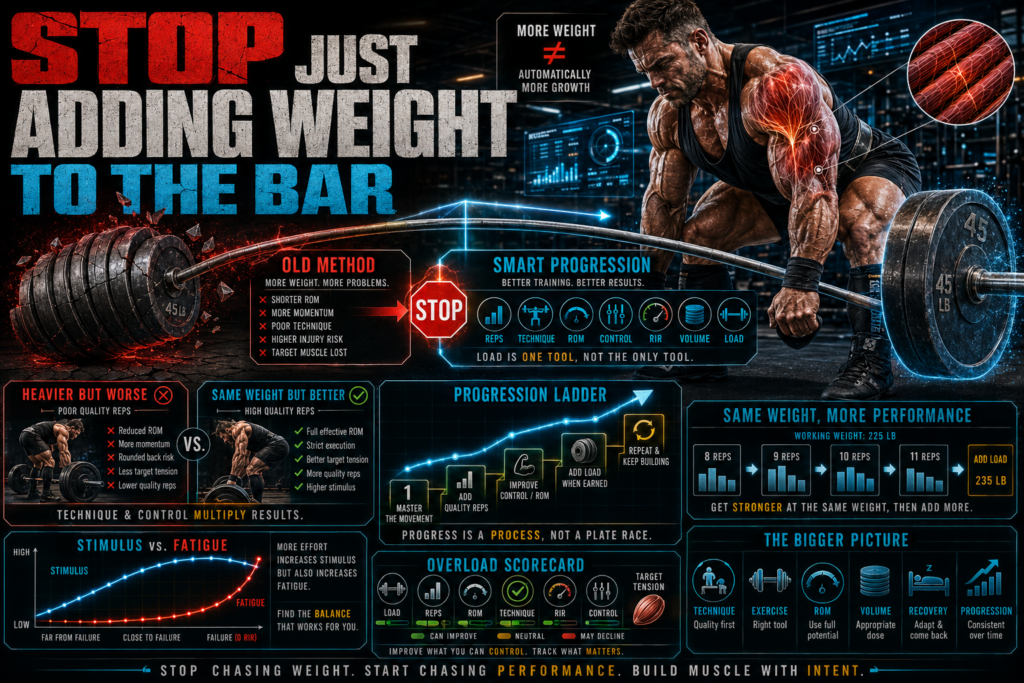
Stop Just Adding Weight to the Bar every single session. Your joints will eventually give out. Your form breaks down before you notice. The secret is controlling tension instead of just chasing numbers.
Why Stop Just Adding Weight to the Bar Makes Sense Now
Your body adapts to stress in multiple ways. Weight on the bar is just one variable. Time under tension matters more than most lifters think. You can grow muscle without adding plates for weeks.
Consider tempo training. Slow down your reps to four seconds down and two seconds up. The same weight becomes brutal. Your muscles don’t count kilos. They respond to mechanical tension and metabolic stress.
Changing rep speed challenges muscles differently. A three-second eccentric phase creates more damage than fast reps. More damage means more growth signals. You get stronger without risking your shoulders or knees.
Most gym sessions focus only on moving weight up. The lowering phase gets ignored completely. That’s where you leave gains on the table. Controlled eccentrics build strength faster than you’d expect.
Moving beyond load-only progression raises a bigger question: what actually counts as meaningful overload for muscle growth? Progressive Overload Is Evolving: What Builds Muscle provides the complete framework for understanding how progressive training should develop over time.
Stop Just Adding Weight to the Bar and Focus on Range
Partial reps let you lift more weight. They also limit your development. Full range of motion activates more muscle fibers. Your joints stay healthier over years of training.
Half squats feel impressive when you load the bar. Your quads don’t get the same work as deep squats. Deep positions build strength where your body is weakest. That translates to real-world function and injury prevention.
Bench press is another common example. Touching your chest every rep is harder than stopping halfway. The stretch at the bottom recruits more muscle. Your shoulders and elbows adapt to full movement patterns.
Increasing your range takes deliberate practice. Drop the weight by fifteen percent first. Work on mobility between sets. Gradually return to heavier loads with better form. Your muscles will thank you in five years.
Stop Just Adding Weight to the Bar When Recovery Suffers
Sleep quality drops when training stress exceeds recovery capacity. You feel tired but can’t fall asleep easily. Morning stiffness lasts longer than it should. These signs mean your nervous system is overloaded.
Adding weight every week sounds logical on paper. Your body doesn’t work on a linear schedule. Some weeks you need the same weight for consolidation. Adaptation happens during rest periods between sessions.
Deload weeks let your body catch up to training demands. Use sixty percent of your normal weight. Focus on perfect technique and controlled movement. You’ll come back stronger after one light week.
Tracking your readiness helps prevent overtraining. Check your resting heart rate each morning. A jump of five beats means you need easier training. Push hard when your body signals it’s ready.
Nutrition plays a massive role in recovery capacity. Protein intake should hit around two grams per kilo daily. Quality supplements can fill gaps in your diet when whole foods aren’t enough. Carbs around training sessions fuel performance and recovery.
How Varying Intensity Beats Linear Progression
The same weight feels different on different days. Monday’s easy set becomes Wednesday’s grind. Your strength fluctuates based on sleep and stress. Smart programming accounts for these natural variations.
Wave loading uses different intensities throughout the week. Heavy day uses five reps at eighty-five percent. Medium day drops to seventy-five percent for eight reps. Light day focuses on technique with twelve reps.
This approach prevents burnout and joint wear. You still lift heavy but not constantly. Your connective tissue gets recovery time. Muscles continue growing from varied stimuli.
Auto-regulation takes this further. Rate each set’s difficulty honestly. If it feels harder than planned, stop there. Come back to progression next session when you’re fresh.
Percentages work better than fixed weights long-term. Your true max changes weekly based on recovery. Basing sessions on current capacity prevents injuries. You make progress without pushing into dangerous territory.
Stop Just Adding Weight to the Bar Without Addressing Weak Points
Sticking points reveal where your body struggles most. The bottom of a squat might be easy. Halfway up is where you fail. That specific range needs targeted work.
Pause reps eliminate momentum at weak positions. Stop for three seconds at your sticking point. The weight will feel much heavier. Your muscles learn to produce force from difficult angles.
Assistance exercises fix imbalances that limit main lifts. Weak glutes cause squat problems. Tight hips prevent proper depth. Romanian deadlifts and hip flexor stretches solve these issues.
Your grip might fail before your back fatigues. Deadlifts suffer when forearms give out first. Farmer carries and dead hangs build grip strength. Stronger hands let you pull heavier weights safely.
Unilateral work exposes side-to-side differences and muscular imbalances that bilateral exercises mask. Your right leg might be noticeably stronger, creating asymmetries that compound over time. Bulgarian split squats, single-leg deadlifts, and single-arm rows force each limb to work equally without compensation. Addressing these strength imbalances prevents chronic injury patterns, improves movement quality, and eliminates weak links in your compound lifts. Balanced strength across both sides also enhances athletic performance and reduces joint stress from uneven load distribution.
The Role of Volume in Muscle Growth
Total work matters more than single-rep maxes for size. Ten sets of eight reps builds more muscle than five sets. Volume drives growth until you hit your recovery limit.
You can add volume without increasing weight. Extra sets with the same load create more tension. Your muscles respond to total time working. Three additional sets beats adding five kilos too soon.
Research shows ten to twenty sets per muscle weekly works best. Going beyond twenty rarely helps natural lifters. More isn’t always better when recovery becomes the bottleneck.
Drop sets increase volume without extending workout time. Take your working weight to failure. Immediately reduce by twenty percent and continue. This technique pushes muscles beyond normal fatigue points.
Density training adds another volume option. Complete the same work in less time. Rest periods shrink from two minutes to ninety seconds. Your conditioning improves while maintaining muscle stimulus.
Mind-Muscle Connection Trumps Numbers
Feeling the target muscle work matters enormously. Swinging weight up engages everything except your target. Controlled reps with focus build better than ego lifting.
Close your eyes during warm-up sets. Concentrate on which muscles are contracting. This awareness carries into heavier sets. You’ll activate fibers that normally stay dormant.
Lat pulldowns demonstrate this principle clearly. Pulling with your arms works biceps more than back. Thinking about driving elbows down shifts work to lats. Same weight produces completely different stimulus.
Slowing down your reps enhances this connection. Fast movements rely on momentum and reflex. Deliberate tempo lets you feel each muscle working. Quality beats quantity when building your physique.
Visualization before sets primes your nervous system. Picture the muscle contracting and lengthening. Your brain activates motor units more efficiently. This mental rehearsal improves actual performance.
When Periodization Outperforms Simple Progression
Changing your training focus every month prevents plateaus. Spend four weeks on strength with low reps. Switch to higher reps for hypertrophy next month. Your body adapts differently to each phase.
Block periodization separates qualities into dedicated periods. Build work capacity first with moderate weights. Then focus on maximum strength. Finally peak with competition-specific training.
This structured approach works better than random variation. Each block builds on the previous one. Fitness qualities stack instead of competing. You end up stronger and bigger than linear programs allow.
Undulating periodization changes stimulus within each week. Monday is strength day with triples. Wednesday targets hypertrophy with sets of ten. Friday uses lighter weight for speed work.
Your joints appreciate the variety this provides. Heavy grinding every session wears cartilage down. Mixing intensities and rep ranges distributes stress. You train hard without accumulating chronic damage.
Supporting Your Training with Smart Nutrition
Food quality affects how well you recover. Processed meals lack the nutrients your body needs. Whole foods provide vitamins and minerals for tissue repair. Your training results depend on what you eat.
Timing matters for performance and growth. Eating protein within two hours after training helps. Carbs during this window refill muscle glycogen. Your next session benefits from proper post-workout nutrition.
Micronutrients often get overlooked by lifters. Magnesium supports muscle relaxation and sleep quality. Zinc helps testosterone production and immune function. Targeted supplementation addresses these specific needs when diet falls short.
Hydration impacts strength more than people realize. Even two percent dehydration reduces force output. Drink water consistently throughout your day. Don’t wait until you feel thirsty during workouts.
Inflammation from training needs management. Omega-3 fats reduce excessive inflammation. Antioxidants from vegetables support recovery. Your diet either helps or hinders your progress.
Listening to Your Body Prevents Setbacks
Pain and soreness are different sensations. Soreness spreads across muscle bellies. Pain concentrates in specific spots near joints. Sharp pain means stop immediately.
Pushing through joint pain creates chronic injuries. Tendonitis develops from ignoring warning signs. Rest and adjustment prevent months of forced downtime. One skipped session beats six weeks off completely.
Fatigue accumulates in ways you don’t always notice. Grip strength drops before you feel tired. Bar speed slows on weights that moved fast before. These objective markers reveal when to back off.
Video recording shows form breakdown you can’t feel. Your back rounds on the last rep. Knees cave in slightly under fatigue. Watching yourself reveals problems to fix immediately.
Taking full rest days allows complete nervous system recovery. Active recovery like walking helps blood flow. Complete rest lets your brain and hormones reset. Recovery supplements can enhance this process alongside proper sleep and stress management.
Frequently Asked Questions
How often should I increase weight on exercises?
Add weight only when you complete all planned reps easily. This might happen every two weeks instead of weekly. Listen to your body rather than following a rigid schedule.
Can I build muscle without adding more weight?
Yes, you can build muscle by increasing volume and tension. Slow down your reps or add extra sets. Improved mind-muscle connection also stimulates growth without heavier loads.
What are signs I’m adding weight too quickly?
Form breaks down on your last reps. Joint pain appears during sets. Your progress stalls completely after a few weeks. These signs mean you should reduce weight temporarily.
How long should I stay at the same weight?
Stay at a weight until it feels noticeably easier. This might take two to four weeks. Focus on perfect form before moving up. Patience prevents injuries and builds better technique.
Does deloading really help strength gains?
Deloading allows your body to fully recover and adapt. Fatigue masks your true strength during hard training blocks. A light week reveals your actual progress clearly.
Stop Just Adding Weight to the Bar and start training smarter today.