
Hamstring Growth Without the Gym Guesswork: What EMG Shows
EMG research reveals which hamstring exercises generate maximum muscle fiber recruitment and genuine growth stimulus, separating effective movements from ineffective ones. Nordic curls rank second only to sprinting for eccentric loading, making science-backed exercise selection crucial for optimal hamstring development.
Your hamstrings—comprising the biceps femoris, semitendinosus, and semimembranosus—hit peak activation at different angles in different moves. Research shows sprinting creates higher activation than common gym exercises, but the Nordic curl ranks second for eccentric hamstring loading. Understanding which exercises maximize electromyographic (EMG) activation helps you distinguish between average movements and genuinely effective hamstring-building protocols. EMG-Verified Hamstring Lifts for Maximum Growth separate exercises that produce weak muscle fiber recruitment from those generating maximal motor unit activation and growth stimulus.
Why EMG Data Shows Which Hamstring Lifts Actually Work
EMG measures electrical signals your muscles produce during contractions. Higher signals mean more muscle fibers fire. This captures what activates during the moment of exercise. Scientists place sensors on biceps femoris and semitendinosus to track which exercises create the strongest signals.
Studies measuring glute-ham raises showed 98% hamstring activation, while Nordic curls reached 82% semitendinosus and 91% biceps femoris. The numbers reveal which movements push your hamstrings hardest. Many popular exercises produce surprisingly weak signals when tested.
EMG readings also expose differences between hamstring muscles. Nordic curls show greater semitendinosus activity, while prone lying curls favor biceps femoris. Your program needs both types to build complete development.
Nordic Curls Deliver the Highest EMG-Verified Hamstring Activation
Nordic curls generate the fastest rate of EMG rise at 1091.8 normalized units per second. This beats leg curls by 705 units per second. The difference matters because rapid activation builds strength through different pathways than slow contractions.
You kneel with ankles anchored and lower your torso toward the floor. Your hamstrings lengthen under load while contracting hard to slow your descent. Researchers classify Nordic curls, fitball curls, and slide exercises as high-intensity movements. Most gym exercises fall into medium or low categories.
The eccentric phase creates the extreme activation. Your hamstrings work overtime to prevent you from face-planting. This lengthening under tension triggers unique growth signals. EMG-Verified Hamstring Lifts for Maximum Growth must include this movement pattern.
Many people struggle to control the descent at first. Start with a resistance band for assistance. Loop it around your torso and attach it to something sturdy in front. This lets you practice the movement without collapsing.
Romanian Deadlifts Target Hamstrings Through Hip Extension for Growth
Romanian deadlifts produce lower erector spinae activation than biceps femoris and semitendinosus. This means your hamstrings do most of the work instead of your lower back. The movement isolates posterior chain muscles better than conventional deadlifts.
You start standing with a barbell at hip height. Push your hips back while lowering the bar along your thighs. Your hamstrings stretch as you descend. Drive through your heels to return upright. EMG research confirms high hamstring, glute, and erector spinae activation throughout the lift.
The bar path determines whether your hamstrings or back takes over. Keep the bar tight against your legs. If it swings away from your body, your spinal erectors compensate. You lose hamstring tension.
The Romanian deadlift stands as one exception where hamstring activation exceeds erector activity. This separates it from conventional deadlifts that spread effort across many muscle groups. For hamstring size, this focused loading works better.
Single-leg versions add balance demands. Research highlights increased neuromuscular activation, especially for hamstrings and gluteus medius. The instability forces each hamstring to work harder without assistance from the other leg.
Lying Leg Curls Isolate Knee Flexion to Build Complete Hamstrings
Your hamstrings cross two joints. Hip extension exercises like Romanian deadlifts train one function. Knee flexion curls train the other. Hip-hinge movements target hamstrings through hip extension, while curls emphasize knee flexion. Skipping either leaves development incomplete.
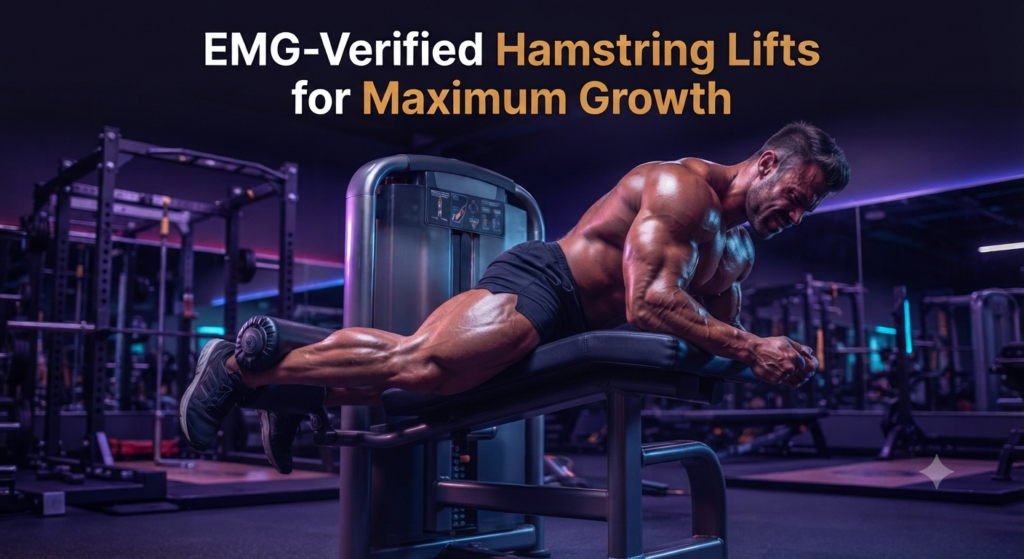
The prone lying position allows greater range of motion and isolated activation compared to seated variations. You lie face down on the machine with the pad behind your ankles. Curl your heels toward your glutes. Lower with control.
Leg curls reach medium intensity at 50% to 80% of maximum voluntary contraction. This lands below Nordic curls but still produces worthwhile muscle activation. The machine stability lets you push sets to failure safely.
Foot position changes which hamstring muscles work hardest. Toes pointed outward emphasize biceps femoris, while inward rotation increases semitendinosus and semimembranosus activation. Rotate foot angles across different sets to hit all three muscles.
Many lifters rush the eccentric phase. The lowering portion builds just as much muscle as the curl. Take three seconds to lower each rep. This doubles your time under tension per set.
Glute-Ham Raises Combine Both Functions in EMG-Verified Hamstring Lifts for Maximum Growth
Glute-ham raises and Romanian deadlifts produced significantly more activation than good mornings and leg curls. The glute-ham specifically dominates during concentric contractions. EMG ratings for semimembranosus and semitendinosus reached their highest during the upward portion.
You secure your ankles on a glute-ham developer machine. Your body starts horizontal and bent at the hips. You extend your hips and flex your knees simultaneously to raise your torso upright. Both hamstring functions fire together.
The movement breaks into four distinct phases. Phase one involves knee extension, phase two adds hip flexion, phase three focuses on hip extension, and phase four completes with knee flexion. EMG readings change dramatically across these phases as different muscles take over.
Most people lack the strength for bodyweight glute-ham raises initially. Set up a resistance band to pull you upward. Attach it overhead and hold the other end against your chest. This reduces the load while maintaining the movement pattern.
Your glutes contribute less than you might expect. Glutes contract isometrically to stabilize the torso during glute-ham raises. Dynamic movements build more muscle than static holds. The name misleads people about which muscle does the real work.
Programming EMG-Verified Hamstring Lifts for Maximum Growth
Two weekly hamstring sessions work for most people. Session one emphasizes eccentric strength through Nordic curls. Start with three sets of five reps using band assistance. Progress by using lighter bands over several weeks.
Session two targets hip extension and knee flexion separately. Romanian deadlifts come first for three sets of eight reps. Follow with lying leg curls for three sets of twelve reps. The higher reps on curls accumulate volume without excessive fatigue.
Deadlifts and kettlebell swings showed greater semitendinosus activity than biceps femoris. Fitball flexion was the only exercise causing greater biceps femoris activation than semitendinosus. Balance your exercise selection to hit both muscles hard.
Add glute-ham raises once you can handle five Nordic curls without assistance. Replace one set of Nordics with glute-ham work. This maintains eccentric stimulus while adding concentric strength.
Most programs fail by treating all hamstring exercises the same. Bilateral hip thrusts produced the highest overall activity at 68.9%, while kettlebell swings and deadlifts showed 13 to 24 percentage points greater semitendinosus favor. Pick movements based on which muscle needs priority.
Track your performance every four weeks. Nordic curl reps should climb steadily. Romanian deadlift loads should increase by five pounds monthly. Leg curl weight jumps signal your hamstrings are adapting to the stimulus.
Frequently Asked Questions
What does EMG measure in hamstring exercises?
EMG records electrical signals your muscle fibers generate during contractions. Higher signals indicate more fibers actively working. Scientists use EMG to compare muscle activation across different exercises.
How often should I train hamstrings with EMG-verified exercises?
Two sessions per week provides enough stimulus without excessive fatigue. Space sessions three days apart. One session should emphasize eccentric work like Nordic curls.
Can I build hamstrings without a glute-ham developer machine?
Yes, Nordic curls deliver similar activation without specialized equipment. Use a partner to hold your ankles. Romanian deadlifts and lying leg curls cover both hamstring functions.
Why do Nordic curls activate hamstrings more than leg curls?
Nordic curls load hamstrings in a lengthened position during eccentric contractions. This creates higher tension than the shortened position of standard curls. The rate of activation also reaches peak levels faster.
Should I focus on biceps femoris or semitendinosus development?
Train both muscles for complete hamstring development and injury prevention. Different exercises favor each muscle. Nordic curls emphasize semitendinosus while prone curls target biceps femoris more.
Start your next hamstring workout with one Nordic curl set before any other exercises.