
Zone 2 Cardio: Why Lifters Are Losing Muscle Without It
Zone 2 cardio solves the strength athlete’s dilemma: you can burn fat without sacrificing hard-earned muscle when you train at the right intensity. Working at 60-70% of max heart rate preserves leg mass while high-intensity cardio causes more interference with your lifting gains.
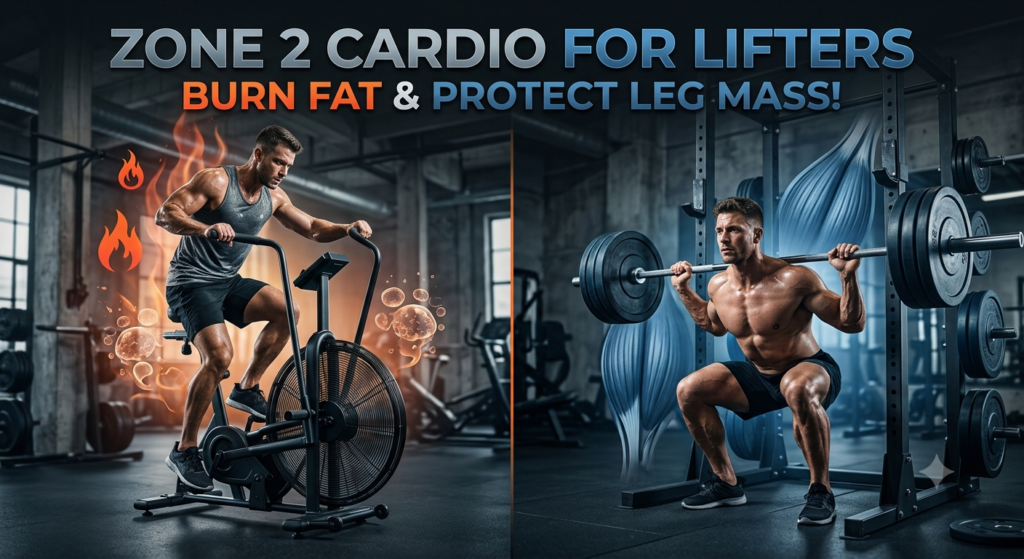
Zone 2 Cardio for Lifters: Burn Fat & Protect Leg Mass fixes the cardio problem most strength athletes face. You skip cardio because you think it kills gains. The truth is different: done right, it makes you stronger.
Why Zone 2 Cardio for Lifters Beats High Intensity Work
Zone 2 means working at 60% to 70% of your max heart rate. Your breathing gets heavier than at rest. You can still talk in full sentences. This is the sweet spot for fat loss without muscle damage.
Zone 2 cardio at conversational pace is easiest to combine with lifting. High intensity intervals trigger more interference. Low-intensity aerobic training like zone 2 produced negligible interference with hypertrophy when volume was kept moderate. This matters for your leg mass.
Running involves substantial eccentric muscle action at every foot strike. Cycling is concentric-dominant and creates much less collateral fiber damage. Your quads take a beating from squats already. Running adds more damage to the same muscles you’re trying to grow.
The research is clear. Running causes meaningfully more interference with hypertrophy and strength than cycling does, even at matched intensity and duration. Pick your cardio method with this in mind.
How Zone 2 Cardio for Lifters Changes Your Body Composition
Fat is the primary fuel substrate at Zone 2 intensity. Your body runs on stored fat instead of carbohydrates. Regular Zone 2 training increased fat oxidation rates by up to 30% after just eight weeks. You teach your cells to burn fat better.
Repeated Zone 2 sessions signal your body to build more mitochondria. These are the power plants inside your muscle cells. More mitochondria means better fat burning capacity. This happens without touching your muscle protein.
Zone 2 training reduces visceral fat accumulation. Excess visceral fat secretes pro-inflammatory cytokines that drive systemic inflammation. By enhancing fat oxidation, Zone 2 training reduces this inflammatory burden. Less inflammation helps muscle recovery between lifting sessions.
This creates a positive cycle. Better fat oxidation means steadier energy. Steadier energy means better lifting sessions. Better sessions mean more muscle growth.
Scheduling Zone 2 Cardio for Lifters Without Ruining Recovery
Separate cardio and lifting sessions by at least six hours when possible. 24-hour recovery between modalities produced superior adaptations compared with same-day or 6-hour spacing. Same-day training works if you have no choice. Just space it out.
Always prioritize strength training first if both are done in the same session. Cardio should be scheduled after lifting, never before a strength workout. You need full glycogen stores for heavy squats and deadlifts. Cardio before lifting drains those stores.
Approximately 30 to 40 minutes of cardio three to four times per week is typical of serious weightlifters. For most lifters, 2-3 Zone 2 sessions per week of 20-30 minutes each is effective without noticeably dragging on strength or muscle gain.
Start with two sessions per week. Add a third if recovery stays solid. Your squat numbers tell you everything. If they drop, you’re doing too much cardio.
Unlock Peak Performance: How to Build Mass, Double Your Energy, and Maximize Vitality
Best Methods of Zone 2 Cardio for Lifters and Leg Preservation
Set a treadmill to 5-8% incline and walk at a pace that keeps your heart rate in range. Incline walking hits zone 2 without pounding your knees. Your hip flexors and glutes work hard. Your joints stay safe.
Rucking has become a go-to for busy professionals. Walking with a weighted backpack builds muscular endurance in shoulders, core, and legs at the same time. You’ll find it easier to elevate your heart rate to Zone 2 by wearing a weighted pack. Start with 10-20% of your bodyweight and a moderate pace.
Cycling works brilliantly. Cycling is particularly good for Zone 2 because it’s easy to control intensity precisely. Set a bike at steady resistance. Keep your heart rate monitor in view. Stay in the zone for 30 minutes.
Swimming and rowing also deliver results. Both keep impact low and protect your leg muscles from eccentric damage similar to cycling. Rowing is particularly effective for building posterior chain endurance without competing with lower body hypertrophy goals. Swimming engages the entire body while remaining non-weight-bearing, making it ideal for active recovery days between lifting sessions. Choose whatever method you’ll actually do consistently, as adherence matters more than perfect modality selection.
How Much Zone 2 Cardio for Lifters Without Losing Muscle
The interference effect becomes meaningful only with high cardio volumes of 6+ hours weekly. For most people focused on muscle growth, less than 150 minutes per week of low-intensity steady-state cardio causes minimal interference. This equals three 50-minute sessions weekly.
If you go to 150-250 minutes weekly, expect 10-20% reduction in muscle growth. Above 300 minutes weekly, interference becomes significant with 20-30%+ reduction. Stay under 150 minutes weekly. Zone 2 Cardio for Lifters works best with smart volume limits.
Research suggests 150-180 minutes per week of Zone 2 cardio produces significant cardiovascular adaptation. That breaks down to a minimum effective dose of 3 sessions of 30-45 minutes. Three 40-minute sessions weekly gives you health benefits without muscle loss.
Track your lifting performance weekly. If your bench press stalls, cut one cardio session. If your deadlift drops, reduce session length to 20 minutes. Your strength numbers are the feedback mechanism.
Tracking Your Heart Rate During Zone 2 Cardio for Lifters
Calculate your max heart rate first. Take 220 minus your age. A 30-year-old has a max heart rate of 190. Zone 2 sits at 60-70% of this number. For our 30-year-old, that’s 114 to 133 beats per minute.
Wear a chest strap heart rate monitor. Wrist monitors miss beats during rowing and cycling. Chest straps stay accurate. Check your heart rate every five minutes during your session.
Most people go too hard at first. Your heart rate climbs to 150. You’re in zone 3 now. Slow down until it drops back to 130. This feels too easy. That’s the point.
A simple way to check your effort is the talk test. When you’re in zone 2, conversation remains possible while singing usually feels out of reach. If you can’t speak in full sentences, you’re working too hard. Drop the intensity.
Nutrition Changes for Zone 2 Cardio for Lifters Success
Adding cardio burns extra calories. The interference effect becomes meaningful with insufficient caloric intake. You need to eat more to maintain muscle mass. Calculate your cardio calorie burn. Add those calories back to your daily intake.
A 200-pound lifter burns roughly 400 calories in 40 minutes of zone 2 cycling. Add 400 calories to your daily target on cardio days. Don’t create an accidental deficit. Accidental deficits kill muscle growth.
Protein needs stay the same. Keep eating one gram per pound of body weight. Carbs fuel both lifting and cardio. Add your extra calories from carbs and fats. Split them 60-40 if you train hard.
Time your carbs around lifting sessions. Save cardio for fasted mornings if fat loss is the goal. Your body pulls from fat stores when glycogen is low. This maximizes the fat burning benefit of zone 2 work.
Frequently Asked Questions
Does zone 2 cardio burn muscle along with fat?
No, zone 2 cardio does not burn muscle when done correctly. Stay under 150 minutes weekly and eat enough protein. Your body uses fat for fuel at this intensity.
Can I do zone 2 cardio on leg day?
You can do zone 2 cardio after leg day lifting. Never do it before squats or deadlifts. Wait at least six hours between sessions for best results.
Is walking enough for zone 2 cardio?
Walking works if it raises your heart rate to 60-70% max. Most people need incline walking or rucking to reach zone 2. Flat walking stays in zone 1 for fit individuals.
How long until zone 2 cardio improves fat burning?
You see measurable improvements in eight weeks of consistent training. Fat oxidation rates increase up to 30% after two months. Stick with three sessions weekly.
Should I do zone 2 cardio while bulking?
Yes, zone 2 cardio helps health markers even while bulking. Keep sessions to 20-30 minutes twice weekly. Add back the calories you burn to maintain your surplus.
Start with two 30-minute zone 2 sessions this week on your rest days from lifting.