
Why Your Hardest Muscles Aren't Where You Think
Calves are the hardest muscles to work out because they’re composed of 70-80% slow-twitch fibers designed for endurance rather than growth. Understanding your muscle fiber composition and adjusting your training approach is key to finally overcoming stubborn calf development.
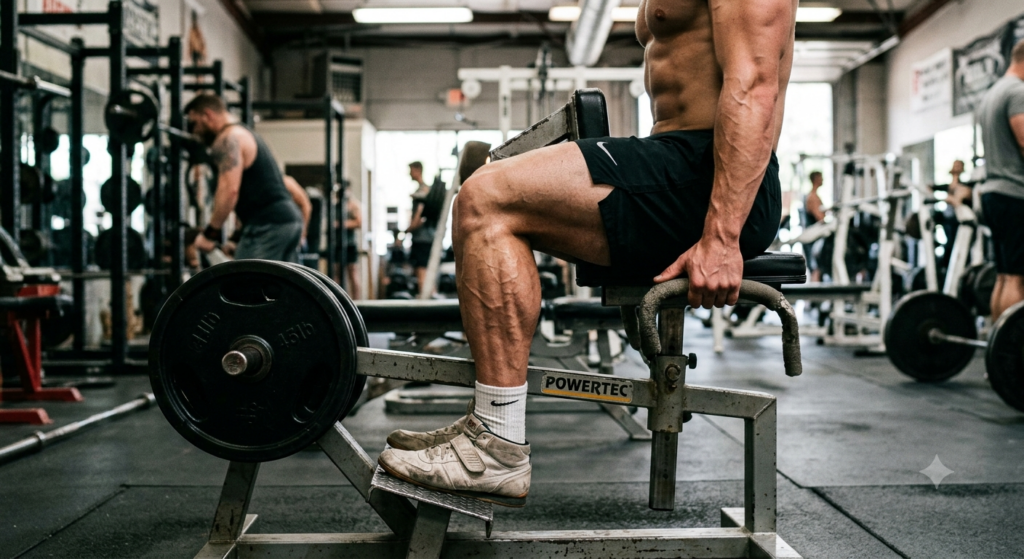
What are the hardest muscles to work out? You train hard every week but one area refuses to grow. Others hit their shoulders or legs and see fast changes. The muscles that fight back hardest need a totally different game plan.
Why Calves Are What Are the Hardest Muscles to Work Out
Calves win this title hands down. The soleus muscle is mostly made up of slow twitch fibers. Type I fibers are built for endurance, not size. Your quads might have 50% Type II fibers that grow big. Your calves often sit at 70 to 80% Type I fibers. This fiber makeup explains why they ignore standard training programs.
You use calves constantly throughout the day like standing and walking. This constant use makes them chronically trained even in people who never exercise. Your calves already handle bodyweight work every single day. They adapt to resist the exact stress you throw at them in the gym.
A 2019 study in the Journal of Applied Physiology found that calf muscles showed 40% less hypertrophy response compared to quadriceps when both received identical training volume and intensity. Same effort. Less growth. The biology works against you here.
Research from the International Journal of Sports Medicine in 2017 showed subjects who trained calves 6 days per week gained 2.3 times more muscle mass than those training twice per week. Frequency matters more for calves than any other muscle group. Two weekly sessions leave them unchanged.
Never Neglect your Calves or Foreman But
And Surely Never Neglect These!
Forearms Mirror Calves as What Are the Hardest Muscles to Work Out
Forearms face similar problems to calves. You use them constantly throughout the day gripping objects. They contain mostly Type I endurance fibers. Every door you open trains them. Every bag you carry adds volume. The gym becomes background noise.
Studies show forearms need 16 to 18 sets per week minimum for growth. Most people do zero direct forearm work. They assume grip work from deadlifts counts. It doesn’t push the muscle hard enough.
Skinny forearms make your arms look ten times smaller than they actually are. No matter how big your biceps and triceps are, skinny forearms can ruin your physique. Big arms with small forearms look unfinished. The imbalance screams neglect.
Train forearms with full range movements. Forearms get a lot of low intensity, short range-of-motion work throughout the day. Make certain to train them through full ranges of motion. Wrist curls done properly take your hand from full flexion to full extension. Half reps waste your time.
Rear Delts Rank High When Asking What Are the Hardest Muscles to Work Out
Of the three deltoid muscles, the rear delts are often the most neglected. You can’t see them in the mirror. They don’t get worked during bench press. Front delts take over on most shoulder exercises.
Most people don’t train their rear delts with enough volume or effort. The front delts get worked during all pressing movements. The rear delts need direct, targeted work. Rows help but they’re not enough. The lats steal the tension.
For the posterior portion of deltoid muscle there was greater activation during the reverse peck deck compared to the seated row and to the inclined lat pull-down. Isolation exercises beat compound movements for rear delt growth. Face pulls and reverse flyes must become staples.
Chances are your posterior delts will actually become underdeveloped if they don’t receive any direct attention. This can eventually lead to shoulder and postural problems as well as reduced performance on upper body exercises. Weak rear delts create forward shoulder rotation. Your posture suffers and pressing strength drops.
Lower Abs Present Unique Challenges Among What Are the Hardest Muscles to Work Out
At the upper end of that range (10-14% body fat), you’ll see some upper abdominal definition. The lower abs remain soft due to subcutaneous fat distribution patterns. Below 10 percent body fat, the full six-pack becomes sharp and well-defined as visceral and subcutaneous fat deposits diminish. Lower abs appear last during fat loss progression because they hide longest under body fat—a phenomenon called “last on, first off” in body composition changes. This hierarchical fat storage pattern affects rectus abdominis visibility from superior to inferior segments.
Bodies tend to store more fat in the lower abdomen. Losing weight specifically in that area is a myth. You cannot spot reduce fat. Lower ab visibility demands lower overall body fat than upper abs require.
Your genetics determine the shape, symmetry, and alignment of your abdominal muscles. They influence how easily you store or lose fat around your midsection. Two people who weigh the same can look very different. One might store fat predominantly in the hips and thighs. The other stores it centrally, covering the same muscle development. Some people see abs at 15% body fat. Others need 10% to show any definition.
The efficient development of abdominal muscles is particularly difficult. Abdominal muscles are not attached to any joint. Traditional joint movement exercises have little or no effect on the abdominals. Sit-ups may indirectly involve the abdominal muscles but are inefficient. Energy gets wasted in hip flexors instead of abs.
Understanding Fiber Types Clarifies What Are the Hardest Muscles to Work Out
Slow twitch muscle fibers are predominantly used during aerobic exercise. These fibers contract slowly and have a very high aerobic capacity. They resist getting bigger. Endurance is their job.
Slow-twitch fibers excel at endurance activities and slow, low-intensity contractions. Fast-twitch fibers provide quick, more powerful contractions and fatigue faster. Muscles rich in slow-twitch fibers need more sets and higher frequency. Standard strength programs leave them untrained.
Endurance-based activities require muscles to use a low amount of power over a longer time. They typically use slow-twitch type I muscle fibers. Walking and standing train calves all day. The gym must exceed daily stress levels to trigger growth.
Both the slow twitch and fast-twitch fibers can be influenced by training. It is possible through sprint training to improve the power generated by slow twitch fibers. Through endurance training, you can increase the endurance level of fast-twitch fibers. The level of improvement varies. Training can never make slow-twitch fibers as powerful as fast-twitch. You work with your genetics, not against them.
Training Frequency Determines Progress on What Are the Hardest Muscles to Work Out
You should usually train a stubborn muscle group two to four times per week. Quality must stay high and recovery must stay intact. Weak points often grow better with more frequent hard practice, not with one rushed burnout session. Once weekly training guarantees stagnation for stubborn muscles.
Training stubborn muscles two to three times per week tends to work better than once a week. Higher frequency gives them more stimulus and more chances to grow and recover. Four short sessions beat one long one. The muscle sees training as a signal, not a single event.
Training a weak muscle first usually improves focus, rep quality, and progression. Your energy is highest at the start. Most lagging muscles stay lagging because they only get leftover effort after the compounds. Calves done last after squats and deadlifts get garbage effort. Schedule them first on leg day.
Drop sets and tempo training work well here. A personal trainer says focus on achieving a strong stretch at the bottom of every rep. Take enough time to dissipate the stretch reflex, 4 seconds at the bottom. Then a controlled but powerful movement up. 2 second contraction at the top. Then a controlled negative. This tempo keeps tension on slow-twitch fibers longer.
Frequently Asked Questions
Can genetics make certain muscles impossible to grow?
Genetics can change shape, insertion, leverage, and growth speed. They do not make a normal muscle impossible to improve. In most cases, the muscle can still grow. It just may need more patient programming.
How many sets per week do calves need to grow?
A 2020 meta-analysis in the Journal of Strength and Conditioning Research found that calf training needs at least 15-20 sets per week to see meaningful growth. Standard programs give them 6 to 9 sets.
Should I train stubborn muscles with heavy weights or high reps?
Do not rely on just one rep range. Heavy sets build strength and recruit more muscle fibers. High-rep sets create metabolic stress and pump. Using both gives stubborn muscles two different types of stimulus.
Why don’t rows build my rear delts effectively?
The posterior portion of deltoid muscle shows greater activation during reverse peck deck compared to seated row. Reverse peck deck should be primarily used rather than seated row for recruitment of posterior deltoid.
Do I need different body fat levels to see upper versus lower abs?
For men, abs typically become visible between 10 and 14 percent body fat. At the upper end of that range, you’ll see some upper abdominal definition. The lower abs remain soft.
Train your weakest muscles first when your focus is sharpest and energy is highest.