

Why Your 1 RIR Sets Are Costing You Muscle Gains
The 1 RIR Hypertrophy Sweet Spot is the optimal training zone where you stop one rep before complete failure, building muscle without destroying your recovery. This approach balances maximum gains with sustainable training, avoiding both overtraining burnout and leaving gains on the table.
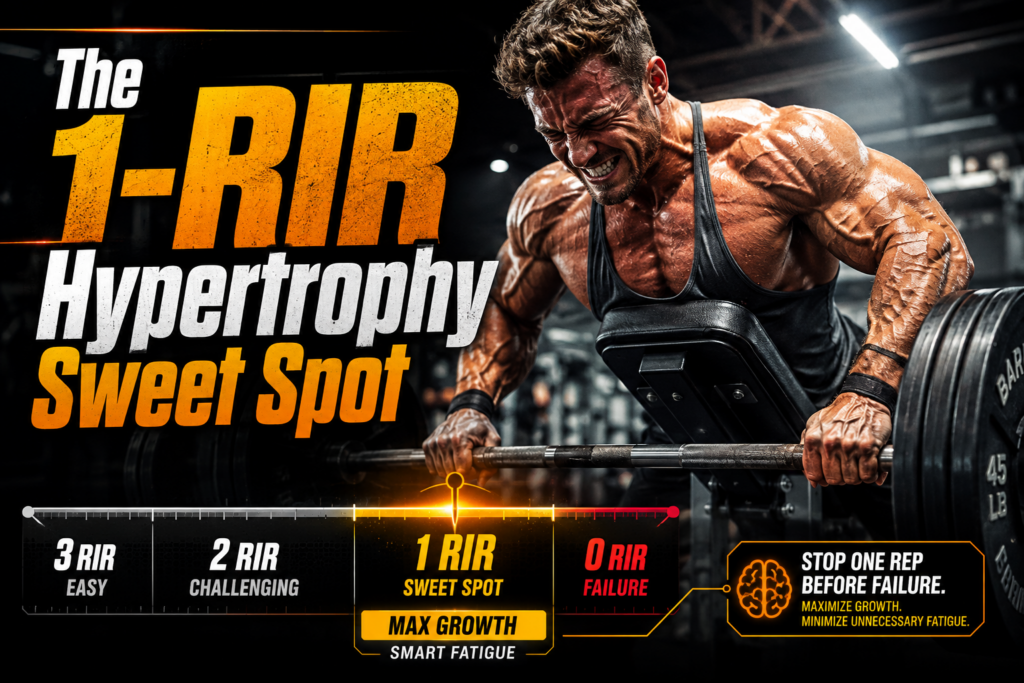
You’ve felt it during a hard set. That moment where you stop short of failure. The 1 RIR Hypertrophy Sweet Spot describes this exact training zone. Stopping one rep before failure builds muscle without destroying your recovery.
What The 1 RIR Hypertrophy Sweet Spot Actually Means
RIR stands for reps in reserve. It’s how many more reps you could do before complete failure. One RIR means you stop when you could do exactly one more rep. You end the set while you still have something left.
This approach sits between two extremes. Training to failure every set burns you out fast. Stopping too early leaves gains on the table. The 1 RIR Hypertrophy Sweet Spot splits the difference perfectly.
Most lifters can’t judge their effort level accurately at first. They think they’re at one RIR when they could do three more reps. This takes honest practice. You need to push close enough to failure to know what it feels like.
The sweet spot works because of how fatigue accumulates. Each set creates both stimulus and stress. You want maximum stimulus with manageable stress. Stopping one rep early keeps that balance right.
Understanding why 1 RIR can work requires placing it within the larger question of how close to failure lifters actually need to train. Train to Failure for Hypertrophy: What Science Says examines the evidence on failure training, proximity to failure, muscle growth, performance, and fatigue.
Why The 1 RIR Hypertrophy Sweet Spot Beats Training to Failure
Failure training damages more than just muscle fibers. It hammers your nervous system hard. Recovery takes longer. Your next workout suffers. The extra fatigue doesn’t produce extra growth.
Studies show similar muscle growth between failure and near-failure training. One 2021 study found no difference in hypertrophy when sets stopped at one RIR. The failure group just felt worse and needed more rest days.
Form breaks down in those final failure reps. You start compensating with other muscles. The target muscle gets less work while injury risk shoots up. That last grinding rep often does more harm than good.
Your later sets matter too. If you go to failure on set one, sets two and three suffer badly. The 1 RIR Hypertrophy Sweet Spot preserves performance across all your sets. Total volume stays higher when you don’t burn out early.
Recovery between exercises improves as well. You can move from bench press to rows without feeling destroyed. Your workout quality stays consistent from start to finish.
How The 1 RIR Hypertrophy Sweet Spot Changes With Exercise Type
Compound movements need more caution than isolation work. Squats and deadlifts at true failure are dangerous. They involve too many joints and muscles. Technical breakdown happens fast when you push to complete failure.
Isolation exercises give you more room to push hard. Leg extensions or bicep curls rarely cause injury at failure. But even here, one RIR still works better for total volume. You can do more sets without excessive fatigue.
Machine exercises are safer to push than free weights. A leg press at failure won’t crush you. A barbell back squat might. Adjust your proximity to failure based on the movement’s risk level.
Some exercises hide their difficulty curve. Pull-ups feel fine until suddenly they don’t. That last possible rep comes up faster than you expect. Learning where one RIR sits takes specific practice with each lift.
Programming The 1 RIR Hypertrophy Sweet Spot Across Your Week
You don’t need to use one RIR on every single set. Your first set can go closer to two RIR. Your last set might touch actual failure. The middle sets should hit that one RIR target consistently.
Different training days call for different approaches. Your heavy compound day might stay at two RIR for safety. Your high-rep accessory day can push closer to failure. Match your RIR to the session’s goal and risk level.
Frequency matters when setting proximity to failure. Training a muscle three times per week requires more restraint. You can’t recover if every session destroys you. The 1 RIR Hypertrophy Sweet Spot allows higher training frequencies to work.
Deload weeks should move further from failure. Drop to three or four RIR. You maintain the movement patterns without the fatigue. This gives your body real recovery time while keeping the habit going.
Progressive overload still applies with RIR management. You add weight when you can do your target reps at one RIR. If it starts feeling like three RIR, it’s time to increase load. The difficulty should feel consistent week to week.
Supporting The 1 RIR Hypertrophy Sweet Spot With Smart Recovery
Your training approach only works if recovery supports it. Sleep matters more than any supplement ever will. Seven hours minimum every night. Eight is better for muscle growth and performance.
Protein intake needs to hit at least 1.6 grams per kilogram of body weight. This supports the muscle repair your training creates. You can’t build tissue without the raw materials. Spread protein across four or five meals throughout your day.
Strategic supplementation can enhance your recovery capacity between sessions. Micronutrients like magnesium, B vitamins, and antioxidants support muscle protein synthesis and reduce exercise-induced oxidative stress. Quality products designed for active individuals help maintain the consistency your program demands by supporting ATP production, reducing delayed-onset muscle soreness (DOMS), and improving sleep quality—all critical factors that make hitting one RIR possible instead of stopping too early from accumulated systemic fatigue or energy depletion.
Stress management affects your recovery as much as nutrition does. High life stress eats into your adaptation capacity. The fatigue from work or relationships limits what you can handle in the gym.
Active recovery days help clear accumulated fatigue without adding new stimulus. Light walking or easy cycling keeps blood flowing. This speeds up waste removal and nutrient delivery. You don’t need to lie on the couch all day.
Common Mistakes When Applying The 1 RIR Hypertrophy Sweet Spot
Most people stop too early when they start using RIR. They call it one RIR when it’s really three or four. They’re not pushing hard enough to create growth stimulus. Honest effort still matters here.
Others swing the opposite way after a few weeks. They creep closer to failure without noticing. What started as one RIR becomes zero RIR on most sets. Fatigue builds up and performance drops off.
Using the same RIR target for all exercises is another error. A barbell squat and a cable fly need different approaches. The squat requires more conservative RIR. The fly can tolerate closer proximity to failure.
Ignoring how RIR changes within a single set causes problems too. Your first rep isn’t at one RIR. Only your last rep is. You need to know when to stop based on bar speed and difficulty.
Some lifters never test their actual failure point. They guess at RIR without calibration. Take some sets to true failure occasionally in safe exercises. This teaches you what one rep before that point feels like.
Tracking Progress With The 1 RIR Hypertrophy Sweet Spot Method
Write down your RIR estimate after every work set. This creates accountability and reveals patterns. You might discover you’re more conservative on certain exercises. Or that you push too hard when tired.
Bar speed gives you objective feedback about proximity to failure. When the bar slows down noticeably, you’re getting close. Video your sets occasionally to see what one RIR actually looks like for you.
Your rep count should increase over time at the same weight. If you did eight reps at one RIR last week, try for nine this week. When you hit your rep ceiling, add weight and drop back down. This is progression.
Recovery markers tell you if your RIR strategy is working. Track your sleep quality and soreness levels. Note your energy going into each workout. Supplements that support joint and muscle recovery can help you maintain training consistency while managing fatigue.
Strength gains should come steadily without excessive fatigue. You should feel challenged but not destroyed after workouts. If you’re always exhausted, you’re probably training too close to failure too often.
The 1 RIR Hypertrophy Sweet Spot for Different Training Levels
Beginners struggle with RIR because they lack the reference point. They don’t know what failure feels like yet. Starting at three RIR makes more sense. This builds technique while still creating adaptation.
After six months of consistent training, moving to two RIR becomes appropriate. Your form is more stable now. You understand the exercises better. The risk of injury from pushing harder drops significantly.
The 1 RIR Hypertrophy Sweet Spot suits intermediate lifters best. You’ve trained for one to three years consistently. You know your body’s signals. You can judge proximity to failure accurately on most lifts.
Advanced lifters sometimes need to push even closer to failure. Years of training mean your stimulus threshold is higher. But even then, saving that last rep on heavy compounds remains smart. Use failure selectively on safer movements.
Older trainees benefit from staying further from failure generally. Recovery capacity decreases with age. Two RIR might work better than one. The goal shifts toward sustainable long-term training rather than maximum stimulus.
Adjusting The 1 RIR Hypertrophy Sweet Spot During Different Training Phases
Muscle building phases allow you to push closest to failure. You’re eating in a surplus. Recovery runs high. Your body can handle more training stress. This is when one RIR shines brightest.
Fat loss phases require more conservative RIR targets. You’re in a calorie deficit. Recovery is compromised. Pushing to one RIR on every set will burn you out fast. Move to two or three RIR instead.
Maintenance phases sit in the middle. You’re eating at maintenance calories. Training volume can stay moderate. One RIR works fine here. You maintain muscle without accumulating excessive fatigue over time.
Specialization blocks for specific body parts might use failure occasionally. If you’re focusing on arms for four weeks, some failure sets make sense. The rest of your training can back off. Total stress stays manageable because volume is concentrated.
Competition prep demands careful RIR management. You need to preserve strength while losing weight. Starting conservative and adjusting based on recovery works best. Quality nutritional support becomes even more important when pushing your body this hard.
Frequently Asked Questions
How do I know when I’m actually at one RIR?
Your bar speed slows down noticeably on the second-to-last possible rep. You feel like one more rep is possible but difficult. Your form starts to break slightly but hasn’t completely fallen apart yet. Record your sets and compare them to actual failure sets occasionally.
Should every set in my workout be at one RIR?
No, only your main work sets need to hit one RIR. Your first set can be slightly easier at two RIR. Your warm-up sets should stay far from failure. Your last set can optionally go to complete failure on safe exercises.
Does one RIR work for strength training too?
Strength training typically requires more recovery between sets and sessions. Two to three RIR works better for heavy sets of one to five reps. One RIR suits hypertrophy work in the six to fifteen rep range better.
Can I build muscle if I stay at two RIR instead?
Yes, you can still build muscle at two RIR. Growth will be slightly slower than one RIR. But if two RIR lets you train more frequently, total volume might end up higher. Pick the approach that keeps you consistent long-term.
What if I accidentally go to failure on a set?
One accidental failure set won’t ruin your progress. Just reduce the weight slightly for your next set. Make sure your following sets stay at one RIR. Adjust your next workout if you feel extra fatigue from the failure set.
Start applying one RIR to your work sets this week and track how your recovery improves.