
Pump or Tension: Which Actually Builds Muscle Faster
Both mechanical tension and the pump drive muscle growth through distinct biological mechanisms that most lifters overlook. Discover the right balance between heavy lifting and metabolic stress to maximize your hypertrophy and transform your training results.
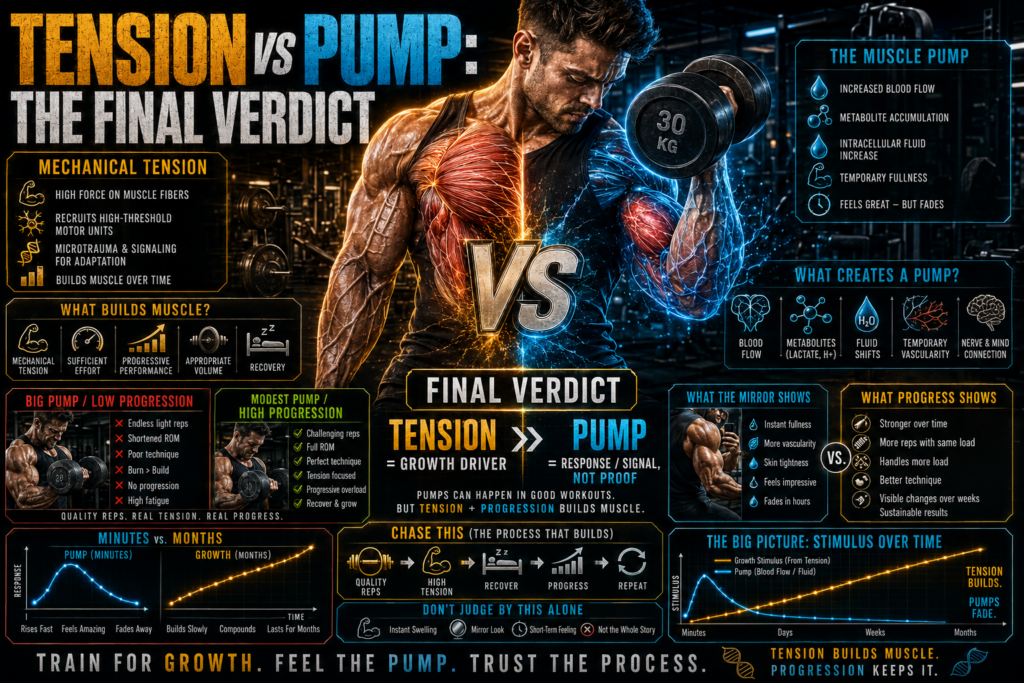
Tension vs Pump The Final Verdict matters more than most lifters realize. You probably chase one and ignore the other. This confusion costs you real muscle growth. The right balance transforms your training completely.
What Tension vs Pump The Final Verdict Reveals About Muscle Growth
Mechanical tension creates micro-tears in muscle fibers. Your body repairs these tears bigger and stronger. This process drives long-term hypertrophy. Tension happens when you lift heavy weight slowly.
The pump fills your muscles with blood and metabolites. This swelling stretches the muscle cell membrane. Your body interprets this stretch as a growth signal. The pump feels incredible but fades within hours.
Research shows both methods build muscle through different pathways. Tension activates mTOR signaling for protein synthesis. The pump triggers cell swelling and metabolic stress. You need both for maximum results.
Most programs favor one approach exclusively. Powerlifters chase tension with low reps. Bodybuilders often prioritize the pump with high volume. Neither group achieves their full potential this way.
How Mechanical Tension Builds Strength in Tension vs Pump The Final Verdict
Heavy loads under control create the most tension. Sets of three to six reps work best here. Rest periods need to be three to five minutes. Your muscles must fully recover between efforts.
Compound movements like squats and deadlifts excel for tension. These exercises load multiple muscle groups simultaneously. The weight you can handle reaches peak levels. Your nervous system adapts to recruit more motor units.
Time under tension matters more than total reps. A slow five-second eccentric beats a fast one. The lowering phase creates the most muscle damage. This damage signals your body to grow stronger.
Progressive overload remains the foundation of tension training. You must add weight or reps each week. Stalling means you stop growing. Track every workout to ensure steady progress.
Tension training builds dense, hard muscle tissue. The pump adds size but not the same strength. If you want to move heavy weight, tension wins. This approach takes patience but delivers lasting results.
The Metabolic Advantages Hidden in Tension vs Pump The Final Verdict
The pump creates an oxygen-deprived environment inside muscles. This hypoxic state triggers anabolic hormone release. Growth hormone and IGF-1 levels spike during pump training. These hormones support muscle repair and growth.
Lactic acid accumulation during high-rep sets causes the burn. Your muscles swell as blood rushes in to clear waste. This swelling stretches the muscle fascia from inside. The fascia limits how big muscles can grow.
Pump work increases capillary density around muscle fibers. More blood vessels mean better nutrient delivery. Recovery speeds up between training sessions. Your muscles also look fuller all day long.
Sets of twelve to twenty reps maximize the pump. Rest periods should stay under ninety seconds. This prevents full recovery and keeps metabolites trapped. Isolation exercises work better than compounds for pure pump.
You can train for the pump more frequently. The muscle damage stays minimal compared to heavy tension. Three to four sessions per week per muscle works. Advanced supplement support helps sustain this higher frequency without overtraining.
Why Tension vs Pump The Final Verdict Changes With Training Experience
Beginners respond to almost any training stimulus. Their muscles haven’t adapted to resistance yet. Simple progressive tension builds most of their initial size. The pump matters less during this phase.
Intermediate lifters need both methods in their programs. Pure strength gains slow down after two years. Adding pump work breaks through plateaus effectively. The varied stimulus keeps adaptation progressing.
Advanced athletes must manipulate both variables strategically. Periodization cycles between tension and pump blocks. Four weeks of heavy tension followed by three of pump. This prevents adaptation and maintains progress.
Older lifters benefit more from pump-focused training. Joint stress decreases with lighter weights. Metabolic stress still builds muscle without injury risk. Recovery capacity drops with age anyway.
Your genetics influence which approach works better. Some people grow from anything heavy. Others need high volume and constant pumps. Experiment for twelve weeks with each method. Your results reveal your individual response pattern.
Practical Programming for Tension vs Pump The Final Verdict
Start each workout with tension-based compound movements. Squat or bench press with three sets of five. Use eighty to eighty-five percent of your max. Rest four minutes between sets completely.
Follow with moderate-weight accessory exercises next. Three sets of eight to twelve reps works here. Rest drops to two minutes between efforts. This middle zone builds both strength and size.
Finish every session with pure pump isolation work. Cable flyes or leg extensions fit perfectly here. Two to three sets of fifteen to twenty reps. Rest only sixty seconds to maintain the burn.
This structure gives you both growth pathways. Heavy work comes first while you’re fresh. Fatigue doesn’t matter as much for pump training. Total session time stays under seventy-five minutes.
Track your tension lifts with precise numbers. Write down every weight and rep count. The pump exercises need less precise tracking. Just focus on achieving maximum muscle fullness.
Common Mistakes That Ruin Tension vs Pump The Final Verdict Results
Chasing the pump with compound movements wastes energy and neural resources. High-rep squats create excessive fatigue without generating sufficient mechanical tension or hypertrophic stimulus. Save heavy compound lifts like barbell back squats, deadlifts, and bench presses for tension-focused training where you can load maximally. Instead, use isolation machines, cable stations, and dumbbells for pump work—these tools allow controlled rep ranges of 12-20 reps that generate metabolic stress and muscle swelling without recruiting stabilizer fatigue from complex movement patterns.
Going too heavy on isolation exercises misses the point. You can’t load a cable fly enough for true tension. These movements exist to create metabolic stress. Use weights you can control for high reps.
Skipping rest between heavy sets kills tension quality. Your nervous system needs full recovery to fire maximally. Short rest turns tension work into cardio. The weight drops and growth stimulus disappears.
Resting too long during pump sets lets metabolites clear out. The burn fades and blood leaves the muscle. Keep moving to maintain that swollen feeling. Thirty to sixty seconds maximum between pump sets.
Many lifters train with medium weight and medium reps always. This lukewarm approach provides neither tension nor pump. You end up spinning your wheels indefinitely. Commit fully to one stimulus at a time.
How Supplements Support Tension vs Pump The Final Verdict Strategies
Creatine monohydrate improves strength for tension-focused training. Your muscles store more phosphocreatine for explosive efforts. Five grams daily increases your max lifts gradually. This compound has decades of research backing it.
Citrulline malate enhances blood flow for superior pumps. Six to eight grams before training works best. Your muscles swell larger and stay full longer. The endurance boost helps you complete high-rep sets.
Beta-alanine buffers lactic acid during metabolic stress work. The burning sensation decreases noticeably with supplementation. You can push through more reps before failure. Three to five grams daily shows clear benefits.
Comprehensive formulas designed for muscle growth combine multiple pathways in one product. You avoid buying six different supplements separately. The synergistic effect often exceeds individual ingredients alone.
Protein timing matters less than total daily intake. Get at least one point six grams per kilogram bodyweight. Spread this across four meals for optimal synthesis. Real food beats shakes but convenience matters too.
The Recovery Differences in Tension vs Pump The Final Verdict Approaches
Heavy tension training damages muscle fibers more severely. You need forty-eight to seventy-two hours between sessions. Training the same muscles sooner prevents full recovery. Strength actually decreases instead of improving.
Pump work causes less structural damage overall. The fatigue comes from metabolite buildup instead. Twenty-four to forty-eight hours proves sufficient usually. Some advanced lifters train the same muscles daily.
Central nervous system fatigue limits tension training frequency. Your brain and spinal cord need recovery too. Too many heavy sessions cause poor sleep and motivation. Two to three max-effort days per week maximum.
Pump training barely stresses the nervous system. The weights stay manageable and controlled throughout. You can train six days weekly without burnout. Joint stress stays minimal compared to heavy loading.
Recovery-focused nutrition supplements help you train more frequently without overtraining symptoms. Sleep quality improves and soreness decreases noticeably. Adaptation happens during rest, not during the workout.
When Tension vs Pump The Final Verdict Depends on Your Goals
Pure strength athletes need tension as their primary focus. Powerlifters and Olympic lifters lift maximally in competition. The pump provides no advantage for one-rep performance. Train specifically for your testing conditions.
Bodybuilders require both methods in equal measure. Stage appearance depends on muscle size and density. Tension builds the foundation but pump adds volume. Contest prep increases pump work for fullness.
Athletes in other sports benefit more from tension. A strong muscle performs better than a pumped one. Football players and fighters need applicable strength. Save pump work for the off-season only.
General fitness enthusiasts should use both approaches. Health benefits come from varied training stimuli. Neither method alone optimizes overall wellness. Mix heavy days with lighter pump sessions.
Physique goals determine your exact ratio here. More size with less concern for strength? Favor pump training sixty percent of the time. Maximum strength with moderate size? Reverse that ratio completely.
Frequently Asked Questions
Can you build muscle with only tension training?
Yes, mechanical tension alone builds significant muscle mass over time. Powerlifters prove this despite never chasing the pump. However, you leave growth potential on the table. Combining both methods produces faster results for most people.
Does the pump actually make muscles grow bigger?
The pump triggers cell swelling that signals muscle growth. This metabolic stress activates separate pathways from mechanical tension. Research confirms both mechanisms contribute to hypertrophy independently. The pump alone builds muscle but not as dense.
How often should I train for tension versus pump?
Start each workout with two to three tension exercises. Follow with one to two pump-focused movements after. This gives you both stimuli in every session. Adjust the ratio based on your specific goals.
Which approach works better for stubborn muscle groups?
Stubborn muscles usually respond better to increased pump training. These areas often have poor mind-muscle connection already. High-rep isolation work improves the neurological link. Calves and rear delts especially need pump-focused attention.
Can beginners focus on just one method?
Beginners should prioritize tension with compound movements first. Learning proper form under challenging weight builds the foundation. Add pump work after six months of consistent training. Master the basics before complicating your program unnecessarily.
Choose one tension exercise and one pump exercise to test this week.