

Why Most Lifters Waste Years Ignoring Heavy Duty Training
Mike Mentzer’s Heavy Duty Training revolutionizes conventional weightlifting by focusing on single sets taken to absolute failure rather than high-volume routines. This method uses advanced techniques like forced reps and rest-pause sets to build muscle more efficiently than traditional three-sets-of-ten approaches.
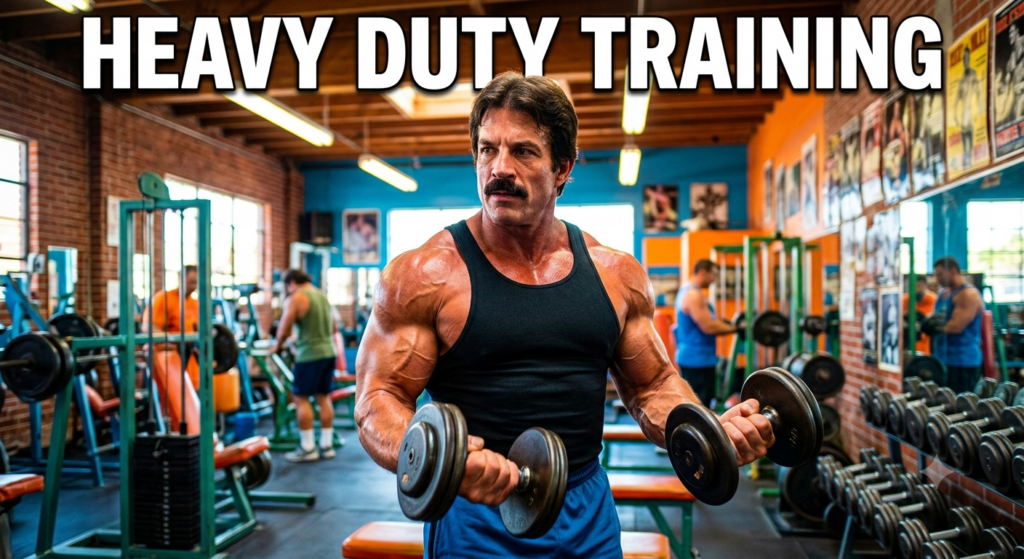
Mike Mentzer Heavy Duty Training is it right for you? You walk into a gym. People spend two hours lifting weights. They do 20 sets per muscle and return the next day. The approach seems backward to some experts.
What Makes Mike Mentzer Heavy Duty Training Different From Regular Programs
The core of Mike Mentzer’s Heavy Duty method was all about one all-out set taken to absolute failure. Mentzer lowered the ideal rep-range to 6-8. You select a weight so heavy that reaching eight reps feels impossible. Then you go beyond failure. The techniques Heavy Duty prescribed foremost were forced reps, negative reps, rest-pause, and pre-exhaust. Most programs tell you to do three sets of 10. This method flips that advice completely upside down.
In the most extreme version of Heavy Duty, he prescribed doing 1 to 2 sets for a muscle group just once a week. Traditional training splits have you hitting chest twice weekly. Heavy Duty says once every seven days suffices. Longer recovery phases between workouts – often 3 to 7 days. The premise shocks people who believe more training equals more muscle.
How Recovery Windows Make Mike Mentzer Heavy Duty Training Work
Mike emphasized that the real growth happens after the workout, not during it. Fast-twitch fibers, while powerful, recover at a slower pace. Depending on the individual, true recovery may take four to ten days or more. This explains why the system demands extended rest periods.
His central principle was not maximum rest, but rather it was optimal recovery. That difference matters. You don’t rest because you’re lazy. You rest because the stimulus already occurred. Additional workouts before full recovery just dig you deeper into fatigue. Mentzer argued that the stimulus from one all-out set is sufficient, and that additional sets only dig into recovery capacity without adding growth.
Research indicates that it can take 4 days or more to recover from muscle damage from a single training session of moderate to high volume. The extended rest that seems excessive actually aligns with muscle recovery science. Your muscles don’t care how often you want to train.
The Science Behind Single Set Training in Mike Mentzer Heavy Duty Training
Morton et al. (2024) among other recent studies affirm that training to failure produces slightly better results than stopping short. The evidence supports intensity over pure volume when sets reach true failure. A 2021 Journal of Applied Physiology study found one set to failure can match multi-set training for hypertrophy in the short term.
But longer studies reveal limitations. A 2023 Sports Medicine meta-analysis pegs 10-20 sets weekly per muscle as optimal—Heavy Duty’s 1-2 sets fall way short. This creates real problems for long-term muscle development. One tester reported results after four weeks. Despite the mental and physical demands of doing one set to failure, he completed all 12 planned workouts and made great progress. While 3.5 pounds might not sound significant, it’s quite impressive considering the minimal workload.
When you push a muscle to full-rep failure, you’re recruiting the largest motor units. Unless you take sets to failure, you’re not fully activating those growth-prone fibers. The mechanism works through complete motor unit recruitment in that final set.
Who Should Actually Try Mike Mentzer Heavy Duty Training
Experience level: Intermediate to advanced (1+ years of consistent training). The program relies on training to absolute muscular failure with perfect form. Beginners who haven’t developed proper motor patterns risk injury training at this intensity. You need technical mastery before attempting true failure training safely.
Over 40: Low frequency fits slower recovery—intensity still works. Older lifters often respond well to reduced training frequency. The low volume is especially appropriate during a caloric deficit when recovery capacity is reduced. People cutting weight face compromised recovery already.
Busy Lifters: 2-3 days/week fits packed lives. Parents juggling work and family can’t spend 90 minutes daily in gyms. Mike Mentzer Heavy Duty Training is it right for you if time constraints matter? Sessions last 20 to 30 minutes. You get stimulus without lifestyle disruption.
People on a Plateau: Since this training regime involves lifting heavy weights, it is incredibly effective for breaking strength and muscle plateaus. When standard approaches stop working, radical changes in training stress can restart progress.
If You use Heavy Duty Training You need the Best Supplements in 2026
Real Problems With Mike Mentzer Heavy Duty Training You Must Know
Only 1 working set per exercise leaves zero margin for error — every rep must be maximally intense, requiring flawless exercise technique and strict form adherence. The mental demand of pushing to absolute muscular failure exceeds the physical challenge for most people, leading to decision fatigue and compromised rep quality. This approach carries significant injury risk; technical breakdown at true failure—particularly in compound movements like squats, deadlifts, and bench press—creates cumulative joint stress and connective tissue strain. Unlike moderate-intensity training that allows form degradation without consequence, Heavy Duty’s intensity-dependent model means even slight form deviation under maximum load can cause acute muscle strains, ligament sprains, or chronic overuse injuries that derail progress entirely.
Stalls long-term—progress slows without volume. Short-term results don’t predict long-term outcomes. Absolute minimum that still works: 1 to 4 hard sets per muscle per week. Mentzer territory. This volume sits at the basement of effective training.
Human beings do not respond uniformly to strength training. Differences in muscle fiber type, tendon insertions, recovery ability, and hormonal profiles make each lifter biologically unique. Some people need more volume regardless of intensity. Mike Mentzer Heavy Duty Training is it right for you depends heavily on individual response patterns.
The approach can be great for some people but disastrous for others. Success with HIT is circumstantial and coaching dependent. Without proper guidance, executing true failure safely becomes nearly impossible. Most gym-goers lack training partners who can provide forced reps correctly.
Testing Mike Mentzer Heavy Duty Training For Your Own Body
Start with a four-week trial period minimum. Track every working set weight and rep count meticulously. If you are genuinely adding weight or reps to your working sets every session, the results are happening. Strength is the proxy for muscle growth in this system. If the numbers are climbing, tissue is being added. Progress reveals truth better than feelings.
If they stall for two sessions, extend the rest window. The cycle is over, deload, and restart. Adaptation requires flexibility in recovery timeframes. Mike Mentzer Heavy Duty Training is it right for you when progress continues session after session? Yes.
You don’t just walk in and hit that set cold. Mentzer always included a ramp-up through strategic warm-up sets. Proper preparation prevents injury and optimizes the working set intensity. Skip warmups and you’ll fail for wrong reasons. Add a warm-up set (50% 1RM, 10 reps) before failure—protect joints.
Monitor fatigue beyond workout performance. Sleep quality matters. Joint soreness differs from muscle soreness. Pay closer attention to recovery including smart caloric intake. Nutrition becomes critical when training volume drops this low.
Modifying Mike Mentzer Heavy Duty Training For Better Results
Beginners should start with straight sets to failure and add pre-exhaustion later if progress stalls. Don’t implement all advanced techniques simultaneously. Adding forced reps: After reaching positive failure, a training partner provides minimal assistance for 1-2 additional reps. Use sparingly — only when progress stalls. These intensity techniques carry costs that exceed benefits when overused.
Consider splitting the difference between extreme minimalism and high volume. Roughly 10 to 20 hard sets per muscle per week, split across… sessions provides better long-term outcomes for most people. You can apply failure training principles without slavish devotion to single sets.
A trainee who continues progressing on a particular schedule should not reduce frequency merely to make the program appear more “Heavy Duty.” Mike Mentzer Heavy Duty Training is it right for you when results dictate programming? Results trump ideology every time. Training frequency is a variable to be tested, not a commandment to be obeyed.
Mike Mentzer Heavy Duty Training is it right for you depends on experience level, recovery capacity, and time availability. The approach works but demands perfect execution and honest assessment. Try it systematically and let objective progress measurements make the decision.
Frequently Asked Questions
What is Mike Mentzer Heavy Duty Training?
Heavy Duty Training involves one working set per exercise taken to complete muscular failure. You rest 4 to 7 days between training the same muscle group. The method emphasizes maximum intensity with minimal volume for muscle growth.
Can beginners use Mike Mentzer Heavy Duty Training safely?
Beginners should wait until they develop proper lifting form and movement patterns. Training to absolute failure without technical mastery creates high injury risk. Most experts recommend at least 6 to 12 months of consistent training first.
How long should workouts last with Heavy Duty Training?
Most Heavy Duty sessions last 20 to 30 minutes including warmup sets. You perform only 3 to 6 total working sets across all exercises. The brief duration reflects the extreme intensity of each working set.
Does science support Mike Mentzer’s one set approach?
Short-term studies show one set to failure can build muscle effectively. However, research indicates 10 to 20 weekly sets per muscle produces better long-term results. The method works but may not be optimal for everyone.
What are the biggest drawbacks of Heavy Duty Training?
The extremely low volume may not provide enough growth stimulus for most lifters. Training to failure every set creates mental fatigue and form breakdown risks. Progress often stalls faster than with moderate volume approaches.
Test Mike Mentzer Heavy Duty Training for four weeks and track strength gains in every session to determine if it fits your response pattern.