

Maintain Muscle on Just 3 Sets Per Week
Low-volume hypertrophy maintenance lets you preserve hard-earned muscle mass with just one-third the training volume you used to build it. Research proves your muscles only need periodic reminders that you still lift, making it possible to maintain gains even when life gets busier.
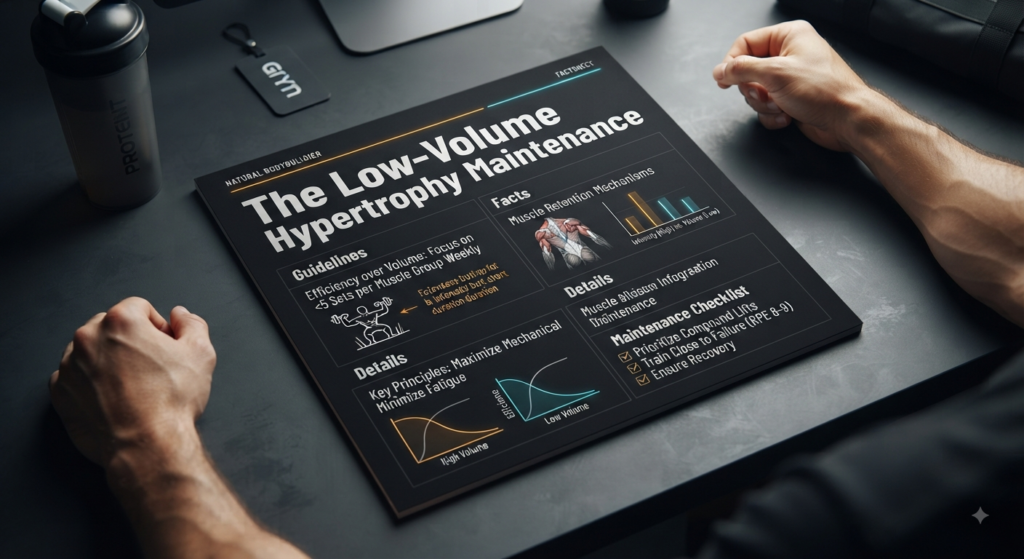
You trained hard for months to build muscle mass. Then life got busier and gym time shrunk. Most lifters panic and watch their gains fade. Low-Volume Hypertrophy Maintenance changes that equation completely.
Why Low-Volume Hypertrophy Maintenance Works With Minimal Time
Your muscles don’t need constant growth signals to stick around. They just need periodic reminders that you still lift. Research shows you can maintain muscle with one-third the volume you used to build it. That means three hard sets per week can preserve what took twelve sets to create.
The mechanism is simple. Building new muscle requires progressive overload and frequent stimulation. Keeping existing muscle only requires proving you still use it. Your body won’t discard tissue it thinks you need. One heavy session per muscle group weekly sends that signal loud and clear.
This isn’t about getting weaker. You keep the same intensity and load. You just cut the total number of sets dramatically. Many lifters maintain their one-rep max while training half as often. The strength stays because neural adaptations persist longer than you’d expect.
To determine how little training you actually need to preserve muscle across different situations, see Minimum Sets to Maintain Muscle: Weekly Volume Guide for a complete breakdown of weekly set requirements and maintenance volume.
How Low-Volume Hypertrophy Maintenance Fits Busy Schedules
Two full-body sessions per week can maintain everything you built. Each session takes thirty to forty minutes. You hit each major muscle group with two to three hard sets. That’s your entire weekly requirement.
Compare that to the traditional bodybuilder split. Five or six days weekly in the gym. Ninety-minute sessions. Multiple exercises per body part. That works great when muscle growth is the priority. It becomes impossible when work explodes or family needs you home.
The time savings are real. You free up four hours weekly minimum. Your recovery improves because you’re not constantly breaking down tissue. Sleep quality often increases when training stress drops. Yet the mirror shows the same physique you worked months to build.
This approach also eliminates gym guilt. Missing one of two sessions isn’t ideal but won’t wreck your progress. Missing one of six sessions in a high-volume program creates anxiety and compounds quickly. The psychological relief matters as much as the physical benefits.
Designing Your Low-Volume Hypertrophy Maintenance Program
Start by picking compound movements that hit multiple muscle groups. Squats, deadlifts, bench press, rows, and overhead press cover everything. You need five or six exercises maximum per session. Each one serves a clear purpose.
Perform two to three sets per exercise at 75 to 85 percent of your max. Rest three minutes between sets. Push each set close to failure but leave one rep in reserve. The intensity must stay high even as volume drops dramatically.
Frequency can vary based on your schedule. Some people prefer one upper and one lower session weekly. Others do two full-body workouts. Both approaches work equally well for maintenance. The total weekly sets per muscle group matter more than the split.
Track your lifts in a simple notebook. Write down the weight and reps for each set. If numbers start dropping consistently, add one more set per muscle group. If you feel constantly beat up, pull back slightly. Supporting your recovery becomes even more important when training volume is minimal.
Nutrition Adjustments For Low-Volume Hypertrophy Maintenance
Your protein needs don’t change much during maintenance phases. Aim for the same 1.6 to 2.2 grams per kilogram bodyweight as during hypertrophy phases. Muscle tissue still requires amino acids for repair and muscle protein synthesis. Cutting protein to match lower training volume backfires quickly because reduced mechanical tension doesn’t eliminate your baseline protein requirements. Your daily protein intake directly supports muscle fiber preservation, recovery from resistance training, and maintaining lean body mass even when total training stress decreases.
Total calories can drop slightly since you’re burning less in the gym. But the reduction should be modest. A hundred to two hundred calories less daily keeps energy stable. Slash too many calories and your body starts breaking down muscle for fuel.
Carbohydrate timing becomes less critical. You don’t need massive glycogen stores for two weekly sessions. Spreading carbs evenly throughout the day works fine. Save the peri-workout nutrition strategies for when you’re chasing growth again.
Micronutrient intake deserves more attention during maintenance. Your training isn’t driving the same adaptation signals. Quality supplementation helps fill gaps that volume used to mask. Vitamin D, magnesium, and omega-3s support muscle retention independently of training frequency.
Common Mistakes With Low-Volume Hypertrophy Maintenance Programs
Too many lifters keep the same exercise variety they used during growth phases. They rotate through ten different chest movements across the month. Maintenance doesn’t need that complexity. Stick with three to four proven exercises per muscle group and repeat them.
Another error is dropping intensity to match the lower volume. You cut sets but also reduce the weight on the bar. This sends the wrong signal. Your body thinks the load isn’t challenging anymore. Muscle disappears within weeks.
Some people treat maintenance sessions as cardio workouts. They rush through sets with minimal rest. Heart rate stays elevated but muscles don’t get taxed properly. Rest fully between sets even when total gym time shrinks.
Skipping deload weeks is common during maintenance. The logic seems sound since volume is already low. But accumulated fatigue builds differently. Take one easy week every eight to ten weeks. Drop intensity to 60 percent and enjoy active recovery.
When To Switch From Low-Volume Hypertrophy Maintenance Back To Growth
Your schedule opens up again. Work calms down after a deadline sprint. The kids go back to school. You suddenly have four or five hours weekly for the gym. That’s the signal to shift gears.
Start by adding one set per exercise for two weeks. Monitor how your body responds to the increased workload. If recovery feels solid, add another set the following fortnight. Build back up gradually rather than jumping straight to your old volume.
Some lifters discover they actually prefer maintenance-level training long-term. The physique they have satisfies them completely. Extra muscle mass isn’t worth the time and recovery cost. That’s a valid choice that saves years of unnecessary grinding.
Others use maintenance phases strategically between growth blocks. Three months pushing for gains, two months maintaining at low volume. This cycling prevents burnout and keeps training sustainable for decades. Strategic supplementation during growth phases maximizes the muscle you build before returning to maintenance mode.
The Psychology Of Low-Volume Hypertrophy Maintenance
Accepting that you’re not currently growing challenges many lifters. The culture celebrates constant progress and new personal records. Maintenance feels like stagnation or even failure. This mindset creates unnecessary stress during busy life periods.
Reframe maintenance as protecting your investment. You spent months building that muscle. Preserving it with minimal effort is actually smart resource management. Athletes do this routinely during off-seasons. Recreational lifters can adopt the same approach.
The mental relief from shorter workouts compounds over weeks. You stop feeling guilty about life taking priority. Training becomes a habit you maintain rather than a demanding hobby. Many people report better adherence during maintenance phases than growth phases.
Some lifters worry their gym peers will judge the reduced volume. Nobody actually cares how many sets you do. Most people are too focused on their own training. The ones who do notice will ask how you’re keeping your physique with such short workouts.
Frequently Asked Questions
How long can I stay on a Low-Volume Hypertrophy Maintenance program?
You can maintain muscle indefinitely with low volume if intensity stays high. Many lifters run maintenance for six months or longer. The key is keeping loads heavy and tracking performance. If lifts start declining consistently, increase volume slightly.
Will I lose strength during Low-Volume Hypertrophy Maintenance?
Strength typically stays stable when you maintain intensity and use compound movements. Some people even set personal records during maintenance phases. Neural efficiency improves when fatigue decreases. You might lose some work capacity for high-rep sets.
Can beginners use Low-Volume Hypertrophy Maintenance programs?
Beginners should focus on building muscle and strength first. Maintenance makes sense only after you’ve developed a base worth preserving. That usually takes at least one year of consistent training. New lifters gain muscle too easily to waste time maintaining.
How many exercises should a Low-Volume Hypertrophy Maintenance workout include?
Five to six compound exercises per session covers all major muscle groups. Focus on squat variations, hip hinges, horizontal pushes, horizontal pulls, and vertical movements. Isolation work becomes optional during maintenance. The basics handle everything efficiently.
What supplements help with Low-Volume Hypertrophy Maintenance?
Protein powder ensures you hit daily targets without huge meal prep. Creatine supports strength even when volume drops. Vitamin D and fish oil aid recovery between minimal sessions. Quality multivitamins fill micronutrient gaps that lower training frequency might create.
Start your next workout with just the core lifts and watch how little you actually need to keep everything you built.