

Why Your Bro Split Might Be Costing You Gains
Recent research reveals full-body and bro split routines produce identical muscle growth when weekly volume is equalized, debunking long-held training myths. The key to hypertrophy success is choosing the program you’ll stick with consistently, not chasing the latest training trend.
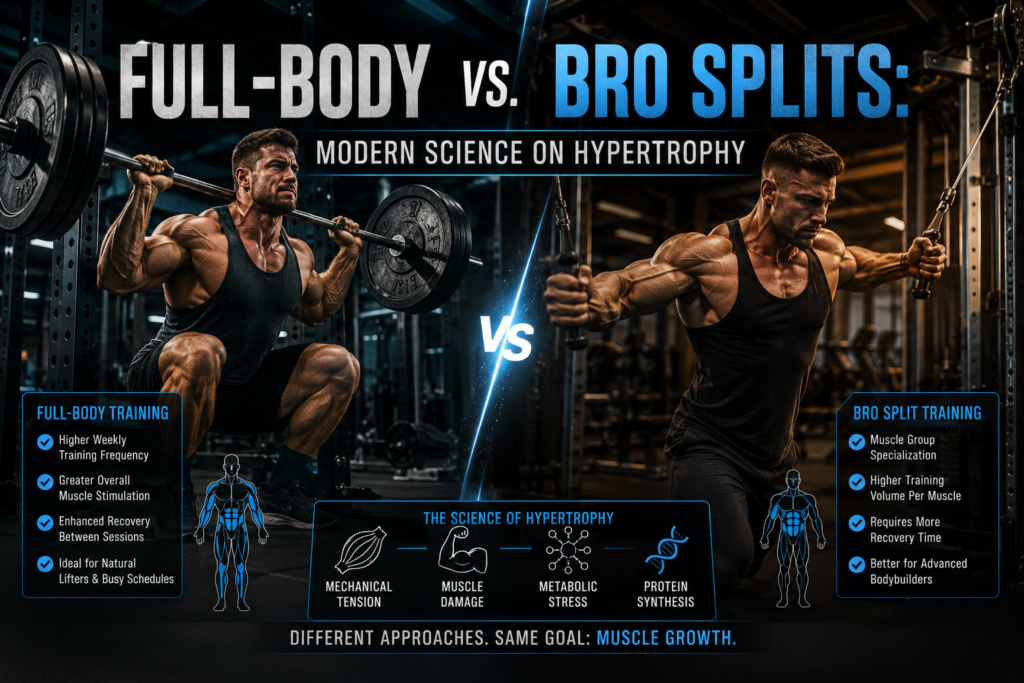
Full-Body vs. Bro Splits: Modern Science on Hypertrophy isn’t about which program sounds cooler. Your chest doesn’t grow more just because you trained it alone. Recent research shows both methods produce equal muscle growth when volume matches. The key is picking the approach that keeps you lifting consistently.
Full-Body vs. Bro Splits: Modern Science on Hypertrophy Reveals Equal Growth Potential
A 2024 meta-analysis of 14 studies found no difference in muscle growth between split and full-body routines when weekly volume was equal. This changes everything we thought about training frequency. The research examined programs lasting 4 to 12 weeks. Split and full-body routines showed no differences in lean body mass. Both routines also yielded similar strength adaptations when volume was equal.
When total weekly volume is equated, full body and split routines produce mostly similar hypertrophy outcomes. This means the debate has been backwards. Your muscle doesn’t care if you did 12 chest sets on Monday alone. It cares that you completed 12 quality chest sets somewhere during the week.
One study randomly assigned 23 participants to full-body training five days per week or split-body training once per week, with both groups performing 75 sets weekly for 8 weeks. The finding confirms the volume-matching principle. Total work matters more than how you spread it out.
The Protein Synthesis Window Changes How We Think About Full-Body vs. Bro Splits for Hypertrophy
Following a bout of heavy resistance training, muscle protein synthesis increases rapidly, is more than double at 24 hours, and declines rapidly so that at 36 hours it has almost returned to baseline. This research rattled the bodybuilding world. It suggests training a muscle just once weekly wastes growth opportunities.
Muscle protein synthesis elevates approximately 36 hours after training, after which it returns back to baseline. If you train chest on Monday, growth stops by Wednesday morning. That gives you four days each week where your chest sits idle.
Training each muscle group at least twice per week is superior to once per week for muscle growth. The practical implication is clear. You want to trigger protein synthesis multiple times weekly. Full-body routines do this automatically.
Bro splits can still work if you get creative. Hit chest directly on Monday, then bench press again on Friday for shoulder day. You sneak in a second growth stimulus without admitting you’re doing higher frequency training.
Weekly Volume Requirements Make Full-Body vs. Bro Splits: Modern Science on Hypertrophy More Practical
Evidence suggests that at least 10 sets per muscle per week is the ideal number to induce hypertrophy, though not everyone will need that many sets and some may need more. This is your baseline. Advanced lifters often need significantly more.
Performing 10 to 19 sets per week allows for a significant hypertrophy stimulus whilst also allowing for sufficient recovery. You can hit this range with either training style. A full-body routine might split 15 chest sets into three sessions of five sets each.
Muscle growth tends to be best around 6 to 8 hard sets per muscle group per training session, which can be 12 to 24 weekly sets for a frequency of 2 to 3 days per week. This explains why bro splits sometimes fail. Doing 20 sets for chest in one session creates diminishing returns.
The classic bro split of blasting a muscle group for very high volumes once per week is likely an inferior way to train, and it is better to split the volume up into frequencies of 2 to 3 days per week. Split those 20 chest sets into two sessions of 10 sets each. You’ll recover better and maintain higher quality work.
Recovery Patterns Differ Between Full-Body vs. Bro Splits: Modern Science on Hypertrophy Shows Surprising Results
After training, muscles can fully recover sufficiently anywhere between 24 to 72 hours, which depends on the muscle’s size, fiber type composition, and mechanical tension applied during the session. Smaller muscles like biceps and triceps with less total muscle mass bounce back faster than larger muscle groups like quadriceps and back, which require extended recovery due to greater glycogen depletion and accumulated metabolic stress. This recovery timeline directly affects how you schedule training frequency and intra-workout rest periods between sets. Understanding these recovery kinetics is crucial for optimizing the training-to-recovery ratio within your chosen split structure.
Full-body routines distribute fatigue across your entire body each session. You never feel completely destroyed. Bro splits concentrate all the damage to one area. Spreading volume across sessions reduces per-session fatigue, leading to higher quality sets.
The quality issue matters more than people admit. Your 15th set of chest flies on Monday won’t match your first set. Split that same volume across two days and every set improves. Better sets mean better growth signals.
By training each muscle group only once per week, bro splits provide ample recovery time, reducing the risk of overtraining and injury. This argument sounds good but misses the point. Your muscles finish recovering by Wednesday. The extra four days add nothing.
Practical Application Determines Success With Full-Body vs. Bro Splits: Modern Science on Hypertrophy Considered
Full-body training more easily achieves optimal frequency for most people training 3 to 4 days per week. If you can only train three times weekly, full-body wins automatically. You hit everything three times instead of once.
Bro splits demand five or six training days weekly to work properly. Miss one session and you skip an entire muscle group that week. To follow bro split properly, you need to reserve 4 to 5 days every week, which isn’t possible for some people.
Individuals may select a weekly training frequency for each muscle group according to their personal preferences, given a consistent training volume. This is the real takeaway. Match your total weekly sets to your goals. Pick whichever split you’ll actually follow.
Advanced lifters with lagging body parts benefit from bro split modifications. Full-body routines make it simple to specialize on lagging body parts without overhauling your entire program. Add extra arm work to each session without disrupting your whole week.
The bro split works best for intermediate lifters with 6 plus months of training experience. Beginners should stick with full-body work. They need to practice movement patterns more frequently. Their muscles don’t need 20 sets of chest flies yet.
Frequently Asked Questions
Which builds muscle faster, full-body or bro splits?
Neither builds muscle faster when weekly volume matches. Research shows equal growth from both approaches. Pick the split you can follow consistently.
How many sets per muscle group should I do weekly?
Start with 10 to 15 hard sets per muscle per week. Advanced lifters may need 15 to 20 sets. Add volume slowly to avoid overtraining.
Can I build muscle training each muscle once per week?
Yes, but twice per week works better for most people. Muscle protein synthesis returns to baseline after 36 hours. Training more frequently captures additional growth windows.
Should beginners use full-body or bro splits?
Beginners should use full-body routines three days per week. This allows more practice with compound movements. Muscle growth happens with lower volumes for new lifters.
What happens if I miss a workout on a bro split?
You skip an entire muscle group that week. Full-body routines handle missed sessions better. Each muscle still gets trained at least twice weekly.
Start tracking your weekly sets per muscle group today and adjust your split to match your schedule.