
The Quad Exercise Most Lifters Skip That EMG Data Proves Works
EMG analysis uses electrode technology to measure electrical signals in muscle fibers, revealing which quad exercises provide the greatest activation for muscle growth. This scientific approach eliminates guesswork and shows you exactly which movements deserve a place in your training program.
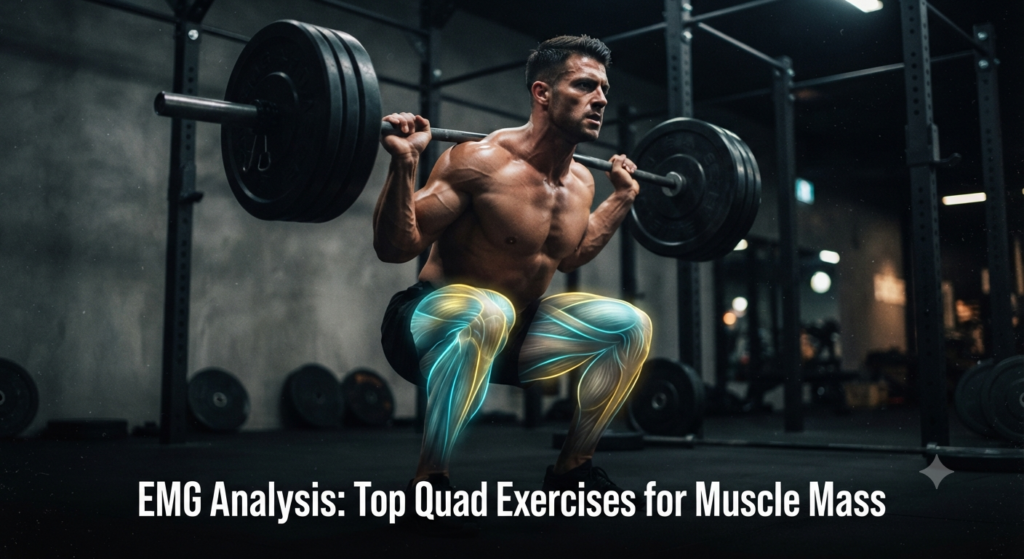
Walk into any serious gym and you’ll see lifters obsessing over squat depth. EMG Analysis: Top Quad Exercises for Muscle Mass proves which movements actually deliver maximum quad activation. Scientists measure electrical activity in muscle fibers during exercises. This data tells you exactly which exercises waste your time.
How EMG Analysis: Top Quad Exercises for Muscle Mass Reveals the Truth
EMG is the gold standard measurement tool for examining muscle activity during training. Researchers place electrodes on your skin over specific muscles. The electrodes detect electrical signals when muscle fibers contract. Raw data gets normalized and expressed as percentage of maximum voluntary isometric contraction. This gives you a clean comparison between different exercises.
Higher EMG readings mean more muscle fibers firing. More fibers firing leads to greater growth stimulus. Researchers use EMG values to indicate the extent of stress on muscles.
The relationship between EMG activity and muscle torque is linear. Double the EMG signal and you double the mechanical force. This makes EMG extremely reliable for comparing exercises. You can’t fake the numbers.
The Four Quad Muscles EMG Analysis: Top Quad Exercises for Muscle Mass Tracks
The quadriceps is composed of rectus femoris, vastus lateralis, vastus medialis, and vastus intermedius. Each muscle has a different job. These four muscles may have specific functions during knee extension. Understanding this changes how you train.
Three vastus muscles only cross your knee joint. The vastus intermedius shows significantly higher activation at 60% to 100% of one rep max during deep knee bends. The rectus femoris crosses both your hip and knee. This dual role matters for exercise selection.
The rectus femoris muscle presents lower EMG amplitude than vastus lateralis and vastus medialis. Standard squats often miss this muscle. You need specific movements to hit it hard.
Bulgarian Split Squats Win EMG Analysis: Top Quad Exercises for Muscle Mass Studies
Bulgarian split squats and backward lunges produce higher activation than split squats, reverse nordics, and half-squats. The rear foot placement creates unique demands. The non-dominant rear foot resting on a box during Bulgarian split squats poses significant challenge to postural control. Your vastus muscles fire harder to control knee stability.
Range of motion determines activation levels. Lateral step-downs show shorter knee motion range compared to Bulgarian split squats and backward lunges. The Bulgarian version takes your knee through 90 degrees of flexion. Shallow movements don’t produce the same muscle response.
Unilateral work fixes imbalances that bilateral exercises hide. Your stronger leg can’t compensate during split squats. Each quad must handle the full load independently.
Leg Extensions Target Rectus Femoris in EMG Analysis: Top Quad Exercises for Muscle Mass Research
Exercises placing rectus femoris in a stretched position, such as 40-degree hip flexion leg extension, enhance hypertrophy. Leaning back on the leg extension machine changes everything. Research involving bodybuilders performing leg extensions at 0, 40, and 80 degrees of hip flexion showed 40 degrees produced higher muscle activation.
Hip position determines how much the rectus femoris contributes. Sitting upright limits this muscle’s involvement. Reclining the seat back stretches the rectus femoris across both joints. This forces greater activation during knee extension.
Isolated knee extension exercises like leg extensions specifically target the rectus femoris. Compound movements don’t hit this muscle as effectively. You need both exercise types for complete quad development.
Bodyweight Sit-To-Stands Beat Machines for Older Adults
Bodyweight sit-to-stand exercise resulted in approximately 14% and 8% greater increase in voluntary quad muscle activity compared with leg press and knee extension machines. This finding surprised researchers studying older populations. Machine exercises should theoretically allow heavier loads. But EMG data showed bodyweight movements won.
The movement pattern matters more than the load. Standing from a chair demands coordination across multiple joints. Your nervous system recruits more muscle fibers to maintain balance. Machines stabilize you and reduce this neural demand.
This doesn’t mean machines are useless. We cannot infer whether elastic band exercises would be superior at supporting longitudinal gains in skeletal muscle mass. Acute activation differs from long-term growth. Both training methods have their place.
Heel Elevation Increases Knee Flexion and Quad Activation
Lifting your heels shifts the stress pattern during squats. The change forces your knees to travel further forward. This increases the angle of knee flexion at the bottom. Greater knee bend means more quad involvement.
An upright torso reduces hip and back contribution. Your quads handle more of the load when your spine stays vertical. Heel plates or wedges make this position easier to achieve. You don’t need perfect ankle mobility to hit depth.
Cyclist squats combine heel elevation with front-loaded weight. The barbell position across your shoulders pulls you upright. Your quads must work harder to prevent you from falling backward. This creates intense activation through the entire range.
Lunges Create High EMG Activation Through Eccentric Loading
Lunges elicit high levels of muscle activation across glute and quad regions, especially during eccentric loading. The lowering phase generates more muscle damage than lifting. Activation of vastus lateralis, vastus medialis, and biceps femoris significantly increased during forward lunges to failure.
Walking lunges add a dynamic component that static versions lack. Each step forward requires balance and coordination. Your stabilizer muscles fire continuously to prevent wobbling. This additional neural demand increases overall activation.
Reverse lunges shift the emphasis slightly. Stepping backward keeps your front shin more vertical. This reduces knee stress while maintaining quad tension. Athletes with knee issues often tolerate reverse lunges better.
Dorsal Foot Extension Amplifies Quadriceps Performance
Pre-activation of dorsal foot extensors significantly increased EMG activity in the quadriceps. Simply pulling your toes toward your shins fires your quads harder. Rectus femoris EMG doubled from 9.4 to 18.9 microvolts at 45 degrees with dorsiflexion.
Mean single leg hop distance increased from 169.8 to 178.9 centimeters with dorsal foot extension. That’s nearly 10 centimeters of extra distance from a simple ankle cue. Functional performance improved alongside muscle activation.
This technique costs nothing and works immediately. Think about driving your toes up during any quad exercise. The neural connection between ankle and knee extensors enhances force production. Coaches can use this during rehabilitation or strength training.
Front Squats Force Upright Posture and Maximum Quad Involvement
Barbell front squats are consistently ranked among the most effective due to their ability to load quads heavily while maintaining upright torso. The bar position across your front deltoids changes the entire movement. Lean forward and the weight falls off your shoulders.
This self-correcting nature makes front squats superior for quad focus. Back squats allow hip dominance and forward lean. Strong glutes and hamstrings can take over the movement. Front squats don’t permit this compensation.
Front squats naturally enhance quad engagement compared to back squats. The loading pattern forces your knees forward. Your quads must work through a longer range at higher tension. Most lifters feel intense quad burn after just a few sets.
Training Volume Determines Growth According to EMG Analysis: Top Quad Exercises for Muscle Mass Evidence
Muscle growth follows a dose-response relationship with training volume, with research indicating at least ten sets per muscle group per week leading to greater hypertrophy. This aligns with meta-analyses on resistance training frequency and mechanical tension. More work creates more growth stimulus up to a point of diminishing returns. You should be doing a minimum of 5 sets of quad exercises per workout, distributed across compound and isolation movements to maximize motor unit recruitment and metabolic stress.
Single exercises won’t build complete quads. The hypertrophy rep range of 8 to 12 reps for 3 to 4 sets per exercise leaves a minimum of 2 quad exercises per workout. Combine compound and isolation movements for balanced development.
Progressive overload matters more than exercise variety. Adding weight or reps over time drives adaptation. EMG studies show what works, but consistency builds muscle. Pick exercises showing high activation and stick with them.
Frequently Asked Questions
What does EMG measure during quad exercises?
EMG measures electrical signals from muscle fibers when they contract. Higher signals indicate more muscle activation and greater growth potential.
Which quad exercise shows the highest EMG activation?
Bulgarian split squats and backward lunges produce the highest vastus muscle activation. Leaning back leg extensions best target the rectus femoris muscle.
Do I need machines for maximum quad growth?
Bodyweight exercises can produce higher activation than machines in some populations. However, machines allow progressive overload that drives long-term muscle growth.
How many quad exercises should I do per workout?
Perform at least two different quad exercises per workout for minimum effective volume. Advanced lifters may benefit from three to four exercises per session.
Does heel elevation really increase quad activation?
Yes, heel elevation increases knee flexion and reduces hip involvement. This shifts more load to your quads during squatting movements.
Start your next leg workout with Bulgarian split squats and finish with reclined leg extensions.