
Why Your Resistance Pattern Might Stall Muscle Growth
Your muscles produce different levels of force at different joint angles during exercises like squats and presses. Understanding ascending versus descending resistance helps you strategically target muscle groups and optimize your training for maximum growth.
You walk into a gym and see someone squatting with chains hanging from the bar. Your friend swears by resistance bands that get harder as you stretch them. These tools represent opposite ends of the resistance spectrum. Ascending vs Descending Resistance for Muscle Growth determines which muscles get worked hardest and when.
Ascending vs Descending Resistance for Muscle Growth
Most lifters compare exercises by the weight used, repetitions performed, or muscles targeted. However, an equally important question is often overlooked: At what point during the repetition does the exercise become hardest?
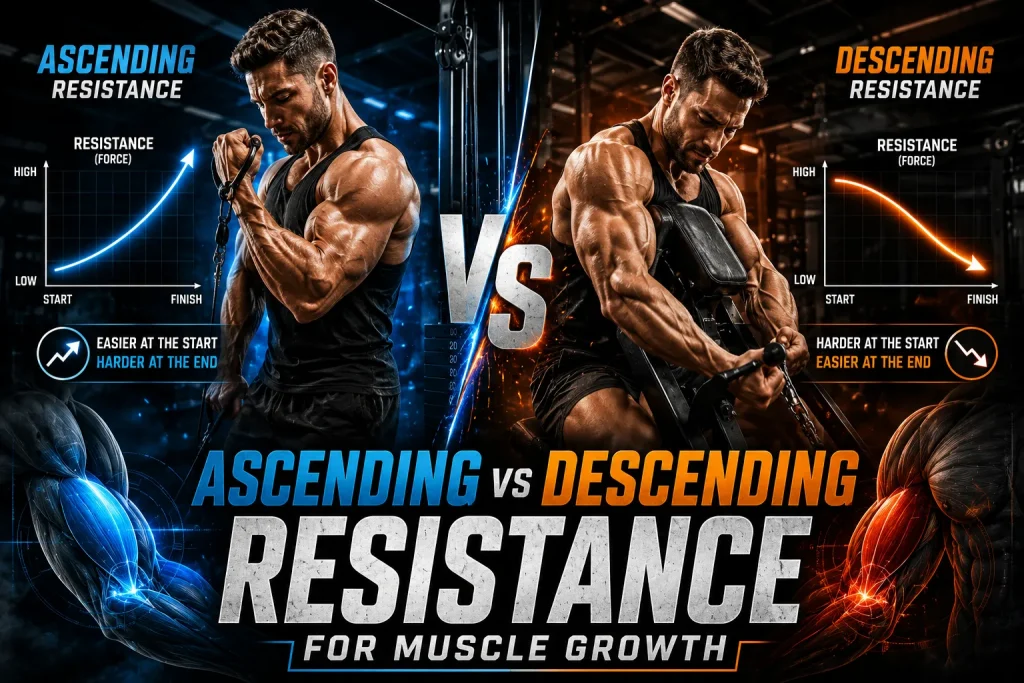
Some exercises become increasingly difficult as the muscle shortens and the repetition approaches completion. These have an ascending resistance profile. Others place their greatest demand near the beginning of the movement and become easier as the repetition continues. These have a descending resistance profile.
Neither resistance profile is automatically superior for hypertrophy. Each emphasizes different portions of an exercise’s range of motion, changes how fatigue develops during a set, and may complement different muscle-building goals.
If you are unfamiliar with the broader concept, begin with this complete guide to resistance profiles for hypertrophy, including their types and benefits. This supporting article focuses specifically on how ascending and descending resistance affect muscle growth—and how to choose between them without unnecessarily complicating your training.
Ascending vs Descending Resistance: Quick Answer
An ascending resistance exercise becomes harder as you move toward the end of the concentric phase. Resistance bands are a familiar example because their tension rises as they stretch. Chains and certain machine designs can create a similar effect.
A descending resistance exercise is more demanding near the beginning of the concentric phase and becomes easier as the repetition progresses. This can occur when an exercise places the largest external demand on a muscle near a lengthened position, although not every descending profile trains the target muscle at a long length.
For muscle growth:
- Ascending resistance can maintain difficulty as leverage improves.
- Descending resistance can emphasize the beginning or stretched portion of a movement.
- Both can stimulate hypertrophy when sets provide sufficient muscular tension and effort.
- Exercise setup and muscle length matter more than the profile’s label alone.
- Combining complementary profiles can provide more complete loading than relying exclusively on one.
The practical question is not simply, “Which profile is best?” It is, “Which part of the movement does my current program underload?”
How Ascending Resistance Changes a Hypertrophy Set
During ascending resistance training, the external demand increases as the repetition progresses. The lifter must continue producing substantial force instead of coasting through a mechanically favorable finishing position.
Bands demonstrate this clearly. A band may provide relatively little added resistance near the beginning of a squat, press, or curl. As it lengthens, its tension increases, making the final portion of the repetition progressively harder.
This can change the experience of a set in several ways.
First, there may be greater incentive to accelerate through the early range. Moving too slowly before reaching the band’s highest tension can make the final portion considerably harder.
Second, fatigue may appear near the shortened position or lockout instead of the normal sticking point. This is valuable when the standard exercise becomes too easy near completion, but it can become counterproductive if excessive band tension turns every repetition into a grinding lockout.
Third, ascending resistance may allow a lifter to retain a familiar compound movement while redistributing its difficulty. It does not necessarily increase the total hypertrophy stimulus; it changes where that stimulus is concentrated.
Potential Muscle-Building Benefits of Ascending Resistance
It prevents the end range from becoming unloaded
Some exercises become substantially easier as the joints approach lockout. Adding bands or chains can preserve more external resistance through that region.
This may be useful when a lifter wants to train force production throughout a larger portion of the concentric phase rather than allowing effort to drop sharply after passing the sticking point.
It can complement lengthened-position exercises
A program dominated by exercises that are hardest near the stretched position may benefit from an ascending movement that emphasizes the shortened half.
For example, a lifter could combine an exercise that heavily challenges the glutes near deep hip flexion with a hip-extension exercise that becomes harder toward full contraction. The two movements need not compete for the title of “best glute exercise.” They can provide different forms of loading.
It may reduce stress in vulnerable bottom positions
Because band tension is normally lower before the band has been fully stretched, an ascending profile can reduce external load near the beginning of certain movements.
This may help a lifter continue training a pattern when the deepest position is temporarily less tolerant of heavy loading. However, bands should not be treated as a universal solution for pain. Persistent or sharp joint pain deserves assessment by an appropriate healthcare professional.
It can create overload without simply adding plates
Bands and chains allow the total resistance to change through the repetition. This gives experienced lifters another progression option when adding the same resistance everywhere would overload the weakest position too aggressively.
Does Ascending Resistance Build More Muscle?
Current evidence does not show that variable resistance consistently produces more hypertrophy than conventional constant-load training.
A systematic review comparing variable and constant resistance training found no significant advantage for muscle growth, although variable resistance showed potential benefits for some performance outcomes. A separate systematic review of variable versus conventional resistance training also concluded that the available short- and medium-term studies did not demonstrate superior gains in muscle mass.
That does not make ascending resistance ineffective. Instead, it means bands, chains, and variable-resistance machines should be selected for a specific programming purpose—not because they supposedly possess unique anabolic properties.
An ascending profile can still be useful when it:
- Improves the fit between an exercise and the lifter
- Makes an underloaded range more challenging
- Allows pain-free progression
- Creates productive variation
- Helps the target muscle remain involved near the end range
The benefit comes from how the resistance is applied, not from the band or chain itself.
How Descending Resistance Changes a Hypertrophy Set
A descending resistance profile demands the most force near the beginning of the concentric phase. Once the lifter clears that difficult region, the external challenge gradually decreases.
This arrangement can make the first few inches of a repetition decisive. As fatigue accumulates, the lifter may be unable to initiate another repetition even though they could complete the middle and final portions if placed there directly.
Descending resistance can be especially relevant to hypertrophy when the target muscle is highly challenged while lengthened. Research on long-muscle-length resistance training suggests that loading muscles in lengthened positions can produce a potent growth stimulus.
However, these concepts must not be used interchangeably.
A resistance profile describes where external demand is greatest. Muscle length describes the anatomical state of the target muscle at that point. An exercise can be difficult at the beginning without meaningfully lengthening the intended muscle. Conversely, an exercise may train a muscle at a relatively long length without possessing a purely descending profile.
Both factors must be evaluated.
Potential Muscle-Building Benefits of Descending Resistance
It can prioritize tension in the stretched region
When an exercise is correctly selected and configured, a descending profile can place high demand on the target muscle while it is lengthened.
This is relevant because a growing body of research favors training at longer muscle lengths in many comparisons. A systematic review examining longer-muscle-length resistance training reported that longer-length training generally produced greater hypertrophy than shorter-length training.
The evidence is promising, but it does not establish that every muscle responds identically or that a harder stretch always means more growth.
It makes the early range difficult without excessive end-range loading
If resistance remained equally demanding throughout the repetition, the lifter might be unable to use enough load to challenge the beginning effectively. A descending profile can place substantial resistance where it is wanted and then reduce the demand as joint leverage or muscular force capacity changes.
It may provide a strong stimulus with lower absolute loads
A muscle can experience a meaningful challenge even when the weight displayed on the machine or dumbbell is modest.
In a study comparing two cable triceps-extension positions, overhead elbow extensions produced greater triceps hypertrophy than extensions performed with the arm in a neutral position, despite participants using lower absolute loads in the overhead condition. The overhead position lengthened the triceps long head, illustrating why the weight lifted cannot be separated from the position in which it is lifted.
This study examined muscle length rather than isolating ascending versus descending resistance. Nevertheless, it demonstrates an important programming lesson: more weight does not necessarily create a better hypertrophy stimulus if the exercise distributes that resistance less advantageously.
It exposes strength limitations that other exercises may hide
A lifter can appear strong through the middle and end of a movement but lack control or force production near the beginning. Descending resistance exercises make this weakness difficult to avoid.
Improving strength and control in that region may produce better overall movement quality and create progression opportunities that were unavailable in shortened-dominant exercises.
Does Descending Resistance Cause More Muscle Damage?
Exercises that challenge muscles at longer lengths can initially produce greater soreness, especially when they are unfamiliar or involve a substantial eccentric component. This does not mean muscle damage is responsible for superior hypertrophy.
Soreness is also not a dependable measure of workout quality. Excessive damage can interfere with performance, reduce the amount of productive training completed later in the week, and create discomfort without adding meaningful growth.
When introducing a descending or stretch-emphasized exercise:
- Start with fewer sets than you think you need.
- Keep the eccentric phase controlled.
- Avoid forcing a painful range of motion.
- Leave one to three repetitions in reserve initially.
- Increase volume only after soreness and performance stabilize.
The goal is to adapt to the exercise and progress it—not to maximize soreness after the first session.
What Research on Muscle Length Tells Us
Muscle-length research does not directly prove that every descending resistance profile is superior. It does, however, help explain why exercises that load the early or stretched portion deserve consideration.
In one controlled comparison, seated leg curls produced greater overall hamstring growth than prone leg curls. The seated position placed the biarticular hamstrings at longer operating lengths because the hips were flexed.
Research also indicates that exercise selection can influence where growth occurs within a muscle. A 2025 randomized trial comparing preacher curls with incline dumbbell curls found different regional hypertrophy outcomes: incline curls favored proximal elbow-flexor growth, while preacher curls favored distal growth. Strength improvements were also specific to the curl participants trained.
These findings challenge the idea that every curl, extension, or press is interchangeable as long as the same muscle appears on an exercise chart. Joint position, muscle length, and resistance distribution can affect the resulting adaptation.
They also support using a small number of complementary movements rather than searching for one theoretically perfect exercise.
Ascending vs Descending Resistance by Training Goal
Choose more ascending resistance when:
- Your existing exercise loses most of its difficulty near lockout.
- You want to emphasize shortened-position force production.
- The bottom position cannot tolerate as much external loading.
- You want to add bands or chains to a familiar compound lift.
- Your program already includes plenty of lengthened-position work.
- You need a variation that encourages continued concentric intent.
Choose more descending resistance when:
- Your target muscle is underloaded near a useful lengthened position.
- Your program relies heavily on exercises that peak near contraction.
- You want the muscle—not momentum—to initiate the movement.
- You can control the stretched position without joint discomfort.
- You want to complement abbreviated or shortened-range training.
- You need more strength and stability near the beginning of the repetition.
Use both when:
- You train the muscle with multiple exercises each week.
- The movements create genuinely different challenges.
- Both exercises are stable and progressively overloadable.
- Total training volume remains recoverable.
- The combination trains the muscle through different functional positions.
Practical Exercise Pairings
The labels below describe the intended emphasis, but the exact profile will depend on equipment geometry, cable direction, bands, body position, and individual anatomy.
Biceps
Pair an incline dumbbell curl or behind-the-body cable curl with a cable variation that maintains resistance as the elbow reaches deeper flexion.
The first movement can emphasize the biceps at a longer length. The second can prevent the shortened range from becoming almost entirely unloaded.
Triceps
Combine overhead cable extensions with pressdowns.
Overhead extensions lengthen the triceps long head by placing the shoulder in flexion. Pressdowns allow heavy, stable elbow-extension work with a different shoulder position and greater emphasis near full contraction, depending on the cable setup.
Glutes
Combine a deep squat, split squat, or leg press with a hip thrust or banded hip extension.
The squat-pattern exercise can challenge the glutes in deeper hip flexion, while the hip-thrust pattern loads them more strongly near hip extension. This creates complementary training without requiring numerous isolation exercises.
Deltoids
Pair a cable lateral raise configured to provide resistance near the bottom with a dumbbell or machine lateral raise that becomes challenging later in the movement.
Because pulley height and body position can change the cable’s line of pull, standardized setup is critical. Record the pulley position and stance rather than casually changing them each workout.
Hamstrings
Use a seated leg curl alongside a hip-hinge movement such as the Romanian deadlift.
This pairing is not simply ascending versus descending resistance. It trains the hamstrings across knee flexion and hip extension while exposing them to long lengths in two different movement patterns.
Should You Match Resistance to the Strength Curve?
In theory, an exercise that closely matches your strength capabilities could keep the target muscle challenged throughout more of the range. In practice, perfect matching is unlikely.
Your force-producing capacity changes with:
- Fatigue during the set
- Repetition speed
- Technique
- Limb proportions
- Muscle architecture
- Training experience
- Machine setup
- Joint position
A resistance profile that feels smooth on the first repetition may feel very different near failure. Fatigue does not develop equally at every joint angle, and the point of failure can shift during a set.
Rather than seeking perfect resistance, choose exercises that meet three practical standards:
- The target muscle receives substantial tension.
- The movement is stable and repeatable.
- Performance can improve over time.
Those qualities matter more than making every inch of the repetition equally difficult.
How to Program Ascending and Descending Resistance
For most natural lifters, resistance-profile variety should come from exercise selection rather than advanced equipment modifications.
Choose one primary movement that can be loaded and progressed reliably. Add a second movement only when it offers a distinct benefit.
A simple weekly structure could include:
- Exercise one: Three sets emphasizing the lengthened or early range
- Exercise two: Two or three sets emphasizing the shortened or finishing range
- Effort: Most working sets completed within approximately one to three repetitions of failure
- Progression: Add repetitions before increasing resistance
- Evaluation period: Keep the exercises consistent for at least six to eight weeks
Do not automatically double your volume to include both profiles. Replace redundant exercises instead of adding more sets to an already demanding program.
For example, if you currently perform three nearly identical curl variations, exchange one for an exercise with a distinctly different shoulder position or line of resistance. The goal is better stimulus distribution, not a longer workout.
Common Comparison Mistakes
Assuming ascending means bands
Bands create ascending tension, but the entire exercise’s resistance profile also depends on gravity, leverage, and band placement. A poorly arranged band can make the final range disproportionately difficult.
Assuming descending always means lengthened
The beginning of the movement is not necessarily the target muscle’s longest position. Confirm what the target muscle does at every joint it crosses.
Comparing exercises by load alone
A heavier stack or dumbbell does not prove that the target muscle receives more tension. Different machines have different pulley ratios, lever arms, and cam designs.
Making every exercise hardest in the stretch
Long-length training is promising, but concentrating all weekly work in the most demanding stretched positions may create unnecessary fatigue or irritation. Complementary loading remains useful.
Changing exercises before measurable progress occurs
Resistance-profile optimization cannot help if exercise selection changes so frequently that load and repetition progress become impossible to track.
Frequently Asked Questions
Is ascending or descending resistance better for hypertrophy?
Neither profile is universally better. Descending resistance may be advantageous when it emphasizes productive tension at longer muscle lengths. Ascending resistance can complement that work by maintaining difficulty toward peak contraction or lockout.
Does ascending resistance improve the muscle contraction?
It can increase external demand near the shortened position, but a harder contraction does not automatically mean greater overall growth. Hypertrophy depends on the complete training stimulus, not the sensation of squeezing alone.
Are resistance bands necessary for ascending resistance training?
No. Chains, cables, cam-based machines, and certain body positions can also create an ascending challenge. Bands are simply one convenient method.
Can beginners benefit from resistance-profile training?
Yes, but beginners should prioritize technique, consistency, and basic progressive overload. They do not need to analyze every strength curve before choosing an exercise.
How many resistance profiles should train each muscle?
There is no required number. One well-selected exercise can build substantial muscle. Larger or more complex muscles may benefit from two complementary movements, especially when those exercises train different joint actions or muscle lengths.
Final Verdict: Ascending or Descending Resistance?
Descending resistance may offer an attractive hypertrophy advantage when it loads the target muscle strongly in a controlled, lengthened position. Ascending resistance can fill a different role by increasing demand as the muscle shortens, strengthening the finishing range, or accommodating improving leverage.
The best muscle-building program does not blindly choose one and reject the other. It uses resistance profiles strategically.
Begin with exercises that are comfortable, stable, and easy to progress. Make sure at least one movement challenges the target muscle meaningfully at a longer length. Then add an ascending or shortened-emphasis exercise when it provides a distinct stimulus rather than redundant volume.
Ultimately, ascending versus descending resistance is not a contest with one permanent winner. It is an exercise-selection tool. When each profile has a clear purpose, both can contribute to greater muscle growth, better strength across the range of motion, and a more complete hypertrophy program.