
Why Core Stability Kills Muscle Growth Without This
Core Stability Lifts for Functional Hypertrophy train your trunk to resist movement under stress, building muscle that actually improves real movement patterns. These lifts prevent lower back rounding during deadlifts by strengthening your core before leg fatigue sets in.
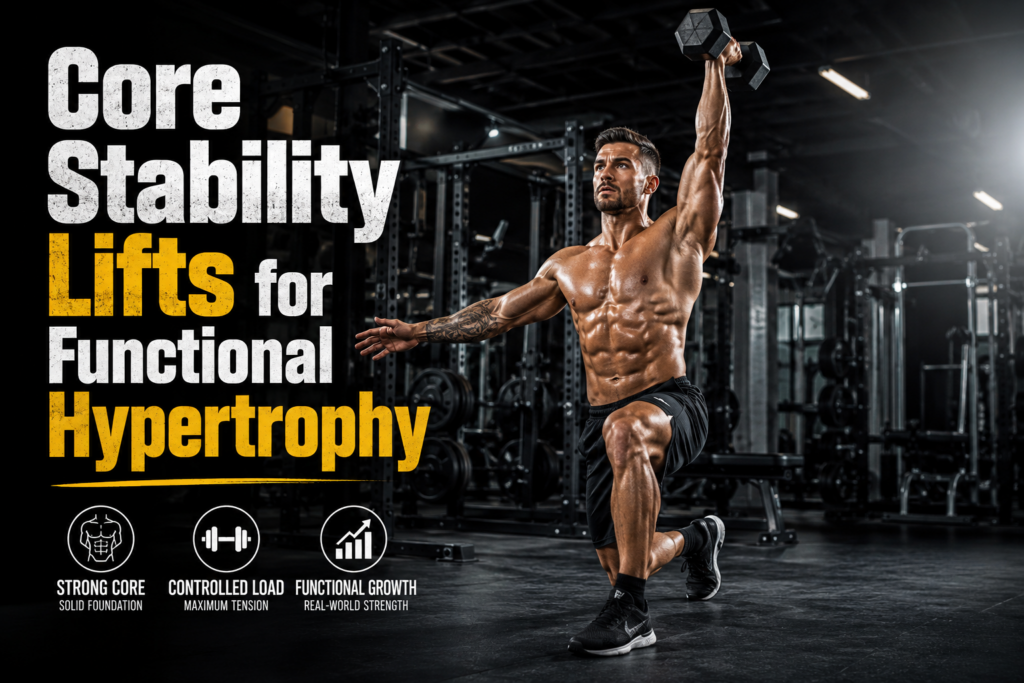
Your lower back rounds during deadlifts after just three reps. This happens when your core fatigues before your legs do. Core Stability Lifts for Functional Hypertrophy fix this exact problem. They build muscle that actually works under load.
What Core Stability Lifts for Functional Hypertrophy Actually Mean
Functional hypertrophy means muscle that improves real movement patterns. You’re not just making muscles bigger for appearance. You’re building tissue that stabilizes your spine during compound lifts. This approach differs completely from isolation work on machines.
Core stability lifts train your trunk to resist movement under stress. Your abs don’t just flex your spine forward. They prevent unwanted rotation and lateral bending during heavy lifts. This is called anti-movement training.
Think about a front squat. Your core fights to keep your torso upright. The weight tries to pull you forward. Your anterior core muscles contract hard but don’t shorten. This builds strength that transfers to every other lift you perform.
The Loaded Carry Method for Core Stability and Functional Hypertrophy
Farmers carries build your entire trunk through sustained tension. You hold heavy weights and walk for distance. Your obliques fire constantly to prevent side bending. Your rectus abdominis keeps your ribs down and pelvis neutral.
Start with dumbbells at half your bodyweight in each hand. Walk 40 yards without stopping. Your grip will fatigue first initially. That’s normal. Over time your core becomes the limiting factor instead.
Suitcase carries use weight on one side only. This creates a massive anti-lateral flexion demand. Your opposite oblique works overtime to keep you upright. The asymmetry builds unilateral core strength that prevents compensations.
Overhead carries add a vertical load above your center of mass. This challenges your ability to maintain spinal alignment differently. Your deep core stabilizers activate harder than during bilateral carries. Use a single kettlebell or dumbbell overhead for 30 yards per side.
Anti-Rotation Exercises Build Core Stability for Functional Hypertrophy
Pallof presses train your core to resist rotational forces, building anti-rotation strength that directly transfers to compound movements and athletic performance. Attach a resistance band or cable at chest height to a sturdy anchor point. Stand perpendicular to the anchor with your feet shoulder-width apart in an athletic stance. Press the handle straight out from your chest while maintaining a neutral spine and upright posture. The rotational tension from the band tries to rotate your torso back toward the anchor point, creating the anti-rotation demand that strengthens your internal and external obliques.
Your obliques and transverse abdominis fight this rotation hard. Hold the extended position for three seconds each rep. Do eight reps per side. This builds the exact stability needed during rotational sports movements.
Landmine rotations work differently but complement Pallof presses perfectly. Hold the end of a barbell with both hands. Stand in an athletic stance. Rotate the bar from one hip to the opposite shoulder. Control the eccentric portion slowly.
The key here is controlling deceleration of the weight. Your core muscles lengthen under tension as you lower the bar. This builds strength through the full range of rotational movement. Start with just the bar until you master the pattern.
How Core Stability Lifts for Functional Hypertrophy Improve Big Compounds
Your squat depth improves when your core can maintain a neutral spine. Many lifters hit a sticking point where their back rounds. This happens because the core fatigues before the legs. Stronger stabilizers eliminate this weak link completely.
Deadlifts rely on anti-flexion strength throughout the entire pull. Your erectors and abs work together to prevent spinal rounding. If either group fails, your back position breaks down. Training both through stability work increases your safe pulling capacity.
Overhead press demands serious anti-extension control. The weight tries to pull your lower back into hyperextension. Your abs must contract to keep your ribs down. Weak anterior core strength limits how much weight you can press.
Even bench press benefits from improved core stability. Your body should form a rigid plank from head to heels. This creates a stable platform to press from. A weak core bleeds force and reduces your pressing power noticeably.
Programming Core Stability Lifts for Functional Hypertrophy Results
Place core work after your main lifts but before accessory exercises. You need a fresh core for heavy squats and deadlifts. Training it first would compromise your performance on those movements. Save direct core work for the middle of your session.
Frequency matters more than volume for core stability development. Train these movements four times per week minimum. Your core recovers faster than larger muscle groups. High frequency builds both strength and muscular endurance simultaneously.
Use three to four sets of each exercise. Keep rest periods under 60 seconds between sets. This maintains metabolic stress on the working muscles. The combination of tension and short rest drives hypertrophy effectively.
Progress by increasing time under tension first. Add five seconds to your carries each week. Increase Pallof press hold times before adding resistance. Only add weight once you can maintain perfect position throughout.
Breathing Strategies During Core Stability Lifts for Functional Hypertrophy
Proper breathing creates intra-abdominal pressure that stabilizes your spine. Take a deep breath into your belly before each rep. Your stomach should expand 360 degrees around your waist. This is called diaphragmatic breathing.
Hold this breath during the hardest part of each movement. Release it slowly through pursed lips during the easier phase. Never fully exhale between reps during a set. Maintaining some pressure keeps your core engaged continuously.
Practice this breathing pattern with lighter weights first. Many people breathe into their chest instead of their belly. Chest breathing doesn’t create the pressure you need. Lie on your back and place a light weight on your stomach to learn proper belly breathing.
Common Mistakes That Limit Core Stability and Functional Hypertrophy
Moving too fast through reps reduces the tension your muscles feel. Stability training demands slow, controlled movement. Rush through a Pallof press and you miss the entire point. The goal is sustained tension, not high rep counts.
Using momentum defeats the purpose of anti-movement training. Your core should prevent motion, not generate it. If you’re swinging during carries, the weight is too light. If you’re twisting during Pallof presses, the resistance is too high.
Neglecting progression leaves gains on the table. You can’t use the same weight and distance forever. Track your loads and times weekly. Add small increments consistently. Progressive overload applies to core training just like any other muscle group.
Holding your breath too long causes blood pressure spikes. This is dangerous during sustained efforts like carries. Breathe continuously during longer duration sets. Only hold your breath during single challenging reps.
Advanced Variations of Core Stability Lifts for Functional Hypertrophy
Add instability once you master basic versions of these movements. Perform Pallof presses standing on one leg. This forces your core to stabilize against two forces simultaneously. The balance challenge and rotation resistance compound the training effect.
Bottoms-up kettlebell carries multiply the stabilization demand dramatically. Hold the kettlebell upside down by the handle. The unstable weight distribution requires constant micro-adjustments from your core. Use much lighter weight than normal carries initially.
Tempo variations increase time under tension without adding load. Walk slower during carries or pause mid-stride. This extends the duration your muscles stay contracted. A 40-yard carry with pauses provides more stimulus than 60 yards at normal speed.
Combine movements for brutal core challenges. Perform a Pallof press while holding a split stance position. Or add a shoulder press at the end of each rotation. These combinations prepare your core for unpredictable real-world demands.
Frequently Asked Questions
How often should you train core stability lifts each week?
Train core stability movements four times per week for best results. Your core recovers quickly compared to larger muscle groups. High frequency builds both strength and endurance effectively. Space sessions throughout the week rather than consecutive days.
Can you build visible abs with core stability training?
Yes, these exercises build significant abdominal muscle mass over time. Visibility depends on your body fat percentage though. No amount of training reveals abs through excess body fat. Combine stability work with proper nutrition for visible results.
How long until core stability lifts improve your compound movements?
Most people notice improvements in squat and deadlift form within three weeks. Your core fatigues less quickly during heavy sets. Position control improves noticeably on your working weights. Strength gains appear after six to eight weeks of consistent training.
Should beginners start with core stability lifts immediately?
Absolutely, beginners benefit the most from early core stability work. Learning proper bracing patterns prevents bad habits from forming. Start with bodyweight planks and dead bugs first. Progress to loaded carries after mastering basic anti-movement patterns.
What weight should you use for farmers carries?
Start with dumbbells at half your bodyweight in each hand. Walk 40 yards without setting them down. Add five pounds per hand each week you complete the distance. Form breaks down when your torso starts leaning sideways noticeably.
Start your next training session with a single loaded carry variation and track your progress weekly.