

Why Less Training Time Builds More Muscle Than Daily Workouts
Most lifters train too frequently, interrupting the muscle-building recovery process before it completes. A High-Intensity, Low-Frequency Program delivers maximum gains by applying serious stress followed by serious rest, allowing your body to fully repair and build new tissue.
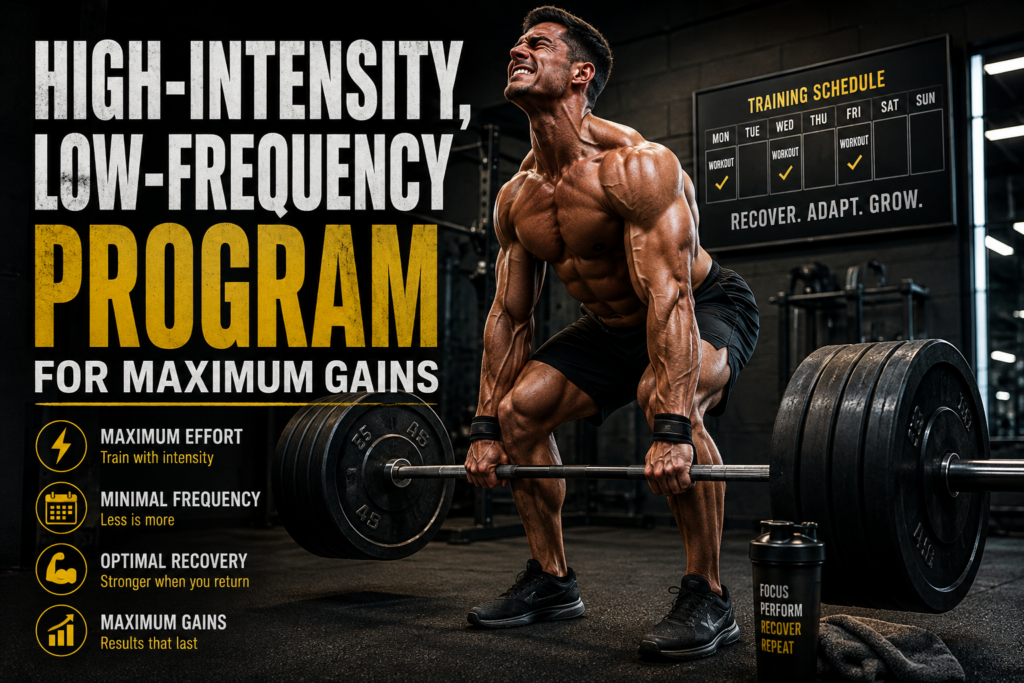
You spend hours in the gym but your muscles refuse to grow. Heavier weights don’t fix the problem. A High-Intensity, Low-Frequency Program for Maximum Gains solves this by giving your body what it actually needs: serious stress followed by serious rest.
Why Training Less Often Builds More Muscle
Your muscles don’t grow during workouts. They grow during recovery. This fact changes everything about how you should train. When you hit a muscle group hard, you create damage at the cellular level. Your body needs time to repair that damage and build new tissue on top of it.
Most people train each muscle two or three times per week. They never give their bodies enough time to finish the repair process. You start a new workout before the last one’s benefits have fully kicked in. The result is constant fatigue with minimal growth.
A High-Intensity, Low-Frequency Program for Maximum Gains flips this approach. You train each muscle group once every five to seven days. That single session pushes you to absolute failure on every set. Then you step back and let your body do its work.
The science backs this up clearly. Studies show muscle protein synthesis stays elevated for 48 to 72 hours after intense training. Some research suggests benefits last even longer when you train to complete failure. You don’t need to hammer the same muscles again while they’re still rebuilding.
How High-Intensity, Low-Frequency Training Builds Strength Faster
Strength gains come from two sources: bigger muscles and better nerve connections. Your nervous system learns to recruit more muscle fibers with each movement. This neural adaptation happens fastest when you lift extremely heavy weights for low reps.
Training less often lets you go heavier every single session. You walk into the gym fully recovered. Your energy reserves are topped off. You can load the bar with weights that would crush you on a high-frequency program.
Consider a basic comparison. Someone training chest three times per week might bench press 185 pounds each session. Their fatigue never fully clears. Now look at someone using a High-Intensity, Low-Frequency Program for Maximum Gains. They train chest once weekly and push 225 pounds to failure.
The heavier load creates stronger neural pathways. Your brain learns to fire more motor units simultaneously. This skill transfers directly to real-world strength. You get better at moving heavy objects because you practice moving heavy objects.
Recovery time also prevents joint wear. Frequent heavy training grinds down cartilage and inflames tendons. Spacing out intense sessions gives connective tissue time to adapt. You build strength without destroying your joints in the process.
The Exact Structure of a High-Intensity, Low-Frequency Program
You need four training days per week maximum. Each session targets different muscle groups. Day one covers chest and triceps. Day two hits back and biceps. Day three focuses on legs. Day four addresses shoulders and abs.
Rest days separate each training session. You never train on consecutive days. This spacing ensures each muscle group gets at least five full days between workouts. Some people stretch this to eight days with excellent results.
Each exercise gets three working sets after warmups. You push every set to complete muscular failure. Failure means you physically cannot complete another rep with proper form. Stopping one or two reps short doesn’t count as true intensity.
Rep ranges stay between six and ten for compound movements. Isolation exercises can go slightly higher, up to twelve reps. Lower reps with heavier weight produce better results than high-rep pump work. The weight should feel brutally heavy by the final reps.
Total exercise count stays low. Three to four movements per large muscle group. Two exercises for smaller muscles like biceps. You’re not trying to destroy muscles from every angle. You’re creating maximum stimulus with minimum volume.
What Happens During Recovery on a High-Intensity, Low-Frequency Program
The real magic happens outside the gym. Your body redirects resources toward muscle repair immediately after training. Blood flow to damaged areas increases. Satellite cells activate and begin fusing to muscle fibers.
Protein synthesis ramps up within hours of your workout. Your muscles become sponges for amino acids. This process continues for days, not hours. Eating enough protein during this window determines how much muscle you actually build.
Sleep becomes your most powerful tool. Growth hormone pulses throughout deep sleep stages. This hormone directly signals muscle tissue to grow larger and stronger. People who sleep seven hours grow significantly more muscle than those sleeping five hours.
You should feel progressively stronger as recovery days pass. Day one after training might leave you sore and weak. Day three should bring noticeable improvements. By day five, you feel ready to attack the gym again. This rhythm tells you the frequency is right.
Skipping rest days destroys the entire system. Your body never completes the adaptation process. You start each workout in a hole instead of on solid ground. More training does not equal better results when intensity is genuinely high.
Common Mistakes That Ruin High-Intensity, Low-Frequency Results
People sabotage themselves by not training hard enough. They think three sets counts as low volume automatically. Volume only matters relative to intensity. Three sets taken to absolute failure—where you achieve momentary muscular failure and cannot complete another rep—creates more stimulus than ten sets stopped early. This misunderstanding of training intensity, rep ranges, and the relationship between mechanical tension and muscle damage leads many lifters to underestimate the demands of true high-intensity training.
You must reach true muscular failure. Your muscles should burn and shake on the final reps. The weight should drop from your hands because you cannot hold it. Anything less means you’re still running a moderate-intensity program with low volume.
Another mistake involves adding extra workouts. You feel fresh on rest days and hit the gym anyway. Maybe you throw in some arms or do extra cardio. These bonus sessions steal resources from muscle growth. Your body has limited recovery capacity.
Poor exercise selection also kills progress. Spending time on cable crossovers and pec deck machines wastes your limited training slots. Stick to compound movements that load multiple muscle groups. Barbell bench press beats cable flies every single time.
Some people panic about losing conditioning. They add running or cycling between strength sessions. Heavy cardio competes directly with muscle growth for recovery resources. Save cardio for short walks that don’t tax your system.
How to Track Progress on a High-Intensity, Low-Frequency Program for Maximum Gains
You need a training log that records exact weights and reps. Write down every working set immediately after completing it. Memory fails you. Numbers on paper show real progress over weeks and months.
Your primary goal is adding weight to the bar. If you benched 185 for eight reps last week, try 190 this week. Even five-pound jumps add up dramatically over time. Strength progression proves your muscles are growing.
Body measurements provide secondary data. Measure your arms, chest, and thighs every two weeks. Use the same time of day and same level of muscle pump. Photos capture changes that numbers sometimes miss.
Scale weight matters less than most people think. Your body composition can improve dramatically without major weight changes. Losing fat while gaining muscle keeps your total weight stable. The mirror and tape measure tell the real story.
Track your energy levels and mood throughout the week. A properly designed High-Intensity, Low-Frequency Program for Maximum Gains should leave you feeling strong most days. Constant fatigue signals too much intensity or not enough recovery time.
Frequently Asked Questions
How long before I see results from high-intensity, low-frequency training?
Most people notice strength gains within two weeks of starting. Visible muscle growth typically appears after four to six weeks. Consistent effort over three months produces dramatic changes that others will notice.
Can beginners use a High-Intensity, Low-Frequency Program for Maximum Gains?
Beginners can absolutely use this approach. They must learn proper form before training to failure. Hiring a coach for the first month prevents injuries and teaches correct technique.
What should I eat on rest days between workouts?
Eat the same amount of protein on rest days as training days. Your muscles need amino acids throughout the recovery period. Aim for one gram of protein per pound of body weight daily.
How do I know if I’m truly reaching muscular failure?
True failure means you cannot complete another rep despite maximum effort. The weight stops moving or your form breaks down completely. Your muscles should feel completely exhausted after each set.
Should I change exercises each week or keep them the same?
Keep the same core exercises for at least eight weeks. Consistency lets you track strength progress accurately. Change movements only when progress stalls completely for three consecutive sessions.
Start your High-Intensity, Low-Frequency Program for Maximum Gains next week with one chest workout pushed to absolute failure.