
Rest-Pause vs Drop Sets: Essential or Junk Volume?
Rest-pause training keeps weight heavy while allowing ATP recovery, making it superior for muscle growth compared to drop sets. Understanding this key difference between rest-pause vs drop sets can transform your training results and eliminate wasted volume in your workouts.
Rest-Pause vs Drop Sets Essential or Junk Volume confuses most lifters in the gym. You see people doing both techniques on the same exercises. They assume more work always means more growth. The truth is that one method builds muscle while the other just wears you down.
How Rest-Pause vs Drop Sets Essential or Junk Volume Changes Your Training Results
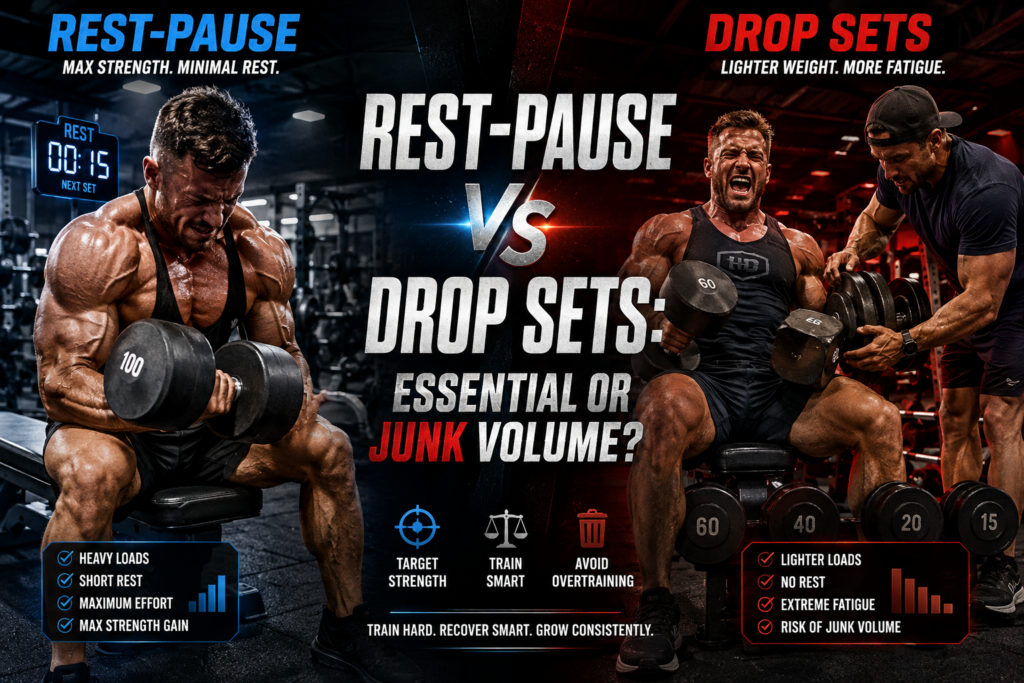
Rest-pause training means you hit failure, rest 15 seconds, then squeeze out more reps. You might get three to five extra reps this way. Drop sets work differently. You hit failure, reduce the weight by 20 to 30 percent, then keep going. Both add volume after your main set ends.
The key difference lies in what happens to your muscles. Rest-pause keeps the weight heavy and gives your ATP system time to recover. Drop sets force you to work with lighter loads immediately. Your muscles don’t get that brief recovery window.
Rest-pause targets the same muscle fibers you just exhausted. Those 15 seconds let phosphocreatine stores refill slightly. You can lift the same heavy weight again for a few more reps. This creates more mechanical tension on the exact fibers you want to grow.
Drop sets shift the work to different muscle fibers. When you lower the weight, you recruit fresh motor units. The original fibers you fatigued stay tired. You’re spreading the work across more tissue instead of hammering the target fibers harder.
Why Rest-Pause vs Drop Sets Essential or Junk Volume Matters for Recovery
Your body needs to repair what you damage in the gym. Rest-pause creates focused damage in specific muscle fibers. You can recover from this in 48 to 72 hours. Drop sets damage a wider range of fibers. Recovery takes longer.
Central nervous system fatigue is the hidden cost. Rest-pause keeps you working at high intensity for short bursts. Your CNS handles this load well. Drop sets force you to push through extended sets while coordination breaks down. This taxes your nervous system more than your muscles.
Sleep quality drops when you do too many drop sets. Studies show that excessive metabolic stress from extended sets disrupts sleep patterns. You wake up more during the night. Rest quality suffers. Rest-pause doesn’t create this same metabolic chaos.
Soreness tells you something but not everything. Drop sets create intense soreness because they damage many fiber types. This feels productive. Rest-pause causes less widespread soreness but targets growth more precisely. Don’t confuse pain with progress.
The Metabolic Cost of Rest-Pause vs Drop Sets Essential or Junk Volume
Your muscles produce lactate and hydrogen ions during hard sets, contributing to metabolic acidosis and the characteristic muscle burn. Drop sets flood your system with these metabolites through extended time under tension, creating acute neuromuscular fatigue. You feel the pump and burn intensely because you’re accumulating byproducts faster than your oxidative capacity can clear them through aerobic pathways. This metabolic stress response activates mTOR signaling but relies more on muscle damage and metabolic factors than mechanical tension alone.
Some trainers claim metabolic stress drives muscle growth. Recent research questions this idea. Mechanical tension matters far more than the burn you feel. Drop sets give you tons of burn but less actual tension per rep.
Rest-pause generates less metabolic buildup. Those 15-second breaks let your blood flow clear some waste. You maintain better form on each mini-set. Better form means more tension on target muscles.
Heart rate stays elevated longer with drop sets. Your cardiovascular system works overtime to supply oxygen and remove waste. This interferes with strength gains. You’re training endurance when you wanted to build size.
When Rest-Pause vs Drop Sets Essential or Junk Volume Actually Works
Rest-pause shines on compound movements. Bench presses, squats, and rows respond well to this method. You can maintain proper form during those brief rest periods. The heavy weight keeps working the prime movers.
Drop sets work better for isolation exercises. Leg extensions, cable flyes, and curls suit this technique. These movements have simpler mechanics. You won’t hurt yourself when fatigue destroys your coordination.
Advanced lifters can handle one rest-pause set per muscle group per week. Beginners should skip it entirely. Your form breaks down too quickly when you’re still learning movement patterns. Master the basics first.
Drop sets belong at the end of your workout if you use them. Never start a session with drops. You’ll be too fatigued for your heavy compound work. Save them for the final isolation movement.
Volume already comes from your straight sets. Adding either technique should replace a normal set, not stack on top. Three straight sets plus rest-pause beats four straight sets. Four straight sets plus drop sets creates junk volume.
Do Not Use Rest Pause or Drop Sets Without This…
Rest-Pause vs Drop Sets Essential or Junk Volume for Different Muscle Groups
Back muscles respond well to rest-pause training. Deadlifts and pull-ups maintain good form during brief rests. Your grip might fail before your back does. Use straps if grip becomes the limit.
Chest training works with both methods but for different goals. Rest-pause on barbell bench builds strength and size together. Drop sets on cable flyes create a pump without risk. Choose based on what you need that day.
Legs handle volume differently than upper body. Drop sets on leg press can make you nauseous. The systemic fatigue hits hard. Rest-pause squats demand perfect form or you’ll get hurt. Consider whether the risk matches the reward.
Shoulders fatigue quickly under any extended technique. The deltoids are relatively small muscles. One rest-pause set on overhead press goes further than multiple drop sets. Less is more for shoulder growth.
Arms recover fast and tolerate more volume. You can use drop sets on curls and extensions more frequently. The injury risk stays low. Just don’t convince yourself that arm volume builds your whole physique.
How to Tell if Rest-Pause vs Drop Sets Essential or Junk Volume Hurts Your Progress
Track your performance on the first set of each exercise. This number should climb over weeks. If it stalls while you add intensity techniques, you’re overdoing it. The extensions interfere with the foundation.
Joint pain signals that volume exceeds your recovery capacity. Elbows and knees hurt when you pile on drop sets weekly. Tendons inflame from repeated high-rep work under fatigue. Pull back before minor pain becomes serious injury.
Your appetite disappears when training volume gets too high. You should feel hungry after hard workouts. Loss of appetite means your stress hormones are chronically elevated. Cut the extended sets immediately.
Strength should increase or hold steady on a proper program. If your main lifts drop while you add rest-pause or drops, you found your answer. The extra work is junk volume. It’s subtracting from results instead of adding to them.
Sleep needs increase slightly with smart training. But if you need two extra hours just to function, something’s wrong. Excessive drop set volume is usually the culprit. Your body is screaming for recovery time you’re not giving it.
Frequently Asked Questions
Can beginners use rest-pause or drop sets safely?
Beginners should avoid both techniques for at least six months. You need solid form on basic exercises first. Adding fatigue before you master movement patterns increases injury risk significantly.
How many rest-pause sets should you do per workout?
Limit rest-pause to one set per muscle group per session. More than this creates too much fatigue for most people. Quality matters more than quantity when using intensity techniques.
Do drop sets build more muscle than straight sets?
No, research shows straight sets with progressive overload build equal muscle. Drop sets add fatigue without adding meaningful growth stimulus. Save them for occasional variety, not regular programming.
Which burns more calories during training sessions?
Drop sets burn more calories because they create higher metabolic stress. This doesn’t mean better muscle growth though. Calorie burn during workouts barely affects fat loss anyway.
Can you combine rest-pause and drop sets together?
You can but you shouldn’t in most cases. Combining both techniques creates excessive fatigue with diminishing returns. Pick one method based on your exercise selection and goals.
Choose one intensity technique per muscle group and track whether your main lifts improve.