

Stop Counting Reps: The Volume Metric That Builds More Muscle
The Ultimate Weekly Volume Guide for Maximum Muscle reveals that 10-20 weekly sets per muscle group drives optimal growth, not exercise selection. Research shows this volume range produces twice the muscle growth compared to lower volumes, making it the foundation of effective training.
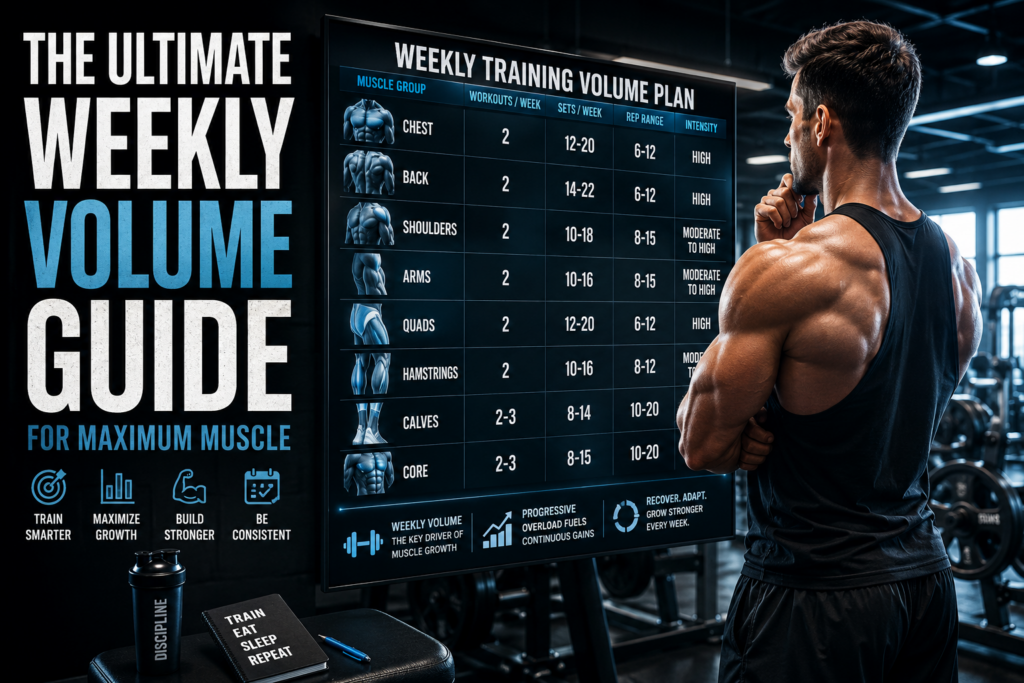
You step into the gym without a clear plan. Your chest gets 12 sets this week. Your back gets 8. Your legs somehow end up with 22. The Ultimate Weekly Volume Guide for Maximum Muscle fixes that chaos.
Why The Ultimate Weekly Volume Guide for Maximum Muscle Matters More Than Exercise Selection
Research shows 10 to 20 weekly sets per muscle group drives optimal growth. That range isn’t arbitrary. Studies show 10 weekly sets produce twice the muscle growth compared to five sets. The gap matters.
Pick any exercise you want. Bench press versus dumbbell press. Deadlifts versus Romanian deadlifts. The exercises change. The volume requirements don’t. This is why obsessing over exercise selection misses the point. Total weekly sets determine growth.
Going above 20 sets per week does not produce meaningfully more muscle growth. In some cases it hurts progress. Your body has a ceiling. Push past it and recovery suffers. Performance drops. Muscle growth stalls.
The Ultimate Weekly Volume Guide for Maximum Muscle works because it respects your body’s limits.
The Three Volume Thresholds That Control Your Gains
Maintenance volume sits around 6 working sets per muscle group per week. That’s the floor. Train less than that and muscle shrinks. Not immediately. But over weeks you lose size.
Minimum effective volume is the lowest amount of training that actually grows muscle. For most people this lands between 8 and 12 sets weekly. Beginners need less. For beginners, minimum effective volume sits close to maintenance volume because growth comes easily. As you advance, the gap widens.
Maximum recoverable volume refers to the maximum amount of training volume your body can handle while still allowing for recovery. Exceeding it can hinder progress and recovery. This is where most people fail. They see 20 sets works. They assume 25 sets works better. Wrong.
If weekly training volume exceeds maximum recoverable volume, the body cannot recover fully between sessions and performance may begin to decline. You get weaker. Muscle stops growing. Fatigue accumulates faster than adaptation.
More weekly sets do not automatically produce more muscle, especially when fatigue begins to exceed your ability to recover. Why Your Weekly Volume Is Killing Gains explains how excessive training volume can turn productive work into a recovery problem that ultimately limits hypertrophy.
How To Calculate The Ultimate Weekly Volume Guide for Maximum Muscle Per Body Part
Count only challenging sets. Sets that bring you close to failure. Hypertrophy increases with volumes up to 6-8 hard sets in a single training session when taking long rests. Per-session volumes of around 6-8 sets per muscle group produce best hypertrophy on average.
Your chest gets worked during bench press. That’s a direct set. Your triceps get worked too. That’s an indirect set. Count sets where the target muscle is the prime mover. When we say 18 sets is maximum recoverable volume for triceps, we mean direct triceps work only. Indirect volume already factors in.
Start low. Add sets weekly. Start the mesocycle with a reduced number of sets per muscle group. Add 1-2 sets per muscle group each week. Identify the moment where performance dips. That’s your limit. Back off two sets. That’s your maximum recoverable volume.
Track everything. Write down weights lifted. Reps completed. Rest periods taken. Taking note of the weights you lift every week is essential. You’ll have invaluable information moving forward regarding programming and your current goals.
General set recommendations provide a useful starting point, but your ideal workload becomes clearer when you quantify what you are actually doing. Stop Guessing Weekly Volume: The Math shows how to evaluate training volume more systematically instead of choosing weekly set targets by guesswork.
The Diminishing Returns Problem With The Ultimate Weekly Volume Guide for Maximum Muscle
Twenty sets per muscle per week is approximately the average point of rapidly diminishing returns for trained lifters. Each set past 20 delivers less growth than the previous one. Sets one through ten per muscle deliver the biggest payoff per unit of recovery. Sets eleven through eighteen still contribute, but each increment of growth costs about 40% more effort.
Doubling your volume produces roughly 50% more relative growth. This pattern holds surprisingly well across a wide range of volumes. Go from 10 sets to 20 sets weekly. You don’t get double the results. You get 50% more growth for 100% more work.
This matters when time is limited. Early sets give you the most bang for your buck. Going from 5 to 10 sets is probably the single best investment you can make. Going from 20 to 30 sets helps. But the cost in time and recovery becomes steep.
Around 6 sets per muscle group per workout is around the optimal range. Extra sets beyond this likely have diminishing returns, especially greater than 12 sets per workout. Spread volume across the week. Don’t pile everything into one session.
Once additional sets stop providing enough stimulus to justify their fatigue cost, more volume can become counterproductive rather than beneficial. Stop Doing Junk Volume: The 10-Set Rule takes a closer look at when extra sets may provide diminishing returns and how to keep individual workouts productive.
Maximum Muscles Mass Solutions
How Training Experience Changes Your Volume Needs
Beginners grow with less volume. Beginner women can experience muscle growth in as little as six weekly sets. Their muscles respond to almost any stimulus. Recovery comes fast. They don’t need massive volumes.
Beginners should start at 9-12 sets per week. Intermediates need 10-15 sets. Advanced lifters require 15-20 sets for continued progress. Your body adapts to training stress. What worked last year stops working now. Volume must increase over time.
Trained lifters gained less total muscle at every volume level. As you become more advanced, gains come slower regardless of what you do. This doesn’t mean give up. It means expectations must adjust. The game slows down.
But the pattern stays the same. The shape of the curve didn’t change. More volume still produced more growth in trained lifters, following the same diminishing-returns pattern. Advanced lifters need more sets to trigger growth. They still benefit from adding volume.
Training Frequency and The Ultimate Weekly Volume Guide for Maximum Muscle
Twelve to 24 weekly sets works well for a frequency of 2-3 days per week. Split your volume across multiple sessions. Don’t train chest once weekly with 20 sets. Hit it twice with 10 sets each time.
Training a muscle more often per week had a negligible effect on muscle growth when total volume was the same. Training more often per week did help with strength gains. For muscle size, frequency doesn’t matter much. For getting stronger, it does.
Why? Practice improves skill. More weekly sessions produced more strength, probably because more practice with the movement pattern sharpens the skill, not because the muscle needed extra stimulus. Your nervous system learns to fire more efficiently.
Do 3-12 sets per muscle per workout. Train your muscles at least twice per week. The more often you train, the fewer sets you need per workout. Six sessions weekly? Use three sets per muscle. Three sessions weekly? Use six sets per muscle. Total weekly volume matters most.
Common Mistakes With The Ultimate Weekly Volume Guide for Maximum Muscle
Counting junk volume destroys progress. Junk volume refers to excessive training volume that does not contribute meaningfully to muscle growth and hypertrophy stimulus. It often involves high repetitions with submaximal loads, low relative intensity, and excessive isolation exercises performed with minimal mechanical tension. Sets far from failure don’t count toward your weekly set total. Warm-up sets don’t count. Only working sets—those within 1-3 reps of failure where the target muscle experiences sufficient time under tension and metabolic stress—matter for your volume calculations and training outcomes.
Blasting one muscle group weekly fails. The classic bro-split of blasting a muscle group for very high volumes once per week is likely an inferior way to train. Recovery suffers. Quality drops. Later sets become worthless. Spread the work out.
Ignoring indirect volume leads to overtraining. Your triceps get hammered during bench press. Then you do 18 sets of direct tricep work. Total volume exceeds maximum recoverable capacity. Performance tanks. Growth stops.
Starting too high guarantees failure. If consistency is a challenge, don’t get caught up chasing the optimal number. A lower volume you can stick to will always produce better results than a higher volume you cannot sustain. Build slowly. Add sets gradually. Rushing kills progress.
Knowing the broad principles of weekly volume is useful, but most lifters eventually want a more practical target for their own training. The Exact Set Range for Maximum Gains examines how to narrow your workload to a productive range without assuming that one set number is optimal for everyone.
Frequently Asked Questions
How many sets per muscle group per week should I do?
Most trainees should aim for 10 to 20 weekly sets per muscle group to optimize growth. Beginners start at the lower end. Advanced lifters push toward the higher end.
Can I build muscle with fewer than 10 sets per week?
Five to nine sets per muscle per week produced roughly 80% of the growth seen with 10 or more sets. In trained individuals, as few as 3 sets per week has been shown to build muscle.
What happens if I exceed my maximum recoverable volume?
If you surpass maximum recoverable volume, you could get weaker and encounter some sort of injury, rather than get stronger. Fatigue accumulates faster than your body can recover.
Do I need to increase volume as I get more advanced?
Yes. As you advance, the gap widens between maintenance volume and minimum effective volume. Your body adapts to training stress. More stimulus becomes necessary.
Should I count indirect volume toward my weekly total?
Indirect volume from pressing movements is already factored in, reducing estimates to account for this additional stimulus. This approach eliminates complicated math while ensuring you don’t exceed recovery capacity.
Start tracking your weekly sets today and adjust volume based on performance and recovery markers.