
Why Your Bulk Stalls (And How to Fix It Today)
Your bulk fails when you ignore protein intake, eat insufficient calories, or train without proper recovery. Fix these 10 critical muscle gain mistakes to finally see the results you’re working for.
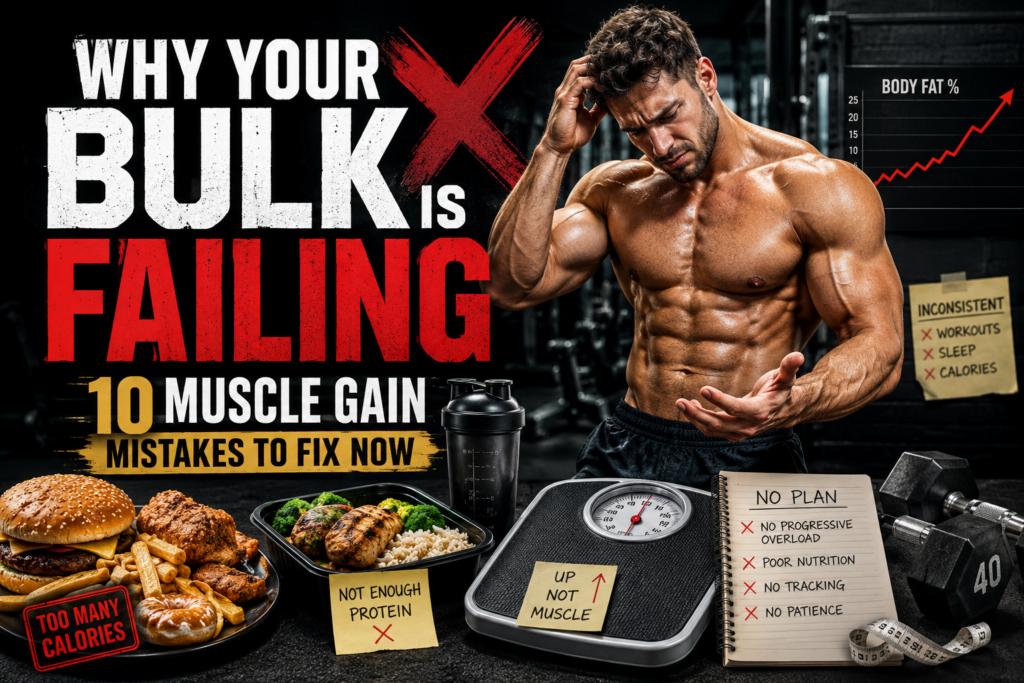
You step on the scale and see the same number. You’ve been eating more for weeks now. The gym sessions feel hard but your arms look identical. Why Your Bulk Is Failing 10 Muscle Gain Mistakes to Fix Now comes down to eating wrong, training wrong, or recovering wrong.
Why Your Bulk Is Failing: You’re Not Eating Enough Protein
Most people count total calories but ignore protein. Your muscles need protein to grow. Without enough, you just get fatter. You need about one gram per pound of body weight. A 180-pound guy needs 180 grams daily.
That’s a lot more than you think. Three chicken breasts only give you about 90 grams. You’d need six to hit your target. Most bulkers eat 100 grams and wonder why nothing happens.
Track your protein for three days. Write down every gram. You’ll probably find you’re eating half what you need. Fix this first before anything else matters.
Your Calorie Surplus Is Too Small to Build Muscle
You add 200 calories and expect growth. Your body burns those extra calories just staying warm. Building muscle requires energy. Your body won’t create new tissue unless it has plenty to spare.
A real surplus means 300 to 500 calories above maintenance. Eat less and your body prioritizes survival over growth. You might gain a tiny bit but progress crawls.
Calculate your maintenance calories honestly. Add 400 on top. Weigh yourself weekly. If the scale doesn’t move up after two weeks, add another 200 calories.
Why Your Bulk Is Failing: You Skip Legs and Compound Movements
Curls and cable work won’t build mass. Your body grows when you stress large muscle groups. Squats, deadlifts, and presses trigger the most growth hormone release. They force your entire system to adapt.
Leg day feels hard so people avoid it. But your legs contain half your muscle mass. Training them creates a growth signal throughout your body. Skip legs and you miss the biggest driver of overall size.
Build your workouts around five exercises. Squat, deadlift, bench press, overhead press, and rows. Do these heavy twice per week. Add isolation work after if you want. But compounds come first always.
You’re Not Progressively Overloading Your Muscles
Using the same weights for months guarantees nothing happens. Your muscles adapt to stress. Once they handle a weight easily, they stop growing. You must add weight, reps, or sets consistently.
Write down every set and rep. Next week, try to beat those numbers. Add five pounds to the bar. Do one more rep. Something has to increase.
Most gym-goers use the same dumbbells forever. They work hard but never progress. Hard work without progression just maintains what you have. Growth requires constant challenge.
Why Your Bulk Is Failing: Your Training Volume Is Wrong
Too little volume and you don’t grow. Too much and you can’t recover. Most people do too much junk volume. They count every set as productive when half are wasted.
Each muscle needs 10 to 20 hard sets per week. Hard means close to failure. If you can do three more reps, that set barely counts. Stop doing 20 sets of easy work.
Pick two exercises per muscle group. Do four sets of each. Push those sets hard. That’s eight quality sets. Do this twice weekly for 16 total. That’s the sweet spot for most natural lifters.
You’re Doing Too Much Cardio During Your Bulk
Running five miles daily burns the calories you need for growth. Cardio has benefits but it fights your bulking goal. Your body can’t build muscle and fuel long runs simultaneously.
Keep cardio minimal during a bulk phase. Two or three 20-minute sessions weekly is plenty. This maintains your heart health without stealing recovery resources. Save the distance running for cutting phases.
Many people bulk and train for marathons at the same time. They eat huge amounts but stay small. The cardio erases their surplus. If you’re trying to maximize muscle growth during your bulk, endurance work has to take a back seat temporarily.
Why Your Bulk Is Failing: You’re Not Sleeping Enough
Growth hormone releases during deep sleep. Your muscles repair while you rest. Six hours of sleep means you’re building muscle for six hours. Eight hours doubles that window.
Sleep deprivation also crashes testosterone and raises cortisol. High cortisol breaks down muscle tissue. You’re literally working against yourself. All your training gets wasted.
Track your sleep for one week. Most people average under seven hours. Aim for eight minimum. Go to bed earlier. Your gains happen in bed, not just the gym.
You’re Not Consistent Enough With Your Program
Missing workouts kills momentum. Your body needs regular signals to grow. Train Monday and Thursday, then skip until next Tuesday, and you’re starting over. Muscles need frequency.
Each muscle should get hit every three to five days. Longer gaps and you just maintain. You’re not building on previous sessions. You’re repeating the same stimulus.
Schedule four training days minimum. Stick to them like doctor appointments. Miss one and make it up the next day. Consistency beats the perfect program done randomly.
Why Your Bulk Is Failing: You’re Eating Junk Instead of Quality Food
A surplus from donuts works differently than one from rice and chicken. Your body needs nutrients to build tissue. Sugar and processed oils create inflammation. Inflammation slows recovery and blunts protein synthesis.
Whole foods provide vitamins and minerals that support muscle growth. Zinc, magnesium, vitamin D, and B vitamins all play roles. Junk food has calories but lacks these building blocks.
Get 80 percent of calories from whole sources. Meat, fish, eggs, rice, potatoes, oats, and vegetables. The remaining 20 percent can be treats. This balance gives you nutrients plus enough calories. Quality nutritional support makes every training session more productive.
You’re Not Tracking Anything So You Can’t Fix Problems
Guessing leads to failure. You think you ate enough but you didn’t. You believe you’re getting stronger but you’re not. Without data you just hope things work.
Track your body weight weekly. Write down your lifts every session. Log your daily protein at minimum. These three numbers tell you everything.
Weight going up and lifts increasing? You’re bulking correctly. Weight stuck and lifts stalled? Eat more or change your program. Weight up but lifts flat? You’re gaining mostly fat. Tracking reveals exactly what needs fixing. Most people avoid it because they don’t want to face reality.
Your Supplement Stack Is Missing Key Muscle Builders
Supplements can’t replace bad training or diet. But the right ones fill gaps. Creatine adds strength and cell volume. Protein powder makes hitting your daily target easier. Vitamin D supports testosterone when you’re deficient.
Most bulkers take random supplements with no plan. They buy pre-workout and fat burners during a bulk. Neither helps muscle growth. Focus on what actually builds tissue.
A solid stack includes protein powder, creatine, and a quality multivitamin. If your diet lacks variety, consider a comprehensive muscle support formula that covers micronutrient needs. These basics support every aspect of growth without wasting money on hype products.
Frequently Asked Questions
How long does a proper bulk phase last?
A good bulk runs eight to sixteen weeks minimum. Shorter periods don’t allow enough muscle accumulation. Longer bulks risk gaining too much fat. Most people do best with twelve-week cycles followed by a short maintenance phase.
Can I build muscle without gaining any fat?
Some fat gain always happens during a bulk. Your body can’t perfectly partition every calorie into muscle. Expect to gain one pound of fat for every two pounds of muscle. Keep your surplus moderate to minimize fat accumulation.
Should I bulk if I already have belly fat?
Cut down to visible abs first. Bulking from a high body fat percentage makes you fatter faster. Insulin sensitivity drops as fat increases. This means more calories go to fat storage instead of muscle. Start lean for best results.
How much weight should I gain per week?
Aim for half a pound to one pound weekly. Faster gains mean you’re adding mostly fat. Slower progress suggests your surplus is too small. Weigh yourself same day and time each week for accurate tracking.
Do I need to eat before training for muscle growth?
Pre-workout meals improve performance for most people. Better performance means more reps and heavier weights. That drives more growth. Eat protein and carbs one to three hours before training. Experiment to find what works for your digestion.
Start tracking your protein intake today and adjust your calorie surplus this week to finally see real muscle growth.