
Why Muscle Growth Works Nothing Like You've Been Told
Science reveals that the pump, metabolic stress, and hormonal surges don’t actually build muscle—mechanical tension is what truly drives hypertrophy. Stop chasing false signals and focus on what research proves actually works for muscle growth.
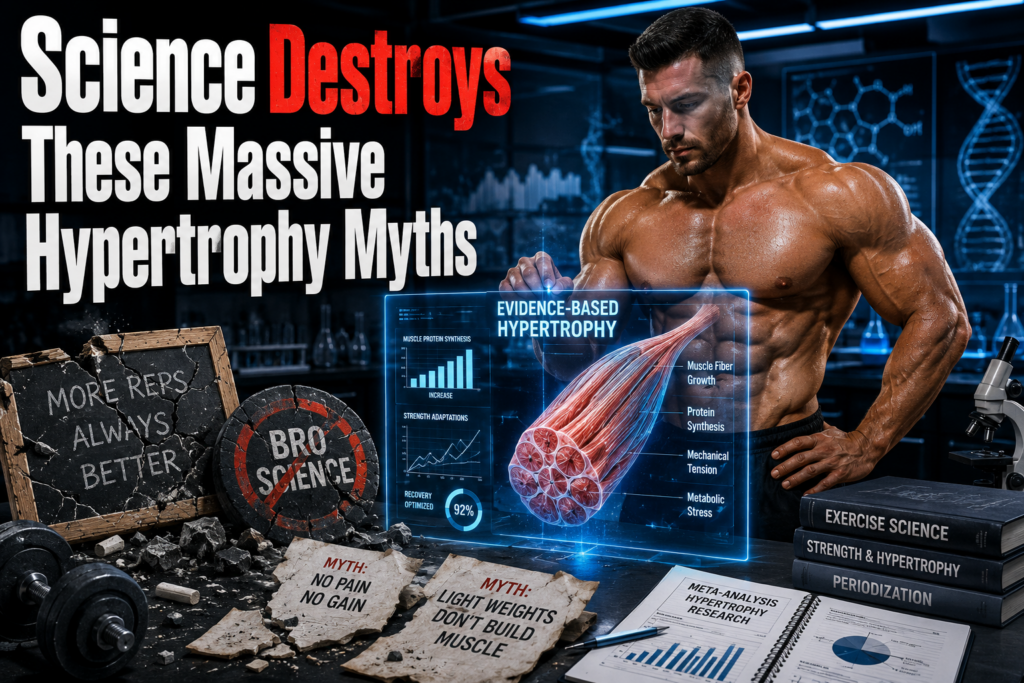
Science Destroys These Massive Hypertrophy Myths in study after study. Gym culture spreads them anyway. You’ve been chasing the wrong signals. Training volume matters more than soreness or testosterone surges.
Science Destroys These Massive Hypertrophy Myths About Chasing The Pump
Claims that acute hormonal responses, metabolic stress, cell swelling or “the pump” meaningfully contribute to hypertrophy are not supported by scientific evidence. The burn feels productive. Blood rushes to your muscles. Your arms look bigger in the mirror.
None of that builds muscle.
Mechanical tension is the primary driver of muscle growth. In simple terms, mechanical tension means putting the muscle under sufficient resistance, forcing it to adapt and grow. The pump is just blood. Cell swelling, as it’s referred to in literature, has a weak at best correlation with hypertrophy. You can chase that feeling every workout. You’ll still make poor gains.
Part of the reason this theory falls short is because endurance training causes a similar response, and we know that this type of training is not conducive to building muscle. Marathon runners get sore too. Their muscles don’t grow.
What actually works? Add weight to the bar. Do more reps than last week. Push harder on each set. That’s mechanical tension.
The Anabolic Window Doesn’t Exist As Advertised
You’ve rushed home from the gym for a protein shake. You set timers. You panicked about missing the magical 30 minutes. Research indicates that the “anabolic window” is broader than initially believed, spanning several hours rather than a strict 30-minute window.
In this randomized controlled trial in resistance-trained men who were consuming high-protein diets, the timing of protein intake around resistance exercise did not affect gains in muscle mass or strength. Another study tested immediate protein versus waiting three hours. When total daily protein was matched, they found no noticeable difference in results in body composition or muscle performance.
Total daily protein intake decides your results. Not the clock. Consequently, the total daily protein intake appears to be the primary factor in facilitating muscle growth induced by exercise. Eating 150 grams spread across the day beats 30 grams right after training.
Stop stressing about the window. Hit your daily number instead.
Science Destroys These Massive Hypertrophy Myths About Post Workout Hormones
Acute increases in testosterone, growth hormone, or IGF-1 after exercise do not influence muscle protein synthesis or hypertrophic outcomes in men or women. Your testosterone spikes after leg day. Your growth hormone surges after heavy squats. The feeling suggests progress.
The spikes don’t matter. One of the most persistent myths in bodybuilding culture is that post-workout testosterone and growth hormone spikes drive muscle growth. They don’t. These hormones rise and fall quickly. They return to baseline within an hour. They’re too brief to affect muscle building.
Researchers tested this directly. They compared groups with different hormone responses. Muscle growth was identical when volume and effort matched. The hormone surge is a byproduct. Not a cause.
This is why women build muscle fine despite lower testosterone. The hormone levels during training sessions mean nothing. Your baseline matters more. But even that plays a smaller role than actual training volume.
Science Destroys These Massive Hypertrophy Myths About Soreness Indicating Growth
The Truth: Soreness (DOMS – Delayed Onset Muscle Soreness) is NOT an indicator of muscle growth. A 2019 study in Sports Medicine found zero correlation between muscle soreness and hypertrophy (muscle growth). You wake up unable to walk. Your legs scream going downstairs. That must mean yesterday’s workout was perfect.
Wrong.
Multiple studies show no reliable connection between muscle soreness and muscle growth. Studies show that soreness, as reported on a visual analog scale, is poorly correlated with both the time course and the magnitude of accepted markers of EIMD, including maximal isometric strength, range of motion, upper arm circumference, and plasma creatine kinase levels.
Since running is not associated with significant muscle growth, it once again indicates that muscle soreness is not really suggestive of muscle growth. Distance runners get sore for days. They don’t build mass. Soreness shows novelty. A new exercise pattern. Different movement angles. Changed loading.
Experienced trainees feel far less sore than beginners, not because their workouts are less effective, but because their bodies have adapted to the stimulus. Reduced soreness over time reflects successful neuromuscular adaptation, not a plateau. Chase progressive overload instead. Add reps. Add weight. Add sets over weeks.
Heavy Weight Isn’t Required For Muscle Growth
Lifting lighter loads was equally as effective at increasing muscle mass as lifting heavy loads, so long as the light load lifting was performed with very high intensity and effort. This contradicts decades of gym lore. Milo lifted a bull. You need to lift heavy.
You don’t.
Research has shown that using lighter weights can be just as effective, provided you train close to failure. Studies consistently show similar hypertrophy across a wide range of loads, provided sets are taken close to failure. A set of 20 reps at 50% max builds as much muscle as 5 reps at 85%.
The catch? You must push close to failure. Light weight with five reps left in the tank does nothing. Hypertrophy is driven by mechanical tension on the muscles, and that tension can be achieved with both heavy and light weights. Lighter weights combined with higher repetitions increase the amount of time your muscles are under tension, stimulating growth.
This matters for joint health. Shoulder problems? Use lighter weight and higher reps. Back issues? Drop the load and work harder per set.
Science Destroys These Massive Hypertrophy Myths About Training Frequency
Updated meta-analytic data show little difference in hypertrophy with frequencies ranging from 1 to 6 days per week on a volume equated basis. Training a muscle twice per week isn’t magic. Once isn’t automatically bad. No differences between groups were observed for any of the measures of muscle growth or muscle strength.
Volume is the primary driver, but frequency influences how effectively that volume is delivered. When volume is equal, training a muscle twice per week slightly outperforms once. The difference is small. Maybe 5% better results with higher frequency. For muscle growth, the research is clear: total weekly volume is the main driver of hypertrophy, but frequency shapes how you can best achieve that volume without tanking your performance.
Pick what fits your schedule. Three full body sessions per week work. A bro split works. Push pull legs works. Muscle growth tends to be best around 6-8 hard sets per muscle group per training session when taking long rests. That can be 12 – 24 weekly sets for a frequency of 2-3 days per week. Hit your weekly volume target. Spread it how you prefer.
High frequency helps if you struggle with long sessions. Split 15 chest sets into two workouts instead of one brutal day.
Realistic Expectations Matter More Than Optimization
Realistic hypertrophy expectations are modest: ∼1–2 kg of fat-free mass gained after 8–12 weeks of training, with gains typically plateauing as experience increases. You won’t gain 20 pounds of muscle in 12 weeks. Instagram transformations lie. Supplement ads exaggerate. Most natural lifters add 2 to 4 pounds of actual muscle per year after their first two years.
This changes everything. Science Destroys These Massive Hypertrophy Myths about rapid gains. Stop program hopping every month. Consistency over years builds physiques. Not perfect optimization of minor variables.
Research shows that 12–20 weekly sets for each muscle group are adequate for hypertrophy to occur. By aiming for this number, you will ensure enough recovery while prioritizing training quality, not just quantity. More sets don’t always help. Hypertrophy appears to increase with increasing volumes of up to 6-8 hard sets in a single training session when taking long rests between sets, with a plateau at higher volumes.
Focus on the basics. Train hard. Eat enough protein. Sleep well. Add weight or reps weekly. These fundamentals outweigh every advanced technique combined.
Frequently Asked Questions
Does the pump help build muscle at all?
No. The pump is just blood flow to the muscle. It feels good but doesn’t cause growth. Mechanical tension from lifting challenging weight drives muscle building.
Should I eat protein immediately after training?
Not necessarily. Total daily protein intake matters far more than timing. Eating protein within several hours of training works fine for muscle growth.
Is soreness a sign my workout was effective?
No. Soreness shows your muscles faced a new stimulus. It doesn’t correlate with muscle growth. You can build muscle without ever being sore.
Do I need heavy weights to build muscle?
No. Lighter weights work equally well if you train close to failure. The key is challenging your muscles hard on each set.
How many sets per week do I need for growth?
Research suggests 12 to 20 sets per muscle group weekly. More doesn’t always help. Quality and effort per set matter more than total volume.
Stop chasing false signals and start tracking what actually matters: weekly sets taken close to failure.


