
Why Your Muscles Stopped Growing (And How to Fix It)
Progressive overload is the fundamental principle of continuously challenging your muscles with greater stress to force adaptation and growth. Without increasing workout difficulty over time, your muscles plateau and stop growing because they’ve adapted to the current stimulus.
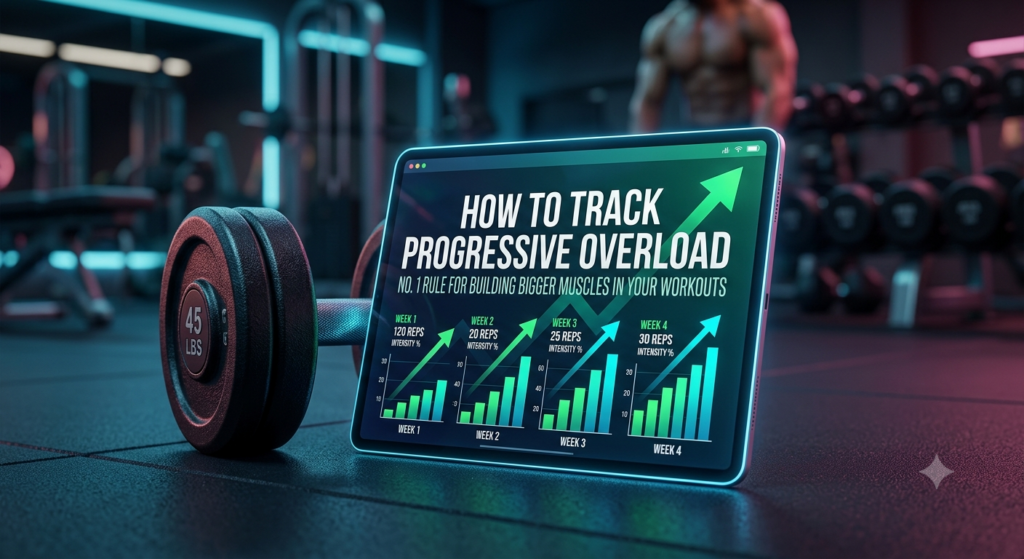
You walk into the gym and do the same workout you did last month. Your muscles adapt after a few sessions and stop growing. Progressive Overload, No. 1 Rule for Building Bigger Muscles, means adding challenge each time you train. Your body changes only when you force it to do more than before.
What Progressive Overload, No. 1 Rule for Building Bigger Muscles Actually Means
Your muscles grow when they face stress they can’t handle. You lift a weight that feels hard today. Your body repairs the damage and builds stronger tissue. Next week, that same weight feels easier because you adapted.
This is where most people stall out.
They keep lifting the same weights for months. Their muscles have no reason to grow anymore. Progressive overload fixes this problem by making each workout slightly harder. You add weight to the bar. You do more reps with the same load. You reduce rest time between sets.
The method works because your body prepares for future stress. When you barely complete eight reps at 100 pounds today, your body thinks it might face nine reps next time. It builds extra muscle to handle that potential demand. Give it the same eight reps again and growth stops.
Think of it like calluses on your hands. Your skin thickens only where friction happens repeatedly. Stop the friction and the calluses disappear. Stop the progressive challenge and your muscles shrink back down.
Why Progressive Overload, No. 1 Rule for Building Bigger Muscles, Beats Other Training Methods
Many gym programs focus on feeling sore or tired. You do high-rep circuits until your muscles burn. You try new exercises every week to shock your body. These approaches create fatigue without forcing real adaptation.
Soreness comes from unfamiliar movements, not from growth stimulus. A new exercise makes you sore because your muscles aren’t used to that motion pattern. Do the same movement again and the soreness disappears. Your muscles didn’t grow. They just got familiar.
Random variety creates the same problem. You bench press 135 pounds one week. Next week you switch to dumbbell presses with 40-pound weights. The week after that you try cable flies. You never progress at any single movement because you keep changing the exercise.
Progressive overload forces you to track specific numbers. You know exactly what you lifted last session. You know what you need to lift this session. There’s no guessing about whether you’re improving.
The numbers don’t lie.
If you squatted 185 pounds for five reps last month and 205 pounds today, you got stronger. If you’re still at 185 pounds six months later, your program isn’t working. This clarity makes progressive overload the most reliable muscle-building method.
The Five Ways to Apply Progressive Overload, No. 1 Rule for Building Bigger Muscles
Adding weight to the bar is the simplest progression method. You bench press 135 pounds for three sets of eight reps. Next session you try 140 pounds for the same sets and reps. Your muscles must produce more force, so they grow to meet that demand.
Most beginners can add five to ten pounds per week on big lifts. Squats and deadlifts progress faster than bench presses and rows. Upper body lifts progress slower because the muscles are smaller. Once you’ve trained for six months, weight increases slow to five pounds every two weeks.
Adding reps works when you can’t increase the weight yet. You get seven reps on your first set this week. Next week you push for eight reps at the same weight. Once you hit your target rep range, you increase the weight and drop back down.
Here’s how that looks in practice. You curl 30-pound dumbbells and get 8, 7, and 6 reps across three sets. Next workout you aim for 9, 8, 7. The following session you get 10, 9, 8. Now you jump to 35-pound dumbbells and start over at lower reps.
Adding sets increases total volume without changing weight or reps. You do three sets of shoulder presses for a month. Then you add a fourth set. Your shoulders handle more total work, which drives new growth.
Reducing rest periods makes the same work harder. You rest two minutes between squat sets right now. Drop that to 90 seconds and the weight feels heavier. Your cardiovascular system and muscular endurance both improve.
Increasing range of motion adds difficulty without changing the load. You squat to parallel depth today. Next month you squat two inches deeper. The longer range requires more muscle activation and creates more growth.
How to Track Progressive Overload, No. 1 Rule for Building Bigger Muscles in Your Workouts
You need a training log to make progress visible. Write down every exercise, weight, set, and rep you complete. A small notebook costs two dollars and fits in your gym bag. Digital apps work too if you prefer typing.
Record the date at the top of each workout. List each exercise in the order you performed it. Next to each exercise, write the weight and reps for every set. Include rest times if you’re tracking those.
Here’s an example entry. Monday, July 14. Squat: 185×5, 185×5, 185×4. Bench: 135×8, 135×7, 135×6. Row: 115×10, 115×10, 115×9.
Before your next workout, review what you did last time. Pick one way to improve on at least one exercise. If you got five reps on all squat sets, try for six reps on the first set. If you completed your rep targets, add five pounds.
Some sessions you’ll fail to progress. You try for six reps but only get five again. This happens to everyone. Stay at the same weight next session and try again. Two failed attempts in a row means you need a different approach.
Take a deload week where you reduce weight by 10 percent. Do your normal sets and reps but with lighter loads. Your body recovers from accumulated fatigue. The following week you’ll break through the plateau.
Common Mistakes That Stop Progressive Overload, No. 1 Rule for Building Bigger Muscles
Adding weight too fast leads to form breakdown. You rush from 135 to 155 pounds on bench press in one jump. The bar path gets shaky. Your shoulders roll forward. You’re no longer training the right muscles effectively.
Form must stay consistent as weight increases. If you squat with perfect depth at 135 pounds, maintain that depth at 185 pounds. Cutting range of motion to lift heavier doesn’t count as real progress.
Changing exercises too often prevents progression. You switch from barbell rows to dumbbell rows to cable rows across three weeks. None of these movements get stronger because you never repeat them long enough. Stick with the same core exercises for at least eight weeks.
Skipping deload weeks causes burnout. You push for new personal records every single session. Your joints ache. Your energy drops. Your strength stops increasing despite hard training.
Plan a deload every fourth or fifth week. Reduce training intensity by cutting weight, sets, or both. This scheduled recovery lets your body rebuild without forcing an injury.
Ignoring nutrition undermines all your training progress. You add weight to the bar each week but eat the same calories you did six months ago. Your body lacks the raw materials to build new muscle tissue. Protein intake matters most, with at least 0.7 grams per pound of body weight daily.
When Progressive Overload, No. 1 Rule for Building Bigger Muscles Slows Down
Beginners progress faster than experienced lifters. A new trainee might add ten pounds to their squat every week for three months. Someone who’s trained for five years might add ten pounds every three months.
This slowdown is normal and expected. Your body adapts quickly when you start because everything is new stimulus. As you get stronger, each pound of added muscle requires more work. A 300-pound squat takes years to reach after you hit 200 pounds.
Advanced lifters switch to smaller increments. They use fractional plates weighing 1.25 or 0.5 pounds per side. Adding 2.5 total pounds to a lift still counts as progression. They might also vary rep ranges across different training blocks.
One month focuses on sets of three to five reps with heavy weight. The next month uses sets of eight to twelve reps with moderate weight. Both approaches build muscle through different mechanisms. Rotating between them prevents adaptation and maintains progress.
Age affects progression speed too. A 20-year-old recovers faster than a 45-year-old. Older lifters need more rest days and longer deload periods. They can still apply progressive overload but at a more gradual pace.
Programming Progressive Overload, No. 1 Rule for Building Bigger Muscles Into Your Weekly Schedule
A three-day full-body routine works well for beginners. You train Monday, Wednesday, and Friday. Each session includes a squat variation, a push exercise, and a pull exercise. You attempt to progress on at least one lift each workout.
Monday you add five pounds to your squat. Wednesday you add one rep to your bench press. Friday you reduce rest time on rows by 15 seconds. Not every exercise progresses every session, but something always improves.
Four-day upper-lower splits let you hit each muscle group twice weekly. Monday and Thursday cover legs and lower back. Tuesday and Friday work chest, back, shoulders, and arms. You can push harder on individual muscle groups with more volume per session.
Five-day body part splits work for advanced lifters. Each muscle group gets one hard session per week with maximum volume. Recovery becomes more important because you’re hitting each muscle with more total sets. Progress comes through rep increases more than weight increases.
Whatever split you choose, plan progression before you walk into the gym. Don’t decide randomly whether to add weight or reps. Review your log and set a specific target for each exercise.
Frequently Asked Questions
How much weight should I add each workout?
Add five pounds to lower body lifts and 2.5 pounds to upper body lifts. Beginners can sometimes add more initially. Advanced lifters need smaller jumps like one pound per side.
What happens if I miss a progression target?
Stay at the same weight and try again next session. Two failed attempts means you need a deload week. Reduce weight by 10 percent for one week, then resume progression.
Can I build muscle without progressive overload?
No, your muscles need increasing stress to grow. Doing the same workouts forever maintains current muscle. Adding challenge creates new growth stimulus.
How long does progressive overload work?
Progressive overload works your entire training life. Progression just gets slower as you advance. Beginners add weight weekly while advanced lifters add weight monthly.
Should I progress on every exercise each workout?
No, focus on progressing one or two main lifts per session. Your body can’t adapt to everything at once. Smaller exercises can progress every few weeks instead.
Start tracking your workouts today and add one small improvement to your next training session.