
The One Number That Changes Beginner Workouts
Beginners should perform three to five exercises per workout session with one to two sets each while their nervous system adapts to training. A focused routine with fewer well-chosen movements produces better results than overwhelming yourself with excessive exercises.
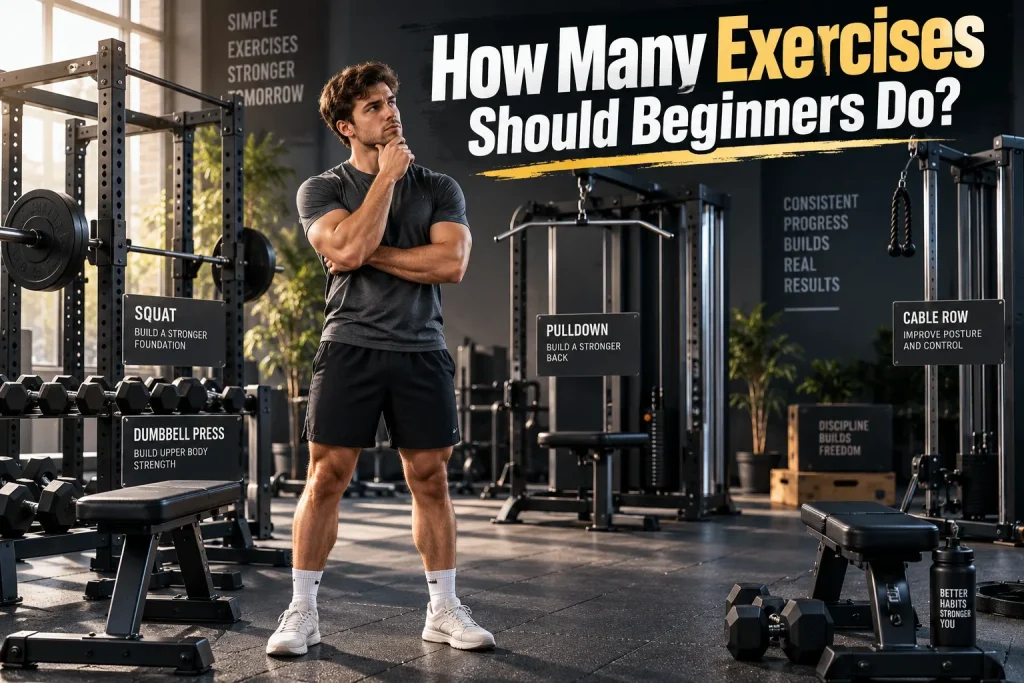
You walk into a gym for the first time. The weight machines look complicated. Other people seem to know exactly what they’re doing. How Many Exercises Should Beginners Do? The answer shapes whether you stick with training beyond week three.
How Many Exercises Should Beginners Do?
Beginners usually need about 5–8 exercises per workout to build muscle, gain strength, learn proper lifting technique, and train the major muscle groups effectively. The exact number depends on whether you use full-body workouts or a split routine, how many days you train each week, and how much work you perform for each exercise.
More exercises are not automatically better.
For a beginner, the goal should be to perform enough exercises to train the entire body while keeping the workout manageable. A routine containing five well-chosen movements can often produce better results than a 12-exercise workout filled with redundant variations.
The best beginner program emphasizes basic movement patterns, consistent technique, progressive overload, and recovery. Exercise variety can increase later as your training experience and needs become more specific.
How Many Exercises Should a Beginner Do Per Workout?
For most beginners, 5–8 exercises per workout is an excellent starting range.
A simple full-body session might contain:
- One squat or leg-press movement
- One hip-hinge or hamstring movement
- One horizontal or vertical press
- One row or pulldown
- One additional upper-body exercise
- One or two isolation or core exercises
This structure allows a beginner to train most major muscle groups without turning every workout into a marathon.
You do not necessarily need a separate exercise for every individual muscle. Compound exercises train several muscles simultaneously.
A bench press, for example, trains the chest while also involving the anterior deltoids and triceps. Rows train the back while requiring substantial involvement from the biceps and other elbow flexors. Squats train several muscles of the lower body within one movement.
This overlap is one reason beginners can build effective programs with relatively few exercises.
What Does the Scientific Evidence Recommend?
A useful scientific reference for beginners comes from the American College of Sports Medicine.
This updated ACSM position stand notes that previous evidence-based guidelines commonly recommended 8–10 exercises involving the major muscle groups per session, generally performed two or three times per week. Importantly, the newer review emphasizes that resistance-training programs can be effective across a much broader range of prescriptions and that relatively small doses of resistance training can produce meaningful improvements.
That distinction matters.
Eight to ten exercises can certainly work, but beginners should not interpret that number as a minimum requirement for muscle growth. A smaller number of strategically selected compound and isolation exercises can cover the major muscle groups effectively.
The American Heart Association similarly describes programs using approximately 8–10 exercises for the major muscle groups, while noting that it is not necessary to perform every possible exercise in each workout and that compound exercises can train multiple major muscle groups.
The practical lesson is simple: exercise coverage matters more than accumulating exercises.
Why Beginners Usually Need Fewer Exercises
Experienced bodybuilders often perform specialized movements because their training goals have become highly specific.
A veteran lifter might use separate exercises for the upper chest, lateral deltoids, rear deltoids, different regions of the back, hamstrings, quadriceps, calves, biceps, triceps, and other muscles.
Beginners generally do not need that level of specialization.
During the first months of resistance training, nearly every major movement is a new stimulus. Beginners are learning how to squat, press, pull, hinge, stabilize loads, control repetitions, and judge effort.
Adding excessive exercise variety can actually make this process harder.
Instead of practicing a manageable collection of movements repeatedly, the beginner constantly switches exercises and never becomes particularly proficient at any of them.
Keeping the exercise menu relatively small makes progression easier to measure.
Start With Compound Exercises
Most beginner bodybuilding programs should be built around several compound exercises.
Compound movements involve multiple joints and muscle groups simultaneously. Common examples include:
- Squats
- Leg presses
- Romanian deadlifts
- Bench presses
- Dumbbell presses
- Overhead presses
- Rows
- Lat pulldowns
These exercises provide considerable training coverage without requiring a huge exercise list.
A beginner performing a leg press, Romanian deadlift, chest press, lat pulldown, and shoulder press has already trained a substantial portion of the body with only five exercises.
One or two targeted isolation exercises can then fill obvious gaps.
For example, adding lateral raises and biceps curls would produce a seven-exercise workout without unnecessary complexity.
How Many Exercises Per Muscle Group Should Beginners Do?
Beginners usually don’t need multiple exercises for every muscle in a single workout.
For many muscle groups, one exercise per workout can be sufficient initially, particularly when the muscle is trained multiple times throughout the week.
Suppose you train your entire body three times per week.
You might perform a chest press during one workout, an incline dumbbell press during another, and a machine chest press during the third. The chest receives repeated weekly training without requiring three different chest exercises in every session.
The same principle applies to the back and legs.
This is very different from trying to perform four chest exercises, four back exercises, three shoulder exercises, and several arm movements every time you enter the gym.
Beginners should think primarily in terms of weekly training exposure, rather than trying to exhaust every muscle during one workout.
A Good 6-Exercise Beginner Workout
A practical beginner full-body workout could look like this:
1. Leg Press or Squat
Primary emphasis: quadriceps and glutes.
2. Romanian Deadlift
Primary emphasis: hamstrings and glutes.
3. Machine Chest Press or Dumbbell Bench Press
Primary emphasis: chest, shoulders, and triceps.
4. Lat Pulldown
Primary emphasis: lats, upper back, and biceps.
5. Seated Cable Row
Primary emphasis: back and elbow flexors.
6. Lateral Raise
Primary emphasis: lateral deltoids.
You could optionally add an arm, calf, or abdominal exercise depending on your goals.
That creates a highly manageable 6–7 exercise beginner workout.
There is little reason to double the exercise count simply because more equipment is available.
How Many Exercises Should Beginners Do Per Week?
Workout frequency changes how many exercises you need during each session.
A beginner training three full-body workouts per week might perform approximately 5–8 exercises each session.
Someone using an upper/lower split might train four days per week but use fewer exercises during each workout because only half of the body is being emphasized.
For example:
Full-body routine:
5–8 exercises per workout, 2–3 workouts per week.
Upper/lower routine:
4–7 exercises per workout, usually across four weekly sessions.
The precise numbers aren’t important enough to obsess over. What matters is whether the weekly program adequately trains the major muscle groups and allows measurable progression.
ACSM guidance has historically recommended that novices train the entire body approximately 2–3 days per week, which remains a practical starting structure.
Don’t Confuse Exercises With Sets
This distinction is extremely important.
An exercise is a movement such as the bench press.
A set is one completed group of repetitions of that exercise.
Doing three sets of bench presses does not mean you performed three exercises. You performed one exercise for three sets.
This matters because training volume is influenced heavily by the number of challenging sets performed—not merely the number of different movements in the program.
A beginner performing six exercises for two sets each completes 12 working sets.
Another beginner performing 12 exercises for two sets each completes 24 working sets.
Those workouts may look similar when you only count exercises, but the second involves twice as many sets and potentially far more fatigue.
That is why asking how many exercises beginners should do is only the first part of designing a program.
How Many Sets Should Beginners Do Per Exercise?
A practical starting point is often 1–3 working sets per exercise.
The ACSM’s resistance-training recommendations for novices have traditionally included moderate loads and approximately 1–3 sets per exercise, while the broader evidence indicates that beginners can make meaningful progress without extremely high training volumes.
For bodybuilding purposes, two working sets per exercise can be particularly practical when starting.
Six exercises performed for two working sets produces 12 total sets.
Once you’ve chosen your exercises and working-set structure, How to Choose Starting Weights: Beginner Guide explains how to select an appropriate initial load without sacrificing technique.
This provides enough work to practice the movements and stimulate adaptation without requiring excessive workout duration.
As your work capacity improves, volume can gradually increase where necessary.
Should Beginners Do Isolation Exercises?
Yes.
The idea that beginners should perform only compound exercises is unnecessarily restrictive.
Compound exercises are efficient, but they do not necessarily train every muscle equally well.
Isolation exercises such as lateral raises, leg curls, biceps curls, triceps extensions, calf raises, and similar movements can complement a compound-focused routine.
The key is proportion.
Your beginner program probably shouldn’t contain three compound exercises and nine isolation exercises. Instead, build the workout around several larger movements and use a small number of isolation exercises to address muscles that need additional direct work.
For example, five compound or major movements plus two isolation exercises gives you seven exercises total—a very reasonable beginner session.
When Are You Doing Too Many Exercises?
A beginner is probably performing too many exercises when additional movements stop improving the workout and start reducing its quality.
Exercise count also directly affects session length, so How Long Should a Beginner Workout Last? explains how to balance exercises, working sets, rest periods and warm-ups without making beginner workouts unnecessarily long.
Warning signs include:
- Workouts routinely lasting far longer than necessary
- Performance declining dramatically near the end
- Difficulty remembering technique for numerous movements
- Constantly changing exercises
- Persistent soreness interfering with the next workout
- Difficulty tracking progressive overload
- Adding multiple exercises that train essentially the same movement pattern
Consider a beginner who performs barbell bench presses, dumbbell bench presses, machine chest presses, cable presses, and push-ups in the same workout.
All five exercises can be useful individually.
That doesn’t mean all five need to be performed together.
Two strategically chosen chest movements—or sometimes just one—may be more appropriate depending on the rest of the weekly program.
When Should Beginners Add More Exercises?
Add exercises when there is a specific reason, not simply because your workouts feel too short.
Good reasons include a muscle receiving insufficient direct training, a movement causing persistent discomfort, a physique goal becoming more specific, or progression requiring a better distribution of weekly training volume.
You might begin with six exercises and eventually move to seven or eight.
That is normal progression.
What you shouldn’t do is assume that becoming more experienced automatically means performing increasingly enormous workouts.
Advanced programming is about better allocation of training stress—not collecting as many exercises as possible.
Exercise Quality Matters More Than Exercise Quantity
Beginners frequently focus on finding the perfect number of exercises when their attention would be better spent improving execution.
A simple program performed consistently is extraordinarily powerful.
Learn how to control the eccentric portion of each repetition. Use a comfortable range of motion. Develop consistent technique. Track your repetitions and loads. Gradually increase performance when appropriate.
If you perform seven exercises but cannot remember what weight or repetitions you completed last week, adding an eighth exercise is unlikely to solve the problem.
Progressive overload requires repeatability.
That becomes much easier when your routine contains a manageable number of movements.
Frequently Asked Questions
Is 5 exercises enough for a beginner?
Yes. Five strategically chosen exercises can train most major muscle groups, particularly when compound movements are emphasized. Beginners do not need a huge exercise selection to make progress.
Is 6 exercises per workout enough?
For many beginners, six exercises is an excellent target. A six-exercise full-body workout can cover the major movement patterns while remaining manageable enough to maintain good technique and track progression.
Is 10 exercises too many for a beginner?
Not necessarily. Evidence-based guidelines have historically included approximately 8–10 exercises covering the major muscle groups. However, beginners do not have to perform that many. Ten exercises can become excessive if each movement involves multiple hard sets or several exercises are redundant.
Should beginners train every muscle in one workout?
Full-body training is an effective option for beginners and can train most major muscle groups during each session. However, beginners can also use other training structures provided weekly muscle-group coverage and recovery are appropriate.
How long should a beginner workout take?
There is no mandatory workout duration. A well-designed session containing approximately 5–8 exercises can often be completed efficiently without sacrificing adequate rest between sets. Performance and progression matter more than reaching a predetermined workout length.
Should beginners change exercises every week?
Usually not. Beginners benefit from repeating movements long enough to improve technique and track progress. Exercises should generally be changed for a specific reason rather than simply to create variety.
The Bottom Line
So, how many exercises should beginners do?
For most beginners, 5–8 exercises per workout is a practical target, especially when following a full-body resistance-training program two or three times per week.
You may eventually perform more or fewer depending on your training split, goals, exercise selection, number of sets, and recovery capacity.
The important principle is not hitting a magical exercise number.
Choose enough exercises to train the major muscle groups without unnecessary redundancy. Prioritize compound movements, add isolation exercises where they provide a clear benefit, perform a manageable number of quality working sets, and repeat the exercises consistently enough to improve them.
Beginners don’t need complicated bodybuilding programs to grow.
They need good exercises, good technique, progressive overload, sufficient recovery, and enough consistency to allow those fundamentals to work.