
The Rest Days Sabotaging Your Muscle Growth
Rest between workouts varies by goal: strength training requires 48-72 hours for large muscles, while small muscles recover in 24-48 hours. Training each muscle group 2-3 times weekly with proper recovery maximizes progress and prevents nervous system fatigue.

How Long Should You Rest Between Workouts? You finish a hard leg day on Monday. Tuesday morning you can barely walk. Most people jump back into training Wednesday. That’s the fastest way to stall progress.
How Long Should You Rest Between Workouts?
One of the most common questions lifters ask is simple: how long should you rest between workouts? The familiar advice to wait 24, 48, or 72 hours sounds straightforward, but muscle recovery does not operate according to one universal countdown.
How much recovery time a muscle needs before training again depends on the muscle group, workout volume, exercise selection, proximity to muscular failure, training experience, sleep, nutrition, and—most importantly—whether performance has actually recovered.
For many hypertrophy-focused lifters, roughly 48 hours between hard sessions for the same muscle group is a useful starting point, but it is not a mandatory rule. A relatively easy session might permit productive training again after 24 hours. A demanding high-volume workout involving substantial eccentric loading or repeated sets to failure may require 72 hours or longer.
The goal is therefore not to wait for an arbitrary number of hours. It is to give the trained muscles enough time to recover so the next workout can deliver another high-quality stimulus.
How Much Recovery Time Does a Muscle Need Before Training Again?
For most lifters, a practical recovery window is approximately 24 to 72 hours, depending on how demanding the previous session was.
Recovery also has several dimensions. Muscle soreness can recover at a different rate from strength, connective-tissue stress, perceived fatigue, and neuromuscular performance. You can consequently feel mildly sore while still being capable of performing normally—or feel almost no soreness while your performance remains suppressed.
This is one reason soreness alone should never determine your training schedule.
A useful way to think about recovery is:
24 hours: potentially sufficient after relatively low-stress training.
48 hours: a practical default following a typical hypertrophy workout.
72+ hours: often appropriate after unusually demanding, high-volume, failure-oriented, unfamiliar, or muscle-damaging training.
Research illustrates why the amount and intensity of training matter. In resistance-trained men, Pareja-Blanco and colleagues compared protocols differing in volume and proximity to failure. Training to failure produced larger reductions in neuromuscular performance and substantially slower recovery than protocols that stopped further from failure. The authors reported faster recovery between 24 and 48 hours when failure was avoided, while failure training prolonged recovery.
For lifters trying to decide when to train again, this is one of the most directly applicable studies:
Time Course of Recovery Following Resistance Training Leading or Not to Failure
Best location: Place this scientific reference here, immediately after introducing the 24–72-hour recovery range and before discussing the individual time periods. It provides direct evidence that recovery time changes according to how the workout is performed rather than supporting a rigid universal waiting period.
Is 24 Hours Enough Between Workouts?
Sometimes.
Training the same muscle on consecutive days is not automatically detrimental. The important question is whether the first workout created enough fatigue to compromise the second.
Imagine performing three moderate sets for your chest on Monday while stopping two or three repetitions short of failure. Training chest again Tuesday may be completely different from attempting another workout 24 hours after 15 demanding sets of presses and flyes performed close to failure.
A 24-hour turnaround is most realistic when:
- per-session volume is relatively low;
- most sets are not taken to failure;
- muscle soreness is minimal;
- performance has returned;
- exercises do not create excessive muscle damage;
- weekly volume is intentionally distributed across frequent sessions.
This approach can work particularly well with higher-frequency programs where weekly volume is spread over three or more exposures.
Instead of doing 15 sets for one muscle on Monday and waiting several days, for example, a lifter might perform five sets Monday, five Wednesday, and five Friday. Higher frequency does not necessarily mean performing more total work—it can simply distribute the same weekly work differently.
Are 48 Hours Between Workouts Enough?
For many lifters, 48 hours is the most useful starting point for training the same muscle again.
This is why routines such as Monday-Wednesday-Friday full-body training and many upper/lower or push-pull configurations can work effectively.
Suppose you train your chest Monday evening and again Wednesday evening. Approximately 48 hours separate the sessions. If Monday’s workout contained a manageable amount of volume and did not generate excessive fatigue, performance may be sufficiently restored by Wednesday.
However, 48 hours should be treated as a programming guideline rather than a biological law.
A lifter performing six moderate working sets may recover considerably faster than someone completing 15 hard sets involving heavy presses, deep-stretch flyes, forced repetitions, and repeated failure.
Your next workout should ultimately be determined by recoverability relative to the stimulus you created.
When Should You Wait 72 Hours Between Workouts?
Seventy-two hours becomes more useful when training stress increases.
You may benefit from three days or longer before directly training the same muscle after unusually high-volume workouts, repeated sets to failure, unfamiliar exercises, substantial eccentric loading, or sessions that produce a meaningful decline in strength.
Research demonstrates how dramatically this can vary between populations and protocols. One study involving untrained women performing four sets of elbow flexion at 80% of 1RM found that several recovery markers had not completely returned after 72 hours.
That does not mean every lifter requires more than 72 hours after four sets. Instead, it demonstrates why fixed recovery rules are problematic: training experience, exercise novelty, muscle group, protocol, and individual recovery capacity all matter.
Different Muscle Groups Can Recover at Different Rates
You also do not need to treat the entire body as one recovery unit.
A hard leg workout does not necessarily mean your chest, shoulders, and arms need three days off.
Smaller or less heavily stressed muscles may sometimes be ready sooner, while demanding compound training can create substantial systemic and local fatigue.
Exercise overlap also matters.
Heavy bench pressing trains the chest but also stresses the anterior deltoids and triceps. Rows involve the upper back and elbow flexors. Squats primarily challenge the lower body but can also create considerable whole-body fatigue.
Therefore, your training split should consider indirect muscle work, not simply the name assigned to each workout.
For example, performing heavy chest work Monday and an aggressive triceps workout Tuesday may not provide the triceps with much recovery at all.
Training Frequency and Muscle Recovery
Recovery matters because it determines how effectively you can distribute training across the week.
A major systematic review and meta-analysis examining resistance-training frequency concluded that when weekly training volume is equated, higher versus lower frequencies do not appear to produce meaningful differences in hypertrophy. This suggests that frequency can largely be selected according to how effectively a lifter can distribute and recover from the required training volume.
That has an important practical implication.
Instead of asking:
“What is the perfect number of days per week to train a muscle?”
Ask:
“How can I distribute my weekly volume so each session is productive and I can recover before training that muscle hard again?”
Two lifters might therefore achieve excellent results with different schedules. One might train each muscle twice weekly with larger sessions, while another trains each muscle three times weekly using fewer sets per workout.
Training Volume Changes How Long You Need to Recover
Training volume is one of the biggest variables affecting recovery.
Research supports a dose-response relationship between resistance-training volume and hypertrophy, although increasing volume also increases the amount of work from which you must recover.
Consider two hypothetical workouts.
Workout A: four hard sets for the quadriceps.
Workout B: twelve hard sets for the quadriceps.
Calling both of them a “leg workout” hides an enormous difference in training stress.
As per-session volume rises, fatigue generally rises as well. This creates an important reason to distribute higher weekly volumes across multiple workouts rather than attempting to perform everything during one marathon session.
Frequency can therefore become a volume-management tool.
Intensity and Training to Failure Affect Recovery
Volume is only part of the equation. How hard you perform those sets matters.
A set stopped with three repetitions in reserve is not equivalent in fatigue cost to grinding until another repetition is impossible.
Repeated failure training can create substantially greater acute fatigue and delay recovery compared with stopping short of failure. The previously cited recovery study found that failure training caused greater reductions in mechanical performance and slowed the restoration of neuromuscular function.
This creates an important programming tradeoff.
Training harder does not automatically mean stimulating more muscle growth if the extra fatigue prevents you from performing enough high-quality training later in the week.
For hypertrophy, most lifters do not need every working set taken to absolute muscular failure.
Does Training Age Affect Recovery Time?
Yes, although the relationship is more complicated than simply saying advanced lifters recover faster or slower.
Beginners often experience substantial soreness after unfamiliar training because resistance exercise represents a novel stimulus. A new lifter who performs too much volume during the first few workouts can remain sore for several days.
As training becomes familiar, the body adapts to repeated exposure, and the same workout generally becomes less disruptive.
Advanced lifters, however, can generate much greater absolute forces and usually have the skill and motivation to train extremely hard. They may therefore create substantial fatigue despite being highly adapted to resistance training.
This produces a useful distinction:
Beginners may need extra recovery because the stimulus is unfamiliar. Advanced lifters may need extra recovery because they can create a much larger stimulus.
Training experience should therefore influence exercise selection, weekly frequency, per-session volume, and proximity to failure.
Performance Recovery Matters More Than Soreness
Delayed-onset muscle soreness, or DOMS, is easy to notice, which is why lifters often use it as their primary recovery measurement.
That can be misleading.
Soreness does not perfectly represent muscle damage, hypertrophy stimulus, or readiness to train. Instead, evaluate whether your performance has recovered.
Suppose your normal first working set on the bench press is 225 pounds for eight controlled repetitions. During your next chest workout, you can only perform five repetitions despite normal effort and conditions.
That is useful information.
Persistent reductions in load, repetitions, bar speed, coordination, or force production can indicate that recovery is incomplete.
Conversely, mild soreness accompanied by completely normal performance may not require another 48 hours of inactivity.
Signs You’re Ready to Train a Muscle Again
Rather than relying exclusively on the clock, look for several recovery signals simultaneously.
You are probably ready to train a muscle again when soreness is absent or mild, normal range of motion has returned, warm-up weights move normally, your expected strength and repetition performance are available, motivation is normal, and there is no unusual joint or tendon discomfort.
One particularly useful test occurs during your warm-up.
If a muscle feels slightly sore when you arrive at the gym but progressively better as you warm up—and your normal loads, movement quality, and repetitions return—the muscle may be sufficiently recovered for productive training.
If warm-ups feel unusually heavy, soreness affects technique, or performance is clearly suppressed, reducing the session’s volume or intensity—or giving the muscle additional recovery—may be the better decision.
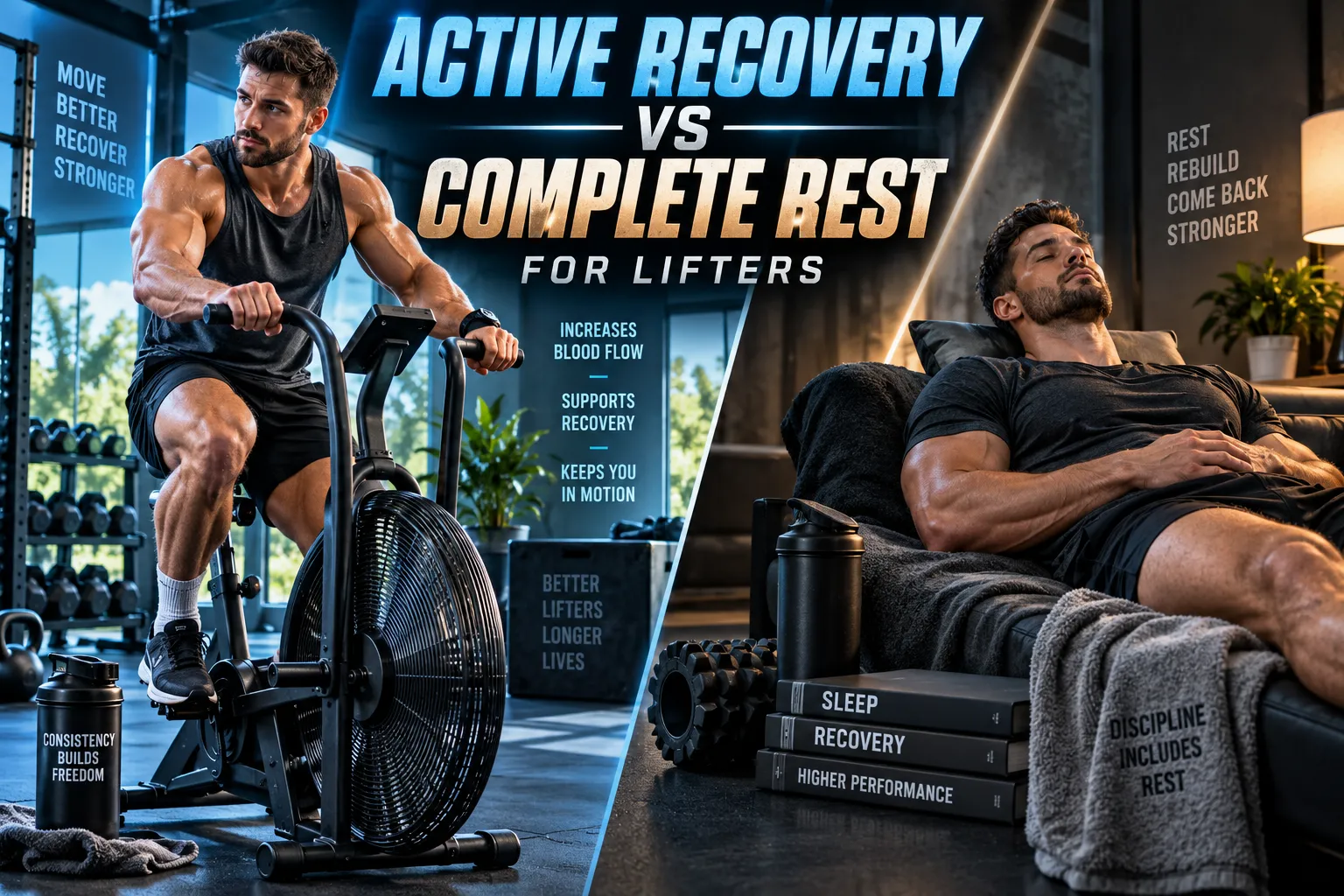
Active Recovery Between Hard Workouts
Rest between workouts does not necessarily mean complete inactivity.
Low-fatigue movement between hard training sessions can help lifters stay active without adding another substantial resistance-training stimulus. Walking, easy cycling, mobility work, or very light resistance exercise can sometimes fit well between demanding sessions.
The key distinction is that active recovery should support recovery rather than become another workout requiring recovery.
For a detailed breakdown of appropriate recovery methods, intensity, timing, and situations where additional exercise may become counterproductive, see Active Recovery for Lifters: Methods, Timing & Limits.
Best location for this internal link: Place it here, immediately after the discussion of performance recovery and readiness to train. This creates a natural transition from determining when a muscle is recovered to understanding what to do between hard workouts to support recovery.
24 vs 48 vs 72 Hours: A Practical Guide
There is no universal recovery number, but these ranges provide a useful starting framework.
| Recovery Time | Most Appropriate When |
|---|---|
| 24 hours | Low-volume training, limited muscle damage, sets stopped short of failure, normal performance |
| 48 hours | Typical moderate-volume hypertrophy training with manageable fatigue |
| 72 hours | Higher-volume or harder training, substantial soreness, repeated failure work, unfamiliar exercises |
| 72+ hours | Performance remains suppressed, severe soreness persists, or the previous workout created unusually high fatigue |
The important qualification is that your performance overrides the timetable.
If 48 hours have passed but strength is still significantly reduced, waiting longer or modifying the next session may make sense. If only 24 hours have passed following a low-stress workout and performance is completely normal, another appropriately programmed session may be reasonable.
Should You Wait Until You’re Completely Recovered?
Not necessarily.
If “completely recovered” means absolutely zero soreness, zero fatigue, and feeling maximally fresh, insisting on that standard before every workout may unnecessarily reduce training frequency.
The goal is to recover sufficiently to produce another high-quality stimulus.
This distinction becomes particularly important for lifters training muscles two or three times per week. Some residual fatigue can exist without making a workout unproductive.
The warning sign is not simply feeling that you trained recently. It is meaningful deterioration in training quality.
How Long Should Natural Lifters Rest Between Workouts?
For most natural lifters focused on hypertrophy, start with approximately 48 hours between demanding sessions for the same muscle group, then adjust according to performance and recovery.
Use 24-hour spacing selectively when sessions are deliberately smaller and fatigue is controlled. Extend recovery toward 72 hours or longer when workouts contain substantial volume, repeated failure training, unfamiliar exercises, or unusually high muscle damage.
Most importantly, do not treat recovery as a stopwatch.
Training frequency, workout volume, intensity, exercise selection, training age, sleep, nutrition, and individual response interact. Research on resistance-training frequency also indicates that when weekly volume is equated, there is considerable flexibility in how that volume can be distributed across the week.
The best recovery interval is therefore the shortest interval that consistently allows you to perform your next planned workout at a high level without accumulating excessive fatigue.
For many lifters that will often be around 48 hours. Sometimes it will be 24. Sometimes it will be 72 or more.
Instead of asking only, “How many hours has it been since I trained this muscle?” ask the more useful question:
“Has this muscle recovered enough for me to train it productively again?”
That shift—from following the calendar to monitoring performance—is one of the simplest ways to build a training schedule that balances frequency, recovery, and long-term muscle growth.