

Why Your FFMI Score Might Be Lying to You
Normalized FFMI solves the height bias problem in muscle mass measurements by adjusting raw scores to a standard 1.8-meter baseline. This lets you fairly compare your lean muscle gains with lifters of any height using the proven Kouri et al. formula.
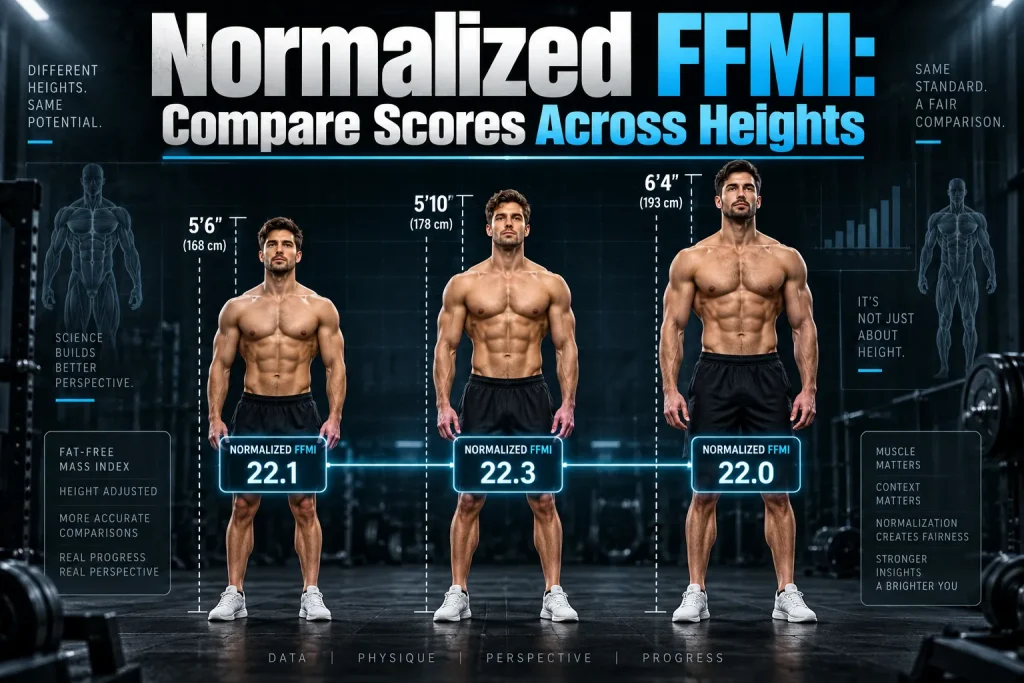
Normalized FFMI: Compare Scores Across Heights fixes a problem most lifters don’t notice. Someone 5’6″ and someone 6’3″ can train identically and eat identically. Their raw FFMI scores can differ by two to three points. The normalization formula adjusts everyone’s FFMI to what it would be if they were 1.8 meters tall.
Normalized FFMI: Compare Scores Across Heights
Fat-Free Mass Index (FFMI) is one of the most useful measurements for natural bodybuilders who want to evaluate muscularity without letting body fat distort the picture. But standard FFMI has an important limitation: comparing two lifters of substantially different heights may not always produce an entirely fair comparison.
That is where normalized FFMI comes in.
Normalized FFMI adjusts a standard FFMI score to a reference height, allowing lifters of different statures to make more meaningful comparisons. Rather than simply asking, “What is my FFMI?”, normalization addresses a more specific question:
How muscular am I relative to someone of a different height?
This guide explains the normalized FFMI formula, why height adjustment is used, how it changes scores, and how natural bodybuilders should interpret the resulting number.
If you first want to understand the complete FFMI calculation, scoring ranges, and how FFMI relates to natural muscular potential, see our FFMI Calculator: Formula, Scores & Natural Limits pillar guide.
What Is Normalized FFMI?
Normalized FFMI is a height-adjusted version of the traditional Fat-Free Mass Index.
Standard FFMI is calculated as:
FFMI = fat-free mass in kilograms ÷ height in meters²
Fat-free mass includes muscle, bone, organs, water, and other non-fat tissue. Therefore, FFMI is not literally a “muscle mass index,” although resistance-trained people with higher levels of muscular development generally have greater fat-free mass.
The idea of using height-normalized fat-free mass indices predates their popularity in bodybuilding. Research proposed dividing fat-free mass by height squared as a potentially useful way of evaluating body composition and nutritional status. See the research on height-normalized fat-free mass and fat mass indices for the scientific background.
For bodybuilding purposes, however, another issue emerges.
Dividing fat-free mass by height squared does not necessarily eliminate every relationship between FFMI and height. Consequently, researchers introduced an additional adjustment that converts an individual’s FFMI toward a standardized reference height.
The Normalized FFMI Formula
The influential 1995 study by Kouri and colleagues examined FFMI among male athletes who reported anabolic-androgenic steroid use and those who did not. The PubMed abstract describes FFMI as fat-free body mass divided by height squared and reports an additional correction of:
Normalized FFMI = FFMI + 6.3 × (1.80 − height in meters)
This standardizes the score toward a height of 1.80 meters, or approximately 5 feet 11 inches.
You can examine the original research here: Kouri et al. study on FFMI in steroid users and nonusers.
The practical effect is straightforward:
- A person shorter than 1.80 m receives an upward adjustment.
- A person taller than 1.80 m receives a downward adjustment.
- A person exactly 1.80 m tall receives no adjustment.
This makes normalized FFMI especially useful when comparing muscularity between people who differ considerably in height.
Raw FFMI vs Normalized FFMI
Suppose two natural lifters have calculated their standard FFMI scores.
One is 1.65 meters tall and the other is 1.95 meters tall.
Looking only at raw FFMI may suggest that one person possesses more muscularity relative to body size. But some of that difference can potentially be associated with the way FFMI scales with height.
Normalized FFMI attempts to reduce that problem.
For a lifter who is 1.65 m tall with a raw FFMI of 22:
22 + 6.3 × (1.80 − 1.65)
= 22 + 0.945
= 22.95 normalized FFMI
Now consider a 1.95 m lifter with a raw FFMI of 22:
22 + 6.3 × (1.80 − 1.95)
= 22 − 0.945
= 21.06 normalized FFMI
Both athletes started with exactly the same raw FFMI, yet their normalized scores differ by almost two points.
That example demonstrates why height normalization can matter when comparing lifters at substantially different statures.
Why Doesn’t Regular FFMI Fully Account for Height?
It is reasonable to wonder why another correction is necessary. After all, standard FFMI already divides fat-free mass by height squared.
The answer is that biological dimensions do not necessarily scale perfectly according to a simple height-squared relationship across every human height.
This is an example of the broader problem of allometric scaling. Human bodies do not simply become identical proportionally enlarged or reduced versions of one another as height changes.
The Kouri adjustment was intended to compensate for the remaining association between FFMI and height within the population studied.
However, that does not mean the adjustment should be regarded as a perfect biological law.
Research involving collegiate American football players illustrates why caution is appropriate. In a sample of 235 players, investigators found that raw FFMI was not significantly related to height in that particular sample. Their sample-derived height adjustment was smaller than the previously published Kouri adjustment. Read the study examining FFMI and height adjustment in collegiate football players.
In other words, normalized FFMI is a useful standardized comparison tool, but the exact correction should not be interpreted as universally perfect across every population.
Why Normalized FFMI Matters for Natural Bodybuilders
Natural bodybuilding makes FFMI particularly interesting because body weight alone reveals relatively little about muscular development.
Imagine two men who both weigh 190 pounds.
One is 5’7″.
The other is 6’2″.
Their identical body weights clearly do not represent identical physiques.
BMI improves the comparison by accounting for height, but BMI cannot distinguish fat mass from fat-free mass. FFMI goes a step further by incorporating body composition.
Normalized FFMI then adds another layer by attempting to make FFMI itself more comparable across different heights.
This can make the metric useful when:
Comparing lifters of different heights. Normalization reduces some of the height-related bias that can remain in standard FFMI.
Tracking long-term muscular development. Your own height will not meaningfully change as an adult, so raw and normalized FFMI should move together as your fat-free mass changes.
Comparing your physique with published FFMI data. If a reference specifically uses normalized FFMI, your score should be calculated using the same methodology.
Evaluating natural bodybuilding benchmarks. Normalized scores can provide context, although they should never be treated as proof of whether someone is natural or enhanced.
How to Calculate Your Normalized FFMI
You need three basic measurements:
Body weight
Body-fat percentage
Height
First calculate fat-free mass:
Fat-Free Mass = Body Weight × (1 − Body-Fat Percentage)
If you weigh 82 kg at 12% body fat:
82 × (1 − 0.12) = 72.16 kg fat-free mass
Next calculate raw FFMI.
Suppose you are 1.75 m tall:
72.16 ÷ 1.75²
72.16 ÷ 3.0625 = 23.56 FFMI
Now normalize that result:
23.56 + 6.3 × (1.80 − 1.75)
23.56 + 0.315 = 23.88 normalized FFMI
Rounded appropriately, the lifter has a normalized FFMI of approximately 23.9.
Comparing Normalized FFMI Across Heights
The value of normalization becomes clearer when we hold raw FFMI constant.
| Height | Raw FFMI | Approx. Normalized FFMI |
|---|---|---|
| 1.60 m | 22.0 | 23.26 |
| 1.70 m | 22.0 | 22.63 |
| 1.80 m | 22.0 | 22.00 |
| 1.90 m | 22.0 | 21.37 |
| 2.00 m | 22.0 | 20.74 |
The farther someone’s height is from 1.80 m, the more meaningful the correction becomes.
This also explains why raw and normalized FFMI may appear nearly identical for lifters around average height.
A lifter measuring 1.79 m, for example, receives only a tiny adjustment. A very short or very tall lifter receives a substantially larger one.
What Is a Good Normalized FFMI?
This question requires more caution than many online FFMI charts imply.
Large population research provides useful context for ordinary FFMI. Schutz, Kyle, and Pichard examined 5,635 apparently healthy adults and reported age- and sex-specific FFMI distributions. Among men aged 18–34, median FFMI was approximately 18.9 kg/m², while the median among young women was approximately 15.4 kg/m².
The full paper can be reviewed here: FFMI and FMI percentiles in adults aged 18–98 years.
Those figures should not be confused with bodybuilding-specific normalized FFMI thresholds. They come from a general population and are useful primarily for understanding how body-composition indices vary across broader populations.
Resistance-trained bodybuilders are a very different group.
Training history, genetics, sex, age, body-fat estimation, hydration, glycogen status, and measurement methodology can all influence an individual’s calculated FFMI.
Therefore, a normalized FFMI score is best interpreted as a reference measurement, not a physique grade.
What About the Famous FFMI 25 Natural Limit?
The number 25 has become deeply associated with FFMI and natural bodybuilding.
Much of that reputation traces back to the Kouri study. Researchers examined 157 male athletes—83 reported steroid users and 74 reported nonusers. The normalized FFMI values among the nonusers extended to approximately 25.
This observation is interesting, but it has often been transformed online into a much stronger claim:
FFMI above 25 = steroid use.
The research does not justify using the number that way.
An FFMI threshold cannot prove drug use, nor should a single historical study be treated as establishing a universal biological ceiling for every human being.
Genetic variation exists. Body-composition measurements contain error. Study populations differ. Training histories differ. And FFMI includes all fat-free tissue rather than measuring skeletal muscle alone.
The more useful interpretation is that 25 is a historical reference point, not a biological wall.
For a broader discussion of FFMI ranges, natural limits, and what different scores may mean, refer to FFMI Calculator: Formula, Scores & Natural Limits.
Body-Fat Error Can Change Your Normalized FFMI
One of the biggest weaknesses in any FFMI calculation is often not the normalization formula.
It is the body-fat estimate.
Consider a 90 kg lifter.
At an estimated 10% body fat, his calculated fat-free mass is:
90 × 0.90 = 81 kg
If his true body-fat percentage is actually 14%, his fat-free mass is:
90 × 0.86 = 77.4 kg
That is a 3.6 kg difference in calculated fat-free mass before FFMI is even calculated.
Therefore, comparing a normalized FFMI of 23.8 with someone else’s 24.1 may be meaningless if the two body-fat measurements were obtained using different or inaccurate methods.
For progress tracking, consistency is often more valuable than chasing false precision.
Use the same body-composition method, measure under similar conditions, and focus on long-term trends.
Normalized FFMI Is Better for Comparison Than Prediction
Normalized FFMI can tell you something about your current amount of fat-free mass relative to height.
It cannot reliably tell you exactly how much muscle you can eventually build.
It cannot determine your genetics.
It cannot predict how many years you need to reach your potential.
And it cannot establish with certainty whether another athlete uses performance-enhancing drugs.
Think of normalized FFMI as a comparative body-composition metric.
That distinction is important.
A natural bodybuilder moving from a normalized FFMI of 20 to 22 over several years has objective evidence that fat-free mass relative to height has increased, assuming body-composition estimates are reasonably accurate.
Whether that athlete can ultimately reach 23, 24, 25, or another number depends on factors that FFMI itself cannot predict.
Raw or Normalized FFMI: Which Should You Use?
Use raw FFMI when tracking yourself over time.
Because your adult height is essentially constant, the normalization adjustment will also remain constant. Changes in raw FFMI therefore provide a straightforward way to monitor changes in fat-free mass relative to your height.
Use normalized FFMI when comparing yourself with people of substantially different heights or with research/reference values that specifically use height-adjusted FFMI.
For serious comparisons, always determine whether the numbers being compared are raw or normalized.
A raw FFMI of 24 and normalized FFMI of 24 are not necessarily equivalent measurements.
The Bottom Line
Normalized FFMI gives natural bodybuilders a practical way to compare fat-free mass across different heights.
Start by estimating fat-free mass, divide it by height squared to obtain standard FFMI, and then apply the height correction to standardize the result toward 1.80 meters.
The concept is particularly useful when comparing shorter and taller lifters because equal raw FFMI values do not necessarily represent identical height-adjusted muscularity.
But precision should not be overstated.
Normalized FFMI depends heavily on the accuracy of the body-fat measurement used to calculate fat-free mass, and the historical height-adjustment equation should be treated as a statistical tool rather than a universal law of human muscularity.
Most importantly, FFMI is a way to measure and compare, not a way to diagnose steroid use or define your genetic destiny.
Use normalized FFMI alongside your training history, strength progression, body measurements, photographs, body-fat trends, and long-term changes in lean mass. Together, those measurements provide a far more complete picture of natural bodybuilding progress than any single FFMI number.