
Everything You Think About Hypertrophy Is Wrong
Science has finally debunked the biggest hypertrophy myths holding back your muscle growth, including the obsession with time under tension. Studies prove slow reps don’t build more muscle than normal-speed training, so your gym approach might be completely backwards.
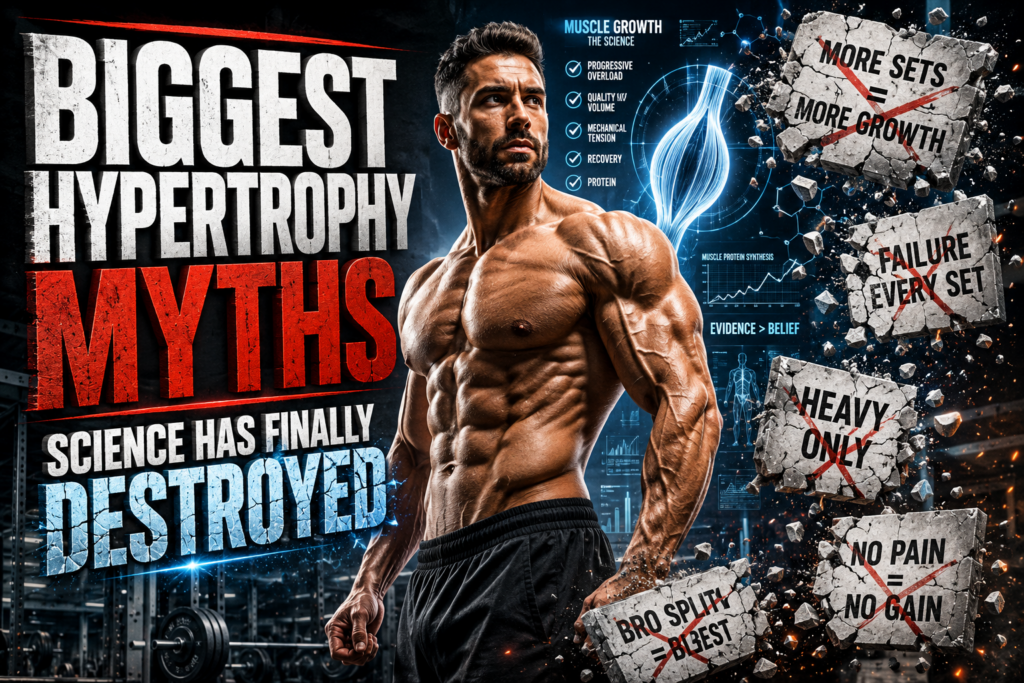
You’ve been training for years but your arms still look the same. Your gym buddy follows none of the rules yet grows like a weed. The Biggest Hypertrophy Myths That Science Has Finally Destroyed explain why your approach might be completely backwards.
The Biggest Hypertrophy Myths That Science Has Finally Destroyed About Time Under Tension
Coaches everywhere preach that you need 40 seconds of time under tension per set. They tell you to count slowly and control every inch of movement. This advice sounds scientific but research shows it’s wrong.
Studies comparing slow reps to normal speed found no difference in muscle growth. A 2015 study had lifters perform reps at six seconds versus one second. Both groups gained the same amount of muscle mass after eight weeks.
What actually matters is taking sets close to failure. You can lift fast or slow as long as you push hard. The muscle doesn’t care about your tempo when you’re three reps from complete failure.
Obsessing over tempo wastes mental energy you could use for intensity. Count your reps instead of seconds. Focus on effort instead of speed.
Why the Pump Doesn’t Equal Growth
The pump feels amazing and looks impressive in the mirror. Many lifters chase this feeling in every workout. They assume a massive pump means they stimulated maximum growth.
Wrong assumption.
The pump comes from blood rushing into muscle tissue during high rep sets. It stretches the muscle cell temporarily but this doesn’t trigger protein synthesis. You can get a huge pump from 50 bodyweight squats without building any muscle.
Real growth comes from mechanical tension and metabolic stress over time. A small pump from heavy sets of five often builds more muscle. The best approach to hypertrophy focuses on progressive overload instead of temporary swelling.
Chase performance metrics instead of mirror tricks. Add weight to the bar each month. Track your strength in the six to twelve rep range consistently.
The Biggest Hypertrophy Myths That Science Has Finally Destroyed About Muscle Confusion
Fitness magazines sold millions of copies promoting muscle confusion workouts. They claimed your muscles adapt quickly so you need constant variation. Every workout should look completely different from the last one.
This myth sounds logical but biology doesn’t work that way. Muscles don’t get confused or bored. They respond to progressive mechanical load applied consistently over weeks.
A 2019 study compared constant exercise selection to varied exercises. The group doing the same movements gained significantly more strength and muscle. Sticking with core lifts allows you to track progress and add weight systematically.
Changing exercises every week prevents you from mastering movement patterns. You never get strong enough to create real tension. Your nervous system stays in learning mode instead of growth mode.
Pick five to eight exercises and run them for at least eight weeks. Add reps or weight each session. Switch only when progress completely stalls for three consecutive weeks.
High Reps Don’t Tone While Low Reps Build Mass
This myth refuses to die despite decades of research proving otherwise. People believe three to five reps build size while fifteen to twenty reps create definition. Trainers still program this way in commercial gyms everywhere.
Muscle tone isn’t a real thing you can train for specifically. Definition comes from having muscle mass and losing body fat. The rep range you use doesn’t change muscle shape or appearance quality.
Recent studies show similar muscle growth from five reps to thirty reps. The key variable is proximity to failure again. Sets of twenty taken to complete failure build just as much muscle.
Heavy weights do build more strength per unit of time invested. Light weights require more sets to match the same growth stimulus. Both work but efficiency differs based on your goals.
Train in multiple rep ranges throughout each week. Use lower reps for compound movements and higher reps for isolation work. This gives you strength gains plus complete muscle development.
The Biggest Hypertrophy Myths That Science Has Finally Destroyed About Soreness
No soreness means no growth according to gym culture. Lifters deliberately seek extreme soreness as proof of a productive workout. They change angles and add volume just to feel crippled the next day.
Soreness indicates unfamiliar stimulus but not muscle building necessarily. Beginners get extremely sore from light workouts that produce minimal growth. Advanced lifters grow consistently without significant soreness between sessions.
A study tracked muscle protein synthesis alongside soreness ratings. The two showed almost zero correlation. Subjects built muscle on days with no soreness at all.
Excessive soreness actually hurts your training frequency and performance. You skip workouts because you can’t sit on the toilet. You lift lighter weights because your muscles feel damaged.
Stop chasing soreness as a goal in itself. Judge workouts by performance metrics instead. Did you add a rep or five pounds compared to last week?
You Don’t Need to Destroy Yourself Every Single Session
Social media shows athletes collapsing after workouts and vomiting in trash cans. This performance convinces people that growth requires complete destruction every time. Anything less means you’re not trying hard enough.
This mentality leads to overtraining and burnout within months. Your nervous system can’t recover from maximum intensity five days weekly. Performance drops and muscle growth stalls completely.
Research on training volume shows moderate difficulty works better long term. Subjects doing three hard sets gained more muscle than those doing six sets. The higher volume group accumulated too much fatigue to progress consistently.
Smart programming includes easy days and deload weeks built into the schedule. You push hard on key lifts then back off on accessories. This strategic variation in intensity allows recovery while maintaining training frequency.
Rate each workout on a scale of one to ten for difficulty. Aim for an average of seven across the week. Some sessions hit nine but others stay at five intentionally.
The Biggest Hypertrophy Myths That Science Has Finally Destroyed About Protein Timing
The anabolic window myth created an entire supplement industry. Companies claimed you had thirty minutes post workout to consume protein. Missing this window meant wasting your entire training session.
Protein timing matters far less than total daily protein intake. Studies show the anabolic window lasts at least twenty four hours. You can eat protein whenever it fits your schedule.
A comprehensive review examined dozens of protein timing studies. Researchers found no benefit to immediately post workout consumption. Daily totals predicted muscle growth while timing showed no correlation.
This doesn’t mean timing has zero impact ever. Spreading protein across four meals probably beats eating it all at once. But stressing over exact timing creates unnecessary anxiety and complication.
Focus on hitting your total protein target between meals throughout the day. Aim for roughly 0.8 grams per pound of body weight. Distribute this across breakfast through dinner however works for your life.
Failure Isn’t Mandatory on Every Set
Bodybuilding culture teaches that every set must reach complete muscular failure. You should need a spotter to rack the weight. Stopping with reps left in reserve means you’re mentally weak.
Training to failure every set increases injury risk and recovery demands. It also provides no additional muscle growth according to recent research. Sets stopped one to two reps short of failure work equally well.
A 2021 study compared failure training to leaving two reps in reserve. Both groups gained identical muscle mass after ten weeks. The non failure group reported less joint pain and better recovery.
Taking final sets of each exercise to failure makes sense. This ensures you pushed hard enough to stimulate growth. But earlier sets can stop short while still contributing to total volume.
Use the RIR system which stands for reps in reserve. Rate how many more reps you could complete with perfect form. Keep most sets at RIR two and take final sets to true failure.
Why Supplements Won’t Fix a Bad Training Program
Beginners often ask about supplements before mastering basic program design. They believe the right powder will unlock growth their training can’t achieve. Marketing pushes this fantasy relentlessly through every platform.
No supplement builds muscle without adequate training stimulus and recovery. You need progressive overload applied consistently for months. Supplements enhance an already solid foundation but never replace it.
Research shows creatine monohydrate adds approximately five percent to muscle gains through enhanced ATP production and training capacity. Protein powder matters only if you struggle to eat enough whole food to reach your daily target of 0.8 grams per pound of bodyweight. Beta-alanine may reduce fatigue during high-rep sets while caffeine can improve strength performance, but these provide marginal benefits at best for natural lifters compared to training consistency and progressive overload.
The exception is when supplements address specific deficiencies affecting performance. Low vitamin D reduces testosterone and training capacity. Quality targeted supplementation fixes these limitations when diet falls short.
Spend money on quality food before buying supplement stacks. Master your training program and recovery habits first. Add one or two proven supplements only after those foundations are solid.
Frequently Asked Questions
How many sets per week do I need for each muscle group?
Most people need ten to twenty sets per muscle group weekly. Beginners grow with less volume while advanced lifters need more. Start at ten sets and add volume when progress stalls.
Does training a muscle twice per week build more growth?
Yes, higher frequency allows more total volume with better recovery. Training each muscle two or three times weekly beats once weekly. Spread your sets across multiple sessions for best results.
Should I change my program if I stop getting sore?
No, soreness is not required for muscle growth at all. Lack of soreness means your body adapted to the movement pattern. Keep adding weight and reps instead of chasing different exercises.
Can I build muscle in a calorie deficit?
Beginners and overweight lifters can build muscle while losing fat. Advanced lifters struggle to do both simultaneously. Eat at maintenance or slight surplus for best muscle growth.
How long should I rest between sets for hypertrophy?
Rest as long as needed to perform your next set effectively. This usually means two to four minutes for compound movements. Shorter rest works for isolation exercises that don’t tax you systemically.
Start applying one myth correction this week and watch your training results finally match your effort.