

Why Your Muscles Stop Growing Without This One Factor
Most lifters ignore the recovery factors that actually determine muscle growth, focusing only on training intensity. Master sleep quality, hormonal timing, and nutrient timing to finally break through plateaus and build the physique you’re training for.
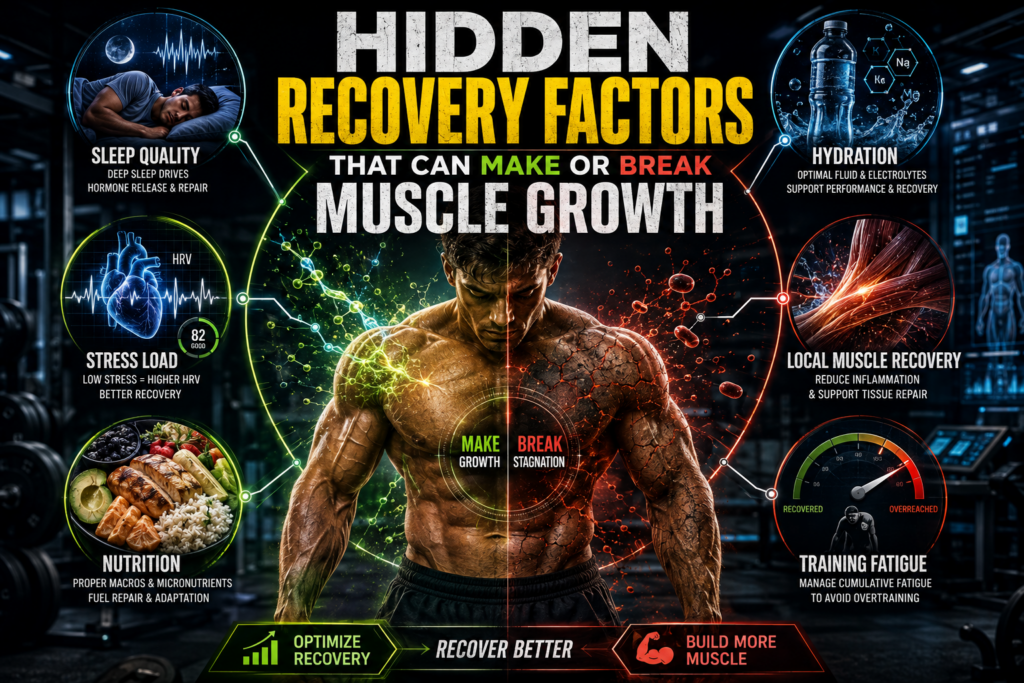
You train hard but your muscles still look flat. Your weights haven’t moved up in weeks. Hidden Recovery Factors That Can Make or Break Muscle Growth determine whether your body actually builds new tissue. The secret lies not in your workouts but in what happens between them.
How Sleep Architecture Controls Hidden Recovery Factors That Can Make or Break Muscle Growth
Your body releases growth hormone in pulses during deep sleep. These pulses happen mostly in the first half of the night. Miss those hours and you lose the biggest anabolic window your body creates naturally.
Most lifters focus on total sleep time. They ignore sleep quality completely. You can lie in bed for eight hours but only get four hours of restorative sleep.
Deep sleep stages activate protein synthesis pathways. Your muscles literally rebuild during these periods. Light sleep and REM sleep don’t trigger the same recovery mechanisms.
Room temperature affects sleep architecture more than people realize. Anything above 68 degrees Fahrenheit disrupts deep sleep cycles. Your core body temperature needs to drop for proper recovery to begin.
Blue light from screens delays melatonin release by two hours. This shifts your entire sleep cycle backward. You fall asleep later and miss the critical growth hormone pulses.
Alcohol fragments sleep even in small amounts. One drink can reduce deep sleep by 25 percent. Your muscles pay the price even if you feel fine the next morning.
The Cortisol Pattern Most Lifters Completely Ignore
Cortisol should spike in the morning and drop at night. This natural rhythm supports muscle growth when it works correctly. Training disrupts this pattern in ways that destroy your gains.
Late evening workouts keep cortisol elevated for hours. High cortisol at night blocks growth hormone release. You create a hormonal environment that breaks down muscle instead of building it.
Chronic stress flattens your cortisol curve completely. Your levels stay moderately high all day and night. This state makes muscle growth nearly impossible regardless of your training program.
Coffee after 2 PM extends cortisol elevation into the evening. The caffeine half-life lasts six hours in most people. Your adrenal glands keep pumping out stress hormones when they should be winding down.
Fasted cardio in the morning amplifies cortisol spikes. Your body breaks down muscle tissue for fuel. The fat loss benefits don’t outweigh the muscle loss for most people.
Meditation and breathing exercises lower cortisol within 20 minutes. Five minutes of box breathing after training brings levels down faster. This simple habit changes your hormonal environment immediately.
Hidden Recovery Factors That Can Make or Break Muscle Growth Through Nervous System Fatigue
Your central nervous system fatigues before your muscles do. Most people never realize this distinction. They keep pushing when their CNS needs recovery time.
Heavy compound lifts drain neural resources faster than isolation work. Deadlifts and squats tax your nervous system for days. Your muscles might feel ready but your CNS hasn’t recovered.
Grip strength drops when CNS fatigue sets in. Test your max grip before workouts. A 10 percent decrease means you need more recovery time.
Reaction time slows under neural fatigue. Your bar speed decreases even with lighter weights. This signals systemic fatigue that rest days won’t fix alone.
Deload weeks restore nervous system function. Taking 40 percent off your working weights for one week reverses CNS fatigue. Most lifters skip this and wonder why their strength plateaus.
Supplements that support recovery become relevant here. Recovery formulas with adaptogens help manage the stress response during heavy training blocks. Your nervous system recovers faster when you give it the right support.
Nutrient Timing Windows That Actually Matter for Recovery
The anabolic window exists but not how supplement companies describe it. You have roughly 24 hours to maximize protein synthesis after training. The first four hours matter most for glycogen replenishment.
Carbs immediately post-workout restore muscle glycogen 50 percent faster. This matters for people training multiple times per day. Once-daily lifters can eat carbs whenever they want.
Protein every three to four hours maintains elevated synthesis rates. Total daily intake matters more than exact timing. Spreading intake evenly works better than loading it all around workouts.
Casein before bed provides amino acids during sleep. This slow-digesting protein supports overnight recovery. Studies show measurable improvements in muscle protein synthesis.
Sodium and potassium help muscles hold water for growth. Cutting these minerals makes you look flat. Your muscle cells need proper hydration to expand and repair.
Magnesium deficiency blocks over 300 enzyme reactions. Many involve muscle recovery and protein synthesis. Most people don’t get enough from food alone.
How Inflammation Levels Determine Whether You Grow or Stagnate
Acute inflammation after training triggers the growth response. Chronic inflammation shuts growth down completely. You need the first type but must avoid the second.
Anti-inflammatory drugs taken immediately after training blunt muscle growth. They block the inflammatory signals that start protein synthesis. Save the ibuprofen for true injuries only.
Omega-6 fatty acids from vegetable oils increase systemic inflammation. Most people eat 20 times more omega-6 than omega-3. This ratio keeps inflammation chronically elevated.
Fish oil and EPA specifically reduce exercise-induced inflammation. Three grams daily speeds recovery between sessions. Your joints feel better and your muscles repair faster.
Gut health controls inflammation levels throughout your body. A damaged intestinal lining leaks bacterial particles into your bloodstream. Your immune system stays activated and cortisol stays high.
Food sensitivities create low-grade inflammation you can’t feel. Dairy and gluten cause problems for many lifters. Removing trigger foods for three weeks often reveals dramatic recovery improvements.
The Parasympathetic Switch Nobody Trains
Your autonomic nervous system has two modes. Sympathetic drives performance. Parasympathetic drives recovery. Hidden Recovery Factors That Can Make or Break Muscle Growth depend on switching between these states.
Most lifters stay stuck in sympathetic mode. They train hard, work stressful jobs, and sleep poorly. Their bodies never enter the parasympathetic state needed for tissue repair.
Heart rate variability measures this balance. Low HRV means you’re stuck in fight-or-flight mode. High HRV indicates good parasympathetic function and recovery capacity.
Cold showers activate parasympathetic response after the initial shock. Thirty seconds of cold water at the end of your shower flips the switch. Your body shifts into recovery mode within minutes.
Nasal breathing during the day keeps you more parasympathetic. Mouth breathing triggers stress responses. This small change affects recovery more than people expect.
Spending time in nature lowers sympathetic nervous system activity. Twenty minutes outside reduces cortisol and improves HRV. You don’t need hiking or exercise to get the benefit.
Hidden Recovery Factors That Can Make or Break Muscle Growth Through Micronutrient Gaps
Zinc deficiency tanks testosterone production within weeks. You need 15 to 30 mg daily during hard training. Most people get half that amount from food.
Vitamin D acts more like a hormone than a vitamin. Levels below 40 ng/ml impair muscle protein synthesis. Get blood work done instead of guessing your status.
B vitamins convert food into usable energy. Deficiencies cause fatigue that feels like overtraining. Your muscles have fuel but your cells can’t process it.
Iron carries oxygen to working muscles. Low ferritin levels reduce training capacity before you feel anemic. Women and vegetarian lifters face the highest risk.
Selenium supports thyroid function and testosterone production. Brazil nuts provide massive amounts in just two nuts. Most people never think about this mineral.
Comprehensive supplements fill these gaps more reliably than diet alone. Quality formulations include recovery-specific nutrients in amounts that actually make a difference. Food comes first but strategic supplementation covers the blind spots.
Training Frequency Versus Recovery Capacity
Beginners recover faster than advanced lifters. They use lighter weights and recruit fewer muscle fibers. Training the same muscle three times weekly works for them.
Advanced lifters create more muscle damage per session. They need 48 to 72 hours between sessions for the same muscle group. Ignoring this principle guarantees stalled progress.
Volume landmarks determine recovery needs. More than 10 hard sets per muscle per session requires extra recovery time. Your training split should match your work capacity.
Recovery capacity changes with life stress. Bad sleep or work problems reduce your training tolerance. Programs need adjustment based on current recovery ability.
Autoregulation lets you adjust training to daily readiness. Rate your energy and motivation before workouts. Drop volume by 30 percent on low-scoring days.
Age affects recovery speed more than most people admit. Lifters over 40 need longer rest periods between hard sessions. The same program that worked at 25 might destroy you at 45.
Blood Flow Restriction and Recovery Amplification
Poor circulation limits nutrient delivery to muscles while metabolic waste products like lactate and ammonia accumulate in tissue, creating an acidic environment that slows recovery. Improving blood flow through active recovery, massage, and contrast therapy speeds nutrient absorption, oxygen delivery, and lymphatic drainage—all essential processes for clearing exercise-induced inflammatory markers and facilitating muscle protein synthesis.
Light movement the day after hard training flushes metabolic waste. Twenty minutes of walking or cycling enhances recovery. Complete rest often works worse than active recovery.
Massage increases blood flow to treated muscles. Studies show faster strength recovery after deep tissue work. The benefit comes from circulation, not breaking up scar tissue.
Contrast showers alternate hot and cold water. This creates a pumping effect that moves blood and lymph. Three cycles of 30 seconds hot and 30 seconds cold works well.
Compression garments improve venous return during recovery. Wearing them for two hours post-workout reduces muscle soreness. The effect is modest but measurable.
Elevation reduces swelling in trained muscle groups. Lying with legs elevated for 15 minutes helps lower body recovery. Gravity assists fluid drainage back to your core.
How Psychological Stress Disrupts Hidden Recovery Factors That Can Make or Break Muscle Growth
Your body can’t distinguish physical stress from mental stress. Both trigger the same cortisol response. Work anxiety affects muscle recovery as much as training stress does.
Overthinking your program creates mental fatigue. Decision fatigue drains willpower and motivation. Pick a plan and stop second-guessing every workout.
Social comparison through social media increases stress hormones. Constantly measuring yourself against others keeps cortisol elevated. This mental habit has physical consequences.
Perfectionism around diet creates chronic stress. Obsessing over every meal activates your stress response daily. The hormonal damage outweighs small nutritional optimizations.
Scheduled worry time contains anxious thoughts. Set aside 15 minutes to think about problems. Outside that window, redirect your mind to other things.
Gratitude practices lower cortisol measurably. Writing three things you appreciate daily changes your stress baseline. This isn’t feel-good advice but a recovery tool.
Hydration Status Beyond Just Drinking Water
Dehydration of just 2 percent reduces strength by 10 percent. Most people train in a mildly dehydrated state constantly. Thirst is a late indicator of fluid needs.
Electrolyte balance matters more than water volume. Drinking plain water without minerals can worsen dehydration. Your cells need sodium to actually absorb the fluid.
Morning urine color tells you yesterday’s hydration status. Dark yellow means you started the day behind. Pale yellow indicates good baseline hydration.
Sweat rate varies dramatically between individuals. Some people lose two liters per hour during training. Others lose half that amount in the same conditions.
Glycerol helps muscles retain water during training. Five grams before workouts improves hydration markers. Your endurance and pump both improve noticeably.
Caffeine’s diuretic effect is overstated in regular users. Habitual coffee drinkers don’t lose extra fluid. You can count coffee toward daily fluid intake.
Strategic Supplement Support for Complete Recovery
Most supplements provide tiny benefits at best. A few make genuine differences in recovery speed. The gap between marketing and reality is massive.
Creatine supports ATP regeneration between sets. This means better performance in later sets. Indirect recovery benefits come from maintaining training quality.
Citrulline malate reduces muscle soreness after training. Six to eight grams daily lowers damage markers measurably. You recover faster between sessions on this amino acid.
Ashwagandha lowers cortisol without sedation. Studies show 300 mg twice daily reduces stress hormones significantly. Your body stays in an anabolic state longer each day.
Tart cherry juice contains compounds that reduce inflammation. Eight ounces post-workout decreases strength loss and soreness. The effect is comparable to anti-inflammatory drugs.
Complete recovery formulas combine these ingredients strategically. Individual supplements work but comprehensive products simplify the process. You get synergistic benefits from properly dosed combinations.
Frequently Asked Questions
What are the most important hidden recovery factors for muscle growth?
Sleep quality, cortisol patterns, and nervous system recovery matter most. Micronutrient status and inflammation control also play major roles. These factors work together to determine whether your body builds muscle.
How much sleep do you actually need for muscle recovery?
Most people need seven to nine hours of quality sleep. Deep sleep stages matter more than total time in bed. Track your sleep architecture instead of just counting hours.
Can you build muscle if your cortisol is high?
Chronically elevated cortisol makes muscle growth extremely difficult. Your body prioritizes survival over building new tissue. Managing stress and cortisol patterns is necessary for consistent gains.
Do recovery supplements actually work for muscle growth?
Evidence-based supplements like creatine and citrulline malate show measurable benefits. Most recovery supplements lack quality research. Choose products with clinical backing for the specific ingredients and doses used.
How do you know if you need more recovery time?
Declining performance, poor sleep, and low motivation signal inadequate recovery. Reduced grip strength and slower bar speed indicate nervous system fatigue. Heart rate variability tracking provides objective data about your recovery status.
Start tracking your sleep quality and cortisol patterns this week to identify which recovery factors need attention first.