

Slow Reps Won't Build Muscle Faster Than You Think
Debunking the Time Under Tension Cult reveals that slow reps and controlled negatives matter far less than progressive overload for building muscle. Discover how mechanical tension, not workout duration, actually drives real hypertrophy gains backed by research.
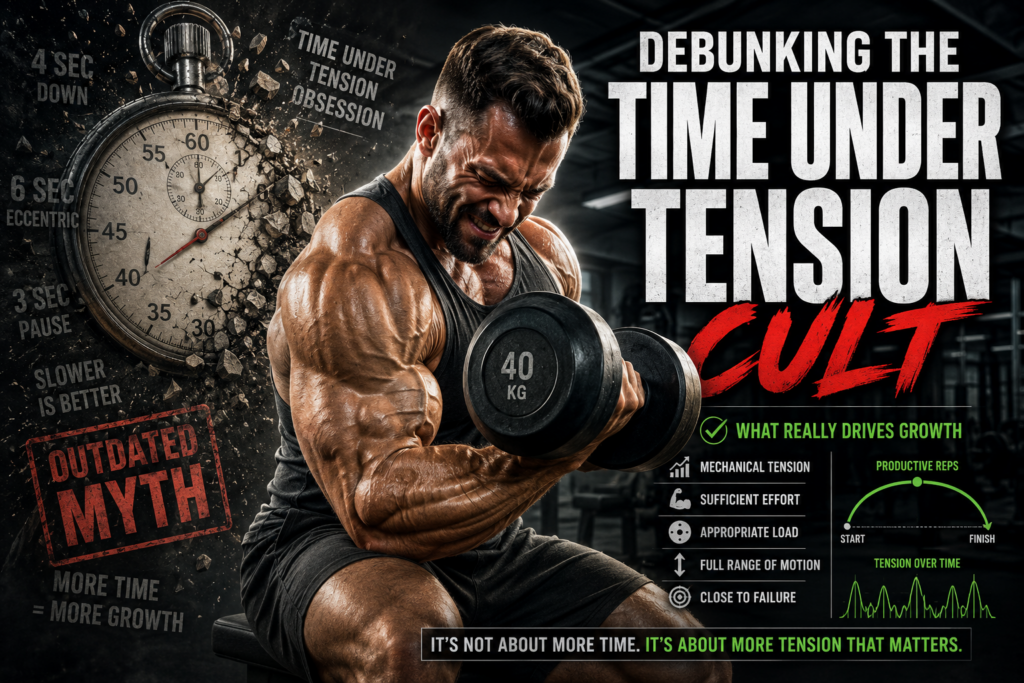
Debunking the Time Under Tension Cult starts with a simple observation. Gym-goers slow down every rep to feel the burn. Coaches preach eight-second negatives like gospel. The truth is tempo matters far less than progressive overload for muscle growth.
The Origins of the Time Under Tension Cult
Bodybuilding magazines popularized time under tension in the 1990s. Writers claimed slow reps created more muscle damage. Photos showed pros grimacing through controlled negatives. Readers assumed this was the secret to mass.
The concept sounds logical at first glance. Muscles work longer during each set with slower reps. More time means more growth stimulus. This reasoning ignores what actually triggers hypertrophy.
Research shows total mechanical tension drives muscle growth. Your muscles don’t count seconds on a clock. They respond to load and effort near failure. A four-second rep and a two-second rep produce similar results when both reach the same proximity to failure.
The confusion deepened when studies measured metabolic stress. Slow tempos create more lactate accumulation and muscle burn. People mistook this discomfort for superior muscle building. Pain doesn’t equal gains in this case.
What Actually Happens During Debunking the Time Under Tension Cult Methods
Slowing down your reps forces you to use lighter weights. A bench press with five-second negatives might drop from 100 kilograms to 70 kilograms. You sacrifice the primary driver of growth to chase a secondary variable.
Your muscles fatigue faster under slow protocols. You might complete eight reps instead of twelve at the same relative intensity. Total work decreases even though each set feels harder. This trades volume for unnecessary fatigue.
Connective tissue receives less adaptation stimulus with ultra-slow training. Tendons and ligaments strengthen through appropriate loading patterns. Crawling through reps at glacial speeds removes the dynamic component your joints need. Long-term injury resilience suffers as a result.
The metabolic stress from slow tempos creates systemic fatigue. Your central nervous system tires from extended tension. Recovery demands increase without proportional muscle growth benefits. You feel exhausted but don’t build more muscle.
Debunking the Time Under Tension Cult Through Real Training Data
Studies comparing rep speeds show minimal differences in hypertrophy. One meta-analysis found no advantage for tempos exceeding two seconds per phase. Muscles grew equally well from one-second concentrics and four-second concentrics. The determining factor was proximity to failure.
Powerlifters build substantial muscle using explosive concentrics. Their focus stays on moving maximal loads. Time under tension remains low per set. Yet they develop impressive muscle mass alongside strength.
Gymnasts perform mostly bodyweight exercises with natural tempos. They don’t artificially slow down muscle-ups and front levers. Their physiques demonstrate that controlled movement differs from deliberately slow movement. Muscle development comes from progressive challenge.
Professional bodybuilders actually use moderate tempos in practice. Watch training footage instead of reading magazine descriptions. Most reps take two to three seconds total. They prioritize feeling the target muscle over counting tempo beats.
The Real Variables Worth Tracking for Muscle Growth
Progressive overload determines whether you build muscle over time. You must add weight, reps, or sets across weeks and months. Joint support supplements can help you train consistently without discomfort. Tempo manipulations become irrelevant if you never increase training stress.
Proximity to failure matters more than rep duration. Taking a set within two reps of failure triggers growth. Whether those reps lasted two seconds or five seconds makes little difference. The challenge to your muscles creates adaptation.
Total weekly volume for each muscle group drives results. Ten sets for your chest might come from any tempo. The accumulated stimulus determines growth. Obsessing over tempo wastes mental energy better spent planning volume progression.
Exercise selection impacts which muscles receive tension. A proper squat pattern loads your quads regardless of tempo. Poor form at any speed reduces effectiveness. Master movement quality before worrying about rep speed.
Why Debunking the Time Under Tension Cult Improves Your Training
Abandoning strict tempo rules lets you lift heavier weights. Heavier loads create more absolute tension on muscle fibers. This mechanical tension remains the primary hypertrophy signal. You build strength and size together.
Normal rep speeds allow more total repetitions per set. Higher rep counts increase total work performed. Your muscles receive more growth stimulus from the added volume. Sets become more productive without feeling artificially harder.
Training feels less tedious when you stop counting tempo. You focus on effort and contraction quality instead. Mental energy goes toward pushing hard rather than timing phases. Workouts become more intuitive and sustainable.
Your joints experience movement through natural ranges. Dynamic loading at reasonable speeds strengthens connective tissue appropriately. Tendon adaptation keeps pace with muscle growth. Injury risk decreases over time.
Recovery improves when you eliminate unnecessary metabolic stress. Excessive lactate accumulation and systemic fatigue from ultra-slow tempos delay adaptation between sessions. Your nervous system recovers faster, allowing increased training frequency and better adherence to progressive overload protocols. Sleep quality and hormonal recovery optimize when training stress aligns with actual stimulus demands rather than artificial metabolic burden.
Practical Tempo Guidelines After Debunking the Time Under Tension Cult
Use a controlled lowering phase of about two seconds. This provides enough eccentric stimulus without excessive fatigue. You maintain tension throughout the range of motion. The weight stays under control rather than dropping.
Lift concentrically with intent to move the weight quickly. Actual bar speed depends on the load you’re using. Heavy weights move slower naturally. The key is applying maximum force rather than artificially slowing movement.
Pause briefly at end ranges when it helps you feel the muscle. A one-second squeeze at the top of a row enhances back engagement. This differs from holding every position for arbitrary time counts. Use pauses strategically instead of universally.
Adjust tempo based on exercise type and goal. Explosive movements like cleans require fast concentrics. Isolation exercises like curls benefit from smooth control. Match your tempo to the movement pattern.
Stop thinking about tempo in seconds altogether. Focus on maintaining tension and controlling the weight. Your natural rhythm will fall within effective ranges. Overthinking tempo creates problems where none existed.
Common Scenarios Where Tempo Myths Derail Progress
New lifters slow down reps excessively after reading tempo prescriptions. They struggle with 20-kilogram dumbbells using eight-second negatives. Strength development stalls because loads stay too light. Muscle growth lags behind what normal training would produce.
Intermediate lifters plateau while chasing the burn from slow reps. They mistake lactate accumulation for effective training. Progressive overload stops because they can’t add weight. Joint health supplements won’t fix a fundamentally flawed approach to progression.
Advanced athletes waste deload weeks on ultra-slow tempo work. The reduced load doesn’t provide adequate recovery. Metabolic stress remains high despite lighter weights. They enter the next training block still fatigued.
Online coaches prescribe complex tempo schemes to appear scientific. Programs list 3-1-2-0 patterns that confuse rather than help. Clients spend more time counting than training hard. Results suffer from misplaced focus.
The Psychological Trap of Time Under Tension Obsession
Tempo manipulation provides false control over muscle building. People want specific formulas that guarantee results. Slowing reps feels like optimization even when it isn’t. This illusion prevents focusing on variables that actually matter.
The burn from slow reps creates misleading feedback. Your brain interprets discomfort as productivity. Sets feel effective even when they produce less growth. You confuse sensations during training with adaptations after training.
Complicated tempo prescriptions make programs seem more advanced. Beginners assume complexity equals effectiveness. Simple progressive overload appears too basic by comparison. This backwards thinking delays progress for years.
Debunking the Time Under Tension Cult requires accepting uncomfortable simplicity. Muscle building follows straightforward principles of progressive tension. No tempo trick bypasses the need for consistent hard work. Most people would rather believe in shortcuts.
Frequently Asked Questions
Does time under tension matter at all for muscle growth?
Time under tension matters only as a byproduct of effective sets. Taking sets near failure naturally creates sufficient tension duration. Artificially extending time by slowing reps provides no additional benefit. Focus on progressive overload and proximity to failure instead.
What rep tempo should I use for building muscle?
Use a controlled two-second lowering phase and an explosive lifting phase. This tempo maintains tension without sacrificing load or volume. Pause briefly at peak contraction when it enhances muscle feel. Don’t count seconds during every rep.
Why do slow reps feel harder if they don’t work better?
Slow reps create more metabolic stress and lactate accumulation. This produces burning sensations that feel challenging. The discomfort doesn’t correlate with superior muscle growth stimulus. Mechanical tension from heavier loads matters more.
Can I build muscle with fast explosive reps?
You can build substantial muscle using explosive concentrics. Powerlifters and Olympic lifters demonstrate this clearly. The key is applying maximum force and progressively increasing loads. Eccentric control still matters during the lowering phase.
When should I deliberately use slow tempo training?
Use deliberately slow tempos during rehabilitation from injury. Slow controlled movement helps rebuild movement patterns safely. Some isolation exercises benefit from slightly slower tempos for better muscle feel. These are exceptions rather than the rule for most training.
Start your next workout by lifting with natural controlled tempo and focus on adding weight or reps each week.